Recruiters often fail to connect with developers because of outdated tactics that erode trust. Developers rate their trust in recruiters at 2.5 out of 5, with 61.5% believing recruiters are ineffective. The main issues include generic outreach, lack of understanding of technical roles, and over-reliance on platforms like LinkedIn, which developers feel don’t reflect their current skills.
Key mistakes recruiters make:
- Over-relying on resumes and LinkedIn: These often miss real-time skills shown on platforms like GitHub (37%) or personal portfolios (17%).
- Sending impersonal messages: 64% feel outreach is copy-pasted, and 55% suspect messages are AI-generated. Developers want specifics like the tech stack (71%) and salary (69%) upfront.
- Focusing on speed over trust: Volume-driven tactics lead 43% of developers to mute recruiters entirely.
Solutions:
- Engage in developer communities through open-source and developer communities, hackathons, and tech events.
- Use tools like daily.dev Recruiter for warm, double opt-in connections.
- Craft concise, detailed pitches with clear role information and personalized references.
Recruiting developers isn’t about sending more messages - it’s about building trust where they already are.
What Recruiters Get Wrong About Developer Communities
Recruiters often miss the mark when it comes to understanding developer communities. While 67% of developers feel their time isn’t respected by recruiters , the issue runs deeper than just poor communication. The traditional recruiting playbooks don’t align with how these communities operate. Developers value proven skills over formal qualifications, authentic connections over mass outreach, and trust over transactional interactions.
When 43% of developers have muted recruiters due to irrelevant or excessive messages , it’s a clear sign that the industry’s approach has eroded trust. Developers build their reputations through ongoing contributions, not static resumes, and failing to acknowledge this only widens the gap. Understanding these missteps is the first step toward repairing trust and fostering meaningful relationships. Here’s where recruiters often go wrong:
Mistake 1: Treating Resumes and Profiles as the Whole Story
Recruiters often rely too heavily on LinkedIn profiles and resumes, assuming they paint a complete picture. But 64% of developers say LinkedIn only tells part of their professional story . Developers frequently showcase their skills in real-time through platforms like GitHub (used by 37%) or personal portfolios (maintained by 17%) . A resume, on the other hand, can quickly become outdated and fail to reflect their current projects or interests.
This over-reliance on traditional credentials means recruiters miss critical signals about a developer’s expertise. Only 15% of developers believe recruiters truly understand the roles they’re hiring for , highlighting a major disconnect.
Mistake 2: Sending Generic Messages That Lack Substance
Another common misstep is impersonal outreach. Developers are quick to spot - and dismiss - generic messages. In fact, 40% say they ignore messages that feel like spam, and 64% feel recruiter outreach often comes off as copy-pasted . Even so-called “personalized” messages don’t always pass the test, with 55% of developers suspecting these are AI-generated . This lack of genuine effort damages trust and makes recruiters indistinguishable from automated noise.
Developers are clear about what they want from the first contact: 71% expect details about the tech stack and role scope, and 69% want salary information upfront . Vague phrases like “exciting opportunity” or “fast-growing startup” signal a lack of effort and respect for their time. Unsurprisingly, 46% of developers rate their trust in cold outreach at a dismal 0–2 out of 5 . Developers trust personal referrals (63%) and connections within their communities (40%) far more than recruiters they’ve never interacted with (25%) .
Mistake 3: Focusing on Speed Instead of Building Trust
Recruiters often prioritize speed, aiming to fill pipelines quickly, but this approach can backfire. Volume-driven tactics leave a bad impression, with 61.5% of developers believing that recruiters aren’t doing a good job . This focus on quantity over quality results in an average trust score of just 2.5 out of 5 , which can hurt long-term recruitment efforts.
When bombarded with messages, developers take action - 43% have muted recruiters entirely . These lost connections represent missed opportunities that better messaging can’t recover later. Slowing down to engage meaningfully within developer communities can lead to better-qualified candidates and higher acceptance rates. While it may take more time upfront, the long-term benefits far outweigh the costs.
Hiring engineers?
Connect with developers where they actually hang out. No cold outreach, just real conversations.
How to Engage Effectively with Developer Communities
If you want to improve developer recruiting, the key isn’t about casting a wide net - it’s about being smarter with your approach. Instead of bombarding developers with mass messages, focus on building authentic connections in the spaces they already frequent. Respect their priorities, craft thoughtful pitches, and use tools that ensure quality over quantity. This strategy not only addresses trust issues but also aligns with how developers prefer to interact.
Building a Real Presence in Developer Communities
Be where developers are. This means contributing to open-source projects, sponsoring hackathons, attending tech conferences, and engaging on platforms they use daily. The goal here isn’t to pitch jobs immediately but to participate meaningfully. Share resources, join discussions, and support initiatives - it’s about showing you’re genuinely invested in the community. Over time, this effort builds credibility.
Tools like daily.dev Recruiter make this process smoother by connecting you with developers who want to engage. Instead of cold messaging static profiles, you’re introduced through warm, double opt-in connections. Developers review your job opportunity first and decide if they want to connect. This shifts the dynamic from intrusive to invitational. Considering that personal referrals earn 63% trust from developers, while cold outreach ranks dead last , this approach better aligns with their preferences.
Writing Job Pitches That Match Developer Priorities
Once you’ve established trust, your job pitches need to hit the mark. Developers care about three things upfront: tech stack details, salary range, and work model (remote, hybrid, or onsite). Data shows that 71% of developers expect role scope and tech stack details in the first message, and 69% want salary information immediately . Leaving these out risks losing their interest - and their trust.
Avoid clichés like "rockstar" or "ninja", which often signal a lack of understanding of developer culture. Instead, be specific. Mention technologies like React 18, Python 3.11, or PostgreSQL 14. Highlight real challenges, such as "migrating our authentication system to support OAuth 2.0." Keep your message concise - ideally within 200 words and three to four sentences. And if you can reference a developer’s GitHub project or technical blog, even better. With 64% of developers feeling messages are copy-pasted , personalizing your outreach makes a huge difference.
Maintaining Quality While Hiring Efficiently
Once you’ve built trust and refined your messaging, the next challenge is balancing quality with efficiency in the hiring process. It’s possible to streamline without cutting corners. The solution lies in accessing pre-qualified developer pools - candidates who’ve already shown interest and proven their skills. Platforms like daily.dev Recruiter provide exactly that, connecting you with active developers who are open to exploring new roles.
Old Recruiting Methods vs. Community-Based Approaches
::: @figure 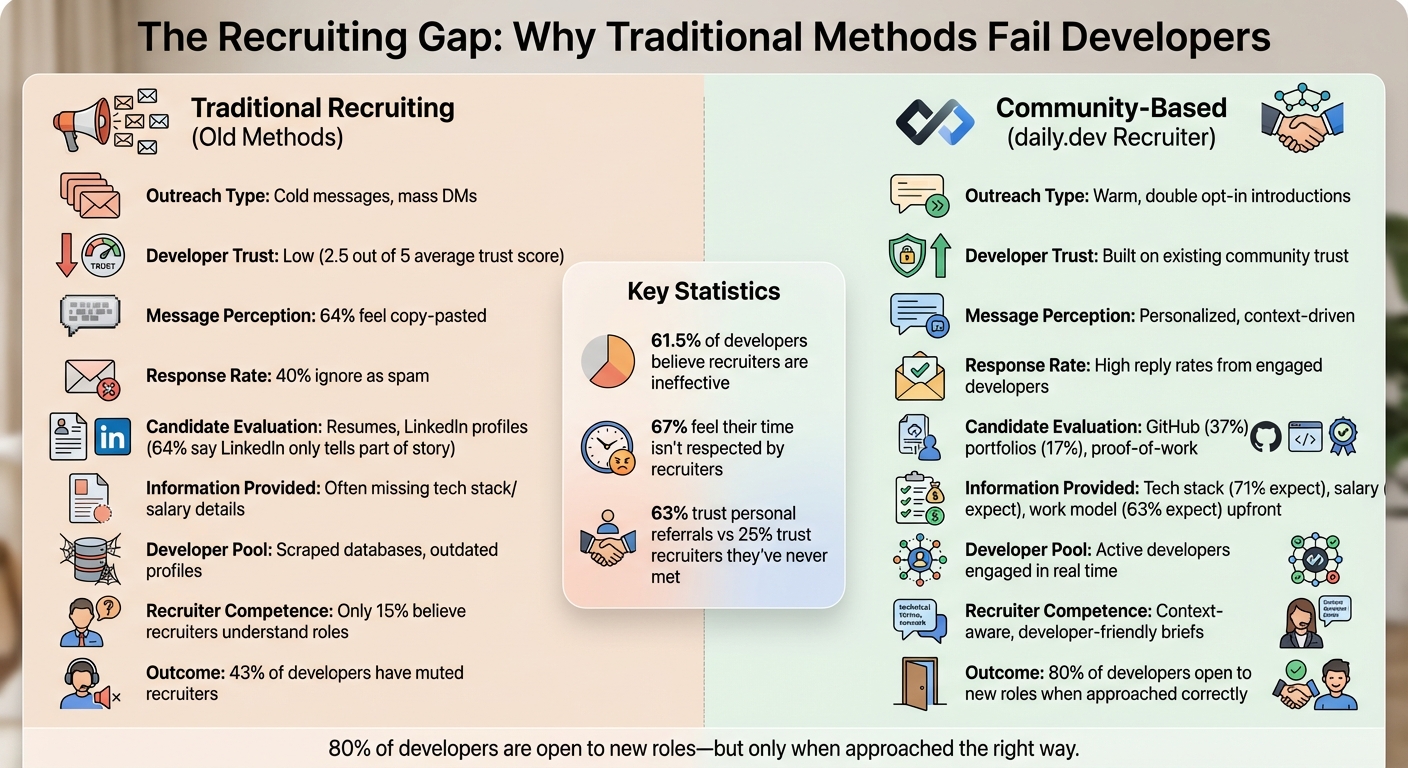 {Traditional vs Community-Based Developer Recruiting: Key Metrics Comparison}
Traditional recruiting often relies on impersonal tactics that can make developers feel undervalued, while community-based approaches focus on building trust and genuine connections. The old-school methods - like cold outreach and generic messages - frequently backfire. Around 40% of developers dismiss these messages as spam, and 64% feel they’re just copy-pasted templates. Even worse, only 15% of developers believe recruiters truly understand the technical roles they’re hiring for. These practices erode trust and credibility quickly.
Community-based recruiting flips this narrative by creating opportunities to build trust from the start. Instead of cold emails vs. warm intros, it uses warm, double opt-in interactions and leverages platforms like GitHub, where 37% of developers feel their skills are accurately represented. What makes this approach stand out is its transparency. By leading with clear details - such as the tech stack, salary range, and work model (which 71%, 69%, and 63% of developers prioritize, respectively) - recruiters align their outreach with what developers care about most. This alignment transforms outreach into a process rooted in trust and mutual respect.
Comparison Table: Old Methods vs. daily.dev Recruiter

| Feature | Traditional Recruiting (Old Methods) | Community-Based (daily.dev Recruiter) |
|---|---|---|
| Outreach Type | Cold messages, mass DMs | Warm, double opt-in introductions |
| Developer Trust | Low trust baseline | Built on existing community trust |
| Message Perception | Feel copy-pasted (64%) | Personalized, context-driven |
| Response Rate | Ignored as spam (40%) | High reply rates from engaged developers |
| Candidate Evaluation | Resumes, LinkedIn profiles | GitHub, portfolios, proof-of-work |
| Information Provided | Often missing tech stack/salary | Includes tech stack, salary, and work model upfront |
| Developer Pool | Scraped databases, outdated profiles | Active developers engaged in real time |
| Recruiter Competence | Only 15% believe recruiters understand roles | Context-aware, developer-friendly briefs |
This side-by-side comparison highlights the transformation in approach. Community-based recruiting moves away from transactional methods and focuses on relationship-building. It’s a shift in mindset. Developers prefer engagement that respects their time and values their skills. While 80% of developers are open to new roles, many have muted traditional recruiting channels entirely. Meeting them where they already are and providing transparent, tailored communication turns what used to be noisy, ineffective outreach into a process grounded in trust and meaningful connections.
Conclusion: A Better Way to Recruit Developers
The hiring landscape is shifting, and the challenges are clear: 65% of CIOs struggle to find the right talent, while 61.5% of developers view recruiters as ineffective. To bridge this gap, it's crucial to move beyond outdated tactics and focus on engaging with developer communities in a way that respects their values and workflows.
Community-based recruiting isn’t just another tactic - it’s a smarter, long-term strategy. With 80% of developers open to new roles, connecting with them where they already collaborate and engage makes a huge difference. This approach transforms recruitment from a numbers-driven process into one built on trust and genuine relationships.
Developers value personal referrals (63%) and community connections (40%) far more than cold outreach. They also expect transparency from the very beginning, preferring clear, detailed job descriptions over vague pitches. By authentically participating in developer communities and sharing meaningful insights, you're not just hiring for today - you’re building a reliable talent pipeline for the future.
Start by joining developer communities - attend meetups, contribute to open-source projects, and offer value without pushing for immediate results. Collaborate with your technical teams to craft role descriptions that highlight growth opportunities and reflect your company’s values. Simplify your interview process, as developers juggling multiple offers won’t wait through endless screening rounds. And don’t overlook the importance of assessing cultural fit and ambition. A team that works harmoniously is far more productive than one relying solely on individual brilliance.
FAQs
What counts as “proof of work” for developers?
For developers, proof of work means showcasing actual results that reflect their abilities and expertise. This can take many forms, such as:
- Portfolios: Collections of completed projects that highlight their range of skills.
- Open-source contributions: Publicly available work that demonstrates collaboration and technical proficiency.
- Code samples: Examples of clean, efficient, and well-documented code.
- Technical blog posts: Write-ups that explain complex problems and solutions, showcasing problem-solving skills and clear communication.
Recruiters should focus on these real-world examples rather than just resumes. Developers place a high value on transparency and concrete evidence of skills. By emphasizing clear and verifiable work, recruiters can build trust and better assess whether a candidate can meet the demands of a technical role.
How can recruiters personalize outreach without sounding fake?
Recruiters looking to make meaningful connections should dive into specifics. Mention a developer's GitHub projects, their tech stack, or even recent contributions they've made. Ditch the one-size-fits-all templates - tailor your outreach to highlight their unique skills and interests.
Being upfront about the role, salary, and company culture goes a long way in building trust. Personalization isn’t just about crafting a pitch; it’s about recognizing their expertise and offering something of value. This thoughtful approach creates genuine connections and avoids coming across as overly pushy or impersonal.
How do you build trust in developer communities without spamming?
To earn trust within developer communities, prioritize genuine interactions and respectful behavior. Contribute meaningfully by sharing knowledge or participating in conversations, and make outreach personal by mentioning specific projects or skills that align with the developer's work. Always use opt-in recruiting methods to maintain transparency and ensure consent. Focus your efforts on platforms like GitHub or Stack Overflow, staying mindful of each community’s guidelines and etiquette. Steer clear of mass messaging - trust is built through thoughtful, relevant communication that values developers' time and attention.
.png)