The demand for machine learning professionals is at an all-time high in 2025, with 97% of companies struggling to hire qualified talent and 4.2 million unfilled AI roles globally. Despite a surge in AI education programs, the supply of skilled experts - especially PhD-level professionals - remains limited. Companies need precise hiring strategies to secure top talent quickly, as salaries range from $120,000 to $300,000 annually.
Key takeaways:
- Top Roles: Machine Learning Engineers, Applied Scientists, MLOps Engineers, and Research Scientists.
- Skills to Look For: Python, TensorFlow, PyTorch, cloud platforms, GitHub activity, Kaggle rankings, and publications.
- Where to Find Talent: Platforms like daily.dev Recruiter, automated candidate sourcing tools, and competition sites like Kaggle.
- Recruitment Tips: Focus on practical skills, use AI-powered tools for sourcing, and highlight meaningful work and growth opportunities in offers.
Hiring the right machine learning experts requires a clear understanding of roles, skills, and sourcing strategies. The article provides actionable insights to streamline recruitment and attract the best talent in a competitive market.
::: @figure 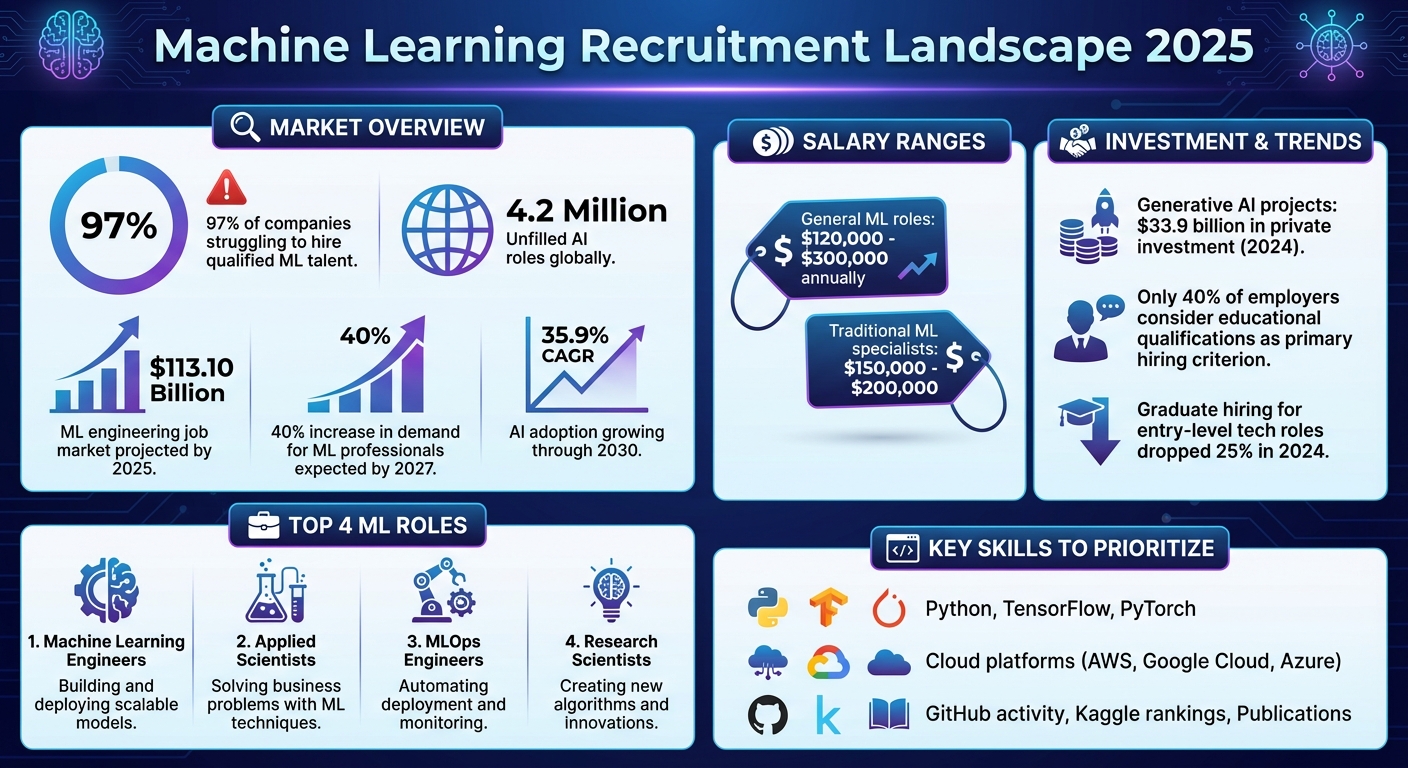 {Machine Learning Recruitment Statistics and Salary Ranges 2025}
Machine Learning Roles You Need to Know in 2025
Core ML Roles Explained
Understanding the key roles in machine learning (ML) is essential for hiring the right talent. Machine Learning Engineers are responsible for building and deploying scalable models. They handle everything from setting up data pipelines to optimizing models, bridging the gap between data science and software engineering to ensure strong performance.
Meanwhile, Applied Scientists tackle specific business problems using ML techniques. They experiment with algorithms, conduct A/B testing, and transform research into real-world applications. On the infrastructure side, MLOps Engineers focus on automating model deployment, monitoring performance, and managing the ML lifecycle. Lastly, Research Scientists drive innovation by creating new algorithms and publishing advancements that shape the future of the field.
By 2025, projections show the ML engineering job market will grow to $113.10 billion . Additionally, demand for ML professionals is expected to increase by 40% by 2027 . Companies are increasingly prioritizing engineers who can manage the full technical stack, from model development to data pipeline management .
Skills and Experience to Look For
Proficiency in Python remains a cornerstone for ML roles, along with experience using frameworks like TensorFlow and PyTorch. Familiarity with cloud platforms such as AWS, Google Cloud, or Azure is another key skill for deploying models in production environments. However, technical skills alone don’t paint the full picture.
Look for tangible proof of expertise - active GitHub profiles, high Kaggle rankings, or academic publications can all showcase a candidate's abilities. Interestingly, only 40% of employers in ML recruitment consider educational qualifications as the primary hiring criterion . This reflects a growing trend toward skills-based hiring, with demonstrated abilities often outweighing formal degrees. For example, graduate hiring for entry-level tech roles at major companies dropped by 25% in 2024 compared to the previous year .
Focus on aligning these demonstrated skills with your company’s specific challenges to find the right ML talent.
Matching Roles to Your Business Problems
Once you understand the core roles and essential skills, tailor your hiring strategy to address your unique business needs. Different challenges call for different ML skill sets. If you're developing a recommendation system for an e-commerce platform, seek ML Engineers who excel in collaborative filtering and real-time predictions. For natural language processing tasks, look for NLP Engineers or Applied Scientists familiar with transformer models.
For generative AI projects, which attracted $33.9 billion in private investment in 2024 , prioritize candidates with experience in large language models and prompt engineering. Computer Vision Engineers are crucial for initiatives like image classification, object detection, or visual search. On the other hand, fraud detection systems demand expertise in anomaly detection and real-time scoring.
Don’t overlook professionals in non-AI-specific roles who possess AI skills. For example, a senior software engineer with ML side projects or a data analyst who has created predictive models might be just what your team needs. These candidates are often more accessible than traditional ML specialists, who typically command salaries between $150,000 and $200,000 . This "hidden AI talent pipeline" could be a valuable resource for finding the expertise you need .
Where to Find Machine Learning Experts in 2025
Developer-First Professional Networks
daily.dev Recruiter is an excellent tool for connecting with machine learning professionals who are actively engaging with technical content and participating in community discussions. It offers double opt-in introductions, ensuring that connections are built on genuine, real-time interactions. With access to a community of over 1,000,000 developers , daily.dev Recruiter provides enriched profiles based on current activity, helping you identify qualified technical candidates in minutes.
In a competitive landscape, finding experts where they naturally gather is crucial. Up next, we’ll delve into how platforms focused on learning and competitions can expand your reach to ML talent.
Techniques and Tools for Targeted Sourcing
AI-Driven Sourcing and Matching Tools
Today's AI-powered sourcing tools go beyond simple keyword searches. They analyze career paths, related skills, and company data to reveal hidden talent pools - those professionals who aren't actively job hunting but could be a perfect fit for your role . These tools interpret the intent behind your search, so when you’re looking for a "machine learning engineer", they can identify candidates with the right experience patterns and skills .
These AI systems continuously scan 600–800 million profiles across 28 to 60+ platforms . They use autonomous agents to maintain and improve talent pipelines around the clock, saving you from starting from scratch each time you need to hire. For instance, in November 2025, Zoho Recruit launched updated AI-driven candidate matching features that also made it easier for recruiters to track their usage .
Skill-Based Filters and Automation
Advanced filtering tools now offer context-aware searches, making it possible to use natural language queries like, "senior software engineers with 5+ years of PyTorch and computer vision experience" . These platforms pull data from 45 to 60+ sources, creating unified talent pools that go beyond basic resumes. They can identify skills mentioned in project descriptions and predict a candidate’s suitability and likelihood to respond.
For specialized roles like machine learning, recruitment strategies now focus on evaluating tangible outputs such as models, notebooks, and data workflows instead of relying solely on keywords . These methods allow recruiters to assess candidates based on their GitHub activity, Kaggle competition rankings, published research, and actual code contributions. Meanwhile, automation tools take care of repetitive tasks like screening qualifications, scheduling interviews, and sending personalized messages - letting you focus on meaningful conversations with top candidates.
Data-Driven Candidate Prioritization
Data-driven scorecards make it easier to rank candidates based on factors like recent activity, seniority, location, and role relevance . AI platforms can help you decide who to contact first and even estimate a candidate's market value, allowing you to prepare competitive offers upfront .
For example, Moonhub claims its prioritization methods can cut time-to-hire by 50% . Structured scorecards play a key role here, listing essential skills like specific stack versions, cloud tools, and data formats to ensure candidates meet technical requirements before moving forward . Additionally, tools like blind screening and objective scorecards help reduce bias in technical hiring by basing hiring decisions on data rather than gut feelings .
Platforms like daily.dev Recruiter take this a step further by prioritizing candidates based on their real-time engagement with technical content and community discussions. Instead of relying solely on static profiles, these enriched profiles reveal what technologies and topics candidates are currently exploring, giving you a deeper understanding of their expertise.
With targeted sourcing streamlined, the next challenge is effectively evaluating and engaging with these candidates.
Hiring engineers?
Connect with developers where they actually hang out. No cold outreach, just real conversations.
Evaluating and Closing Machine Learning Candidates
Technical Evaluation Framework
When evaluating machine learning candidates, it’s essential to look beyond just their theoretical knowledge. Focus on how they approach and solve real-world problems, as well as their ability to deploy models into production. Start by reviewing their portfolio for hands-on experience with tools like PyTorch, scikit-learn, or AWS SageMaker. Check for active GitHub contributions, Kaggle rankings, or relevant research publications to gauge their practical expertise .
Incorporate take-home assignments or live coding exercises that mimic real-world scenarios. For example, you could ask candidates to design an image classification model for a large dataset under tight deadlines. These types of tasks reveal how well they handle practical trade-offs and problem-solving under constraints .
Don’t overlook soft skills and how well they align with your team’s dynamics. As Cassie Kozyrkov from Google explains:
"Machine learning engineers are the bridge between data scientists and software engineers, turning data into actionable insights and scalable solutions" .
Assess their ability to simplify complex concepts and determine whether they thrive in a fast-paced startup environment or prefer a more structured setting. Once you’ve evaluated both technical and interpersonal skills, it’s time to understand what truly motivates these professionals in their roles.
What ML Experts Value in Roles
Machine learning professionals often prioritize intellectually stimulating work and opportunities for growth over just a high salary. According to Stack Overflow's 2024 Developer Survey, many AI/ML specialists value meaningful problem-solving, autonomy, and the chance to continuously learn above financial compensation . They are drawn to roles where they can see their work have a tangible impact, rather than only focusing on theoretical models .
These experts also appreciate access to high-quality datasets, powerful computing resources, advanced development tools, and efficient workflows . If you’re using platforms like daily.dev Recruiter, make sure to highlight these technical and infrastructural strengths in your job descriptions to attract candidates who align with these values.
Competitive Offers in the US Market
After assessing candidates’ skills and understanding their preferences, tailor your offer to meet the high standards of ML professionals. While competitive compensation matters, what truly sets an offer apart is the promise of stimulating challenges, opportunities for real-world impact, and access to cutting-edge technical resources .
Highlight aspects like opportunities for research publication, access to diverse and rich datasets, and a robust development environment. These details can make your role more appealing. Structuring your offer around meaningful work, autonomy, and professional growth ensures alignment with the aspirations of even the most skilled candidates .
Conclusion
Bringing top-tier machine learning (ML) experts on board in 2025 requires clarity around specific roles and the skills needed. With global AI adoption expected to grow at an impressive 35.9% compound annual growth rate (CAGR) through 2030, the competition for talent will only get tougher .
Once you’ve outlined your ML roles, broaden your approach with coding-focused candidate sourcing tools. Use platforms where professionals actively showcase their skills - like code repositories and competition leaderboards. These spaces provide direct access to talent with proven, hands-on expertise.
AI-powered tools can also play a key role in simplifying your hiring process. Automate candidate screening and matching to save time and reduce bias, ensuring a more efficient selection process.
For an even faster turnaround, consider partnering with recruitment agencies specializing in ML talent. These agencies can deliver pre-vetted, interview-ready candidates in as little as 7–14 days, with an average time-to-fill of about four weeks .
When evaluating candidates, practical tasks and portfolio reviews are just as important as theoretical assessments. ML professionals often seek roles that challenge them intellectually and offer opportunities for growth. Highlight the potential impact of the role and career advancement in your offer to stand out from the competition. By combining these strategies, you’ll position yourself to attract and hire the best ML talent efficiently.
FAQs
How can companies successfully recruit machine learning experts in 2025?
To hire machine learning experts in 2025, companies should prioritize targeted outreach and active involvement in professional communities. Start by tapping into platforms where ML professionals frequently engage, like GitHub, Kaggle, and AI-focused research forums, to connect with skilled individuals. Partnering with universities and sponsoring events such as hackathons or workshops can also open doors to promising talent.
Another key step is adopting structured interview processes that evaluate real-world skills. Remote hiring tools can expand your reach to a global talent pool, while upskilling your current workforce or recruiting from industries with overlapping skill sets can help address talent shortages. By focusing on these strategies, businesses can streamline their efforts and attract highly qualified ML professionals.
How can AI-powered tools streamline recruiting for machine learning roles?
AI-driven tools are reshaping how machine learning roles are filled, streamlining repetitive tasks and offering sharper insights. These tools can sift through massive datasets to identify top candidates, including those who aren’t actively job hunting, and assess their fit for specific positions. On top of that, they facilitate tailored outreach, making communications more engaging and targeted.
With AI, recruiters can cut sourcing time by as much as 95%, accelerate hiring timelines, and tap into hidden talent pools that might otherwise go unnoticed. This approach not only saves valuable time but also enhances the overall efficiency of hiring in today’s highly competitive tech industry.
What skills and experience should you look for when hiring machine learning experts?
When hiring machine learning professionals, prioritize candidates who excel in machine learning algorithms, statistical analysis, and predictive modeling. They should also be proficient in programming languages like Python and R, and have hands-on experience with widely-used frameworks like TensorFlow and scikit-learn.
It's also important to evaluate their expertise with data visualization tools and familiarity with big data technologies. A strong ability to manage and analyze large datasets is a must. Candidates with practical experience applying machine learning to solve complex, real-world challenges often stand out as top choices.
.png)