The demand for machine learning (ML) talent in 2026 is higher than ever, with a global shortage leaving 1.6 million positions unfilled. Companies are moving beyond experimental AI projects to large-scale deployments, creating a need for experienced professionals who can build and manage production-ready systems. Here's what you need to know:
- Demand-Supply Gap: The demand-to-supply ratio for AI engineers is 3.2 to 1, with 72% of employers struggling with skill mismatch in tech hiring.
- Focus on Senior Roles: Entry-level hiring has dropped by 73.4% as businesses prioritize senior engineers with production expertise.
- New Roles: Emerging areas like "Agentic AI" have created demand for roles like Agent Architects and ML Orchestrators.
- Key Skills: Proficiency in MLOps, LLMOps, vector databases, and cloud platforms is critical. Domain-specific expertise is also increasingly required.
To hire top ML talent:
- Use platforms like daily.dev Recruiter for warm, opt-in connections.
- Explore specialized communities such as Kaggle, Hugging Face, and GitHub to assess candidates' technical contributions.
- Attend conferences like NeurIPS and ICML to network with experts.
- Leverage AI-powered recruitment tools for skill-based matching and personalized outreach.
Hiring in 2026 requires precision, strong evaluation processes, and personalized engagement to secure the best talent in a competitive market.
::: @figure 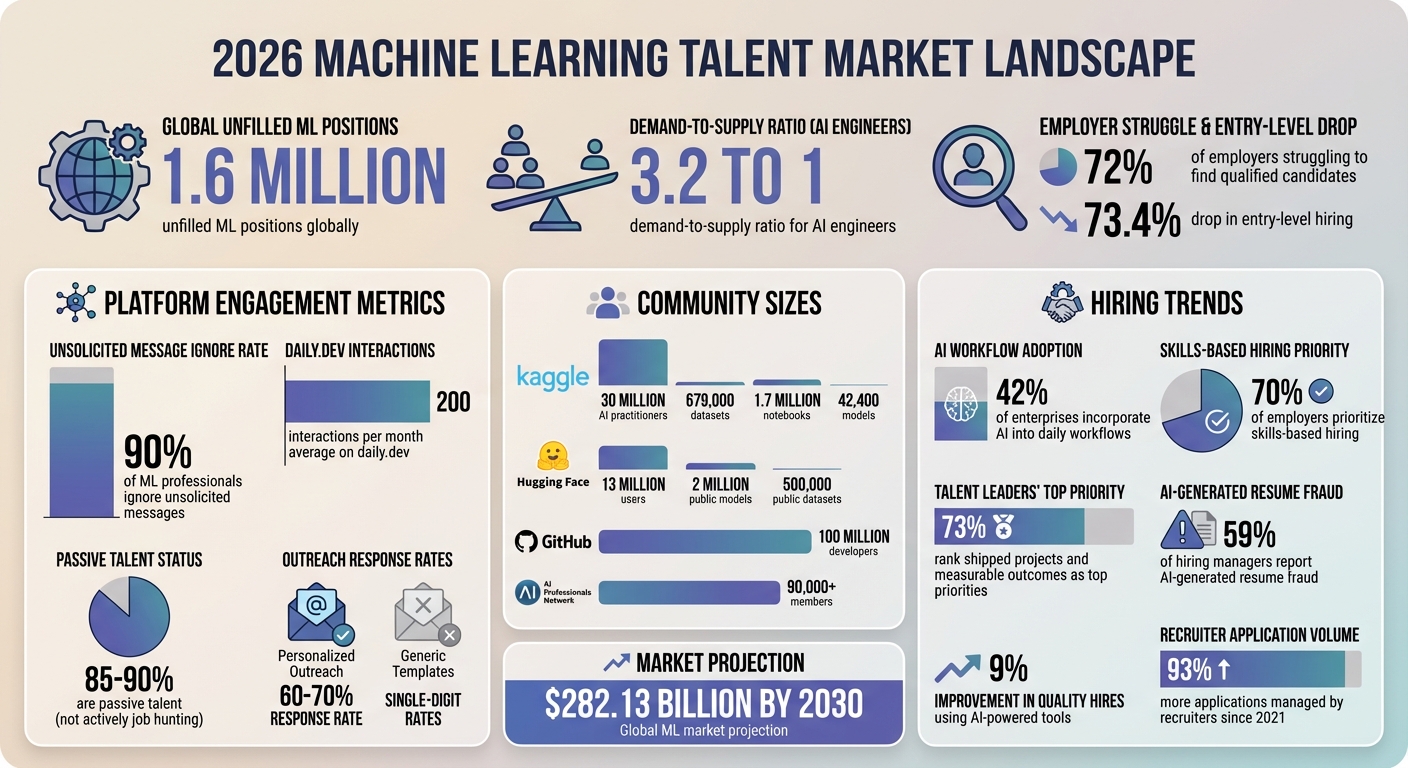 {Machine Learning Talent Market Statistics 2026: Demand, Supply Gap, and Key Hiring Trends}
Use daily.dev Recruiter for Direct Access to ML Professionals
Finding top-tier machine learning (ML) talent is no easy task, especially with the current shortage of skilled professionals. Traditional hiring methods often bombard ML experts with cold, impersonal messages that get ignored. daily.dev Recruiter changes the game by offering warm, double opt-in connections. This approach ensures both parties consent to engage, cutting through the noise of generic outreach that experienced professionals tend to dismiss.
With daily.dev Recruiter, you gain access to a network where, according to platform data, 90% of users generally ignore unsolicited messages. Why? Because 85–90% of these professionals are passive talent - not actively job hunting. However, the platform keeps them engaged. The average engineer interacts with daily.dev 200 times per month, providing consistent engagement without the distractions typical of job boards. This high level of activity makes it easier to connect with the right candidates.
How daily.dev Recruiter Works for ML Hiring
daily.dev Recruiter uses real-time insights - what users read, build, and follow - to match candidates to your specific hiring needs. For instance, if you're looking for an LLM Architect, the system identifies developers actively engaging with content on Generative AI and large language models. This activity-based matching ensures you're connecting with professionals who are genuinely interested in the technologies your role requires.
To streamline the process further, you can create up to three custom screening questions to assess specific ML skills before introductions are made. For example, you could ask candidates about their experience with RAG architectures or managing data drift in production systems. This feature simplifies the initial screening and saves time. Plus, the platform integrates seamlessly with your existing Applicant Tracking System, automating data entry and avoiding duplicate records.
The pricing is refreshingly simple: $350 per role, per month. There are no placement fees, no long-term commitments, and you get unlimited recruiter seats. This straightforward model supports a variety of roles, including AI Research Scientists, ML Engineers, NLP Engineers, Computer Vision Specialists, and LLM Architects, making it easier to fill multiple positions without breaking the bank.
The Advantage of Warm Introductions Over Cold Outreach
Cold outreach often falls flat because it lacks personal context and trust. When you reach out to an ML expert without any prior connection, they have little reason to believe you understand their expertise or that your opportunity is worth exploring. Warm introductions, however, change the dynamic. Both parties have already reviewed the opportunity and shown initial interest, creating a foundation for meaningful conversations.
"Trust is the only hack. Engineers come to daily.dev to learn and stay sharp. They trust the platform enough to share career goals, salary expectations, even employment contracts."
- Nimrod Kramer, CEO & Co-Founder
This trust-driven approach leads to stronger engagement. By connecting through daily.dev Recruiter, candidates already know key details like your tech stack and team size, allowing discussions to focus on what truly matters.
Hiring engineers?
Connect with developers where they actually hang out. No cold outreach, just real conversations.
Find ML Experts in Specialized Communities and Forums
Machine learning professionals often participate in niche online communities where they demonstrate their expertise and share creative solutions. These platforms offer recruiters a unique opportunity to evaluate a candidate's real-world capabilities - insights that go far beyond what a traditional resume can offer. By exploring these spaces, you can gain a transparent view of how candidates tackle real-world challenges.
Where ML Professionals Gather Online
Kaggle is one of the most prominent platforms, boasting over 30 million AI practitioners, 679,000 datasets, 1.7 million notebooks, and 42,400 pre-trained models . Candidates who achieve "Master" tier rankings or consistently perform well in competitions prove their skills in a measurable way.
Hugging Face, with its 13 million users, has become a go-to hub for sharing models, datasets, and demo applications . It hosts over 2 million public models and 500,000 public datasets. Impressively, individual users ranked fourth in developing trending ML models in 2025 . If you're hiring for robotics-related roles, Hugging Face is especially worth exploring - robotics datasets on the platform skyrocketed from around 1,100 in 2024 to nearly 27,000 in 2025, making it the fastest-growing community for this niche.
GitHub also plays a crucial role, with a global community of over 100 million developers . It provides recruiters with verifiable insights into a candidate's technical skills through their commits, pull requests, and collaboration history. Advanced search operators like topic:machine-learning, language:python, and pushed:>2025-01-01 can help you pinpoint active contributors. Meanwhile, Reddit's r/MachineLearning serves as a vibrant space for discussions about research, projects, and the latest industry developments.
Evaluate Candidates Through Open Source Work
Open-source contributions often reveal a candidate's abilities more effectively than a resume. Platforms like GitHub showcase what individuals have genuinely built . Look for projects that have earned community recognition, such as repositories with 100+ stars or 20+ forks, as these indicate expertise validated by peers .
On Kaggle, competition write-ups can highlight a candidate's problem-solving strategies . Notebooks with high upvote counts often demonstrate strong data storytelling and technical clarity . Similarly, GitHub pull requests and issue responses can provide insights into a candidate's communication skills - an essential trait for remote ML roles . Be cautious of profiles dominated by tutorial follow-alongs, bootcamp projects, or replicas of major websites, as these rarely showcase original problem-solving abilities.
When reaching out to potential candidates, referencing specific contributions - like a standout pull request, an innovative dataset, or a competition-winning solution - can significantly improve your chances of a response. It shows that you've taken the time to appreciate their work and understand their expertise .
Connect Through Professional Networks and Industry Events
Professional networks and conferences provide a direct path to connect with machine learning (ML) experts who excel in both technical skills and effective communication.
Finding ML Experts on LinkedIn and X (Twitter)
LinkedIn remains a key platform for professional networking, while X (Twitter) thrives as a hub for real-time AI discussions. Santosh Rout highlights the importance of staying informed:
"One of the strongest signals ML interviewers look for in senior candidates is their awareness of recent developments... to assess whether their thinking reflects the state of the field" .
Rather than following general influencers, focus on established ML engineers who exhibit what Rout describes as "expert attention" - engaging with topics only after multiple trusted voices signal their importance.
The AI Professionals Network, boasting over 90,000 members worldwide, offers resources like a jobs board and connections to senior AI leaders and researchers . Similarly, communities such as ML Collective (MLC) host collaborative events like Research Jams and maintain an Open Collab Discord server for peer-to-peer learning . The TWIML Community organizes study groups for advanced courses (e.g., Stanford CS224N) and special interest groups for Kaggle competitions .
When assessing candidates on these platforms, prioritize those with expertise in both the "Infrastructure Layer" (e.g., PyTorch, JAX, Ray) and the "Application Layer" (e.g., Retrieval-Augmented Generation, agentic architectures). Candidates who summarize research papers or build demos following major announcements often demonstrate senior-level knowledge .
While online networks are valuable, in-person events and conferences offer unparalleled opportunities to meet ML professionals face-to-face.
Meet ML Talent at Conferences and Events
Attending major conferences allows you to connect with experts presenting the latest research. For instance, NeurIPS 2026 (December 6–12 in Sydney, Australia) is set to showcase around 1,100 papers, many accompanied by code . ICML 2026 (July 6–11 in Seoul, South Korea) attracts a wide range of participants, from academic researchers to industry engineers . For those focused on computer vision, CVPR 2026 (June in Nashville, USA) is a standout event, while EMNLP 2026 (November in Miami, USA) gathers top natural language processing experts .
| Conference | Date | Location | Focus |
|---|---|---|---|
| AAAI | January 20–27, 2026 | Singapore | Broad AI Topics |
| ICLR | April 2026 | Rio de Janeiro, Brazil | Deep Learning |
| CVPR | June 2026 | Nashville, USA | Computer Vision |
| ICML | July 6–11, 2026 | Seoul, South Korea | ML Theory & Applications |
| NeurIPS | December 6–12, 2026 | Sydney, Australia | Neural Information Processing |
Networking consistently ranks as the most valuable part of attending conferences . Focus on workshops, which encourage interactive and in-depth discussions . Additionally, platforms like OpenReview allow you to track paper submissions and peer reviews ahead of conferences, helping you identify emerging talent. Industry events such as Google I/O (May in Mountain View, USA), Apple WWDC (June in Cupertino, USA), and AWS re:Invent (December in Las Vegas, USA) also provide excellent opportunities to meet professionals working on AI infrastructure and cloud-based solutions .
These strategies, combined with earlier recommendations, provide a well-rounded approach to finding and connecting with ML talent.
Apply AI-Powered Tools to Speed Up Candidate Sourcing
AI-driven tools are reshaping the recruitment process, especially when it comes to sourcing machine learning (ML) talent. These platforms go beyond simple keyword matching, using advanced techniques like weighted graphs to distinguish between candidates with deep expertise and those with only surface-level experience. For example, they assess factors like project complexity and how long a candidate has worked in specific areas, helping recruiters pinpoint specialists in fields like Retrieval-Augmented Generation (RAG) or LangChain .
How AI Tools Improve ML Talent Sourcing
Modern recruitment tools have moved past traditional keyword searches. Instead, they use natural language queries, enabling recruiters to describe roles in plain English rather than relying on complex Boolean strings . These platforms pull data from over 30 sources, including GitHub, GitLab, technical blogs, and even conference presentations. This approach helps uncover passive candidates - those who might not actively update their LinkedIn profiles - while analyzing over 10 million market data points each month to provide up-to-date salary estimates .
AI tools also incorporate intent and sentiment analysis to automatically categorize candidate responses by interest level. This eliminates the need for manual sorting and keeps pipelines efficient . Additionally, these tools can draft personalized outreach messages that reference a candidate’s specific contributions or project history. This tailored approach achieves response rates of 60–70%, a significant improvement over the single-digit rates seen with generic templates . With recruiters now managing 93% more applications than in 2021, largely due to AI-driven mass applications, automated screening has become indispensable .
These advancements make it easier to identify top candidates, but they also highlight the importance of choosing the right tools to meet your hiring goals. Automated personalization builds recruiter credibility and is a game-changer for candidate engagement, so selecting a platform that aligns with your needs is crucial.
What to Look for in AI Recruitment Tools
When evaluating AI recruitment platforms, focus on features like weighted skill analysis, which can differentiate between superficial mentions of skills and genuine expertise by analyzing factors like duration and company context . Look for systems that integrate with your ATS within 24 hours to ensure smooth data flow . The best platforms rank candidates based on verified technical activity - such as contributions on GitHub - rather than relying solely on self-reported resume information .
Other key features include predictive availability signals, which help recruiters prioritize candidates who are more likely to be open to new opportunities, and automated hyper-personalization, which keeps candidates engaged without requiring constant manual effort . For ML-specific roles, the tool should be capable of identifying verified technical contributions and assessing expertise in specialized frameworks like RAG. However, as Korn Ferry points out, while AI excels at pattern recognition and data analysis, human judgment is still essential for evaluating cultural fit and addressing complex compensation discussions .
Screen and Engage ML Candidates
Once you've pinpointed potential machine learning (ML) candidates, the next step is to assess whether they align with your role's needs and engage them effectively. These evaluations are crucial for building deeper connections with candidates.
Modern ML evaluations focus on four key areas: data literacy (cleaning and exploration), modeling skills (algorithm selection and tuning), software engineering practices (writing clean, modular, and testable code), and MLOps knowledge (deployment and monitoring) . In 2026, it's equally important to evaluate expertise in generative AI, including skills like prompt engineering, experience with retrieval-augmented generation (RAG) architectures, and understanding cost-latency trade-offs . A candidate who can articulate why they chose a simpler model over a more complex one often brings more value than someone who only focuses on the latest frameworks .
"A model that never makes it to production delivers exactly zero business value, no matter how elegant the architecture was" .
Create Competency Profiles for ML Positions
To meet the demands of today's ML landscape, start by defining clear, outcome-driven competency profiles. Focus on the specific business results you expect within the first 90 days - whether that’s automating 30% of manual processes or delivering a reliable RAG-based tool. Tailor these profiles to different ML roles: ML Engineers prioritize production systems and scalable APIs, Research Scientists innovate with novel architectures and experiments, and MLOps Engineers handle infrastructure, model versioning, and drift monitoring .
Develop a role scorecard that separates essential skills from optional ones and incorporates measurable metrics, such as latency reductions or model performance improvements . For technical skills, specify tools like Python, PyTorch or TensorFlow, SQL, vector databases (e.g., Pinecone or Milvus), and MLOps platforms like MLflow. Candidates should also demonstrate strong mathematical foundations, such as reasoning about precision-recall trade-offs, confidence intervals, and gradient descent. By 2026, hiring trends have shifted from academic credentials to production experience, emphasizing deployed models and monitored pipelines .
Evaluate execution skills with a 3–4 hour practical task that mirrors real-world challenges, such as deploying a Hugging Face model via a REST API . Be cautious of red flags, like candidates overly reliant on buzzwords who struggle with fundamental concepts, or those who prioritize model accuracy while neglecting business value or inference speed .
Personalize Your Outreach to ML Candidates
After confirming a candidate's technical and production readiness, tailor your outreach to capture their interest. Generic messages won’t resonate with ML professionals. In fact, 75% of job seekers say personalized job offers are a decisive factor in considering new opportunities . Go beyond basic personalization (like including their name and title) by researching their specific projects, GitHub contributions, publications, or recent achievements. Outreach that mentions a specific reason for contacting them sees a 47% higher response rate .
Position your outreach as a solution to a technical challenge your company is tackling, rather than just announcing a job opening . To engage passive candidates, highlight what their current role might lack, such as access to larger datasets, bigger compute budgets, or opportunities to directly influence product strategy . ML professionals are often motivated by company mission and values - 87% would consider leaving their current role for better alignment with their principles .
Structure your pitch around the "4 P's": People (who they’ll collaborate with), Passion (why the technology is exciting), Purpose (the company mission), and Products (what they’ll help build) . Keep your messages concise - skip long lists of required skills and focus on the unique opportunity and why you’re reaching out . Personalizing email subject lines can increase open rates by 26% to 50%, and using a five-stage email sequence doubles the reply rate compared to one-off emails .
"The difference between a great sourcer and a sub-par sourcer is in how much discipline someone has in following up... Response rates on that initial outreach might be 15%, but they might be 50% on the follow-up" .
Conclusion
Hiring machine learning (ML) experts in 2026 requires a focus on precision rather than volume. With 42% of enterprises now incorporating AI into their daily workflows , finding professionals capable of delivering production-ready systems is more critical than ever.
To navigate these shifts, adopt targeted strategies to connect with top-tier talent. Start with daily.dev Recruiter, a platform offering warm, double opt-in introductions. Expand your efforts by exploring specialized communities like GitHub or technical forums to assess candidates' real-world contributions. Conferences can help you engage with passive talent, while AI-powered tools can effectively match skills, leading to a 9% improvement in quality hires .
In this evolving landscape, MLOps expertise and stack-specific skills (e.g., PyTorch, JAX) are in high demand. Notably, 70% of employers now prioritize skills-based hiring . Evaluating candidates based on shipped projects, measurable outcomes, and critical thinking has become essential, with 73% of talent leaders ranking these attributes as top priorities .
"Organizations that delay hiring often face longer timelines, higher costs, and delivery risk as competition for experienced talent intensifies." - Phaidon International
To address challenges like AI-generated resume fraud - reported by 59% of hiring managers - implement robust verification processes. Use the 70-30 rule: hire for 70% of the required skills and train for the remaining 30% . Personalizing your outreach by referencing candidates' specific achievements can make a significant difference. With the global ML market projected to reach $282.13 billion by 2030 , these strategies are essential for securing top talent and staying ahead of the competition.
FAQs
How do I evaluate real production ML experience fast?
To get a clear sense of someone's hands-on experience with machine learning (ML), it's essential to look at how they handle structured evaluations and use key metrics like accuracy, precision, recall, F1 score, and ROC-AUC. These metrics provide a solid foundation for assessing a model's effectiveness.
Equally important is understanding how they monitor models once deployed. This includes keeping an eye on performance over time, spotting data drift (when the data a model sees in production differs from the training data), and running stability tests to ensure consistent results. Being able to explain and apply these techniques reflects a solid grasp of maintaining ML systems in real-world settings.
What skills matter most for GenAI roles in 2026?
The landscape of GenAI roles in 2026 is evolving, demanding a fresh set of skills. Among the most critical are data judgment, context engineering, system design beyond model names, and expertise in practical deployment.
The emphasis has moved beyond simply understanding AI models. It's now about ensuring the quality of data and creating solutions that deliver measurable results. Employers are on the lookout for individuals who can combine technical expertise with a knack for applying it effectively to produce meaningful outcomes.
How can I get passive ML candidates to reply?
To attract passive machine learning (ML) candidates, focus on personalized outreach that clearly demonstrates how their expertise connects to your company's exciting projects and opportunities for growth. Emphasize a hiring process that is respectful and transparent, highlighting aspects like technical ownership, meaningful contributions, and well-defined career trajectories. Partnering with recruiters who specialize in the ML field can also boost your chances of reaching top-tier talent by making those connections more effective and relevant.
.png)