When hiring developers, you need the right tools for the job. Here's the bottom line: recruiting software (like an ATS) helps you manage candidates after they apply, while developer sourcing tools find skilled developers who aren’t actively job hunting. Both serve distinct purposes, and most teams benefit from using both.
- Recruiting Software: Tracks applications, organizes interviews, and handles hiring workflows. Ideal for managing inbound candidates.
- Developer Sourcing Tools: Finds passive talent through platforms like GitHub and Stack Overflow. Perfect for filling niche or senior roles.
Key Difference: An ATS organizes the hiring process for active applicants. Sourcing tools proactively build your talent pipeline by identifying and engaging developers based on their real-time activity.
Quick Takeaway: If you’re overwhelmed by applications, start with recruiting software. If you’re struggling to find qualified developers, add a sourcing tool. Together, they create an efficient hiring stack, but you should periodically audit your tech hiring stack to ensure you aren't overpaying for overlapping features.
Quick Comparison
| Feature | Recruiting Software (ATS) | Developer Sourcing Tools |
|---|---|---|
| Purpose | Manage candidates and workflows | Find and engage passive talent |
| Best For | Organizing active applicants | Filling niche or senior roles |
| Data Source | Resumes, applications | Real-time coding activity, forums |
| Pricing | ~$3,000–$15,000/year per user | ~$380–$4,800/year per user |
| Integration | Central hub for hiring | Works as a sourcing layer |
Pro Tip: A well-integrated stack combines sourcing tools for talent discovery with recruiting software for managing the hiring process.
::: @figure 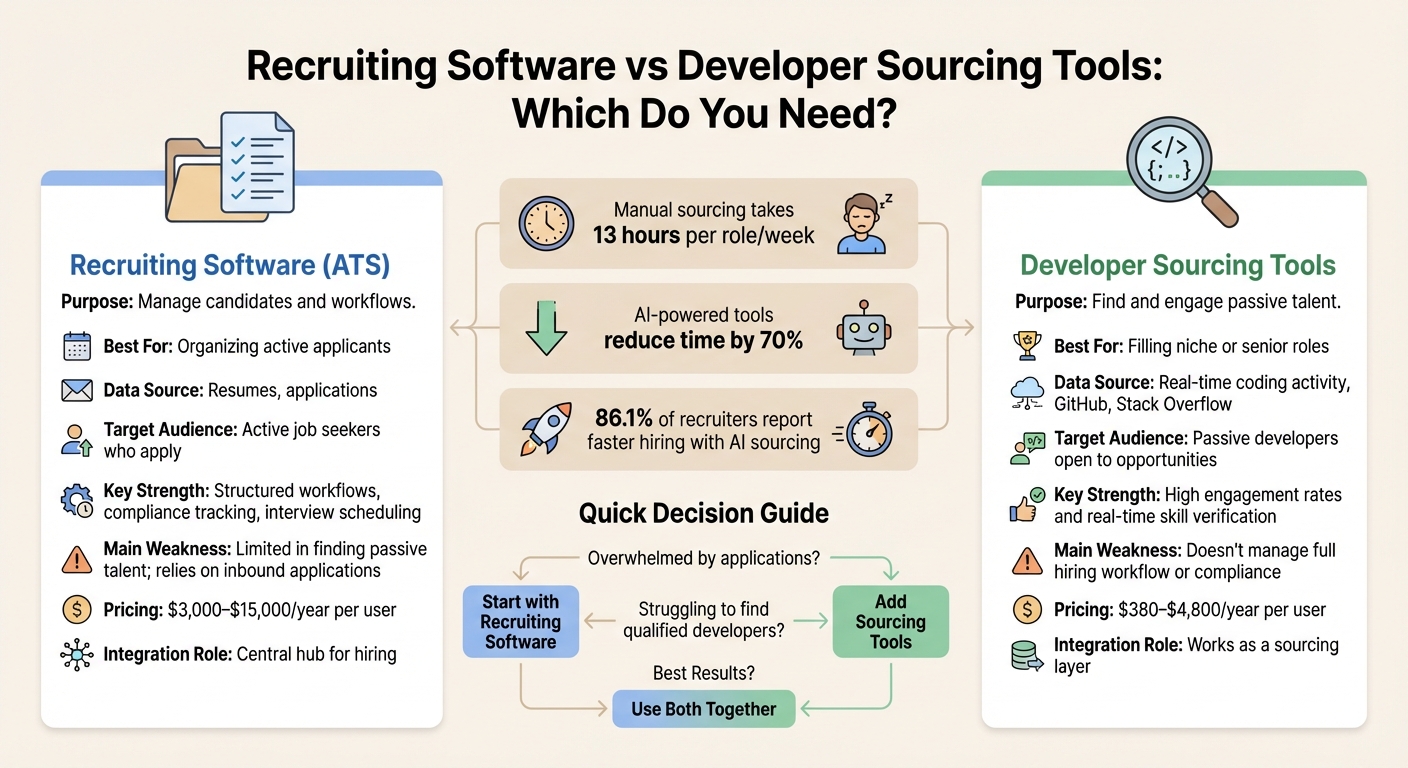 {Recruiting Software vs Developer Sourcing Tools: Key Differences and Features Comparison}
What Is Recruiting Software?
Recruiting software is the backbone of the hiring process, streamlining everything from posting job openings to onboarding new employees. It serves as a centralized hub for managing candidate data, interview feedback, and hiring decisions - eliminating the need for scattered spreadsheets and endless email chains.
The most common type of recruiting software is an Applicant Tracking System (ATS). An ATS organizes the hiring journey into stages like application, screening, interview, offer, and hire. Some platforms also include Candidate Relationship Management (CRM) features, which are designed to nurture and maintain relationships with passive candidates over time. The main distinction? An ATS moves candidates through a linear path (from application to hire), while a CRM focuses on an ongoing cycle of engagement, nurturing, and re-engagement with potential talent . Below, we’ll break down the key features and when to use recruiting software.
Core Features of Recruiting Software
Recruiting software takes the hassle out of the administrative side of hiring. An ATS handles tasks like posting job ads, collecting applications, organizing candidate profiles, and tracking progress through your hiring pipeline. It can also store interview notes and manage approval workflows. Some of these tools are surprisingly budget-friendly, starting at around $15 per user per month, making them accessible for even smaller teams .
On the other hand, a CRM focuses on creating and maintaining talent communities. It tracks details like engagement history, candidate preferences, and past interactions. While an ATS is great for measuring metrics like time-to-fill, a CRM is more about tracking engagement and response rates .
By understanding these features, you can determine the right time and purpose for adding recruiting software to your toolkit.
When to Use Recruiting Software
An ATS is a must-have if your hiring process feels chaotic - multiple open positions, a flood of applications, and no clear way to monitor progress. It’s the first tool you should implement to bring order to your recruitment pipeline before layering on additional hiring tools for technical roles like sourcing or assessment platforms .
A CRM, on the other hand, is ideal if your challenge lies in finding qualified candidates. If your focus is less about organizing applications and more about building relationships with potential hires - especially those who aren’t actively job hunting —often requiring specific passive candidate recruitment strategies - a CRM can help you stay connected over time. In short, if your workflows are disorganized, start with an ATS. If you’re struggling to find quality candidates, consider adding CRM capabilities .
Hiring engineers?
Connect with developers where they actually hang out. No cold outreach, just real conversations.
What Are Developer Sourcing Tools?
Developer sourcing tools are platforms designed to find and connect with passive technical talent - those who aren't actively searching job boards. Unlike traditional recruiting software that focuses on managing inbound candidates, these tools allow you to discover developers in their natural habitats: contributing to GitHub projects, engaging in technical forums, or consuming industry-related content.
The main distinction lies in how they gather data. While an ATS (Applicant Tracking System) relies on static resumes and applications, sourcing tools analyze real-time activity. They monitor coding contributions, discussions in tech communities, and other engagement patterns, giving you insights based on actual skills and behaviors rather than just what's listed on a resume. This proactive approach sets sourcing tools apart from conventional ATS systems.
Consider this: manual sourcing can take up to 13 hours per role each week. AI-powered tools can slash that time by as much as 70% . In fact, 86.1% of recruiters report that AI sourcing speeds up their hiring process . These tools consolidate developer data from platforms like GitHub and Stack Overflow , enabling access to passive talent pools that job boards often miss.
The impact of these tools goes beyond efficiency. For example, Talking Rain used analytics from a sourcing platform to boost female applicants from 22% to 50% and BIPOC candidates from 32% to 41% between 2020 and 2021 . Similarly, Inizio reduced its reliance on costly third-party search firms by 92% through internal sourcing automation . These results highlight how sourcing tools can streamline hiring while improving diversity.
Core Features of Developer Sourcing Tools
Developer sourcing tools stand out because of three key features:
Access to developer networks and communities: These tools tap into platforms where developers naturally spend time, such as GitHub, Stack Overflow, and niche tech forums. This allows recruiters to explore passive talent pools that traditional job boards struggle to reach.
Personalized engagement: They enable tailored outreach by referencing a candidate's recent work, like pull requests, blog posts, or community contributions. For instance, Atlassian’s "Talent Community" sent 20,000 personalized messages, achieving a 62% open rate and nearly 300 hires .
Advanced pre-screening: By analyzing coding activity and contribution quality, these tools help identify candidates who fit your needs before you even contact them. Behavioral signals like coding frequency, preferred technologies, and project quality are evaluated. Fetcher, for example, offers AI-reviewed candidate lists starting at $379/month for its Growth plan, saving recruiters hours of manual screening .
These features make developer sourcing tools indispensable for filling specialized roles - an area we'll explore further in the next section.
When to Use Developer Sourcing Tools
Developer sourcing tools are most useful when your ATS is functioning well, but your candidate pipeline isn’t delivering enough qualified applicants. If you're struggling to fill specialized roles requiring niche technical skills or facing a lack of responses to job postings, these tools allow you to proactively build a pipeline rather than waiting for applications.
They’re especially effective in competitive markets where finding top technical talent is tough. Whether you're hiring senior engineers, machine learning experts, or specialists in emerging technologies, sourcing tools can give you a competitive edge. For example, in 2025, Okta used these tools to meet high hiring demands and achieved a 227% ROI by improving candidate discovery .
For solo recruiters or small teams, tools with Chrome extensions and automated outreach features can help reduce manual effort . HireEZ, priced at approximately $4,800 per user annually , offers AI-driven sourcing across 45+ platforms with automated messaging - perfect for scaling recruitment efforts without adding extra team members. If your goal is to build long-term relationships with passive candidates rather than just filling immediate openings, developer sourcing tools become an essential part of your strategy.
Recruiting Software vs Developer Sourcing Tools: Key Differences
Building on earlier definitions, let’s dive into the core differences between recruiting software and developer sourcing tools. It’s easy to see why these tools might get confused - after all, both aim to help you hire developers. But their focus is entirely different. Recruiting software is designed to manage the hiring process, while developer sourcing tools are all about building a strong candidate pipeline. Essentially, recruiting software organizes candidate data, tracks interviews, and ensures compliance. It’s a reactive tool that comes into play once applications start rolling in.
Developer sourcing tools, on the other hand, take a proactive approach. They help you find and connect with passive talent - developers who might not even be actively job hunting. These tools allow you to engage with candidates based on their latest work, such as contributions to open-source projects, making your outreach feel personal and relevant instead of spammy.
The type of data these tools rely on highlights their differences. Recruiting software typically works with static data like resumes or applications that may be weeks or even months old. In contrast, sourcing tools pull dynamic, real-time signals - recent pull requests, online discussions, or even preferred technologies. While recruiting software is great for managing candidates who apply directly, sourcing tools excel at uncovering hard-to-find talent, especially for senior or niche roles like machine learning experts.
If your job postings regularly attract qualified applicants, recruiting software might be all you need to keep things organized. But if you’re hiring for specialized positions where candidates rarely apply, sourcing tools become indispensable.
Here’s a quick breakdown of how these tools compare:
Comparison Table
| Factor | Recruiting Software (ATS) | Developer Sourcing Tools |
|---|---|---|
| Primary Purpose | Manage candidates through hiring stages | Discover and engage passive technical talent |
| Best For | Organizing applications, compliance tracking, team coordination | Finding developers who aren't actively job hunting |
| Data Source | Resumes, applications, manual entries | Real-time coding activity, community contributions, and behavioral signals |
| Target Audience | Active job seekers who apply | Passive developers open to opportunities |
| Key Strength | Structured workflows, legal documentation, interview scheduling | High engagement rates and real-time skill verification |
| Main Weakness | Limited in finding passive talent; relies on inbound applications | Doesn't manage the full hiring workflow or compliance requirements |
| Ideal Team Size | Any team needing structured processes | Teams hiring for senior/niche roles or scaling quickly |
| Typical Pricing | Approximately $3,000–$15,000+ annually per user | Typically offered on a subscription basis, with costs ranging from around $380 per month up to about $4,800 per user annually |
| Integration Need | Sits at the center of your recruiting stack | Feeds candidates into an ATS as a dedicated sourcing layer |
Up next, we’ll look at how these tools can work together to streamline your hiring process.
How Recruiting Software and Developer Sourcing Tools Work Together
Bringing sourcing tools and your ATS (Applicant Tracking System) together creates a streamlined, efficient recruiting process. Instead of viewing these tools as rivals, think of them as complementary parts of your hiring strategy. Sourcing tools operate at the top of your funnel, helping you find and engage passive candidates through real-time activity tracking. Once candidates are identified, your ATS steps in to handle everything from interview scheduling to feedback collection, compliance documentation, and offer management. This integration eliminates clunky handoffs and ensures a smooth flow from sourcing to hiring.
This collaboration also establishes what recruiters often call a "single source of truth." By syncing your sourcing tool with your ATS, all candidate data - like engagement history, developer assessment tools, and interactions - gets stored in one centralized database. This setup reduces manual errors, such as typos or incorrect salary details, and saves time by eliminating the need to switch between platforms or search through scattered email threads.
Using daily.dev Recruiter as a Sourcing Layer
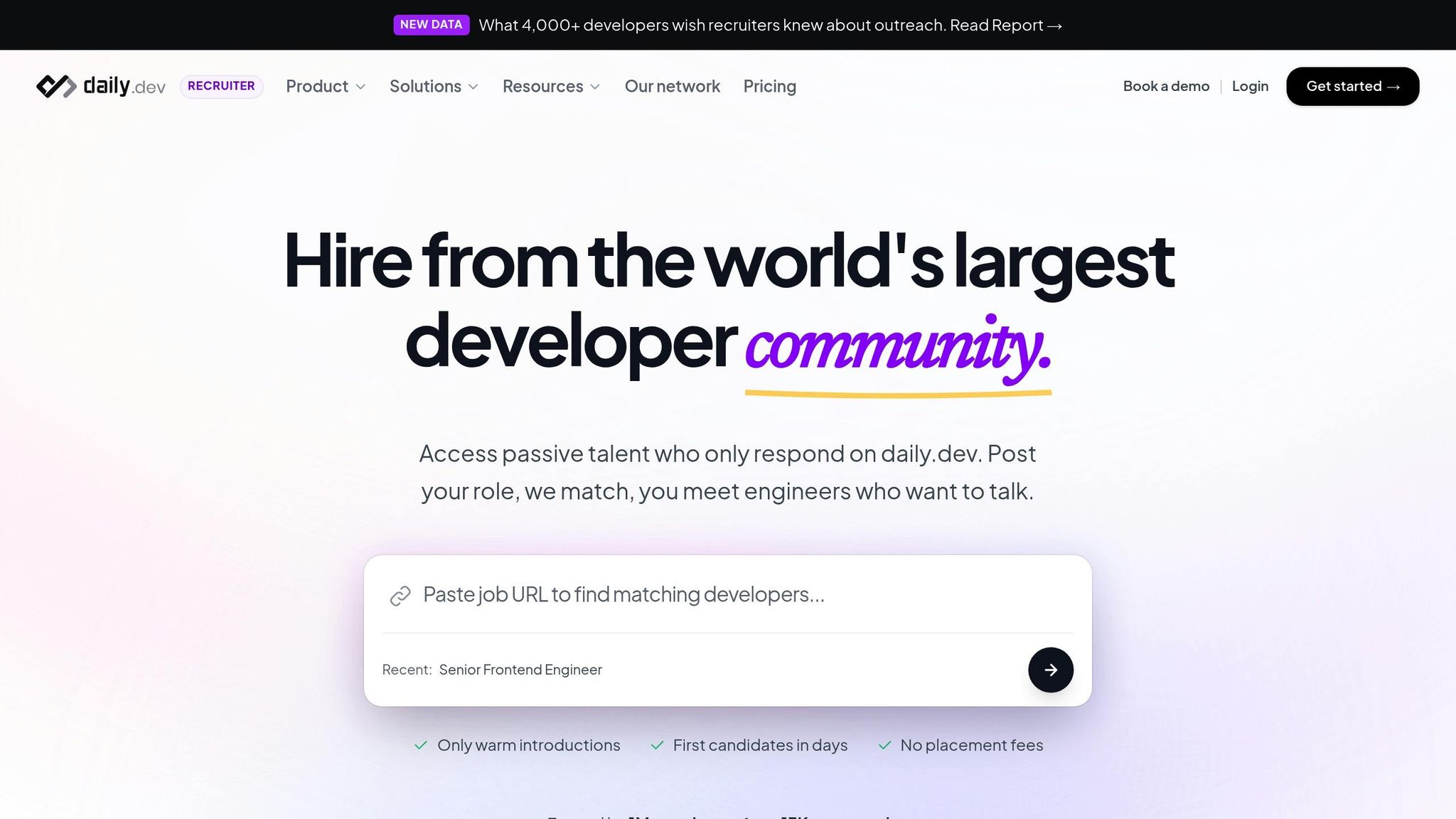
daily.dev Recruiter acts as a sourcing and screening layer on top of your ATS. It connects you with developers who are active on the daily.dev platform - people who are reading articles, engaging in discussions, and staying updated on industry trends. The platform ensures that every introduction is warm and double opt-in, meaning developers have already expressed interest in opportunities that align with their preferences.
When a developer agrees to an introduction through daily.dev Recruiter, their profile, along with their engagement data, is automatically synced with your ATS. This means you're not just getting a resume - you’re also gaining insight into their current interests, technical expertise, and recent activity. Starting your pipeline with candidates who are genuinely interested in your roles eliminates the frustration of cold outreach and increases the likelihood of meaningful conversations.
API and Data Syncing
Modern integrations leverage REST APIs with secure authentication methods like OAuth 2.0 to ensure candidate data is protected during transfers. When daily.dev Recruiter integrates with your ATS, it maps critical fields - such as names, email addresses, and job titles - while standardizing terms so that "Jobs" in one system aligns with "Opportunities" in another. This prevents syncing errors that could disrupt your workflow.
To optimize performance, these integrations use delta syncs, which only update recently changed records instead of reloading the entire database. This reduces API strain and speeds up the process. Batch processing helps manage data transfer loads, while bi-directional syncing ensures any status updates in your ATS (like moving a candidate to "Interview Scheduled") are reflected back in your sourcing tool. This prevents redundant outreach to candidates already in your pipeline.
Before fully implementing an integration, it’s wise to test it in a single department first. This trial run helps identify potential issues, such as mismatched fields or authentication problems, so you can resolve them before rolling it out company-wide. This careful approach ensures a smoother transition for your entire recruiting team.
Example Tech Recruiting Stacks
When it comes to recruiting, the tools you choose should align with your hiring needs and team size. A solo recruiter managing a handful of roles doesn’t need the same setup as a large talent acquisition team. Below are examples of recruiting stacks tailored to different team sizes, showing how organizations can build efficient workflows.
Solo Recruiter Stack
If you’re a one-person team or hiring for just a few roles each quarter, simplicity and cost-efficiency are key. Start with a free or budget-friendly ATS like Breezy HR to keep track of candidates and monitor their progress. For sourcing, leverage free tools like GitHub’s search feature alongside platforms like daily.dev Recruiter, which connects you with developers already interested in new opportunities. Since sourcing can take 7–10 days within a typical 3- to 4-week hiring cycle, tools that offer warm introductions can save you time on cold outreach.
For technical assessments, consider a basic plan from Coderbyte. It’s affordable while still providing essential screening capabilities. Together, these tools create a streamlined workflow: sourcing tools bring in qualified candidates, and your ATS organizes them throughout the hiring process. If you’re growing slightly, adding collaborative tools can help scale your efforts.
Small Team Stack
For teams managing 10–20 hires annually, collaboration and automation become more important. Upgrade to an ATS like Workable or Recruiterflow, which allows multiple team members to leave feedback, schedule interviews, and track candidates within a shared system. Use daily.dev Recruiter to build a pipeline of pre-qualified developers who are already interested in roles that match their skills.
To standardize technical evaluations, incorporate HackerRank’s starter plan. This ensures fair and objective candidate comparisons. If screening becomes overwhelming, adding an automated assessment tool can lighten the load. This stack shows how sourcing tools and ATS platforms work together: sourcing tools identify potential hires, while the ATS streamlines collaboration and decision-making within the team.
Enterprise Stack
For organizations hiring 50+ developers annually, a more robust stack is essential to handle compliance, reporting, and large-scale workflows. Start with enterprise-grade ATS platforms like Greenhouse or Lever to serve as your system of record. Enhance this with a CRM like Gem, Beamery, or Avature, which helps nurture long-term talent pipelines and engage passive candidates well in advance of job openings.
For high-volume sourcing, combine daily.dev Recruiter with advanced integrations for added reach. Use tools like Codility or CodeSignal for thorough technical assessments. To prevent bottlenecks in the interview process, consider platforms like Tenzo, which use AI to conduct structured screening interviews automatically. By 2026, many enterprise teams are adopting these "interview capacity platforms" to handle initial candidate conversations efficiently.
At this scale, every tool integrates into a cohesive ecosystem. Sourcing tools feed candidates into the ATS, which then coordinates with assessment and interview platforms to ensure candidates move seamlessly through the pipeline. This setup supports high-volume hiring without sacrificing quality or efficiency.
Building Your Own Tech Recruiting Stack
When putting together your tech recruiting stack, focus on solving your specific hiring challenges instead of grabbing every tool available. The goal is to address the pain points in your process. For instance, if you're losing candidates in messy spreadsheets, it's time to invest in an applicant tracking system (ATS). Struggling to attract qualified developers? Using developer sourcing tools might be the answer. And if technical screening is causing delays, an assessment platform can help speed things up and ensure consistency in evaluations .
Your ATS should act as the backbone of your recruiting stack. It handles workflows, compliance, and keeps candidates visible throughout the process - especially crucial if you're hiring more than just a handful of people each year . Once your ATS is in place, you can build on it by adding tools that address specific gaps. For example, if you need more candidates, a developer sourcing tool like daily.dev Recruiter can connect you with developers already open to opportunities. On the other hand, if technical assessments are slowing you down, integrate a platform that standardizes and streamlines evaluations.
Start small. If you're a solo recruiter hiring just a few developers annually, there's no need for a complex customer relationship management (CRM) system or enterprise-level assessment tools. The key is ensuring that whatever tools you choose can integrate easily with your ATS - whether through APIs or even simple CSV exports. This keeps your data flowing smoothly without the hassle of manual data entry.
As your hiring needs grow, your stack should evolve with it. What works for 10 hires might not cut it when you're scaling up to 50. You may need to upgrade your ATS, add collaboration features, or introduce tools designed for managing high-volume hiring. But the principle stays the same: tackle the bottlenecks first, and then expand your stack to support your growing needs. A well-designed stack simplifies hiring - it shouldn't make it more complicated.
This approach ensures your recruiting stack grows in a way that aligns with your needs, complementing earlier examples of effective setups.
Conclusion
When you align sourcing and recruiting software, your hiring process becomes smoother and more efficient. While recruiting software focuses on evaluating candidates once applications are submitted, sourcing tools actively discover and engage with passive talent. These tools serve different purposes, and confusing their roles can lead to fragmented systems, slow transitions, and missed hiring opportunities.
The most effective recruiting stacks position sourcing as a proactive top-of-funnel layer that works alongside your ATS. For example, daily.dev Recruiter identifies and engages developers, then seamlessly hands off qualified candidates to your ATS for evaluation. This integration bridges the gap between discovering talent and systematically assessing it. By addressing common inefficiencies in traditional hiring, such tools create a more streamlined process .
Whether you're a solo recruiter or part of a larger team, customizing your tech stack is key. Focus on solving your biggest challenges first. If finding skilled developers is your main hurdle, start with a sourcing tool. If manual workflows are slowing you down, prioritize an ATS. As your hiring needs grow, your stack should adapt - sourcing uncovers talent, recruiting evaluates it, and integration ensures a smooth workflow from start to finish.
Statistics highlight the impact of these tools: manual sourcing takes around 13 hours per role each week, and 86.1% of recruiters report faster hiring with AI-powered sourcing . Automated, double opt-in introductions save time, allowing recruiters to focus on building real connections and closing candidates. Ultimately, an integrated recruiting stack simplifies the hiring process, enabling faster, more meaningful interactions with candidates.
FAQs
Do I need an ATS before a developer sourcing tool?
An ATS is great for managing applicants, but it’s not designed to source passive developer talent effectively. That’s where developer sourcing tools, like daily.dev Recruiter, come into play. These tools actively identify potential candidates by analyzing their coding activity and online interactions. While they can function on their own, pairing them with an ATS can streamline workflows and improve data organization - especially useful as your hiring needs grow. The right choice depends on how much you’re recruiting and whether engaging talent proactively is a priority for your team.
How do sourcing tools verify developer skills without resumes?
Sourcing tools evaluate developer skills by focusing on tangible activity signals rather than relying on resumes. They analyze factors like open-source contributions, coding activity, and AI-powered skill assessments. This approach offers a direct insight into a candidate's practical, job-ready abilities, helping recruiters pinpoint qualified talent more effectively.
What should I integrate first in my tech recruiting tools stack?
The first step is to connect your applicant tracking system (ATS) with sourcing tools. This integration simplifies your hiring process by automating data entry, cutting down on repetitive tasks, and speeding things up overall. It also brings all candidate information into a single platform, making it much easier to handle a high volume of technical applicants.
By setting up this integration, you create a solid base for efficient sourcing - like reaching out to passive developer candidates - and leave room to add more specialized tools as your needs grow.
.png)