Recruiting developers on LinkedIn often falls flat. Why? Developers prefer platforms that showcase their skills and contributions, like GitHub, Stack Overflow, and niche communities, over static resumes and cold outreach. These platforms provide real-time insights into coding expertise and problem-solving abilities, making them more effective for technical hiring. Additionally, LinkedIn's generic messages and lack of technical depth frustrate developers, with only 5% trusting LinkedIn InMail.
Key Takeaways:
- GitHub: Access 65M users and evaluate real-time code contributions.
- Stack Overflow: Engage with 14M developers and analyze problem-solving styles.
- Coding Platforms: Use tools like HackerRank or LeetCode to identify top performers.
- Developer Communities: Reddit, Dev.to, and others help build trust through meaningful interactions.
- Events & Meetups: Build connections through face-to-face engagement at conferences and hackathons.
- daily.dev Recruiter: A platform with behavioral matching and double opt-in ensures higher response rates (85–90%).
Switching from LinkedIn to these alternatives not only saves costs but also improves hiring outcomes. Start by testing one platform for a role and track metrics like response rates and candidate quality.
::: @figure 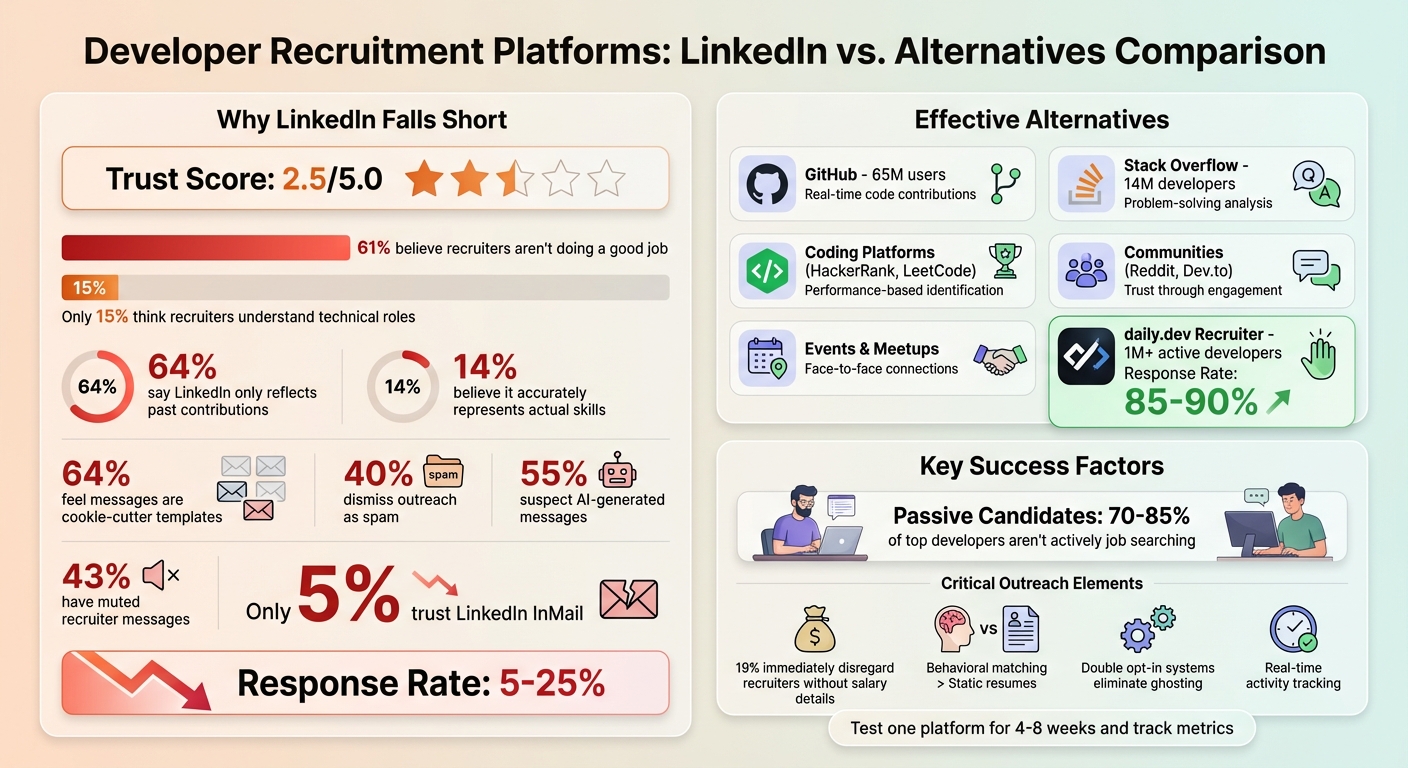 {LinkedIn vs Alternative Developer Recruitment Platforms Comparison}
Why LinkedIn Doesn't Work Well for Developer Recruitment
Recruiters don't exactly have the best reputation among developers. In fact, developers rate recruiters with an average trust score of just 2.5 out of 5.0. A significant 61% believe recruiters aren't doing a good job, and only 15% think recruiters truly understand the technical roles they're trying to fill.
One of LinkedIn's major flaws is its focus on past job titles and buzzwords rather than current skills or potential. Sixty-four percent of developers feel that LinkedIn only reflects their past contributions, while a mere 14% believe the platform accurately represents their actual skills. This gap makes it tough for recruiters to identify candidates with the niche technical expertise they need. Without dynamic, up-to-date signals about a developer's capabilities, LinkedIn profiles often fail to provide the depth needed for informed hiring decisions. The result? Outreach that feels generic and disconnected.
Another challenge is the sheer volume of recruiter messages on LinkedIn. Developers are inundated with outreach, and it shows: 64% of them feel these messages are cookie-cutter templates, 40% dismiss them outright as spam, and 55% suspect they're generated by AI. It's no wonder 43% of developers have muted recruiter messages on professional platforms. Trust in LinkedIn InMail is also abysmally low, with only 5% of developers placing any faith in it. Add to this the technical mismatches in communication, and the problem only grows.
For instance, recruiters often confuse programming languages like Java and JavaScript or fail to distinguish between roles such as "senior" and "lead." These errors damage credibility. On top of that, 19% of developers say they'll immediately disregard a recruiter if salary details aren't included upfront.
At its core, LinkedIn wasn't built with technical hiring in mind. While it works well as a broad professional network, it struggles to highlight the real-time, code-based signals that matter in the tech world - things like active coding contributions, problem-solving approaches, or evidence of continuous learning. These are the qualities that truly define technical talent, and LinkedIn simply doesn't deliver them. Instead, teams are turning to data-driven methods to identify qualified technical candidates more efficiently.
Other Ways to Find and Hire Developers
When LinkedIn falls short, other platforms can provide a clearer picture of a developer's current skills and expertise. These platforms let you see what developers are actively working on, offering insights that outdated resumes often miss. Here’s how to tap into these resources effectively.
Using Developer Communities and Forums
GitHub is like a living portfolio. By exploring a developer's repositories and contributions, you can evaluate their coding skills in real time. Pay attention to original projects and consistent activity in their contribution history to gauge engagement and expertise.
Stack Overflow serves as a knowledge-sharing hub where reputation points and badges reflect a developer's standing in the community. When reaching out, reference specific answers or discussions they’ve contributed to - it shows you’re genuinely interested in their work. Be upfront about your company, the role, and why their skills are a good fit.
Reddit has specialized subreddits like r/MachineLearning or r/rust where talented developers often share insights. To build credibility, follow the 90/10 rule: focus 90% of your activity on contributing valuable content and limit recruitment efforts to 10%. This approach fosters trust within the community.
Platforms like Dev.to, Hashnode, and Hacker News attract developers who write technical articles and engage in thoughtful discussions. These spaces are often frequented by experienced engineers, many of whom aren’t actively job hunting but might be open to the right opportunity. Start by contributing to the conversation to build trust before initiating recruitment. Always be transparent about key details like salary, tech stack, and the challenges of the role - it goes a long way in establishing credibility.
Using Coding Platforms to Find Talent
Platforms dedicated to coding challenges and competitions, such as HackerRank, LeetCode, or Codewars, are excellent for spotting skilled developers. These platforms highlight problem-solving abilities and coding proficiency, giving you a chance to identify top talent based on their performance in real-world scenarios.
Meeting Developers at Events and Meetups
While online platforms provide technical insights, in-person events offer the chance to build trust through face-to-face interactions.
Conferences, hackathons, and meetups are ideal for connecting with developers in their element. These settings allow for natural conversations that feel more genuine than cold outreach. When attending, make it clear you’re there to hire - simple gestures like role-specific badges or clear introductions can help avoid any confusion.
Rather than focusing solely on collecting resumes, engage in meaningful discussions about their projects, technologies, and challenges. Listening more than pitching can lead to valuable connections that might not pay off immediately but could be instrumental down the line.
For event organizers, using color-coded badges or icons to distinguish speakers, sponsors, and hiring representatives makes networking smoother. It helps attendees identify who to approach, setting the stage for more productive conversations.
The true value of these events lies in the relationships you cultivate. A developer you meet today might not be looking for a job, but when the time comes, that established trust can make all the difference.
Building Relationships with Developers Who Aren't Job Searching
Most top-tier developers aren’t actively scouring job boards. In fact, around 70–85% of them fall into the "passive candidate" category - they’re happily employed but might be intrigued by the right opportunity. That’s why building relationships is your secret weapon.
Instead of diving straight into a job pitch, focus on creating meaningful, long-term connections. Platforms like GitHub and Stack Overflow are perfect for this. Take the time to explore a developer’s public repositories, see how they contribute to projects, or check out their high-ranking answers in areas like AI/ML or Rust. These details can spark personalized and thoughtful conversations.
When you do reach out, lead with value. Share a technical article that aligns with their interests, acknowledge their recent contributions, or even offer a solution to a problem they’ve been tackling. Avoid generic, cookie-cutter messages - they’re usually met with silence.
To keep the relationship alive, engage consistently and respectfully. Celebrate milestones like project completions or new certifications with a genuine note of congratulations. Sponsoring events like meetups or supporting open-source projects related to your tech stack can also enhance your credibility. The aim here isn’t to make an instant hire but to nurture trust over time.
Using permission-based systems can take your efforts a step further. Platforms that facilitate double opt-in introductions ensure that every interaction begins with mutual agreement. This approach not only respects a developer’s time but also increases the chances of a positive response.
Hiring engineers?
Connect with developers where they actually hang out. No cold outreach, just real conversations.
How daily.dev Recruiter Changes Developer Hiring
daily.dev Recruiter reimagines the hiring process by meeting developers where they already are - within a thriving community of over 1 million active developers. Instead of relying on cold outreach vs. warm intros, which often goes unanswered, this platform connects you with developers who are actively reading, learning, and honing their skills every day. This creates a more natural and respectful way to start conversations compared to traditional methods of recruitment.
The platform’s standout feature is its behavioral matching system, which focuses on what developers are doing in real time. Rather than relying on static resumes, it tracks activities like the articles they read, the tools they use, and the technologies they engage with. For example, if a developer is diving into GenAI or Rust documentation, it signals a clear interest in those areas - giving you actionable insights right away.
What truly sets daily.dev Recruiter apart is its double opt-in system. Both parties must agree before any conversation begins, eliminating ghosting and ensuring that only genuinely interested candidates are contacted. Thanks to this approach, reply rates soar to an impressive 85–90%, far surpassing the dismal response rates often seen with cold outreach.
Another advantage is the seamless integration with popular ATS tools like Greenhouse, Lever, and Ashby. This means introductions sync automatically, saving you the hassle of manual data entry. You can also add up to three custom screening questions during the pitch phase to confirm technical alignment before scheduling a call. This allows you to assess technical skills without coding tests by focusing on real-world experience. And with no placement fees or long-term contracts, daily.dev Recruiter offers a straightforward, efficient way to connect with active, skilled developers who are open to new opportunities. Together, these features create a recruitment process that’s smarter, faster, and more effective.
Conclusion
Relying only on LinkedIn for recruiting developers is no longer effective. Today, recruitment teams connect with developers through coding platforms, technical forums, and industry events, focusing on genuine, relationship-driven outreach. Static resumes and bulk InMails just don’t cut it anymore. Instead, prioritize platforms that showcase real-time activity and technical contributions - like exploring GitHub projects, interacting with Stack Overflow users, or engaging in niche developer communities. The key is building trust and showing authentic interest in a developer's work.
A great example of this shift is daily.dev Recruiter, which uses behavioral matching alongside a respectful, double opt-in system. This approach leads to reply rates of 85–90%, compared to LinkedIn’s typical 5–25% response rates . By targeting developers who are actively learning and contributing, you’re not just filling positions faster - you’re fostering meaningful relationships with candidates who are genuinely interested in the opportunity.
To get started, try using an alternative platform for one or two roles over 4–8 weeks. Track metrics like response rates, time-to-hire, and candidate quality. Modern developer recruitment is about smarter strategies that align with how developers actually engage today.
FAQs
How can GitHub and Stack Overflow help recruiters find top developer talent?
GitHub and Stack Overflow offer recruiters a unique lens into a developer's abilities, going far beyond what a resume can show.
On GitHub, recruiters can dive into a candidate's code contributions, repositories, and overall project activity. This gives a clear picture of their technical skills, how they collaborate with others, and their approach to solving problems. It’s like seeing a portfolio of real-world work, offering insight into the developer’s capabilities in action.
Stack Overflow, on the other hand, showcases a developer’s ability to share knowledge and solve problems within a community. By reviewing their questions, answers, and engagement on the platform, recruiters can gauge their expertise and how they contribute to the tech community. It’s also a great way to identify passive candidates - those who may not be actively job hunting but are clearly passionate and deeply involved in their field.
Together, these platforms allow recruiters to connect with talent on a deeper level, offering a more authentic and meaningful way to evaluate potential hires compared to traditional methods.
Why isn’t LinkedIn as effective for hiring developers?
LinkedIn often misses the mark when it comes to attracting developers because it doesn't align with how they prefer to showcase their skills or engage with others. Developers are more drawn to platforms like GitHub and Stack Overflow, where they can actively demonstrate their expertise through code contributions, problem-solving, and discussions. These platforms highlight their real-world skills far better than static resumes or LinkedIn profiles ever could.
Traditional LinkedIn outreach methods - like cold messages or generic InMails - tend to fall flat. Developers generally find these approaches impersonal and uninspiring. They’re more likely to respond to personalized, community-focused interactions that feel genuine. On top of that, LinkedIn profiles are often outdated or fail to provide a detailed picture of a developer’s current skill set or professional activity.
Recruitment strategies today are shifting toward platforms that offer a clearer, more dynamic view of a developer's abilities and involvement. These approaches help foster trust and make it easier to form meaningful connections.
What are the advantages of using a double opt-in process in recruitment?
A double opt-in process can make a big difference in recruitment by boosting candidate engagement, building trust, and ensuring accurate data. Here’s how it works: candidates express interest initially, then confirm their intent through a follow-up email. This extra step ensures that only those genuinely interested move forward, creating a talent pool of more committed and qualified individuals. It also saves time by filtering out those who aren’t truly engaged.
On top of that, this approach strengthens trust. By giving candidates control over their participation, it demonstrates respect for their consent and aligns with data privacy standards. This not only reduces spam complaints but also improves the chances of your communications being delivered successfully. In short, it’s a smart way to build a transparent, professional connection with potential hires while staying competitive in today’s job market.
.png)