Recruiting developers today means navigating a landscape flooded with impersonal and irrelevant outreach. Generic messages and excessive follow-ups not only alienate candidates but also harm your company's reputation. To stand out and build genuine connections, focus on these key strategies:
- Personalize Outreach: Reference specific achievements or projects to boost response rates by 47%.
- Limit Follow-Ups: Cap sequences at four emails to avoid overwhelming candidates and damaging your sender reputation.
- Measure Quality, Not Quantity: Track meaningful conversations and optimize recruitment funnel conversion rates instead of just message volume.
- Use Opt-In Channels: Build talent pools through referrals, content engagement, and developer-focused platforms like GitHub.
- Be Transparent: Include salary details, role specifics, and perks to help candidates quickly assess opportunities.
Identify Spam Behaviors in Tech Recruiting
How Volume-Driven Outreach Damages Your Brand
Every message you send has the potential to either strengthen or weaken your brand. When your outreach feels irrelevant, overly templated, or part of a mass email blast, it chips away at your employer brand . The tech community, in particular, has been so inundated with these types of messages that many developers have become adept at tuning recruiters out entirely. Osman (Ozzie) Osman, author of The Holloway Guide to Technical Recruiting and Hiring, highlights this issue:
"Every time you reach out to a candidate you are consuming some of your company's brand equity. Unsolicited messaging is always a potential unwarranted interruption" .
This overexposure has led many technical candidates to develop what recruiters often call "bullshit detectors." As a result, they’re increasingly less likely to respond to recruiters and instead prefer direct engagement with hiring managers. Below, we’ll explore the specific behaviors developers commonly label as spam.
What Developers Consider Spam
Developers have identified several behaviors that immediately signal spam. One of the most common offenders is irrelevant targeting - reaching out about roles that don’t align with a candidate’s skills, location, or career stage . Technical recruiter Ionut Roghina explains:
"If the subject line is generic and doesn't mention relevant things such as your location, the technologies that are relevant to you or something very interesting, the details in the email will probably be the same" .
Another red flag is the omission of salary details, which often gives the impression of a "salesy" approach and discourages candidates from engaging . Excessive follow-ups can also backfire. While a four-stage email sequence can double response rates compared to a single email - with engagement typically plateauing after the fourth email - pushing beyond that risks damaging your sender reputation and even triggering spam filters .
Personalization is key, but it must go beyond surface-level efforts. Simply inserting a candidate’s name or current company into a message isn’t enough. Instead, referencing specific achievements, projects, or promotions can boost response rates by 47% .
Measure Pipeline Health by Quality, Not Volume
::: @figure 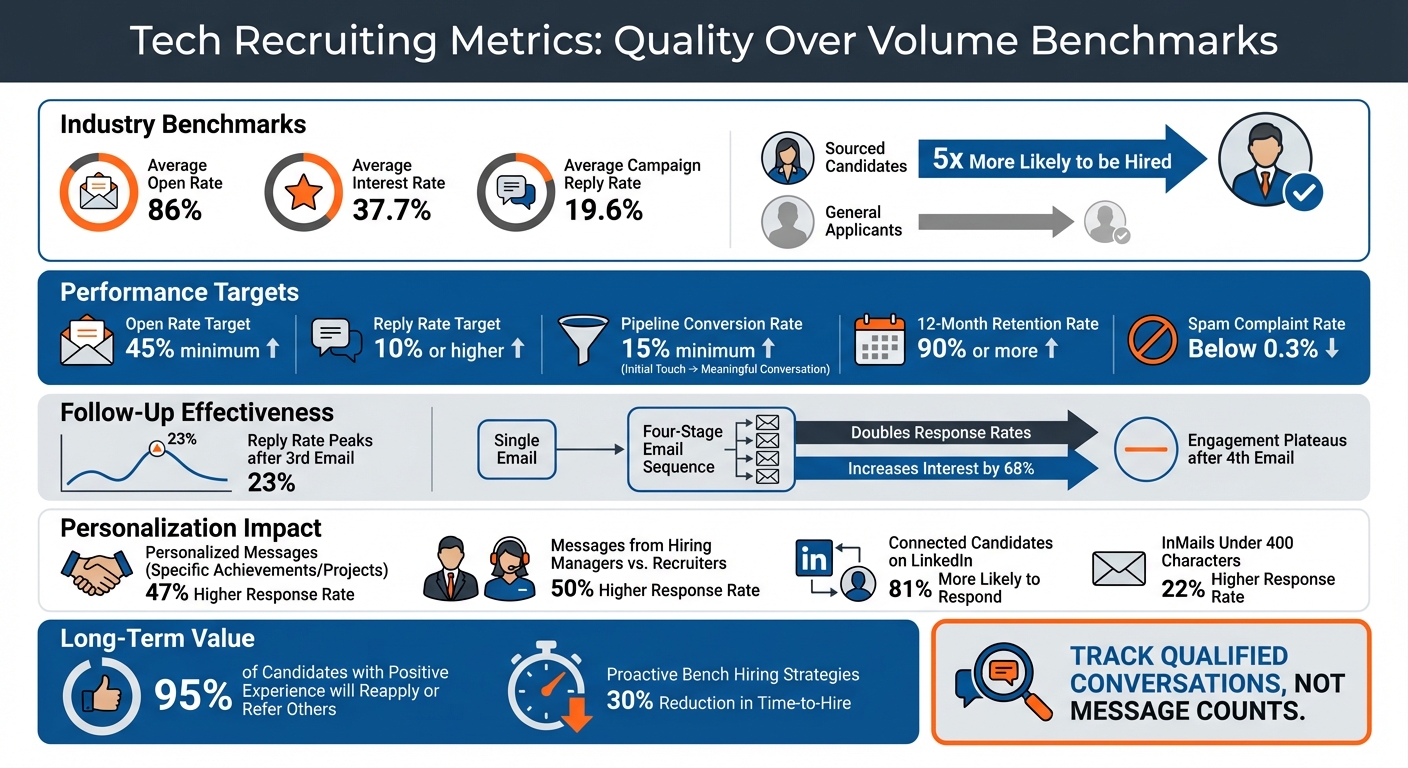 {Tech Recruiting Metrics: Quality Over Volume Benchmarks}
Track Qualified Conversations Instead of Message Counts
Counting the total number of messages, InMails, or sequences sent doesn’t give a clear picture of recruitment quality. Instead, the focus should be on meaningful, qualified candidate responses. For reference, industry benchmarks show an average campaign reply rate of 19.6% . Simply measuring success by volume can lead to overlooking replies that are just polite declines.
To truly assess pipeline health, track conversion rates - monitor how candidates move from initial outreach to engaged conversations and, ultimately, to being qualified. As Sonya Yeonas explains:
"We analyze sourcing activity through our Ashby dashboards with reply rates, passthrough rates for sourced candidates, sequences sent weekly, time to fill, and conversion rates overall" (using a hiring timeline planner can help optimize these stages) .
Set clear performance benchmarks to maintain quality. Aim for an open rate of at least 45%, a reply rate of 10% or higher, and a pipeline conversion rate (from initial touch to meaningful conversation) of at least 15% . To ensure long-term success, track the 12-month retention rate of sourced hires - targeting 90% or more. These metrics help shift the focus from quantity to quality, laying the groundwork for more disciplined outreach.
Set Minimum Standards for Outreach
To build trust with candidates, establish clear standards for outreach messages. Every message should answer three key questions: Why this candidate? Why this job? Why now? . If you can’t clearly address all three, it’s better not to send the message.
Keep follow-up sequences concise and limited. Research shows reply rates peak around 23% after the third email, with little improvement after the fourth touchpoint . Angela Miller highlights the importance of disciplined follow-ups:
"The difference between a great sourcer and a sub-par sourcer is in how much discipline someone has in following up... Response rates on that initial outreach might be 15%, but they might be 50% on the follow-up" .
Overdoing follow-ups not only hurts your sender reputation but also risks triggering spam filters without adding value.
When crafting initial messages, aim for brevity - stick to 101–150 words and avoid including the full job description . As Chinsin Sim points out:
"I'm definitely in the shorter-is-better camp... The essential thing is to make sure you're always adding value for the candidate, whether it's in 20 words or 200 words" .
Be transparent by including details like the salary range and highlighting specific perks, such as remote work options or career growth opportunities. These specifics make it easier for candidates to quickly evaluate whether the opportunity aligns with their goals.
Create a System to Reduce Spam
Improve Targeting and Relevance
Before reaching out to candidates, take the time to align with hiring managers. Work together to craft detailed candidate profiles that go beyond technical skills. Include traits like problem-solving methods or communication styles to ensure everyone agrees on what makes a candidate a good fit. This step helps avoid sending messages to people who aren’t likely to match the role.
Focus your efforts on specialized platforms like GitHub for developers, Kaggle for data scientists, or Dribbble for designers. These communities showcase candidates' work, making it easier to personalize your outreach. When you do contact someone, use language that centers on the candidate and highlights why their background stands out. For example, referencing a recent open-source project or a technical blog they wrote can make your message more meaningful. Messages that include these specific "reason" tokens see a 47% higher response rate .
Segment candidates based on their likelihood to engage. For instance, someone who has been in their current role for 2.5 years (out of an average three-year tenure) might be more open to new opportunities than someone who just started a new job. This kind of data-driven approach ensures you’re reaching out at the right time.
For high-priority roles, consider using "Send on Behalf Of" (SOBO) emails. Sending messages from a hiring manager or executive rather than a recruiter can boost response rates by 50% . Joe Gillespie from OpenAI shares:
"We use SOBO very intentionally for things like leadership hires and key individual contributors... The efficiency we've achieved with the SOBO feature is fantastic" .
By focusing on precise targeting, you’ll create a stronger pipeline that prioritizes quality over quantity. Once your targeting is refined, adjust your follow-up strategy to respect candidates’ preferences.
Limit Follow-Ups and Honor Candidate Preferences
Keep your outreach sequences to a maximum of four messages. Engagement typically drops after the fourth attempt, and overdoing it can harm your brand . In fact, a well-structured four-stage sequence can double reply rates and increase interest by nearly 68% compared to one-off emails .
Space out your follow-ups thoughtfully. For active recruitment, wait a week after the initial message before following up, and then check back two months later if needed. For longer-term engagement, sending updates every three to four weeks keeps you on the radar without overwhelming the recipient .
Always make it easy for candidates to opt out or pause communication. Include a simple line in your messages like, "Not interested? Just reply 'no thanks,' and I'll remove you from my list", or "Want to pause outreach for six months? Let me know." Respecting these preferences builds trust and protects your sender reputation.
Even if you use automated tools, balance them with personal touches. Schedule a one-on-one check-in from a recruiter at least once a quarter to show candidates they’re more than just names on a list .
By capping follow-ups and respecting boundaries, you uphold ethical recruitment practices that enhance both the candidate experience and your employer brand.
Write Transparent Messages
Start your messages with the candidate in mind, skipping generic phrases like "Hope you're well." Instead, lead with a specific observation, such as: "It looks like you’ve been focusing on scaling distributed systems - that’s exactly the kind of challenge we’re tackling on our new infrastructure team."
Keep your messages short. InMails under 400 characters tend to get 22% higher response rates . As Chinsin Sim from Anthropic explains:
"I'm definitely in the shorter-is-better camp. Of course, the shorter the message, the more compelling its words need to be. The essential thing is to make sure you're always adding value for the candidate" .
Be upfront about key details like the role title, tech stack, salary range (or an approximate figure), and whether remote work is an option. This transparency helps candidates quickly decide if the role aligns with their goals. End with a clear call-to-action, such as: "Are you available for a 15-minute call tomorrow at 2:00 PM or Monday at 10:00 AM?" Offering specific options reduces decision fatigue and makes it easier for candidates to respond.
Move to Opt-In Channels
Why Opt-In Talent Pools Work Better
Cold outreach often feels rushed and impersonal, focusing on filling roles as quickly as possible. Opt-in channels take a completely different approach. Instead of chasing after strangers, you create a dynamic pipeline of developers who have already expressed interest in your company or community .
Here’s the thing: candidates who follow your company on LinkedIn or are connected with your team are up to 81% more likely to respond . Developers who’ve engaged with your content, joined your Slack group, or attended one of your technical meetups already have a sense of your brand. That means future conversations feel more natural - like reconnecting with a colleague, not dodging a pushy sales pitch .
Referrals work in a similar way. When employees recommend someone from their network, they’re often suggesting candidates who align better with your company’s culture and are more likely to stay long-term . To encourage these referrals, consider offering meaningful rewards - extra vacation days or public recognition often resonate more than cash incentives . The results speak for themselves: sourced candidates are five times more likely to be hired than general applicants . Even better, 95% of candidates who have a positive experience are likely to reapply or refer others, regardless of whether they’re hired . This proactive approach not only improves immediate engagement but also strengthens your talent pipeline over time.
To make the most of these opt-in talent pools, segment candidates by seniority, tech stack, and availability. This allows you to tailor your outreach for maximum relevance . Use engagement metrics - like email opens, clicks, and replies - to identify the most interested candidates when a role becomes available . Keep these connections warm with quarterly check-ins and by sharing non-recruitment content, such as technical articles or open-source project highlights . As Index.dev puts it, "You can't out-spend Big Tech, but you can out-nurture them" .
With this strategy as your base, leveraging platforms designed specifically for developers can take your efforts to the next level.
Use Platforms Built for Developers
General job boards can feel crowded and impersonal. developer sourcing channels - like GitHub, Stack Overflow, or Kaggle - offer a more targeted way to connect with candidates where they’re already active .
For example, daily.dev Recruiter stands out as the only platform built directly on a developer network. It connects you with engineers who are actively engaging with content every day. Every introduction is warm and double opt-in, meaning developers have already shown interest. This approach removes the guesswork: candidates are pre-qualified based on your criteria, and because they’ve opted in, response rates are much higher than traditional outreach.
Instead of risking your brand reputation with spammy tactics, you’re building genuine relationships with developers who are open to the right opportunities. It’s not about sending mass messages - it’s about thoughtful matchmaking. And it works because it respects the candidate’s time and preferences from the very start.
Track and Improve Your Anti-Spam Approach
Monitor Outreach and Engagement Metrics
Keeping an eye on the right metrics is key to maintaining a strong outreach pipeline. Start with the campaign reply rate - this is the percentage of candidates who respond to any email in your sequence. For technical roles, the average reply rate hovers around 19.4% . If your rate is significantly lower, it might be a sign that your outreach feels irrelevant or too pushy.
But reply rate alone doesn’t paint the full picture. Pay attention to your interest rate - the percentage of replies that show genuine interest, which averages 37.7% . Also, keep tabs on your spam complaint rate, which should stay below 0.3% to protect your sender reputation .
Another helpful metric is the open-to-reply rate. If your emails have high open rates (around 86% on average ) but few replies, it might mean your subject lines are working, but the content of your message isn’t connecting. Finally, track candidate engagement over the long term - six to twelve months - to understand how responsive they remain. These metrics will guide the improvements we’ll discuss next.
Test and Refine Your Approach
A/B testing is a powerful way to figure out what works best in your outreach. For example, in late 2024, Jaime Onofre, a Recruiting Manager at Zapier, ran an A/B test comparing short, concise messages with longer ones that detailed team challenges and impact. The longer messages had fewer opens and replies overall, but the replies they did get were more meaningful. As Onofre explained:
"I had fewer opens and replies on the long [message], but more candidates replied with interest. So dive into your own metrics to figure out what works for you" .
You can also experiment with follow-up timing and who sends the messages. For instance, emails sent by a hiring manager can improve reply rates by 50% or more . Limit your outreach sequences to four emails, as engagement tends to drop off after that point . Testing and refining your strategies not only improves your results but also ensures your methods align with ethical recruiting practices.
Adopt Ethical Recruiting Standards
Ethical recruiting isn’t just about filling roles - it’s about creating a positive experience that reflects well on your employer brand. To do this, make sure your outreach is respectful and low-pressure. Instead of asking for resumes or applications in your first message , consider requesting permission to share more information or inviting candidates to a quick introductory chat.
Tailor your candidate relationship management (CRM) system by factors like seniority, skill set, and availability - whether someone is ready to move immediately or might be open to opportunities in six to twelve months . This keeps your outreach relevant and avoids coming across as spammy. While automation can help you scale your efforts, it’s crucial to have a real recruiter check in personally at least once a quarter to maintain a human connection .
Go beyond job pitches by sharing technical insights, inviting candidates to relevant communities, or offering open-source contributions. These gestures build trust and show you value them as more than just potential hires . Remember, 95% of candidates who have a positive experience are more likely to reapply or refer others, even if they don’t get the job . Every interaction should be seen as an opportunity to strengthen your employer brand, not just a step in the hiring process.
Conclusion
Reducing spam in tech recruiting isn’t about cutting down on the number of messages - it’s about making those messages count. By prioritizing relevance, respecting candidate preferences, and using opt-in communication channels, you not only protect your brand but also improve your hiring efficiency. Companies that shift to proactive bench hiring strategies can see a 30% reduction in time-to-hire .
This approach - focusing on quality rather than sheer volume - offers a clear edge. As Index.dev aptly says: "You can't out-spend Big Tech, but you can out-nurture them" . Thoughtful and well-crafted outreach builds trust with developers, even those who may not be looking to make a move right away. That trust becomes an investment that pays dividends over time.
Metrics are key to ensuring this quality-first approach works. Keep an eye on reply rates, engagement levels, and the strength of long-term relationships. Experiment with your outreach strategies, leverage AI-driven personalization where it fits, and always pause to ask yourself, "Would I send this to someone I know?" If the answer is no, it’s time to rethink your message.
FAQs
How can personalized outreach help improve response rates in tech recruiting?
Personalized outreach can significantly boost response rates by showing candidates that you’ve taken the time to understand their unique background and interests. Mentioning specific details - like a recent project they worked on, a publication they authored, or an open-source contribution they made - helps your message stand out as thoughtful and relevant, rather than just another generic email.
To make your outreach more impactful, focus on these three steps:
- Do your homework: Research the candidate’s work, achievements, or interests.
- Make it personal: Use these insights in your subject line and opening paragraph to immediately grab their attention.
- Be clear and concise: Keep your message short, while clearly explaining why the role aligns with their skills and goals.
This tailored approach doesn’t just improve response rates - it also leads to more meaningful conversations and builds a stronger, more engaged hiring pipeline.
Why should follow-up emails in recruiting be limited?
Limiting the number of follow-up emails is crucial to ensure you don't appear spammy, which can hurt your reputation and erode trust with candidates. Sending too many follow-ups can also negatively impact your email deliverability, making it harder for your messages to reach the intended recipients down the line.
A better strategy is to focus on sending fewer, more targeted emails that are both relevant and considerate of the candidate's time. This not only boosts your chances of getting a response but also leaves a positive impression of your company.
What are the advantages of using opt-in channels to build a talent pool?
Opt-in channels are a game-changer when it comes to building a talent pool. They bring together candidates who have actively shown interest, paving the way for more meaningful conversations and fostering trust. Whether it's through talent communities, referral programs, or platforms tailored for developers, these candidates have already signaled their willingness to engage. This makes your outreach feel personalized and far from the usual spam.
The benefits? Higher response and engagement rates, fewer complaints, and a significant drop in unsubscribes. Over time, nurturing these connections allows you to cultivate a reliable talent pool that you can tap into again and again - without resorting to cold outreach. In today’s competitive hiring landscape, opt-in channels provide a steady stream of qualified candidates while ensuring a positive experience for them and safeguarding your employer brand.
.png)