The way companies hire remote developers has transformed significantly by 2026. Here's what you need to know:
- Remote Work Dominates: 58% of developers now work fully remote, with startups and mid-sized companies leading the remote-first approach, while large enterprises lean toward hybrid models.
- Developer Expectations: Flexibility is non-negotiable for most developers, with 85% prioritizing remote work in job searches. Many are willing to accept lower pay for flexibility.
- Hiring Trends: Companies are adopting "Geographic Arbitrage with Quality Parity", hiring top talent from regions like Latin America and Eastern Europe to balance costs and quality.
- AI's Role: AI tools have reshaped hiring and work processes, with a 20–35% productivity boost, shifting focus from junior roles to AI-augmented specialists.
- Challenges: Legal and compliance hurdles for cross-border hiring are growing, with local labor laws, tax rules, and data privacy regulations requiring careful navigation.
- Retention: Onboarding quality and meaningful work are key to retaining talent, with 67% of retention influenced by the first week of onboarding.
Quick Overview:
- Cost Savings: Remote hiring saves up to 60% on costs by tapping into global talent markets.
- Salary Trends: Senior U.S. developers earn $120–$180/hr, while Latin American counterparts earn $50–$70/hr.
- Tools: Asynchronous platforms like Loom and Notion simplify processes, while Employer of Record (EOR) services handle compliance.
Following a comprehensive guide to hiring remote developers ensures you navigate these shifts effectively. Remote hiring requires clear communication, streamlined onboarding, and flexible work policies to attract and retain top talent.
Remote Developer Hiring in 2026: Current State
Return-to-Office Backlash and What Developers Want
The return-to-office mandates that dominated 2023 and 2024 left a noticeable impact on the developer job market. By 2026, companies have had to rethink their best practices for hiring remote technical talent due to the backlash these policies created. One striking example? A staggering 73% of Amazon employees said they considered quitting because of strict return-to-office policies . Companies enforcing in-office requirements now face a 23% longer time to fill open roles and a 17% drop in overall hiring rates .
Why such resistance? The costs - both financial and personal - are hard to ignore. Working in an office adds an estimated $12,240 annually to expenses like commuting and meals, while remote workers save about $7,000 per year . On top of that, the average daily commute for developers eats up 54 minutes, with 73% of that time being reinvested into work when remote . Beyond saving money and time, remote work significantly reduces stress, with 79% of remote professionals reporting lower stress levels .
"Remote work isn't going away. It's stabilizing. The hype of 2021 is gone. The return-to-office panic of 2024 is fading. We're settling into a new normal." - Даниил Корнилов, iOS Developer
The shift in worker priorities is clear: 85% of employees now consider remote work their top factor when job hunting, and 64% would actively look for a new job if flexibility disappeared . Interestingly, 69% of workers are willing to accept lower salaries in exchange for remote options - an 11% increase from 2024 . These changing attitudes are reflected in the broader trends shaping the remote job market.
Remote Job Market Numbers for 2026
The effects of this shift are evident in the numbers. By late 2025, 22% of the U.S. workforce - roughly 32.6 million people - worked remotely . For software developers, the trend is even more pronounced, with 58% working fully remote . Companies offering remote roles can tap into a talent pool that's 340% larger than those limited by geography .
The financial benefits for companies embracing remote work are also compelling. Between 2020 and 2022, organizations with flexible work policies achieved 21% revenue growth, compared to just 5% for those sticking to in-office setups . Remote workers report being 24% more satisfied with their jobs , and employers see a 16% reduction in time-to-hire for technical roles (averaging 32 days) and a 13% increase in offer acceptance rates .
The market, however, has split into two approaches. Large enterprises and Big Tech companies have settled on hybrid work models, requiring employees to come into the office 2-3 days a week. Meanwhile, startups and mid-sized companies are doubling down on fully remote setups to attract top talent . This division gives developers more options to match their work preferences, enhancing their bargaining power.
AI Roles and Skills-Based Hiring Growth
As the market evolves, so do the skills companies look for in developers, with AI taking center stage. AI/ML and data science job postings surged by 163% in 2025, while broader AI-related roles saw an even more dramatic 283% increase . But it’s not just about new roles - AI tools are reshaping how developers work. These tools can boost productivity by 20-35%, meaning five AI-augmented developers can match the output of a much larger team . AI now handles up to 90% of boilerplate code, allowing developers to focus on higher-level tasks like architecture and security .
This shift is redefining the junior developer role. Instead of traditional entry-level positions, companies now seek AI-augmented specialists who can perform at a mid-level capacity right from the start . Hiring criteria have pivoted from raw coding ability to skills like auditing AI-generated code for security risks and ensuring alignment with architectural goals . With 70% of security breaches in 2026 originating at the endpoint, a cybersecurity-first mindset has become a must for remote developers .
The hiring process itself has transformed. Skills-based assessments have replaced traditional credential checks. Employers prioritize candidates who can handle complex APIs, maintain robust security protocols, and make strategic technical decisions . For remote roles, however, technical skills alone aren’t enough. Asynchronous communication skills now top the list. Developers must excel at writing clear documentation, crafting detailed pull requests, and communicating effectively without relying on real-time meetings . These abilities have become just as critical as technical expertise in today’s remote-first hiring landscape.
Hiring engineers?
Connect with developers where they actually hang out. No cold outreach, just real conversations.
How the Remote Hiring Funnel Changed
::: @figure 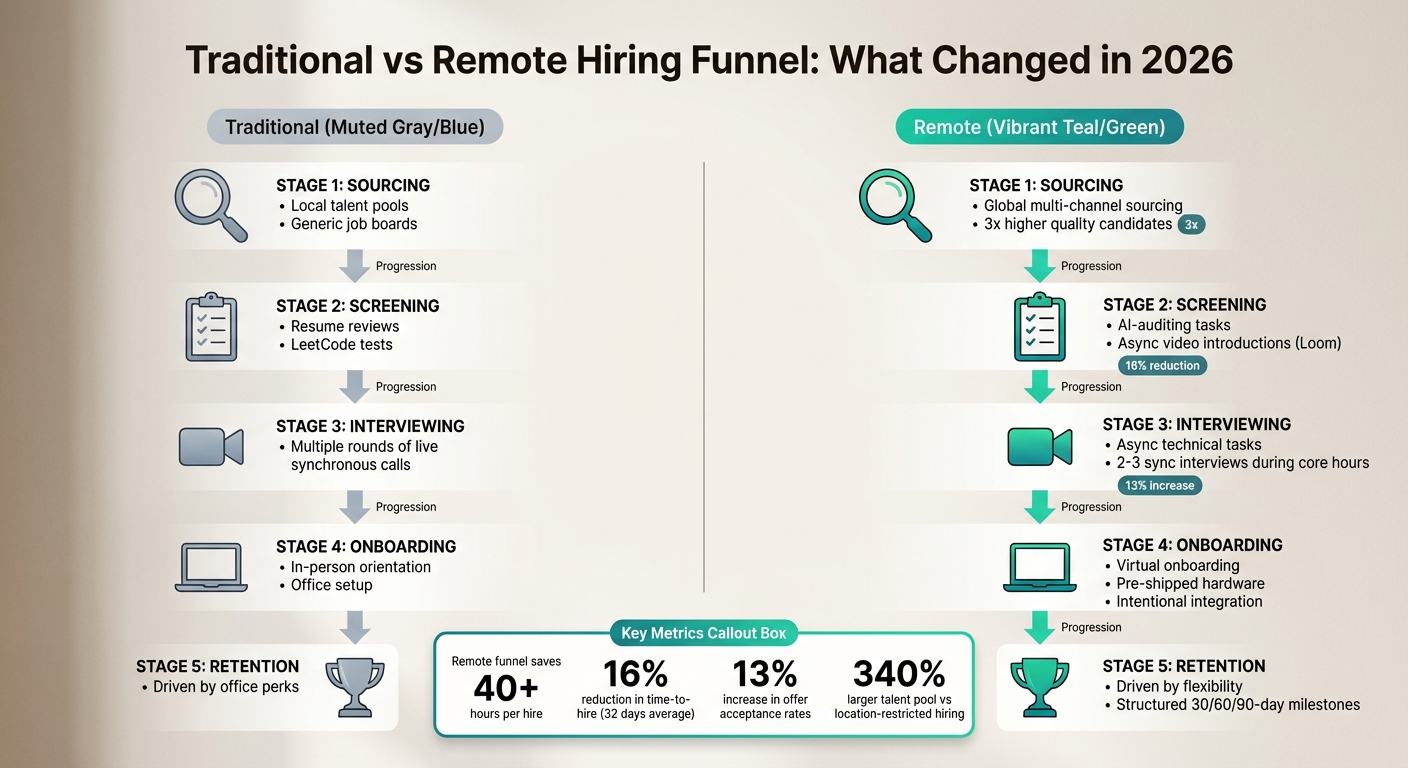 {Traditional vs Remote Developer Hiring Funnel Comparison 2026}
The hiring landscape for developers in 2026 looks nothing like it did a decade ago. Traditional methods - relying on local candidates and in-person interviews - have become outdated, especially for remote roles. Companies sticking to these old-school processes are losing out to competitors who’ve embraced change. Today’s hiring funnel is built around asynchronous communication, timezone flexibility, and purposeful virtual integration, reflecting a shift toward a global and results-driven approach.
This evolution isn’t just about making things easier. Using various developer sourcing channels, for example, brings in three times more high-quality candidates than posting on a single platform . On top of that, using async methods and pre-vetted platforms can save companies up to 40+ hours per hire .
Async Interviews and Managing Timezones
One of the biggest hurdles in remote hiring is scheduling. Picture this: your top candidate is in Poland, and your hiring manager is in California. Coordinating multiple live interviews across such time differences can feel impossible. Async interviews solve this by eliminating the need for real-time meetings.
The best hiring processes today focus on clear communication and problem-solving skills over how fast someone can code. Instead of live coding tests, companies often ask candidates to record a Loom video explaining their approach to a technical concept or how they’d audit AI-generated code . This approach evaluates what really matters: clarity in communication, the ability to spot security flaws, and architectural decision-making.
"The era of high-margin managed services where the client has no visibility into the developer's actual rate is ending. Modern hiring managers want to see the filters: hourly rates, minimum experience, and AI-literacy scores." - Softaims
Timezone management has also become more structured. Teams with 2–4 hours of overlap often operate primarily asynchronously, with just one weekly sync meeting. Those with 4+ hours of overlap can manage daily standups . To streamline the process, job descriptions now clearly state overlap requirements - like “10 AM to 2 PM EST” - so candidates know what’s expected upfront . And to respect candidates’ time, technical assessments are capped at 3–4 hours, focusing on real-world problem-solving .
Once the interview process is streamlined, the next step is ensuring a smooth virtual onboarding experience.
Virtual Onboarding for Remote Engineers
Onboarding is a make-or-break moment for remote engineers. In fact, 67% of long-term retention hinges on how the first week of onboarding is handled . Unlike in-office setups where new hires can pick up context through casual conversations, remote onboarding requires everything to be documented and thoughtfully planned .
A successful virtual onboarding process spans a 90-day framework, broken into three phases: "Learn and Orient" (Days 1–30), "Contribute and Grow" (Days 31–60), and "Own and Lead" (Days 61–90) . To set new hires up for success, companies ship all necessary hardware - like laptops and monitors - at least seven days before Day 1 . Preboarding tasks include setting up accounts (e.g., Slack, GitHub, Jira) so that by Day 3–5, the new hire can submit their first pull request .
The buddy system is another key innovation. Assigning a non-manager buddy gives new hires a go-to person for questions they might hesitate to ask their manager . Recorded walkthroughs of architectural designs via Loom ensure future hires can catch up asynchronously. It’s also critical to set clear expectations for communication - for example, “respond to Slack within 4 hours, emails within 24 hours” .
"Trust is the currency of a successful remote team. Empower developers to work when they're most productive." - Boundev Team
These updates have reshaped the hiring funnel entirely, as shown in the comparison below.
Traditional vs. Remote Hiring Funnels Compared
The differences between traditional and remote hiring are evident at every stage:
| Stage | Traditional Funnel | Remote Funnel |
|---|---|---|
| Sourcing | Local talent pools and generic job boards | Global, multi-channel sourcing (3x higher quality candidates) |
| Screening | Resume reviews and LeetCode tests | AI-auditing tasks and async video introductions (Loom) |
| Interviewing | Multiple rounds of live, synchronous calls | Async technical tasks + 2–3 sync interviews during core hours |
| Onboarding | In-person orientation and office setup | Virtual onboarding with pre-shipped hardware and intentional integration |
| Retention | Driven by office perks | Driven by flexibility and structured 30/60/90-day milestones |
The remote hiring funnel isn’t just quicker - it’s more effective. Measuring outcomes like Cycle Time, PR Throughput, and Code Quality Metrics beats monitoring whether someone is online at 9 AM . By setting 2–3 hours of mandatory core hours for collaboration and letting developers work when they’re most productive, companies are seeing better retention and productivity .
Legal and Compliance for Cross-Border Hiring
Once you've fine-tuned your remote hiring process, perhaps by using a tech candidate fit analyzer to score potential hires, the next major challenge is navigating the maze of legal and compliance requirements for cross-border hiring. Hiring a developer in Poland or Brazil is not the same as hiring someone in California - and treating them identically can lead to serious legal issues. The key takeaway? The laws that apply are based on where the employee works, not where your company is located . This applies to both domestic and international hiring.
Cross-State and International Hiring Laws
When hiring across U.S. states, you’ll encounter a patchwork of laws around worker classification, taxes, and benefits. At the federal level, the Department of Labor uses the "economic reality" test to decide whether someone is an employee or a contractor . However, states like California, New Jersey, and Illinois enforce stricter standards, such as the ABC Test. This test assumes workers are employees unless you can prove they are free from your control, perform work outside your usual business, and operate independently .
Tax rules also vary. You must withhold state income tax based on where the employee works . Some states, like New York and Pennsylvania, enforce "convenience of the employer" rules, which may tax remote workers even if they live in another state . On the other hand, nine states, including Florida and Texas, have no state income tax .
Other state-specific rules can complicate compliance. For instance, eight states require salary ranges in job postings for remote roles. Paid leave and double-time pay laws also differ. In California, employees working over 12 hours in a day or more than eight hours on the seventh consecutive workday are eligible for double-time pay, a rule that doesn’t exist federally . Additionally, you’ll need to register for unemployment insurance and workers' compensation in every state where you employ remote workers .
International hiring adds another layer of complexity. In civil law countries like France, Germany, and Brazil, intellectual property rights often default to the creator, and moral rights are typically non-transferable. To address this, contracts must include specific "licensing-type" language, such as "hereby assigns", to ensure IP rights are clearly transferred .
Data privacy laws are also tightening. Starting January 1, 2026, California will require annual cybersecurity audits and privacy risk assessments for high-risk data processing, including the use of AI in hiring . Similarly, under the EU AI Act, hiring is classified as "high risk", requiring Data Protection Impact Assessments (DPIA) .
Employer of Record Services and Global Payroll
Setting up a legal entity in every country where you want to hire can be time-consuming and expensive. Employer of Record (EOR) services offer a practical alternative by acting as the legal employer in the worker's country. EORs manage local payroll, tax withholdings, social security contributions, and statutory benefits like the 13th-month salary common in countries such as Brazil and the Philippines. Meanwhile, you retain control over the employee's day-to-day work .
EORs also help mitigate Permanent Establishment (PE) risks. According to the OECD’s 2025 update, a remote employee’s location generally isn’t considered a "fixed place of business" if they spend less than 50% of their time there over a 12-month period . However, if an employee has the authority to sign contracts on your behalf, PE risk may still arise. By avoiding direct legal contracts with workers, EORs help reduce this risk .
Social contribution rates vary significantly by country. For example, employers in France may pay over 45% of an employee's salary in social charges, while in Spain, the rate is closer to 32% . EORs handle these calculations and payments, ensuring compliance with local labor laws. Managing these processes in-house would require obtaining local tax IDs and social security registrations, such as Brazil’s eSocial system, which can be both complex and time-intensive .
It’s also critical to avoid including U.S.-style "at-will" termination clauses in contracts for European or Latin American employees. These clauses are often unenforceable and could result in hefty fines . EORs typically provide localized contracts that account for regional notice periods, mandatory holidays, and statutory pay requirements, ensuring compliance with local laws.
Remote Developer Salary Trends by Region
In 2026, companies continue to focus on regions like Latin America and Eastern Europe, which combine strong technical talent with lower costs. Hiring in these areas can save companies up to 60% compared to U.S.-based hires . For instance, the fully loaded cost of a senior U.S. developer (including benefits and taxes) can exceed $250,000, while a senior developer in Latin America typically earns $50 to $70 per hour .
| Region | Junior (0–2 yrs) | Mid-Level (3–5 yrs) | Senior (6+ yrs) |
|---|---|---|---|
| United States | $60–$80/hr | $90–$120/hr | $120–$180/hr |
| Western Europe | $35–$50/hr | $55–$75/hr | $75–$100/hr |
| Eastern Europe | $25–$35/hr | $40–$55/hr | $55–$75/hr |
| Latin America | $20–$30/hr | $35–$50/hr | $50–$70/hr |
| Southeast Asia | $15–$25/hr | $30–$45/hr | $45–$65/hr |
Globally, senior remote developers earn between $45 and $95 per hour on average in 2026 . However, compensation isn’t the only factor to consider. For example, the U.K. mandates a minimum of 28 days of paid leave, while Washington state in the U.S. has the highest minimum wage at $16.28, followed by California at $16.00 .
To avoid compliance pitfalls, consider using tools like geo-fencing or travel trackers to monitor "work-from-abroad" days. Extended stays in another country could trigger tax nexus or PE risks . If you rely on AI for hiring, ensure compliance with updated CCPA rules regarding Automated Decision-Making Technology (ADMT) disclosures starting in 2026 .
Tools for Remote Tech Recruiting
Once you've tackled the legal aspects of remote hiring, the next step is assembling a tech stack that works smoothly for distributed teams. The right tools can drastically reduce your time-to-hire from 35–45 days to just 24–48 hours . On the flip side, the wrong tools can complicate an already challenging process.
Video Interview and Async Assessment Tools
Asynchronous screening has become the go-to method for handling high-volume remote hiring in 2026. One-way video interview tools allow candidates to record their responses at their convenience, eliminating the hassle of coordinating across time zones . These platforms streamline early-stage screening with features like AI-generated transcripts and match scoring, helping teams review candidates more efficiently .
For technical assessments, there's been a shift from outdated "whiteboard trivia" to solving practical, real-world problems. Browser-based coding platforms now offer automated tests, live code execution, session recording, and even pair-programming environments .
Async video responses and real-world coding tests now assess a candidate's ability to audit and refine AI-generated code for issues like security and architectural consistency, rather than focusing solely on speed . Tools like Loom have become a critical part of the process. Developers who can clearly explain complex pull requests or technical decisions in short video clips showcase the async communication skills that are essential for distributed teams .
How daily.dev Recruiter Works for Remote Hiring
daily.dev Recruiter takes a fresh approach by connecting you directly with developers in their natural environment - while they're reading, learning, and engaging on daily.dev. The platform uses behavioral signals to identify passive candidates who are genuinely open to new roles without resorting to spammy outreach.
Every introduction is warm and double opt-in, meaning the developers have already expressed interest in your role before you reach out. This eliminates the spammy outreach that often plagues daily.dev Recruiter vs. Hired and other traditional recruiting and ensures you're only speaking with candidates who are ready to engage. You can also set custom criteria to target specific developer segments, all while maintaining a process that respects their time.
Because daily.dev Recruiter is built on a thriving professional network for software engineers, it connects you with active, engaged developers who are already part of a community. This transforms recruiting into a trust-driven process, where credibility and intent replace endless cold calls. With this streamlined approach, understanding the key tool categories becomes crucial for building a cohesive hiring tech stack.
Tech Recruiting Tools Compared by Category
Each tool serves a unique purpose at different stages of the hiring funnel. Here's a breakdown of the major categories for 2026:
| Platform Type | Best For | Key Features |
|---|---|---|
| Zero-Commission Marketplace | Cost savings; long-term team building | Direct hiring without agency fees |
| Elite Vetted Network | Mission-critical projects; top-tier talent | Pre-screened candidates with proven experience |
| AI-Powered Matching | Fast full-time remote team building | Behavioral signals and skill-based filtering |
| Nearshore + EOR Platform | Time-zone aligned talent with compliance | Combined vetting and legal services |
| Live/Async Assessment | Technical evaluation with code execution | Real-world problem-solving tests |
AI-powered platforms stand out for delivering the best candidate quality (4.8/5) and the fastest time-to-hire (14 days). In contrast, traditional job boards lag behind with a 3.2/5 rating and an average hiring time of 49 days . Zero-commission platforms also offer significant cost savings, potentially cutting $3,000 to $45,000 annually per developer compared to traditional agency fees .
When assessing tools, prioritize those with ATS integrations (like Greenhouse, Lever, or Workday) to automate your hiring pipeline . Also, opt for browser-based platforms that don’t require downloads - this is especially important for candidates in areas with varying technical infrastructure . A well-integrated tool ecosystem tailored for remote developer hiring can eliminate bottlenecks and make every stage - from sourcing to onboarding - run more smoothly.
Location-Based vs. Role-Based Pay Models
With remote hiring reshaping how companies find talent, compensation strategies have become a key factor in attracting and retaining employees. Now, it’s time to dive into how to fairly and effectively pay your remote team.
Remote Developer Salary Benchmarks for 2026
In the United States, remote software engineers earn an average of $141,205 annually, while general remote developers bring in about $111,845 . For US-based remote roles, salary ranges vary significantly by experience level:
- Junior developers (0–2 years): $70,000–$100,000
- Mid-level engineers (2–5 years): $100,000–$150,000
- Senior developers (5+ years): $145,000–$250,000
When US companies hire globally, salaries tend to decrease. Junior developers might earn $40,000–$70,000, mid-level engineers $60,000–$100,000, and senior developers $90,000–$150,000 .
Specialized roles command higher pay. For example, Python AI/ML specialists average $136,905 annually, a 22% premium over general Python roles . Machine Learning Engineers, on the other hand, average $168,730 . However, tools like AI coding assistants have reduced demand for junior roles by 30%, pushing their salaries down by 10–15% annually, while senior-level compensation continues to hold steady or increase .
These benchmarks provide a foundation for choosing between two popular pay models: location-based and role-based.
Location-Based vs. Role-Based Pay: Trade-offs
The choice between location-based and role-based pay models is a significant one, with 60% of companies opting for tiered geographic salary bands, while only 15% adopt location-agnostic models . Each approach has its own benefits and challenges:
| Pay Model | Pros | Cons |
|---|---|---|
| Location-Based (Tiered) | Reduces costs for the company, stays competitive in local markets, accounts for local tax and benefit variations. | Complex to manage, may feel unfair to employees in similar roles, requires frequent market updates. |
| Role-Based (Agnostic) | Easier to administer, attracts top talent globally, perceived as fairer by employees. | Can be costly if tied to high-cost cities like San Francisco or NYC, risks overpaying in lower-cost regions. |
Some companies have embraced bold strategies. Basecamp and Automattic, for instance, pay all senior engineers at San Francisco market rates, starting at $175,000–$210,000 annually, regardless of location . Airbnb follows a similar model within the US, offering senior engineers $200,000–$280,000 in base salary, with total compensation reaching $300,000–$400,000 when including RSUs .
Others, like GitLab, use a tiered system. Senior engineer salaries in Tier 1 markets (US, Canada, UK) range from $155,000 to $215,000, adjusted by a "location factor." Moving to a lower-tier region can result in a 15–25% salary reduction .
The "purchasing power paradox" adds another layer of complexity. For example, an engineer in Austin earning 85% of a San Francisco salary can save $107,000 annually compared to $91,000 in San Francisco, thanks to lower taxes and housing costs . This means employees in lower-cost areas may actually enjoy higher disposable incomes despite earning less on paper.
Transparency is also gaining traction. By 2026, 42% of tech companies now publish salary bands, up from 18% in 2024, and 28% openly share geographic adjustment formulas, influenced by the EU Pay Transparency Directive .
What Developers Value: Pay vs. Flexibility
For many remote-first US developers, flexibility is just as important as salary. In fact, they often accept 10–15% lower pay in exchange for fully remote roles compared to hybrid setups . Flexibility is so valued that 58% of workers say they’d "absolutely" look for a new job if forced to return to the office . Partial remote policies can create friction, with one in five employees willing to ignore return-to-office mandates or exploit legal loopholes to stay remote . For example, after Amazon announced return-to-office policies, 75% of its employees reportedly considered leaving .
"Forcing people back to the office won't fix your communication issues or low engagement rates. It definitely won't cure your inability to innovate or collaborate." - Dajana Berisavljević Đakonović, Head of People, Toggl
Remote jobs also attract three times as many applicants as in-office positions . However, replacing a senior developer can cost companies between $28,000 and $58,000 in recruiting fees and lost productivity . This makes it essential to define a clear compensation philosophy - whether location-based or role-based - early on. Transparent policies help align with company culture and prevent resentment. Developers often evaluate the total value of an offer, factoring in tax savings and cost of living, rather than focusing solely on the salary figure .
These decisions not only shape how you attract talent but also play a critical role in keeping your team engaged and loyal.
Building Remote Engineering Culture That Retains
Hiring effectively and staying compliant are just the starting points. To keep top tech talent, you need a strong remote culture. Compensation alone won’t cut it. By 2026, 58% of developers will work fully remote , and they’re paying attention to whether your culture supports remote work or merely tolerates it. That distinction can make or break long-term retention.
How Flexibility Drives Retention
Retention goes hand-in-hand with fostering a supportive and adaptable culture. Flexibility isn’t about monitoring activity - it’s about focusing on outcomes. Developers thrive when they have the freedom to work during their most productive hours. Companies that measure results - like Cycle Time, PR Throughput, and Business Impact - often see the benefits . A good starting point is setting 2–3 core overlap hours for real-time collaboration while giving engineers control of their remaining schedules .
"Remote work strips away the artificial levers that mask bad retention practices. There's no geographic lock-in... the only thing keeping them is whether the role is actually worth staying for." - Remotely
The data backs this up: 67% of long-term retention is influenced by the quality of the first-week onboarding experience . Considering that replacing a senior developer can cost between $28,000 and $58,000 and take around 8 months , getting onboarding right is non-negotiable.
To keep remote developers engaged, treat them as integral team members. Involve them in sprint planning, architecture decisions, and company OKRs. Use the same Slack channels and knowledge-sharing tools. When remote engineers are sidelined to maintenance tasks while in-office teams work on exciting new projects, engagement plummets . Meaningful work is critical: 93% of engineers find coding rewarding, yet they spend only 16% of their week doing it . Remove the barriers that keep them from doing what they love.
Avoiding Culture Problems in the AI Hiring Era
AI tools are boosting productivity by 20–35% in 2026, allowing smaller teams to accomplish more . But this shift also reshapes what a strong culture looks like. Many junior roles are being replaced by specialists who use AI to perform at a mid-level capacity from day one . Your culture needs to prioritize AI-auditing skills - the ability to refine, review, and build around AI-generated code - over traditional coding speed.
This transition requires trust and clear communication. Shift from an "always-on" approach to an "always-informed" one by documenting decisions in platforms like Notion or Confluence . Asynchronous communication isn’t just a convenience for remote teams - it’s essential for maintaining alignment without causing burnout. Poor management is responsible for 71% of voluntary turnover , and in remote settings, bad management becomes even more apparent. Developers leave when they feel micromanaged, excluded from decision-making, or stuck in roles that don’t match their skills.
Proactively address these issues with "stay interviews" to learn what might make current team members consider leaving. This can help you identify risks before they escalate . Regularly benchmark compensation, especially in fast-moving markets like Latin America, to avoid salary gaps that could prompt turnover . While remote hiring gives access to global talent, retaining that talent depends on aligning your values with remote-friendly practices.
Using daily.dev Recruiter to Find Culture Fit
Addressing cultural challenges starts with finding candidates who align with your remote-first values. That’s where daily.dev Recruiter can help. The platform connects you with passive, pre-qualified developers through warm, double opt-in introductions. These introductions are based on how candidates engage with content, contribute to discussions, and demonstrate learning habits. Such behavioral signals can reveal whether a candidate values autonomy, stays updated on emerging tools, and shares knowledge - key traits for thriving in distributed teams.
Unlike cold outreach or scraped databases, daily.dev Recruiter ensures every introduction is high-context and trust-driven. Developers opt in because they’re genuinely interested, saving you from endless screening calls. The platform also allows you to filter candidates by skills, experience, and engagement patterns, helping you hire not just for technical expertise but also for long-term retention in a remote environment.
Building a strong remote culture isn’t about flashy perks. It’s about autonomy, meaningful work, and intentional integration. Nail these elements, and your team will stick around - and advocate for your company .
Conclusion: Remote Developer Hiring Playbook Summary
Remote developer hiring in 2026 calls for a shift in mindset, strategies, and tools. The move from office-centric practices to a remote-first approach has redefined how developers evaluate roles, how companies assess talent, and the methods needed to maintain long-term engagement.
Flexibility is essential. With 58% of developers working fully remote , the competition for talent spans the globe. Developers are quick to decline roles that claim to be remote-friendly but enforce in-office requirements or micromanagement. Instead, focus on outcome-based management by tracking meaningful metrics like Cycle Time, PR Throughput, and code quality rather than superficial activity .
Legal compliance protects your business. Hiring across state lines or internationally comes with risks like misclassification, back-taxes, and audits. Employer of Record (EOR) services can handle local payroll, benefits, and legal requirements, such as 13th-month salaries, helping you scale globally without needing to establish entities in every country .
The right tools streamline remote collaboration. Async-first platforms like Loom, Notion, and Slack reduce timezone challenges and promote alignment without requiring constant availability. For sourcing talent, tools like daily.dev Recruiter connect you with pre-qualified developers through warm, double opt-in introductions based on their engagement and learning habits - eliminating cold outreach and excessive screening.
Culture drives retention. Retaining remote developers hinges on fostering autonomy and intentional integration. First-week onboarding plays a crucial role, influencing 67% of long-term retention . Fully integrate remote engineers by involving them in sprint planning, architecture discussions, and key projects. Poor management is responsible for 71% of voluntary turnover . Building a culture rooted in autonomy, transparency, and inclusion ensures your team stays engaged and committed for the long term.
FAQs
What’s the best async interview process for remote developers?
The most effective asynchronous interview process for remote developers in 2026 emphasizes structured, skill-focused assessments that are considerate of candidates' time. Instead of lengthy tests, opt for take-home coding challenges that take no more than 3–4 hours. These challenges should mimic real-world scenarios, providing insight into a candidate's problem-solving abilities and technical expertise.
To make the process even smoother, let candidates complete these tasks on their own schedule, minimizing the hassle of coordinating across different time zones. A detailed review process, paired with clear and actionable feedback, ensures a fair assessment. Additionally, keeping an eye on behavioral indicators, such as consistent communication, can further refine the screening process.
When should I use an Employer of Record (EOR) to hire internationally?
Using an Employer of Record (EOR) offers a straightforward solution for managing global employees without the hassle of establishing a local entity. An EOR takes care of critical responsibilities like benefits, taxes, and legal compliance in different countries. This approach is especially useful for short-term projects or when you need the flexibility to scale your workforce. It streamlines international hiring while ensuring that all local regulations are followed.
How do I choose between location-based and role-based pay for remote engineers?
Deciding on location-based pay versus role-based pay comes down to what aligns best with your company's objectives.
Location-based pay tailors salaries to match local living costs and market conditions. This approach can help manage expenses but might lead to pay gaps between employees in different regions.
Role-based pay, however, prioritizes the skills and responsibilities tied to a job, regardless of where the employee is based. This method supports global consistency and can be appealing to top talent seeking fairness in compensation.
As of 2026, many companies lean toward role-based pay to ensure equity, though some still adjust for location to keep costs in check.
.png)