Salary transparency is transforming tech recruiting. Here’s what you need to know:
- As of September 2024, 57.8% of U.S. job postings on Indeed included salary information, up from 18.4% in 2020.
- 82% of workers are more likely to apply to jobs with listed pay ranges, making transparency a key factor in attracting talent.
- States like California, New York, and Colorado now require salary ranges in job postings, with compliance rates nearing 90% in some regions.
For recruiters, this shift builds trust, improves candidate quality, and reduces mismatched expectations. Companies that disclose pay ranges report 70% more applicants and 66% higher-quality candidates. Transparency also appeals to passive talent, with 73% of workers saying they trust companies more when pay is disclosed upfront.
The takeaway? Listing salary ranges isn’t just about legal compliance - it’s a smarter way to recruit top tech talent while saving time and effort.
::: @figure 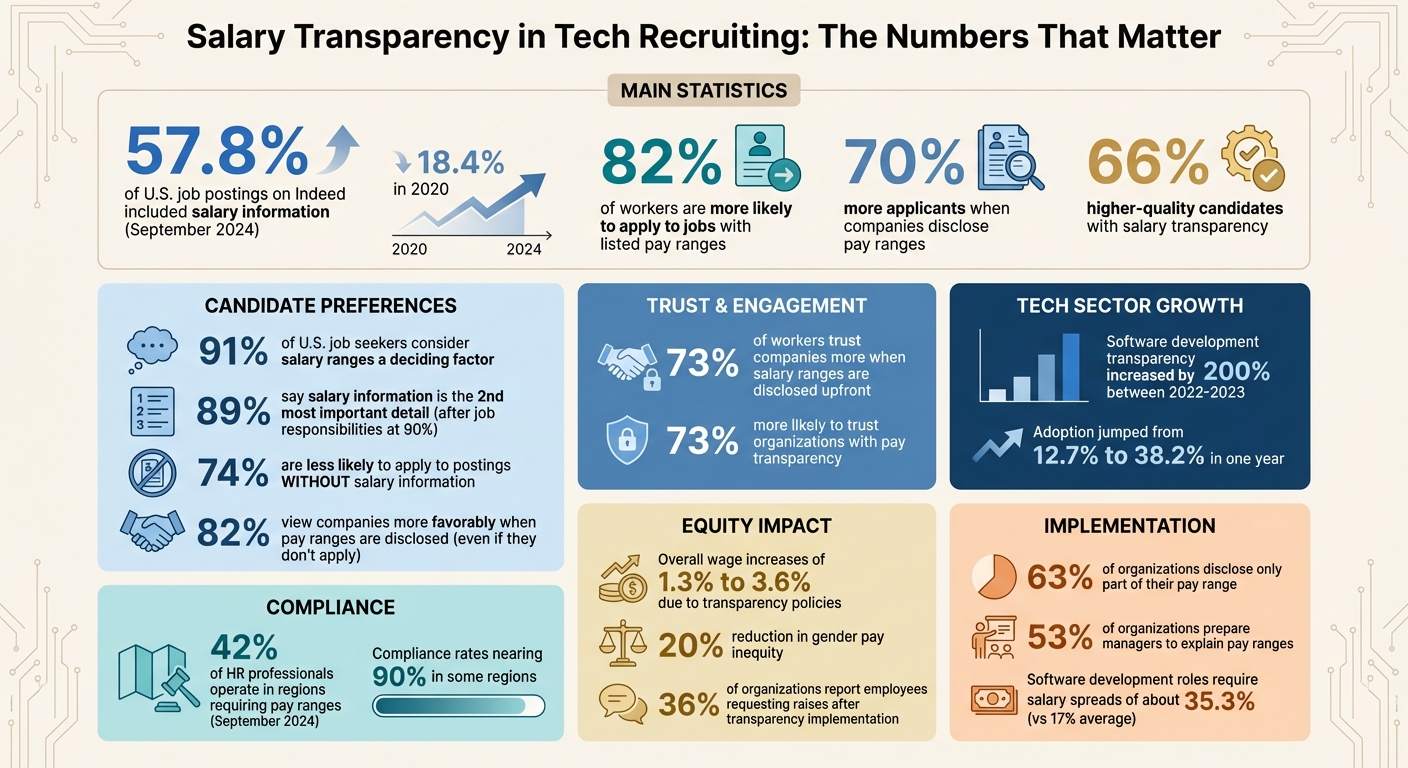 {Salary Transparency Impact on Tech Recruiting: Key Statistics and Response Rates}
How Salary Transparency Affects Candidate Engagement
Including salary details in job postings doesn’t just fill inboxes with resumes - it attracts the right candidates. Recruiters who share pay ranges report not only an increase in applicant numbers but also a noticeable improvement in the quality of those applications. This means you're connecting with developers whose expectations align with what your company can realistically offer, saving time and effort down the line .
Candidate Preferences and Response Rate Data
The data speaks volumes: 91% of U.S. job seekers consider salary ranges a deciding factor when applying for jobs . For tech roles, salary information is the second most important detail in a job description (89%), just behind job responsibilities (90%) . Even when developers don’t apply, 82% view companies more favorably when pay ranges are disclosed .
On the flip side, 74% of workers are less likely to apply to job postings without salary information . This creates a natural filter - transparent postings attract candidates who are genuinely interested, while vague listings discourage engagement. For recruiters, this clarity eliminates mismatched expectations early in the process, saving time and avoiding unnecessary back-and-forth during the offer stage . And while these trends strongly influence active job seekers, they also resonate with passive candidates.
Better Engagement with Passive Candidates
Salary transparency doesn’t just appeal to active job seekers - it also catches the attention of passive talent. These are the developers who aren’t actively job hunting but might be tempted by the right opportunity. For this group, pay transparency builds trust. 73% of workers say they trust companies more when salary ranges are disclosed . This trust is crucial when reaching out to candidates who are content in their current roles but open to exploring new possibilities.
Michelle Cheng, Talent Director at Notion Capital, highlights this point: "A company that embraces pay transparency conveys so much more than just the salary itself. It's the subtext in treating everyone like an adult and establishing a culture of openness" .
For passive candidates, this openness goes beyond numbers. It signals a company culture that values honesty and respect, turning cold outreach into a genuine conversation. This approach not only improves reply rates but also sets the stage for more meaningful interactions right from the start.
How to Implement Salary Transparency
Rolling out salary transparency involves creating a fair, competitive, and sustainable pay structure. The first step? Establish clear internal pay bands that balance market competitiveness with internal equity.
Creating Structured Compensation Bands
Start with an internal equity audit to uncover and address any pay gaps before publishing salary ranges. This is crucial since 36% of organizations report that transparency often leads employees to request raises .
For tech roles, like software development, salary bands typically need to be broader. While the average spread across all jobs sits around 17%, software development roles often require spreads of about 35.3% to reflect the wide range of skills and experience levels . This flexibility is essential in the tech world, where expertise can vary dramatically.
A key decision here is whether to post the entire internal range or just a portion of it. Right now, 63% of organizations opt to disclose only part of their pay range in job postings . Kristin Boraas, General Counsel at Payscale, sheds light on this trend:
"Some employers shift to showing a minimum and a median or mid-range. They don't even include a max. But it ultimately depends on training your HR team and managers to talk about why a new hire wouldn't start at the top" .
Training is critical. In fact, 53% of organizations prepare managers to explain how pay ranges are determined . This ensures smoother conversations and builds confidence in your transparency strategy.
Tools for Real-Time Salary Benchmarking
In fast-moving industries like tech, salary data can become outdated quickly. Between 2022 and 2023, transparency in software development job postings increased by 200% , signaling rapid shifts in market expectations. Keeping up requires tools that provide up-to-date insights.
Platforms like daily.dev Recruiter offer real-time data on what developers are looking for, helping you set competitive and realistic ranges. With these tools, you can stay aligned with current market trends, ensuring your salary bands remain attractive to top talent.
Writing Developer-Friendly Job Briefs
Once your salary bands are set, communicate them clearly in job postings. Why? Because 91% of U.S. job seekers say salary ranges influence their decision to apply . Clarity is key.
Be upfront about what the range includes. For roles with variable pay, such as commissions or bonuses, specify if the range refers to base pay only or total target earnings . This helps prevent why developers misunderstand job descriptions and sets clear expectations during negotiations.
Stick to realistic numbers - what you’re genuinely prepared to offer based on the role’s demands. Pair the salary range with detailed responsibilities and growth opportunities. Transparency pays off: 70% of organizations report increased applicants, and 66% see better-quality candidates when they list salary ranges .
Finally, keep your language simple and honest. Developers value straightforward communication over corporate buzzwords. Explain how the range reflects different experience levels and what factors influence where a candidate might fall within it. This kind of openness builds trust right from the start, making your company more appealing to top tech talent. These transparency practices not only ensure compliance but also create a foundation of trust that helps you attract and engage the best candidates out there.
Common Recruiter Concerns About Salary Transparency
While the benefits of salary transparency are well-documented, recruiters often face practical challenges in implementing it. Luckily, many of these hurdles have been addressed successfully by other organizations, offering clear solutions.
Handling Compliance Challenges
One of the biggest hurdles recruiters face is navigating the patchwork of state and local salary disclosure laws. By September 2024, 42% of HR professionals were operating in regions requiring pay ranges in job postings . However, these laws vary widely. States like Colorado, California, Washington, New York, Hawaii, Maryland, and the District of Columbia all have distinct requirements. For instance, California and Washington exempt employers with fewer than 15 employees, but similar exemptions don’t apply everywhere . Complicating matters further, some regulations extend to any company employing even one worker in a regulated state, regardless of whether the job is remote .
Despite these complexities, compliance is achievable. Regularly auditing job postings ensures they align with the specific disclosure requirements of each state where positions - or potential remote workers - are located . For example, companies in Maryland that embraced transparency well before the October 2024 deadline avoided last-minute operational headaches and built early trust with employees . Beyond meeting legal requirements, recruiters must also juggle external market factors and internal pay equity.
Balancing Internal Equity with Market Rates
After compliance, the next challenge is ensuring internal pay practices align with market expectations. Transparency often prompts a deeper look at internal equity, which isn’t a drawback - it’s a necessary step in addressing pay disparities.
Before publishing salary ranges, conducting a voluntary equity audit can help identify and address gaps between current employee pay and market rates. This proactive approach minimizes awkward conversations and reduces potential retention risks. In fact, state-level pay transparency policies have been linked to overall wage increases of 1.3% to 3.6% and a 20% reduction in gender pay inequity .
Emily M. Dickens, Chief of Staff and Head of Public Affairs at SHRM, emphasizes this approach: "The path toward equity requires more than recognizing that there are systemic gaps... It requires more directed education on the compensation process, increased engagement with compensation specialists and HR professionals" .
When employees question differences between new hire salary ranges and existing pay, employers should be ready to explain the factors influencing those differences, such as specific skills, certifications, or experience levels.
Building Trust Through Warm Introductions
Salary transparency becomes even more effective when paired with a recruitment strategy that values candidates’ time and preferences. For instance, daily.dev Recruiter uses warm, double opt-in introductions to connect employers with pre-qualified developers who are already interested in new opportunities. This personalized approach avoids the impersonal nature of cold outreach.
The results speak for themselves: 73% of U.S. workers say they’re more likely to trust organizations that disclose pay ranges upfront , and 82% of job seekers report a more favorable impression of companies that include salary information . By combining transparent pay practices with thoughtful, personalized recruitment efforts, organizations can build a solid foundation of trust with both current and future employees.
Conclusion
Salary transparency isn't just about ticking compliance boxes - it’s a game-changer for tech recruiters looking to stand out. The numbers back it up: companies that disclose pay ranges see 70% more applicants, attract 66% higher-quality candidates, and earn 73% more trust from workers. Plus, 82% of candidates say they're more likely to apply when compensation details are shared upfront .
Being upfront about pay also streamlines the hiring process. It helps filter candidates early, ensuring expectations align before the first conversation even happens. In software development, the shift toward transparency is undeniable, with its adoption jumping from 12.7% to 38.2% in just one year . Clearly, tech companies are catching on to how this approach draws in top-tier talent.
Take daily.dev Recruiter as an example. By pairing transparency with warm, double opt-in introductions, they’ve redefined recruiting. Instead of sending cold messages, recruiters connect with developers who’ve already reviewed detailed job postings - complete with salary ranges. This approach builds trust and transforms recruiting from a numbers game into a thoughtful, quality-driven process.
FAQs
How does sharing salary details upfront affect the quality of tech job applicants?
Being upfront about salary in tech job postings can make a noticeable difference in the quality of applicants. When candidates see the compensation details right away, it draws in those who are both interested and qualified, cutting down on mismatched expectations later in the hiring process.
Sharing salary information also fosters trust with potential hires. It signals that your company values fairness and honesty, making it more appealing to skilled professionals who feel assured about the opportunity you're offering.
What challenges do recruiters encounter when implementing salary transparency?
Recruiters encounter a range of hurdles when implementing salary transparency. One major concern is how disclosed salary ranges might lead to misunderstandings or biases. For instance, candidates could perceive a role as less appealing if the salary range doesn't meet their expectations. On the other hand, employers might inadvertently form opinions about a candidate's worth based on their current pay, which can complicate the hiring process.
Another issue lies in addressing internal pay equity. Transparency often sheds light on existing pay gaps, which can spark dissatisfaction among employees. This requires careful communication and, in some cases, pay adjustments to ensure fairness across the board. Wage transparency can also intensify competition, potentially pushing salaries higher and complicating budget planning for organizations. Additionally, recruiters may worry that candidates will develop rigid expectations based on posted salary ranges, limiting flexibility during negotiations.
However, when handled thoughtfully, salary transparency has the potential to build trust and strengthen candidate engagement.
How can companies keep their salary ranges competitive in the tech industry?
To thrive in the ever-changing tech world, companies need to keep a close eye on how their salaries stack up against the market. This means diving into reliable salary surveys and data to make sure pay rates match the latest industry norms. Since tech salaries can swing widely depending on the role, location, and demand, regular updates are a must.
Being upfront about salary ranges in job postings is another smart move. When you're transparent about pay, it can boost candidate interest and help you draw in top-tier talent. Plus, open communication about compensation builds trust and shows your company is modern and competitive - qualities that matter in today’s tight labor market.
It’s also crucial to keep tabs on shifts in the labor market, like rising wages tied to in-demand skills. Adjusting your pay strategy to reflect these trends can make a big difference. By staying ahead of the curve, you’ll not only appeal to qualified candidates but also create a workplace where employees are motivated to stick around for the long haul.
.png)