If you're hiring for "DevOps Engineers", you're likely setting yourself up for failure. Here's why:
- DevOps isn't a job title: It's a way of working that emphasizes collaboration between development and operations teams - not a role for one person.
- The term is too broad: Job postings for "DevOps Engineers" often include unrealistic skill requirements, ranging from system administration to multi-cloud expertise.
- It creates silos: Assigning one person to handle "DevOps" contradicts its core purpose of breaking down silos and promoting shared responsibility.
- It repels top talent: Skilled professionals often avoid these roles, seeing them as firefighting positions with unclear expectations.
Instead of hiring for a vague title, focus on specific roles like Site Reliability Engineer, Platform Engineer, or Cloud Engineer. Look for candidates with problem-solving skills, technical expertise (e.g., Kubernetes, Terraform), and a collaborative mindset. Tools like daily.dev Recruiter can help you connect with the right talent by targeting developers actively engaged in relevant technical topics.
Hiring the right people for DevOps isn't about chasing buzzwords - it's about building teams that work together to solve real problems.
::: @figure 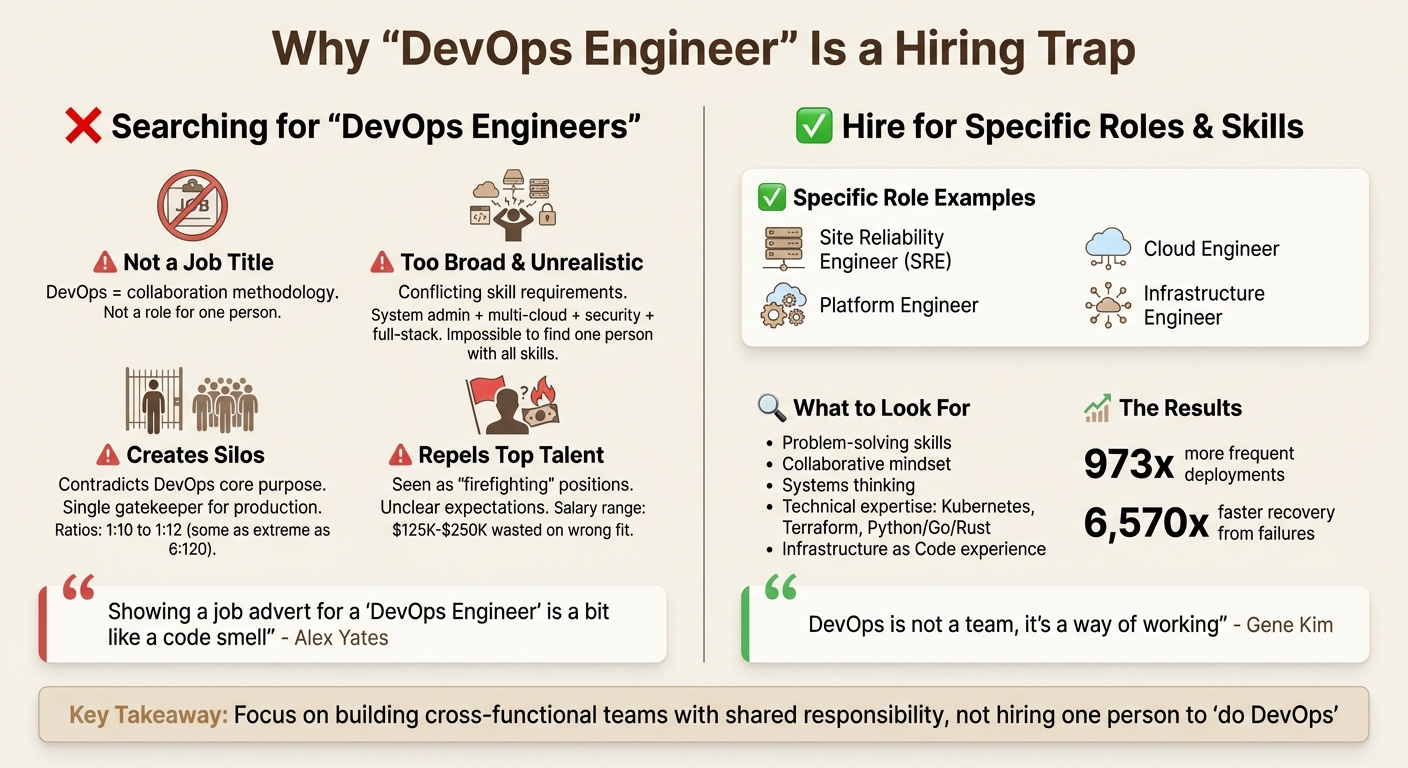 {DevOps Engineer vs Specialized Roles: Hiring Strategy Comparison}
Problems with DevOps as a Job Title
Conflicting Skill Requirements
When you advertise for a "DevOps Engineer", you're often asking for someone with an overwhelming and unrealistic mix of skills. One job listing might call for system administration expertise and basic scripting, while another demands full-stack development, multi-cloud mastery, and a strong grasp of security protocols . The expectation of finding someone who excels in all these areas is far from practical.
In reality, candidates usually lean into one of two backgrounds. Those with system administration experience may not have strong coding abilities, while developer-focused candidates might struggle with the intricacies of multi-cloud hybrid infrastructure. Without clearly defining your organization's needs, you risk hiring based on trendy buzzwords rather than addressing actual technical challenges . This misalignment often leads to hiring someone who doesn't fully fit the role, creating more problems than solutions.
Limited Candidate Access in a Competitive Market
The challenges don't end with mismatched skills. The title "DevOps Engineer" itself can repel top-tier talent. DevOps author and practitioner Alex Yates highlights this issue:
"Seeing a job advert for a 'DevOps Engineer' is a bit like a code smell. It hints that the organization is likely to interpret DevOps in this counter-productive narrow sense" .
By sticking to this label, you risk alienating skilled professionals who excel in cross-functional, dynamic practices .
Additionally, this rigid title can unintentionally exclude qualified candidates working under different roles. Site Reliability Engineers (SREs), Cloud Engineers, Infrastructure Engineers, and Platform Engineers often possess overlapping skills, but they might not apply if your search focuses solely on "DevOps Engineers." Terry Room, Global CTO at CapGemini, explains:
"a lot of companies are missing out [on talent by overly focusing on specific labels and certifications]" .
In a competitive market where salaries for DevOps professionals range from $125,000 to $250,000 , narrowing the talent pool with restrictive job titles can be an expensive mistake.
Single-Function Roles vs. Team Collaboration Requirements
Hiring one person to "do DevOps" goes against the core principles of the practice. As Uri Zaidenwerg, DevOps Lead at Replix, points out:
"DevOps was invented to make that gap [between departments] smaller. Having a separate role would thus appear to contradict one of the fundamental tenets of the methodology" .
Assigning a single individual to handle all DevOps responsibilities often creates a new silo, where this person becomes the sole gatekeeper for production knowledge. This setup can lead to what some describe as "Waterfall-as-a-Service", where developers hand off their code and disengage, leaving the DevOps engineer to manage deployments and troubleshoot issues in unfamiliar code . Such an arrangement undermines the collaborative essence of DevOps.
Tom Marsh, Principal Developer at Novartis, emphasizes this point:
"The point of a DevOps practice is that developer teams are empowered to control their own operations, not that you have specialists who know how to script operations" .
With typical staffing ratios ranging from 1:10 to 1:12 DevOps engineers per developer - and some organizations reporting ratios as extreme as 6:120 - it becomes clear that one person cannot manage the workload or foster the collaborative culture that DevOps is supposed to promote.
Hiring engineers?
Connect with developers where they actually hang out. No cold outreach, just real conversations.
DevOps Is a Practice, Not a Position
What DevOps Actually Means
At its core, DevOps is about teamwork. It brings together development, operations, security, and QA teams through tools like automation, continuous delivery, shared pipeline ownership, and real-time monitoring . Back in 2009, John Allspaw and Paul Hammond from Flickr demonstrated at the Velocity Conference how trust and shared responsibility could lead to over 10 deployments a day without system failures. This wasn’t about creating a new job title - it was proof that collaboration trumps working in silos .
Gene Kim, co-author of The Phoenix Project, sums it up perfectly:
"DevOps is not a team, it's a way of working" .
This approach requires every engineer to take ownership of how their code performs in production, rather than leaving it to someone else.
Hire for Skills, Not Titles
To embrace DevOps as a collaborative practice, hiring should focus on skills, not job titles. Instead of hunting for a "DevOps Engineer", look for candidates with strong problem-solving abilities, excellent communication, and a willingness to learn. The industry is moving toward roles that reflect specific responsibilities, such as Site Reliability Engineering (SRE) for system reliability, Platform Engineering for internal tools, and Cloud Engineering for infrastructure management . The 2024 CNCF State of Cloud Native Report highlights this shift, showing a rise in "platform engineering" while the term "DevOps Engineer" has plateaued .
Ideal candidates should understand systems thinking - how services interact, how failures can cascade, and how to automate repetitive tasks . Proficiency in programming languages like Python, Go, or Rust, hands-on experience with containers and Kubernetes, and familiarity with Infrastructure as Code tools like Terraform are key skills to prioritize . As Alex Yates from Octopus Deploy explains:
"DevOps is an interface, not a class" .
The goal is to hire individuals who can implement collaborative practices, not just check off a box on a resume.
Traditional DevOps Roles vs. Multi-Disciplinary Skills
This perspective challenges the outdated idea of a single "DevOps" role that does it all. Job descriptions that expect one person to be a "jack of all trades" often lead to burnout . Instead, modern DevOps thrives on multi-disciplinary teams. For instance, SREs focus on reliability metrics, developers gain infrastructure knowledge, and platform engineers create self-service tools .
This shift from relying on a single "hero" to building resilient teams has a measurable impact. Organizations that embrace this approach deploy 973 times more frequently and recover from failures 6,570 times faster . It’s clear: collaboration and specialization drive success in DevOps.
How to Hire for DevOps Skills
Connect Through Developer Networks
Traditional job boards often miss out on the best candidates - those who are deeply engaged in technical communities and regularly consume specialized content. Platforms like daily.dev Recruiter bridge this gap by connecting with candidates where they naturally engage, turning cold outreach into warm, interest-driven connections.
AI-powered tools can detect "intent signals", subtle indicators of a candidate's curiosity and problem-solving mindset that go beyond what's listed on a resume. As Nimrod Kramer, CEO of daily.dev, puts it:
"The signal is can this person solve our kind of problems, with our kind of constraints, with curiosity and care?"
When reaching out, referencing a candidate's GitHub activity or technical blog posts shows you're paying attention to their work. This personal touch builds trust and sets the stage for meaningful conversations. Once you've made that connection, shift your focus to evaluating their interpersonal and collaborative skills.
Screen for Attitude and Teamwork
After establishing initial contact, the next step is assessing how well candidates work with others and handle challenges. While technical expertise is important, attitude and collaboration often play a bigger role in long-term success. Interactive sessions lasting 60–90 minutes can be a great way to evaluate these traits. Walk candidates through real-world DevOps scenarios, such as analyzing a past incident, debugging production logs, or tackling an architectural problem. These exercises reveal how they communicate under pressure and approach problem-solving.
For instance, asking, "Describe a production failure you experienced and how you responded", can provide insights into their mindset. Look for candidates who focus on systematic improvements rather than pointing fingers. Aurynn Shaw from Eiara Limited sums it up well:
"DevOps is cultural, a mindset of dismantling barriers between developers and systems administration, between IT and the business as a whole"
Candidates who show empathy, psychological safety, and a blameless approach to failures are more likely to contribute positively to your team's culture.
Build Trust with Warm Introductions
Generic cold emails rarely resonate with top-tier talent. Instead, opt for double opt-in introductions, where both parties express mutual interest before any formal conversation begins. This approach respects the candidate's time and lays the groundwork for a more productive relationship.
Transparency is key to building trust. Share details about salary ranges, tech stacks, work models, and on-call expectations right from the start. Candidates appreciate knowing what to expect, and it sets a tone of openness. Additionally, streamline your hiring process to include just 3–4 steps, wrapping up within two weeks. This not only respects the candidate's time but also signals that your organization values efficiency. In the fast-paced world of DevOps, these strategies align with the emphasis on collaboration and adaptability over rigid job roles.
How daily.dev Recruiter Supports Multi-Disciplinary Hiring
Recruiting DevOps talent with a mix of skills can be tough, but daily.dev Recruiter simplifies the process by improving how you reach and screen candidates.
Targeted Job Briefs and Role Visibility
Finding DevOps professionals with diverse expertise starts with meeting them where they’re already engaged. daily.dev Recruiter connects you with developers actively consuming technical content - not just browsing job boards. This means your job postings reach engineers interested in areas like platform engineering, infrastructure as code, or developer experience tooling.
The platform gives you a complete view of a candidate’s work history, their current activity on daily.dev, and their career goals . Instead of relying on outdated resumes, you can see what topics they’ve been exploring recently - like Kubernetes, CI/CD pipelines, or observability tools. These real-time insights provide a clearer picture of their current skills and interests than any job title could.
As platform engineering continues to grow , daily.dev Recruiter helps you identify engineers with a focus on developer experience and internal tooling - key traits for modern DevOps roles. You can create job briefs tailored to these interests, avoiding outdated job titles and zeroing in on the actual responsibilities. This approach boosts job visibility and sets the stage for meaningful candidate engagement.
Higher Response Rates
Traditional cold outreach often misses the mark with top-tier talent. daily.dev Recruiter solves this with a double opt-in introduction system - both you and the candidate must express interest before connecting. This ensures you’re engaging only with developers who are genuinely open to hearing from you, cutting out the noise and frustration of unsolicited messages.
The result? Much higher response rates compared to cold emails or LinkedIn outreach. When candidates see that you’ve noticed their engagement with specific technical topics, they’re more likely to respond positively. This trust-first approach aligns well with the collaborative and open culture that’s central to DevOps.
ATS Integration and Screening Options
Once you’ve captured interest, daily.dev Recruiter keeps things efficient with seamless integration into your existing Applicant Tracking System (ATS). You can continue using your current workflows while accessing a higher-caliber talent pool - no need to juggle multiple tools or manually transfer data.
To streamline screening, you can include up to three custom questions focused on critical DevOps skills. Ask about their experience with incident response, infrastructure as code, or deployment process improvements. These targeted questions help you quickly identify candidates with the technical expertise and collaborative mindset needed for success, all without dragging out your hiring timeline.
| Feature | daily.dev Recruiter Advantage |
|---|---|
| Outreach Style | Warm, double opt-in introductions |
| Candidate Signal | Real-time behavior and interests + work history |
| Screening | Up to 3 custom questions to validate specific DevOps skills |
| Integration | Works with existing Applicant Tracking Systems (ATS) |
With nearly 90% of tech leaders citing recruitment and retention as major challenges, and demand for DevOps engineers expected to more than double by 2028 , having a tool like daily.dev Recruiter can make a real difference in hiring multi-disciplinary talent.
Conclusion
The term "DevOps Engineer" often creates more confusion than clarity. It mixes a broad philosophy with a single role, which can lead to issues like burnout, limited expertise, and siloed thinking. As Alex Yates aptly notes, "DevOps is an interface, not a class" . Instead of pinning hopes on one individual to resolve organizational challenges, companies should focus on hiring developers who embrace collaboration and shared accountability.
This perspective highlights the need to rethink traditional job titles. A better approach is to recruit for specific roles like Site Reliability Engineer, Platform Engineer, or Cloud Engineer, emphasizing skills and mindset. Look for candidates with systems thinking, curiosity, and a knack for working across boundaries. Additionally, investing in your current teams by training them in infrastructure-as-code and automation can pay off significantly.
Tools like daily.dev Recruiter simplify this process by connecting you with developers actively learning and building. Its double opt-in system ensures you engage with genuinely interested candidates, while real-time behavioral signals showcase expertise in areas like Kubernetes and CI/CD. This approach helps you identify individuals with both the technical skills and collaborative mindset that modern DevOps practices demand. Plus, its ATS integration makes the hiring process smoother from start to finish.
Given that the average time-to-hire for DevOps roles is 5 to 7 weeks , wasting time on an ill-defined title is a luxury no company can afford. Ditch the "DevOps Engineer" label and focus on building cross-functional teams with the right skills, mindset, and ownership of production systems.
FAQs
What role should replace “DevOps Engineer” on my job posting?
DevOps is increasingly viewed as a collaborative approach rather than a standalone job title. Instead of sticking to "DevOps Engineer", consider focusing on roles that emphasize DevOps practices or platform engineering. These positions align more closely with today's industry demands, prioritizing teamwork, adaptability, and cross-functional expertise over narrowly defined roles.
How do I assess DevOps skills without relying on titles?
When hiring for DevOps roles, shift the focus from formal titles to practical skills and mindset. Instead of relying on resumes alone, evaluate candidates through technical assessments like coding challenges or real-world automation scenarios. These tests reveal hands-on experience and problem-solving abilities.
During interviews, ask about past projects or how they’ve handled incidents to uncover traits like cross-functional collaboration, a willingness to learn, and the ability to adapt to changing situations. A candidate’s approach to teamwork and their practical application of DevOps principles should carry more weight than rigid role definitions. Prioritize those who demonstrate a collaborative attitude and the ability to translate theory into action.
How can I transition from a DevOps silo to shared ownership?
To shift from a siloed DevOps setup to a model of shared ownership, it's essential to emphasize collaboration, shared responsibility, and continuous improvement. Think of DevOps not as a specific role, but as a mindset that drives how teams work together.
Here’s how to make it happen:
- Encourage shared accountability across all teams to ensure everyone feels responsible for outcomes.
- Break down barriers by fostering open communication and transparency between departments.
- Automate repetitive processes to free up time for more strategic work.
- Equip teams with the right tools and training to enable seamless collaboration.
This shift in approach helps create integrated teams that perform better and adapt faster.
.png)