Recruiting senior backend engineers in 2026 is all about precision and active engagement. The best candidates aren’t applying to job boards - they’re already employed, working on niche technologies, and contributing to specialized communities. Companies now rely on AI-driven platforms, verified skill data, and personalized outreach to find and connect with these professionals. Here’s what’s changed:
- AI Tools Dominate: Tools like JobGPT analyze real-time data to match engineers with jobs based on skills, salary benchmarks, and company needs.
- Verified Contributions: Platforms monitor GitHub activity (e.g., pull requests, code reviews) to assess expertise, avoiding reliance on self-reported resumes.
- Specialized Communities: Engineers are found in tech-specific hubs discussing distributed systems, microservices, and AI integration.
- Personalized Outreach: Recruiters use market data (e.g., $213K salaries at Warner Bros. Discovery) and double opt-in introductions to improve engagement.
- Content Over Job Listings: Companies attract engineers by publishing technical content showcasing challenging projects and advanced tools like Go, Kubernetes, and Kafka.
The key to hiring in 2026? Move fast, focus on verified skills, and engage where engineers are already demonstrating their expertise.
How Discovery Methods Have Changed for Senior Backend Engineers
::: @figure 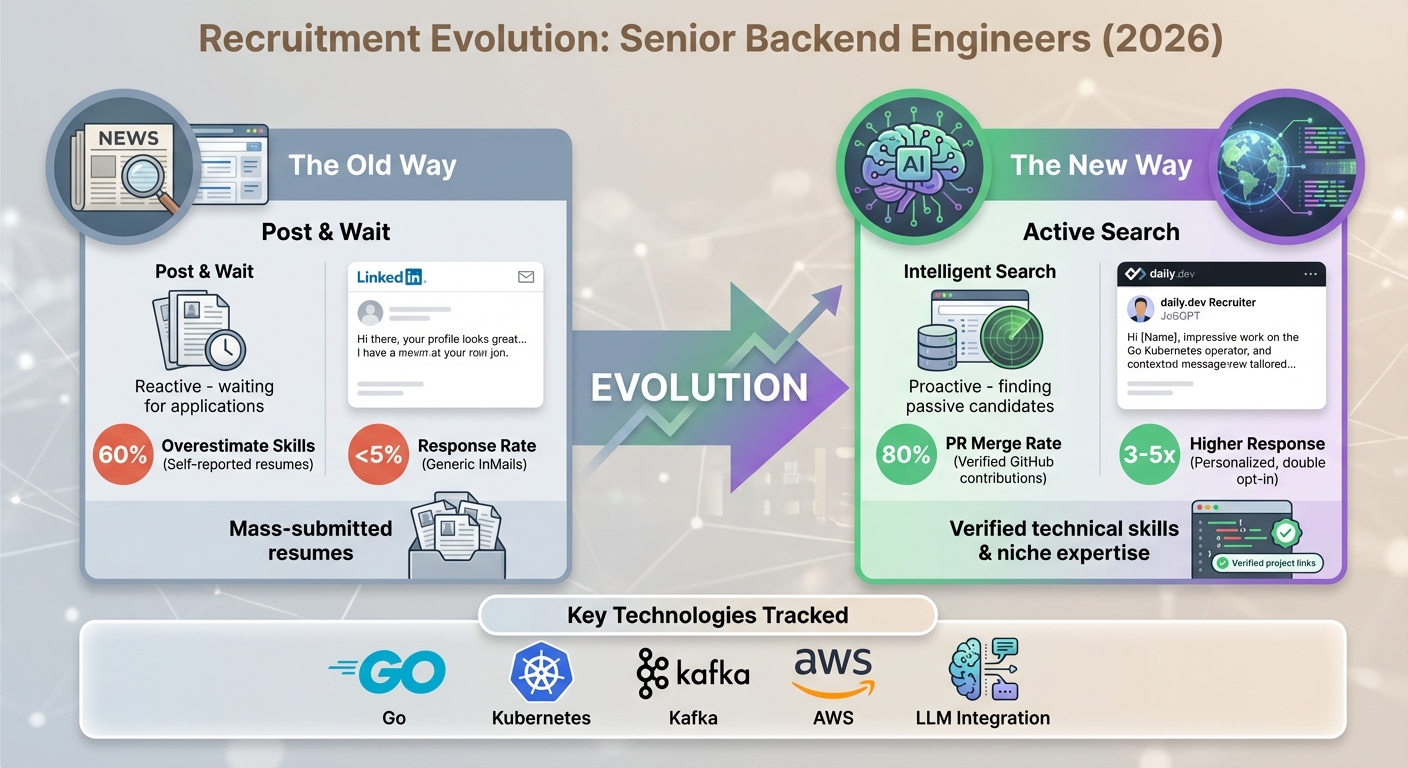 {Traditional vs Modern Backend Engineer Recruitment Methods 2026}
From Posting Jobs to Finding Talent
Recruiting senior backend engineers has undergone a major transformation. In the past, employers relied heavily on traditional job boards like Indeed. This method was straightforward: post a job listing and wait for applications to roll in . However, this reactive approach is quickly becoming outdated.
Today, the process has flipped. Platforms now empower employers to actively search for candidates, rather than passively waiting for resumes. This shift requires knowing where to find experienced tech talent in a landscape dominated by niche communities. Engineers are encouraged to build verified digital profiles showcasing their expertise. These profiles allow companies to identify niche technical skills - think Go, Kubernetes, Kafka, or even LLM integration - without wading through generic job listings . Tools like JobGPT even automate application submissions across multiple roles , making it harder for recruiters to rely on traditional job boards. As a result, companies are shifting their focus to platforms that highlight passive candidates with proven technical skills, rather than sorting through a flood of mass-submitted resumes.
This evolving landscape is setting the stage for AI-driven systems that can refine the process even further.
How AI Helps Find the Right Candidates
Tech recruiting in the age of AI is taking recruitment to the next level by blending technical expertise with market insights. By 2026, AI tools are analyzing data in real time to match engineers with roles that align not just with their skills but also with organizational values. These platforms use AI agents to examine verified profiles and salary benchmarks, ensuring that candidates and companies are paired based on accurate, data-driven insights.
This shift benefits engineers, too. AI agents monitor the job market, flagging roles that match verified skills and salary preferences, and even auto-applying on behalf of candidates. Employers, on the other hand, leverage the same technology to zero in on individuals who meet specific criteria. For instance, platforms like 6figr track data from over 30 verified profiles at companies like Warner Bros. Discovery , offering recruiters reliable compensation data and skill verification - going beyond the limitations of self-reported resumes.
As backend roles increasingly require expertise in building AI-driven solutions, this data-centric approach is becoming indispensable. Companies are now actively seeking engineers who can combine traditional backend skills with AI capabilities . These advancements directly address the recruitment challenges of today, ensuring a better match between top-tier talent and critical roles in the industry.
Using AI-Powered Platforms to Find Backend Engineers
Collecting and Analyzing Developer Data
Platforms like daily.dev Recruiter use advanced tools to gather data directly from the environments where backend engineers actively work, such as GitHub and other open-source repositories. Instead of relying on self-reported skills - where around 60% of engineers reportedly overestimate their abilities - these platforms analyze real-time contributions. By monitoring commits, pull requests, and code reviews, they provide a more accurate picture of technical expertise.
The process begins by targeting high-value repositories that align with specific tech stacks. For instance, repositories like golang/go are monitored to identify Go engineers, while kubernetes/kubernetes serves as a hub for infrastructure specialists . Once potential candidates are identified, AI enriches their profiles by adding verified details such as work emails, LinkedIn URLs, current job titles, and employers through layered data modeling techniques .
Key metrics like pull request (PR) merge rates and contribution histories are then analyzed to assess a candidate's technical reliability and depth . An 80% PR merge rate, for example, indicates consistent peer approval, a strong signal of quality work . Platforms also evaluate consistent contributions over a year to measure reliability and analyze the complexity of pull requests - distinguishing between minor fixes and more challenging tasks like performance optimizations . Even detailed bug reports or architecture proposals are considered, as they reflect analytical skills and effective communication . Review comments are another important factor, often highlighting leadership and mentoring abilities .
"A developer with 80% PR merge rate across multiple projects has consistently written code that senior engineers approved. That's a stronger quality signal than any take-home assignment." - LeadCognition
This data-driven approach forms the backbone of a robust candidate evaluation process. And it works - recruiter outreach tailored to specific GitHub contributions sees response rates 3–5x higher than generic LinkedIn InMails, which often yield less than a 5% response rate . Advanced filters further refine the pool, ensuring only the most qualified candidates are considered.
Filtering Candidates and Connecting to Your ATS
After identifying candidates through their verified contributions, advanced filters help recruiters fine-tune their search by focusing on key signals like recency, technical depth, and location . For example, merged pull requests highlight technical expertise, consistent contributions over a year suggest reliability, and thoughtful review comments point to leadership and mentoring capabilities .
The real advantage comes with seamless integration into applicant tracking systems (ATS). Pre-qualified profiles can be pushed into your ATS with just one click, cutting out manual data entry. These integrations keep candidate profiles up-to-date, automatically reflecting new contributions or skill updates. This ensures hiring managers always have the most current information at their fingertips.
Platforms like daily.dev Recruiter take things a step further by combining verified developer activity with warm, double opt-in introductions. This means that by the time a candidate enters your ATS, they've already expressed interest in the opportunity. This approach eliminates the inefficiency of cold outreach, creating a more engaging experience for both recruiters and candidates.
Finding Engineers Through Communities and Technical Content
Connecting in Specialized Backend Communities
By 2026, senior backend engineers are gravitating toward specialized communities instead of traditional job boards. Take Warner Bros. Discovery, for example - they’ve moved away from conventional job postings, opting to invite engineers into their fold with a message like, "Join our community of extraordinary technologists who are truly building the tools that will run the future of entertainment" . This shift reflects where top-tier talent is spending their time.
These niche communities thrive in areas where backend engineers tackle intricate challenges, like distributed systems. In Healthtech, companies such as Ro and Nourish attract engineers skilled in crafting fault-tolerant microservices. Cybersecurity firms like CrowdStrike appeal to those proficient in Go, Kubernetes, and large language models. Meanwhile, Fintech players like Bilt and Galaxy seek developers experienced in event-driven architectures and distributed data pipelines. Within these focused spaces, recruiters can connect directly with engineers who have the precise expertise needed for tasks like integrating advanced language models or leading greenfield projects.
What makes this approach effective is its focus on specific skills. Engineers discussing topics like "fault-tolerant backend microservices" or "event-based architecture" in real time are essentially showcasing their expertise. Beyond that, those who mentor or lead backend teams often hold influential roles in these communities. Open-source contributions and side projects now carry as much weight as traditional resumes, so recruiters need to meet engineers where they’re actively demonstrating their abilities. By leveraging these connections, companies can further strengthen their appeal through well-crafted technical content.
Attracting Engineers with Technical Content
While communities help establish connections, technical content builds credibility and attracts engineers who value innovation and challenging work. Publishing in-depth technical articles - far more detailed than a typical job description - can establish trust with senior talent. Content that dives into globally distributed systems, robust data pipelines, or large language model integration resonates because it signals that your team is solving meaningful, complex problems. Sharing architectural insights, such as detailed technical plans, testing strategies, or backend service documentation, further underscores a culture of technical rigor and transparency.
A mission-driven story adds another layer of appeal. Positioning your team as innovators shaping the future can attract engineers who want their work to have purpose, not just a paycheck. Being upfront about compensation - highlighting salaries exceeding $200,000 - also bolsters credibility and shows a commitment to attracting top talent.
The tools and technologies you spotlight are just as important as your narrative. Highlighting sought-after tools like Go, Kubernetes, Kafka, and AWS appeals to engineers eager to work with advanced systems. Offering opportunities to lead greenfield projects, especially those involving AI-driven solutions or cutting-edge architectural designs, draws senior developers who crave creative challenges over routine tasks. When engineers see your team tackling the kinds of problems they care about - using the tools they want to master - they’ll be far more likely to engage. Together, these targeted community and content strategies complement data-driven approaches, such as those offered by platforms like daily.dev Recruiter, creating a well-rounded method for discovering top backend talent.
Better Outreach Through Data and Warm Introductions
Personalizing Outreach with Market Data
Generic outreach often falls flat because it ignores critical factors like competitive compensation and technical alignment. For example, referencing a $213,000 total compensation for a Senior Engineer at Warner Bros. Discovery immediately shows market awareness and respect for the candidate's value .
Location matters, too. In high-cost areas like New York, Software Engineer roles can command up to $500,000 in total compensation for top-tier talent . Highlighting these benchmarks in your outreach demonstrates a deep understanding of the market. Including salary ranges upfront - along with equity, bonuses, and benefits - saves time and respects the candidate's priorities. Transparency like this helps your message stand out in a sea of generic pitches.
To go further, reference the actual technical challenges the role involves. Whether it’s building content supply chain systems, working on on-chain/off-chain boundaries, or solving ammonia refrigeration issues, being specific shows that your outreach is informed and relevant. Combining this level of technical detail with accurate compensation data ensures your message is both targeted and meaningful. From there, incorporating a double opt-in introduction model can take engagement to the next level.
Double Opt-In Introductions That Work
Double opt-in introductions are an effective way to streamline engagement and identify qualified technical candidates in minutes. Instead of sending cold, unsolicited messages, this approach ensures both parties are interested in connecting before any conversation begins. Platforms like daily.dev Recruiter make this possible by allowing engineers to express interest in specific roles first. Only then do recruiters receive an introduction, ensuring candidates are already open to discussing opportunities.
This method can significantly improve response rates by eliminating the awkwardness of traditional outreach. Engineers aren’t bombarded with irrelevant messages - they’re engaging with roles they’ve already shown interest in. These introductions provide clear context, including details about the role, compensation, and technical challenges. By skipping the cold pitch and starting with a discussion about fit and mutual interest, both recruiters and engineers save time while fostering trust from the outset.
Conclusion
Recruiting senior backend engineers in 2026 calls for a mix of forward-thinking strategies, data-driven tools, and community engagement. AI-powered platforms now streamline candidate filtering and matching, while developer communities provide direct access to engineers shaping the future of their industries. Indicators like technical content and side projects often outweigh traditional resumes or degrees, and warm, trust-based introductions are replacing impersonal cold outreach. These tools and methods turn the process of finding the right candidate into a precise and efficient operation.
To succeed, recruitment strategies must align with what engineers value most. By 2026, most senior engineers will avoid roles requiring office presence, demand salary transparency with competitive pay ranging from $150,000 to $500,000, and prioritize roles offering meaningful technical challenges. Balancing these priorities with modern tools creates a recruitment process that meets both technological and market demands.
Speed is equally important. While the average hiring time for a senior engineer is 43 days, top candidates often juggle several offers. Reducing the time to hire by completing the interview and offer process within 7–10 days provides a critical advantage. Referred candidates, who tend to stay 45% longer and perform 15% better in their first year , highlight the value of warm introductions through platforms like daily.dev Recruiter.
The most effective hiring strategies combine multiple approaches: leveraging talent platforms for speed and quality, engaging specialized communities to build credibility, and using data-driven outreach that respects engineers' time. Together, these methods create a streamlined process that aligns with the expectations of senior engineers. By adopting these modern techniques, recruiters can secure top talent quickly and efficiently in a competitive market.
"The senior engineering talent market in 2026 favors startups that move fast. The best candidates get multiple offers. You need to interview quickly and decide faster" .
Act decisively, build trust from the first interaction, and ensure your methods reflect the priorities of the engineers you aim to hire.
FAQs
What signals actually prove senior backend skill in 2026?
In 2026, senior backend engineers stand out through a mix of advanced expertise and career milestones. One clear indicator is compensation, with salaries typically ranging from $191,000 to $402,000, showcasing the high demand for their technical skills.
Another strong signal is their progression through senior engineering levels, such as achieving L7 roles at major tech companies. These positions often require years of experience and the ability to lead in-depth technical initiatives.
Finally, a proven history of delivering results on complex, high-stakes projects further highlights their capabilities. Whether it's scaling systems, optimizing performance, or solving critical business challenges, their work consistently makes a measurable impact.
How do I find passive backend engineers without job boards?
To connect with skilled backend engineers who aren’t actively job hunting, consider using AI-powered talent platforms and data-driven outreach tools. These platforms can sift through profiles, assess project contributions, and track online activity to pinpoint experienced candidates who might not be on traditional job boards.
Another effective strategy is engaging with niche developer communities and professional networks. Building relationships in these spaces can help you connect with senior engineers who may not be actively seeking new roles but could still be interested in the right opportunity. Crafting personalized outreach messages tailored to their expertise and interests can significantly improve your chances of sparking their interest.
How can I shorten senior backend hiring to 7–10 days?
To cut senior backend hiring time to just 7–10 days by 2026, leverage AI-powered talent platforms and data-driven outreach. These tools can quickly pinpoint candidates who align perfectly with job requirements. Additionally, tapping into niche developer communities allows you to connect with highly skilled professionals more directly. By combining these approaches, you can simplify sourcing and initial screening, speeding up the hiring process in the fast-paced tech industry.
.png)