Tech recruiting often feels like sorting through noise to find the right signal. Companies face challenges like too many unqualified applicants, long hiring timelines, and wasted engineering hours. This inefficiency leads to higher costs and missed opportunities to hire top talent. Here's the core issue and how to fix it:
- The Problem: Too much "noise" (unqualified candidates, inefficient processes) slows hiring and frustrates both recruiters and candidates.
- The Impact: Traditional hiring takes 49 days, costs $14,076 per hire, and consumes up to 60 engineer hours per role.
- The Solution: Streamline your process by reducing noise, improving sourcing, using technical hiring tools, personalizing outreach, and tracking key metrics.
How Noise Damages Recruitment Funnels
::: @figure 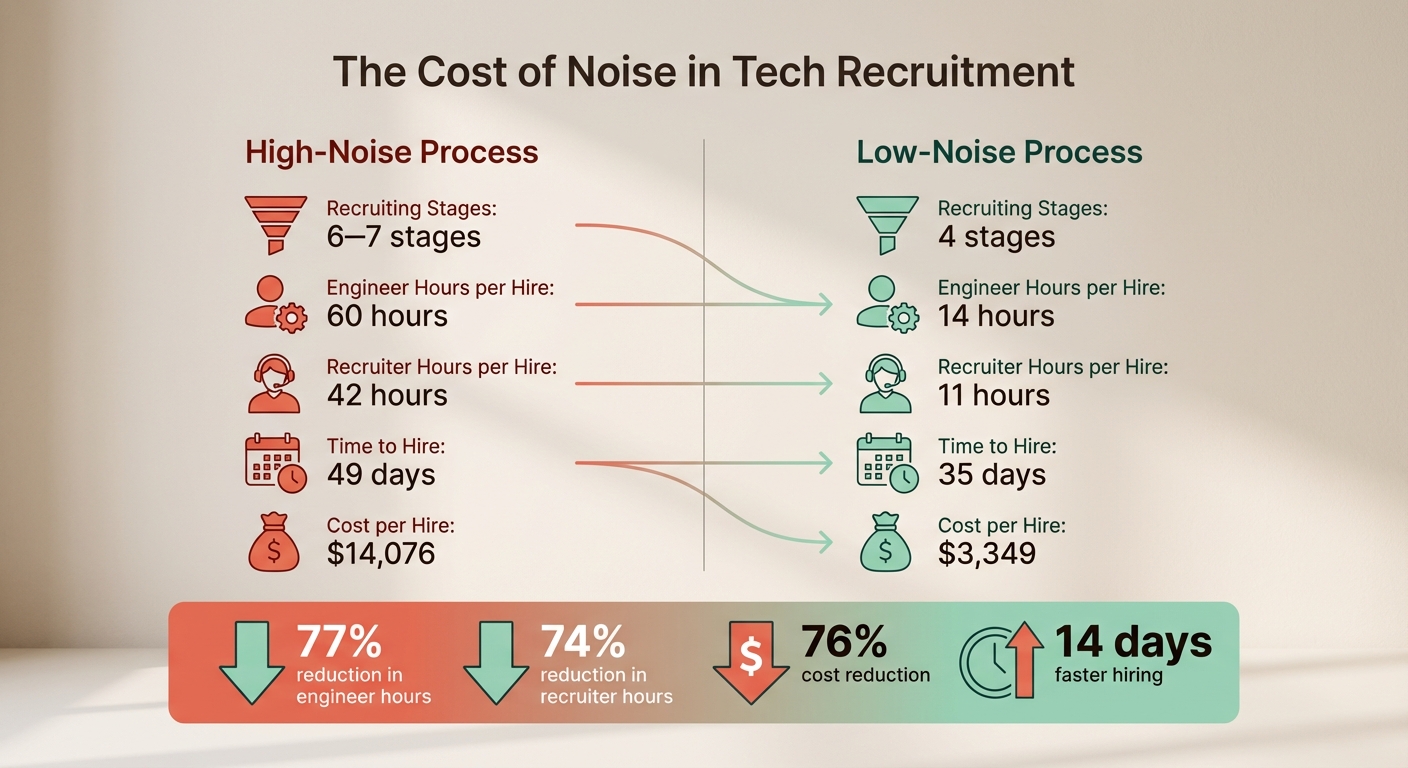 {High-Noise vs Low-Noise Tech Recruitment Process Comparison}
Noise in your recruitment funnel doesn’t just slow things down - it drains time and resources at every step. The numbers don’t lie: traditional, high-noise recruitment processes consume about 42 hours of a recruiter’s time per hire. Compare that to just 11 hours in a more streamlined process, and it’s clear how much effort is wasted. That’s nearly four times the work for the same result. The cost of this inefficiency becomes even more apparent when you look at its impact on both time and money.
This inefficiency also leads to "interviewing fatigue." Your technical team could be spending anywhere from 40 to 60 hours per hire just on screening candidates. That’s time they could spend on higher-value tasks.
Calculating the Cost of Noise
The gap between a noisy recruitment funnel and a clean one is easy to measure. Traditional processes take an average of 49 days to fill a role, costing $14,076 per hire. On the other hand, an optimized, low-noise process reduces the time to 35 days and slashes costs to $3,349 per hire. That’s a 76% drop in costs and two weeks saved - time that could be spent getting the new hire up to speed instead of leaving the position vacant.
| Metric | High-Noise Process | Low-Noise Process |
|---|---|---|
| Recruiting Stages | 6–7 stages | 4 stages |
| Engineer Hours per Hire | 60 hours | 14 hours |
| Recruiter Hours per Hire | 42 hours | 11 hours |
| Time to Hire | 49 days | 35 days |
| Cost per Hire | $14,076 | $3,349 |
The longer a position stays open, the more it impacts your team’s productivity and your company’s bottom line.
How Noise Hurts the Candidate Experience
Noise doesn’t just waste your team’s time - it can also harm your reputation with candidates. When your hiring process is bogged down by excessive applications and inefficiencies, it becomes harder to spot top talent. High-quality candidates may interpret this as a sign of disorganization and lose interest. Delays in response times and inconsistent communication only make matters worse, pushing them toward companies with smoother, faster processes.
Shannon Castleman, Senior Talent Acquisition Manager at Greenhouse, sums it up perfectly: "You have to make sure efficiency doesn't come at the expense of experience".
A noisy recruitment funnel often leads to non-responses or long delays, leaving candidates frustrated and looking elsewhere. Worse, it can give the impression that your organization isn’t well-run - not exactly the image you want to project.
Noise also introduces inconsistency in how candidates are evaluated. Subjective judgments and gut feelings can vary wildly between recruiters, leading to poor hiring decisions and biased technical evaluations. Over time, this lack of standardization can create a sense of unfairness that damages your employer brand. Cleaning up this noise is critical before you can implement strategies to improve your hiring process.
How to Reduce Noise and Improve Signal Quality
Noise in recruitment can waste time and energy, but addressing it effectively can help you focus on what truly matters: connecting with top-tier candidates. By refining your sourcing methods, simplifying application processes, and optimizing your tools, you can reduce distractions and zero in on developers who are the right fit for your roles.
Choosing Better Sourcing Channels
Traditional job boards often generate a flood of applications, but many lack the quality you're looking for. Here's a key insight: professional networks outperform other channels. Data shows engagement rates of 85–90% with double opt-in introductions, while cold outreach on social media barely registers. Even more interesting, 90% of developers on professional networks are passive candidates - they aren’t actively job hunting but are open to the right opportunity.
These platforms are particularly effective for senior and specialized roles because they connect you with developers who’ve already shown some level of interest. In contrast, job boards primarily attract active job seekers, which limits your pool of experienced talent.
To get the best results, track your metrics by channel. Measure response rates, interview-to-offer ratios, and overall hire quality. If a channel consistently underperforms, it’s time to move on. Platforms like daily.dev Recruiter take a different approach by connecting you with developers in their natural habitat - while they’re reading and engaging with technical content. Every introduction is warm and double opt-in, ensuring you’re reaching out to candidates who are already interested. Once you’ve optimized your sourcing, it’s time to tackle the application process.
Simplifying Application Processes
Developers, especially passive candidates, won’t waste time on lengthy or clunky applications. Every extra field you add is another reason for them to drop off. Stick to the basics: name, email, resume, and portfolio. And don’t underestimate the importance of mobile-friendly design - many developers browse job opportunities on their phones during downtime. A poor mobile experience could cost you a great candidate.
Automation can also make a big difference. Send immediate confirmation emails and provide clear next steps. Silence after an application is a surefire way to lose interest. The goal is to make applying as frictionless as possible. If a developer can complete the process in under three minutes without creating an account or re-entering redundant information, you’ll see fewer drop-offs and more qualified applications.
Using Pre-Screening Tools Effectively
Pre-screening tools can save your team a significant amount of time when used wisely. On average, traditional technical recruiting requires 60 engineer hours per hire. With optimized pre-screening platforms, that number drops to just 14 hours - a 77% reduction in time spent on interviews .
Focus on tools that evaluate resumes for skills and technical qualifications. AI-powered platforms can quickly identify candidates who meet your must-haves, filtering out those who don’t fit. However, don’t rely solely on keywords, as this can exclude strong candidates who may not use the exact phrasing you’re looking for.
To minimize unconscious bias, consider blind resume screening. Anonymize details like name, gender, age, and education so your team evaluates candidates based purely on their skills and accomplishments . Here’s a practical tip: recruiters typically spend just 7 seconds scanning a resume. Start reading from the bottom up to focus on actual experience rather than being distracted by formatting or titles at the top . Once you’ve identified qualified candidates, personalized outreach becomes the next critical step.
Personalizing Candidate Outreach
Generic outreach doesn’t work. Developers are bombarded with recruiter emails every week, and they can spot a template from a mile away. Personalization is the key to standing out and improving response rates.
Reference something specific from their profile - a project they’ve worked on, a technology they’re passionate about, or a recent open-source contribution. A few tailored sentences can make all the difference. Show them you’ve done your homework and understand what makes them unique.
While automation can help you scale outreach, balance it with authenticity. Customize the core message to explain why this role aligns with their background and career goals. Be transparent about important details like compensation, remote work policies, and the interview process. The more context you provide upfront, the more likely they are to engage. By personalizing your approach, you can cut through the noise and connect with candidates who are genuinely interested in your opportunities.
Tracking Funnel Performance and Fixing Problems
Once you've streamlined your recruitment processes, the next step is making sure those changes are actually working. By keeping a close eye on every stage of your hiring funnel, you can confirm whether your efforts are paying off or if adjustments are still needed.
Here’s the truth: you can’t fix what you’re not measuring. Tracking your recruitment funnel helps you identify where candidates drop off and why. Without this visibility, you’re essentially operating in the dark.
Recruitment teams that embrace analytics are twice as likely to improve their processes and three times as likely to cut costs . The trick? Focus on the metrics that matter and use them to guide your decisions.
Key Metrics to Track
Each stage of your funnel tells a different story, so you’ll need to track specific metrics at every point.
Top of the funnel: Keep an eye on your outreach-to-interested rate. For senior engineers, a healthy rate falls between 5% and 10% . If your numbers are lower, your pitch or role description might not be hitting the mark.
Middle of the funnel: Focus on technical assessment pass rates and screening-to-interview ratios. High drop-offs here often signal a screening process that's too complicated or misaligned with the job. Remember, it takes an average of 40 hours of engineering time to fill a single engineering role - you can’t afford to waste that time on unqualified candidates.
Bottom of the funnel: Pay attention to your onsite-to-offer and offer acceptance rates. Aiming for an offer acceptance rate of at least 70% and an onsite-to-offer rate around 80% is standard . If your onsite-to-offer rate is at 100%, you might be playing it too safe and missing out on candidates with potential .
Post-hire metrics are equally important. Track quality of hire, time to productivity (usually 30–90 days), and early retention rates at 30, 90, and 180 days. These numbers help you determine if your hiring funnel is bringing in the right talent or just filling seats.
| Funnel Stage | Key Metric | What It Tells You |
|---|---|---|
| Sourcing | Outreach-to-Interested Rate | How effective your pitch is |
| Screening | Assessment Completion Rate | Friction in the application process |
| Evaluation | Technical Pass Rate | Alignment between sourcing and skills |
| Interview | Onsite-to-Offer Rate | Quality of pipeline and interviewer fit |
| Closing | Offer Acceptance Rate | Competitiveness of your offer and culture |
| Overall | Time-to-Fill | Efficiency of your entire process |
Finding and Fixing Bottlenecks
Once you’re tracking the right metrics, the next step is identifying where things are getting stuck. This ties back to earlier efforts to streamline your process by ensuring every stage is running smoothly. Look at how long candidates spend in each stage. If they’re stuck for days or weeks, you’ve likely found a bottleneck . Common culprits include slow interview scheduling or delays in hiring manager feedback.
“Data clarifies the path to talent only if it drives decisions and actions.” - Jackie Wiles, Gartner
Dive deeper into your data by breaking it down by recruiter, hiring manager, or department. For example, if a specific team consistently has a low offer acceptance rate, targeted coaching might be needed .
Start with quick, low-effort fixes. If an interview stage feels redundant, try cutting it. Experiment with new outreach messaging to see if it resonates better . You don’t need a complete overhaul - small tweaks can lead to noticeable improvements.
For early-stage companies, focus on the "bookends" of your funnel: outreach-to-interested at the top and offer-to-close at the bottom. Refining your pitch and closing process will yield the biggest returns before addressing mid-funnel issues.
Finally, don’t overlook data hygiene. Regularly clean up duplicate records and standardize how your team enters information into your applicant tracking system (ATS) . Inconsistent or messy data leads to poor decisions. Require recruiters to log specific reasons when candidates are rejected so you can understand why talent is leaving your funnel . Monthly reviews with hiring managers can help fine-tune job descriptions and screening criteria. Tools like daily.dev Recruiter make this easier by providing clean, structured data from the start, ensuring every candidate interaction is tracked and actionable.
Building a Developer-Focused Recruitment Funnel
Recruiting developers isn't like hiring for other roles. Traditional methods often fall short because they fail to address the unique trust gap that exists in developer engagement. With a trust score of just 2.5 out of 5.0 and 40% of developers ignoring generic recruiter messages, the problem is clear: it's not about finding developers - it’s about earning their trust.
A developer-focused recruitment funnel flips the script. Instead of relying on outdated resumes and mass emails, this approach prioritizes meaningful engagement over volume. The idea is simple: meet developers where they already are - spaces they trust - and connect with authenticity. As Nimrod Kramer, CEO and Co-Founder of daily.dev, succinctly puts it:
By focusing on trust and engagement, this updated funnel addresses the core challenges of recruiting developers.
Using Developer-First Platforms and Warm Introductions
Specialized platforms designed for developers are key to building trust. Tools like daily.dev Recruiter don’t follow the traditional recruitment playbook. Instead, they tap into communities where developers are already active - reading technical articles, exploring frameworks, or joining discussions. This approach ensures you're reaching candidates based on their current interests and skills, not outdated keywords on a resume.
What sets these platforms apart is their warm, double opt-in introduction model. This means developers only see opportunities they've personally opted into, avoiding the impersonal, high-volume outreach that has damaged trust in recruitment. Additionally, these platforms offer access to a global pool of pre-qualified talent, aligning naturally with your technical needs. They also integrate with your ATS, ensuring your efforts remain streamlined and efficient.
Building Trust with Developers
Cutting through the noise isn’t just about standing out - it’s about being transparent and relevant. Developers value clear communication. For instance, 69% expect salary details upfront, 71% want immediate information about the tech stack, and 19% will dismiss vague outreach altogether. If your message doesn’t include the "Big Three" - tech stack, salary range, and work model (remote or hybrid) - you risk being ignored.
To grab attention, focus on what developers care about: the challenges they'll tackle, the growth opportunities available, and the specific tools they’ll use. Personalization is critical here. Instead of sending generic templates, tailor your outreach using behavioral cues. A message like, "I noticed you've been exploring React performance", shows you’ve done your research and that the opportunity is relevant to their interests. This level of effort not only builds trust but also sets you apart in a crowded recruiting landscape.
Conclusion
Tech recruiting isn’t about sending out a flood of messages - it’s about building meaningful connections with the right developers. By cutting through the noise and focusing on what truly matters, you can create a recruitment process that’s both efficient and impactful. When you prioritize quality over quantity, your hiring funnel becomes more streamlined, candidates have better experiences, and the entire process moves faster.
The key lies in smarter sourcing, tailored outreach, tracking the right metrics, and addressing bottlenecks with precision. It’s about understanding what developers want and moving away from treating them as just passive candidates and instead engaging with them in the spaces they already trust and value. This shift in perspective naturally leads to using platforms that align with developers' preferences and habits.
Adopting a developer-first approach can completely reshape how recruiting works. By focusing on warm, double opt-in introductions, tools like daily.dev Recruiter help you connect with actively engaged developers who are genuinely interested - ensuring your efforts are targeted and effective.
FAQs
How can I minimize distractions and focus on the right candidates in tech recruiting?
To cut through distractions and zero in on the right candidates, start by clearly outlining the role's requirements and crafting detailed, targeted job descriptions. This ensures applicants understand exactly what the position entails, reducing irrelevant applications. Adding screening questions can further filter out unqualified candidates early, so your team only spends time on the most suitable ones.
Integrating automation into the early stages of your hiring process can also be a game-changer. Tools like technical filters or knockout questions can handle initial screenings, saving you time and letting your team focus on top-tier applicants. On top of that, using data-driven insights can reveal trends and help fine-tune your recruitment strategy for better results over time.
By blending clear communication, smart automation, and actionable data, you can streamline your hiring funnel, prioritize the strongest candidates, and boost both efficiency and outcomes.
What are the advantages of using developer-focused platforms for recruitment?
Recruiting through developer-focused platforms offers a smarter way to connect with tech talent by aligning with how developers interact and work. These platforms emphasize skills, interests, and actual activity, allowing recruiters to zero in on qualified candidates while cutting down on unnecessary outreach.
With access to real-time insights and data-driven tools, recruiters can refine their search, engage more meaningfully, and make faster hiring decisions. This method not only boosts the efficiency of the hiring process but also improves the candidate experience by highlighting their expertise and promoting open, respectful communication.
Simply put, developer-focused platforms simplify the hiring process, making it easier to find and connect with the right talent efficiently.
Why should recruiters track key metrics in the hiring process?
Tracking the right metrics during the hiring process is essential for gauging the effectiveness of your recruitment funnel. It sheds light on where candidates might be dropping off - whether that's between outreach and interviews or interviews and offers - allowing you to fine-tune your approach and improve conversion rates.
Metrics like time-to-fill, offer acceptance rates, and stage-to-stage conversion rates provide valuable insights. They help recruiters spot bottlenecks, forecast hiring timelines, and focus efforts on drawing in top-tier talent. A data-driven strategy like this not only saves time and resources but also boosts your chances of securing high-quality hires.
.png)