Skills-based hiring is reshaping recruitment by prioritizing abilities over credentials. Unlike resume-based hiring, which relies on degrees and past titles, this approach focuses on what candidates can actually do. This shift addresses many of the flaws in developer hiring that frustrate both candidates and companies. It’s especially relevant in tech, where 39% of core skills become outdated within five years.
Key Points:
- Resume-based hiring uses degrees and job history as proxies for skills but often overlooks capable candidates (e.g., 70M U.S. workers without four-year degrees).
- Skills-based hiring evaluates candidates through assessments like coding challenges, offering five times better performance predictions.
- Companies using skills-first methods report:
- 88% fewer mis-hires
- 25% better performance ratings
- 30% lower recruitment costs
Why It Matters:
- Improves retention: Hires stay 9%-34% longer.
- Expands talent pools: Includes "STARs" (Skilled Through Alternative Routes) and non-traditional candidates.
- Reduces bias: Focuses on measurable performance, not subjective resumes.
Quick Comparison:
| Feature | Resume-Based Hiring | Skills-Based Hiring |
|---|---|---|
| Focus | Degrees, past employers | Practical skills, tests |
| Objectivity | Low, prone to bias | High, data-driven |
| Talent Pool | Narrow, degree-focused | Broad, includes STARs |
| Predictive Value | Weak | Strong |
| Retention | Lower | Higher |
This shift is not just about better hiring - it’s about finding untapped talent and building stronger teams. Platforms like daily.dev Recruiter make adopting this approach easier by connecting employers with skilled candidates based on real-time activity and expertise.
::: @figure 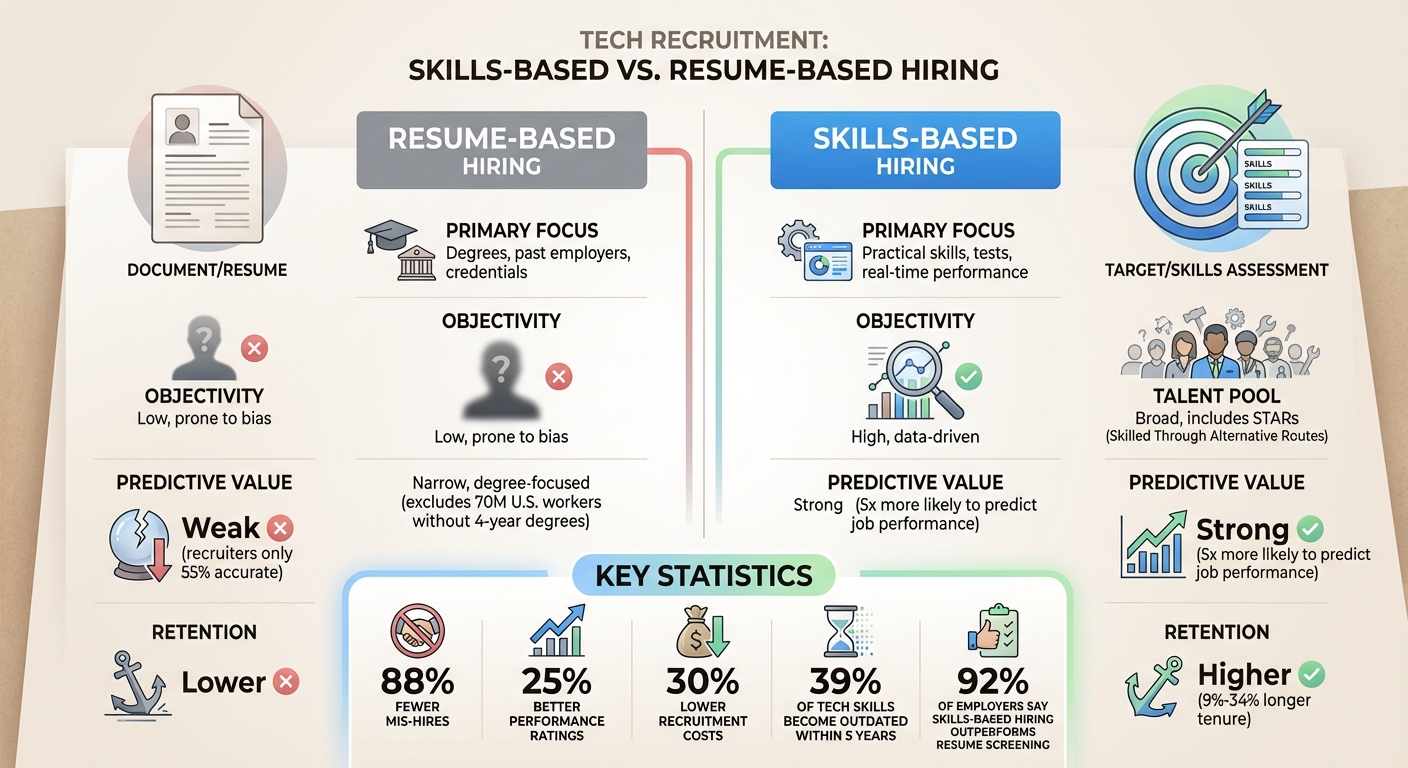 {Skills-Based vs Resume-Based Hiring: Key Differences and Performance Metrics}
Main Differences Between Skills-Based and Resume-Based Hiring
When it comes to hiring, the key difference lies in what's being measured. Resume-based hiring leans on credentials as proof of capability - things like education, previous employers, and years of experience. It relies heavily on proxies, which are indirect indicators of someone's abilities. On the other hand, skills-based hiring shifts the focus to actual performance, requiring candidates to demonstrate their abilities through coding challenges, writing tasks, or job simulations that reveal their current skills.
This difference in approach has a major impact on how candidates are evaluated. Resumes, for instance, are self-reported and often unreliable - over 70% of workers admit to inaccuracies on their resumes . Even when truthful, resumes tend to highlight past responsibilities rather than showcasing what a candidate can contribute to your specific role. In fact, one study found that candidates with the "best" resumes had a 34% lower performance rating compared to those who excelled in skills assessments . Employers overwhelmingly agree that skills-based hiring is a better way to identify talent - 92% say it outperforms traditional resume screening .
Industry leaders have also voiced their support for this approach:
"For me, attitude and aptitude are more important than whatever letters you have after your name, or whatever qualifications you've got on a sheet." - David Meads, former Cisco U.K. and Ireland CEO
Another critical issue with resumes is their lack of objectivity. Bias can creep in through details like school names, previous employers, or even a candidate’s address. Skills-based assessments, in contrast, rely on standardized rubrics and often use blind evaluations, removing personal identifiers to focus solely on measurable performance. This shift has proven impactful - employers who’ve adopted skills-based hiring report an 88% reduction in mis-hires .
Here’s a quick comparison of the two approaches:
Comparison Table: Skills-Based vs Resume-Based Hiring
| Feature | Resume-Based Hiring | Skills-Based Hiring |
|---|---|---|
| Primary Focus | Credentials, history, and "pedigree" | Practical abilities and real-time performance |
| Objectivity | Low; prone to bias regarding schools/names | High; focuses on measurable output and data |
| Talent Pool | Narrow; limited to those with specific degrees | Broad; includes "STARs" and non-traditional paths |
| Predictive Value | Weak; degrees are often "static" proxies | Strong; 5x more likely to predict performance |
| Time Requirement | Fast initial screening; slow long-term (turnover) | More upfront time for testing; faster onboarding |
| Retention | Lower; traditional hires are more mobile | Higher; skills-based hires stay 9%–34% longer |
Why Skills-Based Hiring Works Better for Tech Recruitment
How Skills-Based Hiring Finds Better Candidates
The tech world evolves at breakneck speed - frameworks shift, languages update, and yesterday's cutting-edge solutions become today's outdated practices. In this environment, relying on static credentials like degrees often falls short when it comes to identifying qualified technical candidates who can thrive in a technical role. By focusing on practical assessments instead of resume credentials, you’re zeroing in on what truly matters: a candidate’s ability to tackle real-world challenges with current tools.
The numbers tell the story. Recruiters are only 55% accurate in predicting whether a candidate will pass a technical interview based solely on their resume - just slightly better than a coin toss . Even more startling, two recruiters reviewing the same resume often have wildly different takes, with their predictions of a candidate's success varying by an average of 41 percentage points . This inconsistency underscores how subjective and unreliable resume screening can be.
Skills-based assessments eliminate much of this guesswork by providing standardized, objective evaluations. Instead of spending a median of just 31 seconds skimming a resume , you’re watching candidates actively solve problems - writing code, debugging issues, or designing solutions for scenarios they’ll encounter on the job. This method is five times more effective at predicting job performance , and 78% of HR professionals report improved hire quality after adopting skills assessments .
These practical evaluations also uncover a broader range of abilities. While only 13% of college graduates possess the immediate skills needed for technical roles , real-world simulations showcase both hard skills (like clean, efficient coding) and soft skills (such as how candidates explain their technical decisions or tackle challenges under pressure). This approach not only identifies top talent but also highlights the shortcomings of traditional resume-based hiring.
Problems with Resume-Based Hiring
Despite the advantages of skills-based hiring, many companies still rely on resumes - an approach riddled with flaws. Resume-based hiring often creates a false sense of confidence. Spotting a degree from a prestigious university or a stint at a FAANG company might seem reassuring, but this "pedigree bias" can lead to overlooking highly skilled candidates from non-traditional backgrounds. Worse, it can result in hiring individuals whose impressive credentials don’t necessarily translate to strong on-the-job performance.
The issues with resumes go beyond bias. Even when truthful, resumes are self-reported documents that emphasize responsibilities rather than proven abilities. Research from the American Psychological Association reveals that candidates with standout resumes actually performed 34% worse than those who excelled in skills-based assessments . Essentially, making hiring decisions based on resumes is like betting on a hunch rather than relying on hard evidence.
Resume filtering also unnecessarily narrows the talent pool. More than half of college graduates (54%) don’t work in their original field of study , which makes their degrees poor indicators of current technical skills. Automated resume filters often reject these candidates outright, along with the 70 million "STARs" (Skilled Through Alternative Routes) in the U.S. who’ve gained expertise through bootcamps, self-study, or hands-on experience . As the White House highlighted in January 2021:
"Degree-based hiring is especially likely to exclude qualified candidates for jobs related to emerging technologies."
The speed at which resumes are reviewed only compounds these problems. Spending just 14 extra seconds - raising evaluation time from 31 to 45 seconds - can improve prediction accuracy by 34% . But even with more time, resume reviews remain intuition-driven rather than data-driven. Skills assessments flip this script, replacing gut instincts with measurable, performance-based insights that actually predict success.
Business Impact of Skills-Based Hiring
Shifting the focus to performance-based evaluations, skills-based hiring not only brings in stronger candidates but also helps organizations save money and retain employees more effectively.
Efficiency and Cost Savings
Skills-based hiring streamlines recruitment, cutting costs while improving the quality of hires. Companies using this approach save an average of 30% on recruitment expenses compared to traditional methods, roughly $2,000 saved per hire . For Fortune 500 companies, this translates into significant savings - around $1 million annually in reduced recruitment costs .
Hiring mistakes can be costly, draining up to 30% of an employee's first-year salary , while unfilled positions cost businesses an average of $500 per day in lost productivity . By starting with technical assessments that test real-world skills, companies can identify qualified candidates early on, cutting down on lengthy and expensive interview processes . This shift has proven effective, with 89.8% of organizations using skills-based practices in 2022 reporting lower hiring costs and 92.5% experiencing fewer hiring mistakes .
For instance, Revolut implemented language proficiency tests for multinational hires in 2022, improving its time-to-hire metrics by 40% . Similarly, a mid-sized financial services firm working with Madison Approach reduced its annual recruiting costs by 34% and saw a 28% improvement in new hire performance ratings . These examples highlight how skills-based hiring not only saves money but also creates operational efficiencies that support long-term success.
Better Retention and Long-Term Results
Beyond immediate cost savings, skills-based hiring fosters a more stable and committed workforce. Employees hired through this method tend to stay longer, with retention rates significantly higher than those achieved through traditional hiring practices . By focusing on demonstrated abilities rather than academic credentials, companies often unlock opportunities for individuals who might otherwise be overlooked, which in turn builds loyalty.
Data shows that skills-based hires deliver 25% better performance ratings and experience 40% lower turnover rates compared to traditional hires . Organizations using skills-first strategies are also 107% more likely to place talent in the right roles and 98% more likely to retain high-performing employees .
For example, since 2017, Aon has partnered with City Colleges of Chicago to eliminate degree requirements for entry-level roles, placing over 300 early-career apprentices into full-time positions across IT, HR, finance, and marketing . Another success story comes from BMO’s BMORE initiative, which prioritized transferable skills like customer service and communication over formal degrees, hiring over 100 associate bankers across three states and helping them transition into long-term finance careers . These cases demonstrate how skills-based hiring builds stronger, more engaged teams that deliver lasting results.
Hiring engineers?
Connect with developers where they actually hang out. No cold outreach, just real conversations.
How Skills-Based Hiring Expands Your Talent Pool and Increases Diversity
Traditional hiring practices often rely on a "paper ceiling" - an invisible barrier that excludes around 70 million U.S. workers from higher-paying roles simply because they lack a four-year degree . By focusing on skills instead of credentials, skills-based hiring removes this barrier, opening up a more diverse talent pool.
Today, nearly 70% of jobs require a four-year degree, but less than 40% of U.S. workers have one . The disparity is even greater among underrepresented groups: 61% of Black adults and 55% of Latino adults don’t hold college degrees . These degree requirements disproportionately limit access to tech roles for these groups. By shifting the focus to practical abilities and expertise, skills-based hiring not only broadens access but also fosters innovation across tech industries.
Reaching Non-Traditional Candidates Through Skills-Based Hiring
Skills-based hiring shines a spotlight on candidates who are "Skilled Through Alternative Routes" (STARs) - those who have gained expertise through pathways like coding bootcamps, military service, community college, or self-teaching. These individuals often bring valuable, hands-on experience but are frequently overlooked by traditional hiring systems that prioritize degrees over accomplishments.
For example, in 2017, GE Digital collaborated with TechHire Rhode Island to fill positions at a new IT center in Providence. By focusing on bootcamp graduates rather than exclusively seeking degree holders, the company filled one-third of its open roles with non-traditional hires . Similarly, at IBM's Rocket Center in West Virginia, nearly one-third of new hires in cybersecurity and cloud computing lacked four-year degrees. Instead, they were chosen for their technical skills, such as Java coding, as IBM shifted to evaluating specific proficiencies .
"In the past, a manager might have said, 'I need someone with a four-year degree and X years of experience.' Now it's 'I need someone who knows how to code in Java.'" - Joanna Daly, Vice President of Talent, IBM
This emphasis on STAR candidates helps break down traditional degree barriers, opening doors to a more diverse workforce.
Removing Degree Requirements to Increase Diversity
Eliminating degree requirements helps level the playing field, shifting the focus from academic pedigree to demonstrated skills. This approach reduces unconscious bias during the hiring process and makes recruitment more inclusive. Research shows that hiring based on skills is five times more predictive of job performance than hiring based on education .
In May 2022, Maryland Governor Larry Hogan made a bold move by eliminating four-year degree requirements for about half of the state’s public-sector jobs. This decision created thousands of opportunities in fields like healthcare, law enforcement, and engineering for candidates with alternative training . Following Maryland’s lead, over 20 U.S. governors have removed degree requirements for public-sector roles .
The private sector is also embracing this shift. Ernst & Young UK removed degree requirements for entry-level programs after discovering no link between academic credentials and job performance. Instead, the company implemented proprietary assessments to gauge candidate potential. Between 2017 and 2022, the percentage of U.S. job postings requiring a bachelor’s degree dropped by 14% for roles like computer programmers and computer scientists .
"If you're limiting hiring to people with college degrees, we know minorities are underrepresented. In certain fields, we know women degree-holders are underrepresented." - Beth Cobert, CEO, Skillful
Beyond hiring, this skills-first approach also supports career advancement within companies. Employees can climb the ladder based on their proven abilities rather than their academic credentials, creating new pathways for growth. This not only helps build more engaged teams but also encourages long-term loyalty among employees.
How daily.dev Recruiter Supports Skills-Based Hiring
daily.dev Recruiter brings a fresh perspective to tech recruitment by focusing on what truly matters: skills. Unlike traditional platforms that rely on static resumes or outdated profiles emphasizing credentials, daily.dev Recruiter connects employers with developers based on their real-time engagement and proven abilities within a thriving professional network.
The platform pre-qualifies developers by analyzing their active participation on daily.dev, where engineers regularly read, learn, and interact with technical content. This approach ensures that recruiters engage with candidates whose skills are evident through their professional activities - not just written down on a resume. Studies show that skills-based hiring is five times more effective at predicting job performance than education alone . daily.dev Recruiter takes this insight further by aligning developer skills with their actual work and activity in the tech world . This creates a streamlined, skills-first recruitment process that stands apart.
How daily.dev Recruiter Makes Skills-Based Hiring Easier
daily.dev Recruiter simplifies hiring with warm, double opt-in introductions, removing the guesswork and bias often associated with traditional resume-based hiring. Matches happen only when both the recruiter and the developer show genuine interest, ensuring that every conversation begins with mutual intent and credibility rather than cold outreach.
This thoughtful approach addresses the "rigid classification" issue common in older systems . Instead of relying on keyword searches or degree requirements, the platform connects recruiters with developers who are actively engaged in their field and open to new opportunities. The result is impressive: 81% of companies using skills-based hiring report faster hiring times, and 78% see significant cost reductions .
Why daily.dev Recruiter is Designed for Tech Hiring
With 39% of core worker skills expected to change in the next five years , it's clear that formal education often struggles to keep up with evolving technologies in the tech industry. What matters most is a developer’s ability to quickly adapt and learn new technologies - not their mastery of tools that may already be outdated.
"Degrees don't always align with market needs." - Johnny C. Taylor, Jr., CEO, SHRM
daily.dev Recruiter bridges this gap by linking employers with developers whose current skills align with industry demands . The platform’s high engagement rates within a dedicated developer community make it easier for recruiters to discover top-tier talent that often goes unnoticed on traditional job boards. With 94% of employers agreeing that skills-based hiring is a better predictor of job success than resumes alone , daily.dev Recruiter ensures you’re connecting with candidates who have the right abilities - not just the right credentials.
Conclusion: Why Skills-Based Hiring is the Future for Tech Roles
The move from resume-focused hiring to prioritizing skills represents a major shift in how tech companies find and keep top talent. The numbers speak for themselves: skills-based hires are five times more likely to predict job performance . With 39% of core tech skills expected to change in the next five years , relying on static degrees simply doesn’t align with the rapid evolution of the tech industry.
This approach isn’t just about better performance and retention - though those benefits are clear. Skills-based hiring has led to a tenfold expansion of the talent pool and a 9% longer tenure for employees hired through this method . For an industry grappling with a global talent shortage and a projected $8.5 trillion loss due to the skills gap by 2030 , these improvements are game-changers. On top of that, this approach boosts workforce diversity in meaningful ways.
Dropping degree requirements opens up opportunities for 70 million workers with alternative skills, creating a more inclusive and merit-based hiring process . This shift is particularly impactful when you consider that 61% of Black adults and 55% of Latino adults don’t hold college degrees . By focusing on skills, companies can remove barriers and create pathways for underrepresented groups.
The key to making this transition successful lies in using the right tools. Platforms like daily.dev Recruiter are designed to support skills-based hiring by connecting you with developers who showcase their expertise in real-time. With warm, double opt-in introductions and pre-qualified candidates actively engaged in the tech community, this platform helps you identify talent where it’s already thriving. Considering that 96% of companies are now adopting skills-based hiring in some form , leveraging a specialized platform gives you a clear advantage.
From stronger candidate performance to broader, more diverse talent pools, the benefits of skills-based hiring are undeniable. The tech world is evolving quickly, and your hiring strategies need to keep pace. Skills-based hiring isn’t just a trend - it’s a smarter, more inclusive way to build high-performing teams that can meet the demands of a fast-moving industry.
FAQs
How does skills-based hiring help lower recruitment costs?
Skills-based hiring offers a practical way to cut recruitment costs by addressing mismatches early and speeding up the hiring process. By focusing on a candidate's actual abilities, this approach leads to smarter hiring decisions, reducing expenses tied to turnover and rehiring.
In fact, employers can save anywhere from $7,800 to $22,500 per role when they prioritize skills over traditional resumes. Beyond just saving money, this strategy enhances the efficiency and effectiveness of the entire recruitment process.
How does skills-based hiring improve diversity in the workplace?
Skills-based hiring opens doors to more opportunities by focusing on what candidates can do, rather than the degrees they hold. This method helps dismantle barriers that have historically kept many skilled individuals out of the running, particularly those without formal academic credentials. In the U.S., nearly half of the adult workforce doesn't have a college degree. Yet, studies reveal that workers hired based on their skills perform just as well as those with degrees - and often stay in their roles longer.
Relying on degree requirements also affects underrepresented groups disproportionately. For instance, only 28% of Black adults and 20.6% of Latino adults hold a bachelor’s degree, compared to 38% of White adults. By shifting from degree filters to skills-based assessments, companies can build more inclusive hiring practices. This change not only increases representation of women, minorities, and non-traditional candidates in tech but also enhances the overall quality of the talent pool.
For businesses ready to adopt this approach, daily.dev Recruiter offers a developer-focused platform that connects companies with pre-qualified engineers. By evaluating proven skills, this tool helps organizations tap into a broader, more diverse range of technical talent.
Why is skills-based hiring ideal for tech roles?
Skills-based hiring works particularly well in tech because it zeroes in on the exact technical skills that drive success on the job. By using tools like coding tests, project portfolios, or skill-based assessments, companies can quickly identify candidates who are ready to hit the ground running.
This method doesn't just save time and cut costs - it also broadens the talent pool, opening the door to a more diverse group of applicants. In a field where technologies and skill requirements are constantly shifting, relying solely on degrees or traditional resumes often misses the mark. Skills-based hiring helps you connect with candidates who are genuinely equipped to meet your needs.
.png)