When hiring developers, the debate often boils down to technical skills versus team fit. Both are important, but they serve different purposes:
- Technical Skills: Ensure immediate contributions to projects, reduce onboarding time, and directly impact productivity. However, overemphasizing skills can lead to poor collaboration and higher turnover.
- Team Fit: Promotes better collaboration, retention, and alignment with company values. But prioritizing fit too much risks skill gaps and groupthink.
Key Takeaways:
- Technical skills predict short-term performance but may become outdated quickly.
- Team alignment fosters long-term success but can delay immediate productivity.
- A balanced approach - hiring for both skills and fit - leads to stronger teams and better outcomes.
Quick Comparison
| Dimension | Focus on Skills | Focus on Fit | Balanced Approach |
|---|---|---|---|
| Immediate Impact | High | Low to Moderate | Moderate to High |
| Retention | Lower | Higher | Highest |
| Trainability | High | Low | Combines both aspects |
| Hiring Risks | Collaboration issues | Groupthink risks | Complex assessments |
Solution: Define role-specific benchmarks, use structured interviews, and assess both skills and alignment early in the process. Tools like daily.dev Recruiter can streamline hiring by connecting with pre-qualified developers who meet both criteria.
Why Technical Skills Matter in Developer Hiring
Technical skills are the backbone of a developer's ability to contribute from day one. Developers who already possess the required skills can hit the ground running, bypassing lengthy onboarding and training periods. Research backs this up: technical skills tests with a validity coefficient above 0.40 are reliable predictors of job performance. In fact, a hire based on skills is five times more likely to predict job success than one based on educational background.
Cognitive ability combined with job-related skills shows a strong correlation of 0.51 with performance. By bringing in a developer who already meets your technical requirements, you not only speed up productivity but also reduce the need for extensive mentoring.
Immediate Impact on Projects
When it comes to driving project momentum, nothing beats the advantage of hiring someone with the right technical expertise. Skilled developers can dive straight into your codebase, understand the architecture, and start shipping features with minimal hand-holding. This is especially important when deadlines are tight or when scaling rapidly.
On the other hand, hiring someone without the necessary technical foundation can create "technical debt." Developers lacking the right skills may produce buggy or incomplete code, leading to future fixes that drain team resources and disrupt timelines. In such cases, senior developers often have to step in to clean up the mess, taking time away from building new features and pushing projects forward.
"A developer without the right skills won't be making positive contributions... nine mediocre developers can't match the output of one great developer." – Frederick Brooks
The stakes are high: only 13% of college graduates are estimated to have the skills needed to start a job immediately. Add to this the fact that 78% of candidates admit to exaggerating their qualifications on resumes, and the importance of using the best developer assessment tools becomes crystal clear.
Role-Specific Technical Requirements
Not all technical skills are equally relevant - it’s about finding the right match for the specific role. For example, while a Python web developer might excel in one area, they may lack the TensorFlow expertise required for machine learning applications. This makes it crucial to evaluate whether a candidate has the exact competencies your role demands, whether that’s expertise in frontend frameworks or backend optimization.
However, 77% of developers feel that the technical assessments they face don’t accurately reflect the skills they’ll need on the job. To address this, design assessments that closely mirror real-world tasks. For instance, if your company operates in investment banking, testing candidates on financial data handling is far more relevant than asking them to build a generic weather app.
The trend is clear: 96% of developers believe problem-solving ability should take precedence over rote memorization in technical evaluations. Work sample tests and job auditions that simulate actual job responsibilities provide the clearest picture of a candidate’s abilities. To ensure these tests are fair and effective, have your top-performing developers complete them first to gauge difficulty and time requirements.
While technical expertise is a must, ensuring those skills align with your team’s specific needs is equally critical.
Why Team Alignment Matters in Developer Hiring
Once you’ve nailed down the importance of technical skills, it’s time to focus on what keeps everything running smoothly: team alignment. While technical expertise gets projects off the ground, team alignment ensures long-term success by fostering collaboration and retaining talent. The stats don’t lie: 80% of employee turnover happens because of poor hiring decisions, with most issues tied to misalignment with team values and work styles - not technical shortcomings. Even the most brilliant coder can become a challenge if they clash with your team’s dynamics.
Companies that emphasize soft skills and team alignment report 25% higher profit margins, and 9 out of 10 global executives agree that traits like adaptability and collaboration are more crucial than ever. As AI takes over repetitive technical tasks, the demand for people who excel in communication and teamwork has surged by 53%. In this new landscape, human compatibility is what sets teams apart.
Better Team Collaboration
Great teams aren’t just built on technical know-how - they thrive on qualities like trust, empathy, and open communication. These traits, collectively known as agreeableness, are the glue that holds high-performing teams together. Google’s Project Aristotle backs this up: their research revealed that emotional intelligence and effective communication are far more critical to team success than individual IQ scores.
"Agreeableness is the secret sauce of great agile teams... It means saying 'yes, and...' instead of 'yes, but.'" – Wouter Aghina, Partner, McKinsey
When team members share values and communicate clearly, roadblocks are easier to overcome. Aligned teams create an environment of psychological safety, where developers can voice challenges without fear of criticism. This doesn’t mean everyone sees eye to eye all the time; instead, it encourages healthy debates that lead to better solutions. Developers who align with your team’s core values tend to work more independently, freeing senior team members to focus on innovation.
This kind of collaboration also drives higher engagement and helps keep employees on board.
Higher Retention and Engagement
When developers connect with your company’s mission, they’re more than just employees - they’re invested team members. This alignment reduces turnover, boosts morale, and builds a team that’s in it for the long haul. Research from the Stanford Graduate School of Business shows that cultural fit during the first six months is a strong predictor of long-term success.
Take Starbucks as an example. In 2018, they started using behavioral interviews to evaluate interpersonal strengths, cutting employee turnover by 25% in just a year. Similarly, Unilever revamped their hiring process in 2023 by adding behavioral questions and gamified assessments. The results? A 50% reduction in hiring time, a 10% boost in hire quality, and a 16% increase in diversity hiring.
Moreover, 61% of employees say that opportunities to develop new skills play a major role in their decision to stay at a job. Developers who feel aligned with their team’s mission and work style are far more likely to engage in growth opportunities rather than look for their next gig.
Risks of Prioritizing Skills Over Fit
Hiring a developer who’s great at coding but struggles to work well with others is a recipe for disaster. In fact, 75% of employers have dealt with a "bad hire", and the consequences go far beyond the cost of recruitment. It can derail productivity, create friction within teams, and often ends with the employee leaving anyway . Focusing solely on technical skills can lead to poor communication and mismatched values, which not only disrupt workflows but can also spark deeper conflicts within the company.
Here’s the reality: 98% of employers and 97% of employees agree that alignment with company culture is key to workplace success . Yet, many hiring managers still prioritize resumes packed with technical achievements, only to watch these hires clash with managers, alienate colleagues, or disengage after a short stint . A developer who’s technically brilliant but disrupts team harmony can end up slowing progress rather than driving it forward . This challenge is even more pronounced in remote or hybrid teams - 82% of tech professionals prefer flexible work arrangements, but 65% report feeling less loyal when they don’t share their employer’s values .
"Imagine a tech genius who can't communicate with a team or be flexible when necessary." – Nadiia Kovalchuk, Leading IT Recruiter, Huntly
Another factor to consider is how quickly technical skills can become outdated. The shelf life of technical expertise has dropped significantly - from around 10 years in the 1980s to just four years today, with some predicting it could shrink to less than two years soon . Developers hired for niche skills, like Hadoop or Blockchain, may find their expertise irrelevant as technology evolves. Without strong interpersonal skills or the ability to adapt, they’re more likely to stagnate - or leave. Tech professionals already switch jobs 20% more often than workers in other fields, with an average tenure of just 2.7 years .
Workplace conflicts are another risk. Developers who struggle to communicate effectively often face challenges when discussing project requirements or resolving issues with stakeholders . And if they don’t share the company’s values, they may see their role as just a stepping stone, not a long-term opportunity . It’s no surprise that 58% of employers prefer to train a new hire rather than risk hiring someone overqualified who ends up feeling unchallenged or disengaged . The fallout? Lower morale, higher turnover, and more time spent managing conflicts than delivering results. Balancing technical skills with cultural alignment is crucial to avoid these pitfalls.
Risks of Prioritizing Fit Over Skills
Choosing a developer who blends well socially but lacks the necessary technical skills can seriously impact a team's productivity. The data speaks for itself: cognitive ability and job-related skills show a strong correlation with job performance at 0.51 . Yet, many companies still lean toward hiring for social compatibility rather than assessing both technical and soft skills needed to meet project demands. This imbalance often leads to immediate operational challenges.
With 84% of engineering leaders raising productivity targets due to AI integration and 67% of developers feeling the strain , even small skill gaps can create significant inefficiencies. Teams are left scrambling to make up for these gaps, resulting in avoidable errors and slower progress .
"Culture fit is just code for liking someone socially." – Patty McCord, former HR Head, Netflix
Beyond the operational impact, overemphasizing "fit" can stifle creativity. When teams are built around social compatibility, they often become too homogeneous, which fosters groupthink and limits innovative thinking. The numbers back this up: diverse teams are 35% more likely to outperform their peers financially . This advantage is lost when hiring focuses on sameness. Meanwhile, 87% of global senior executives acknowledge their companies are ill-equipped to address digital skills gaps . On top of that, 61% of developers without access to learning opportunities plan to leave their roles within a year , leading to expensive turnover and lost time.
Over time, these skill shortages slow down technology adoption, delay AI integration, and erode the productivity gains enjoyed by early adopters . Hiring managers are increasingly wary of candidates whose steep learning curves could disrupt project timelines . In short, while cultural alignment has its place, neglecting to vet technical expertise can derail both immediate goals and long-term success for teams.
Skills vs. Fit Comparison
::: @figure 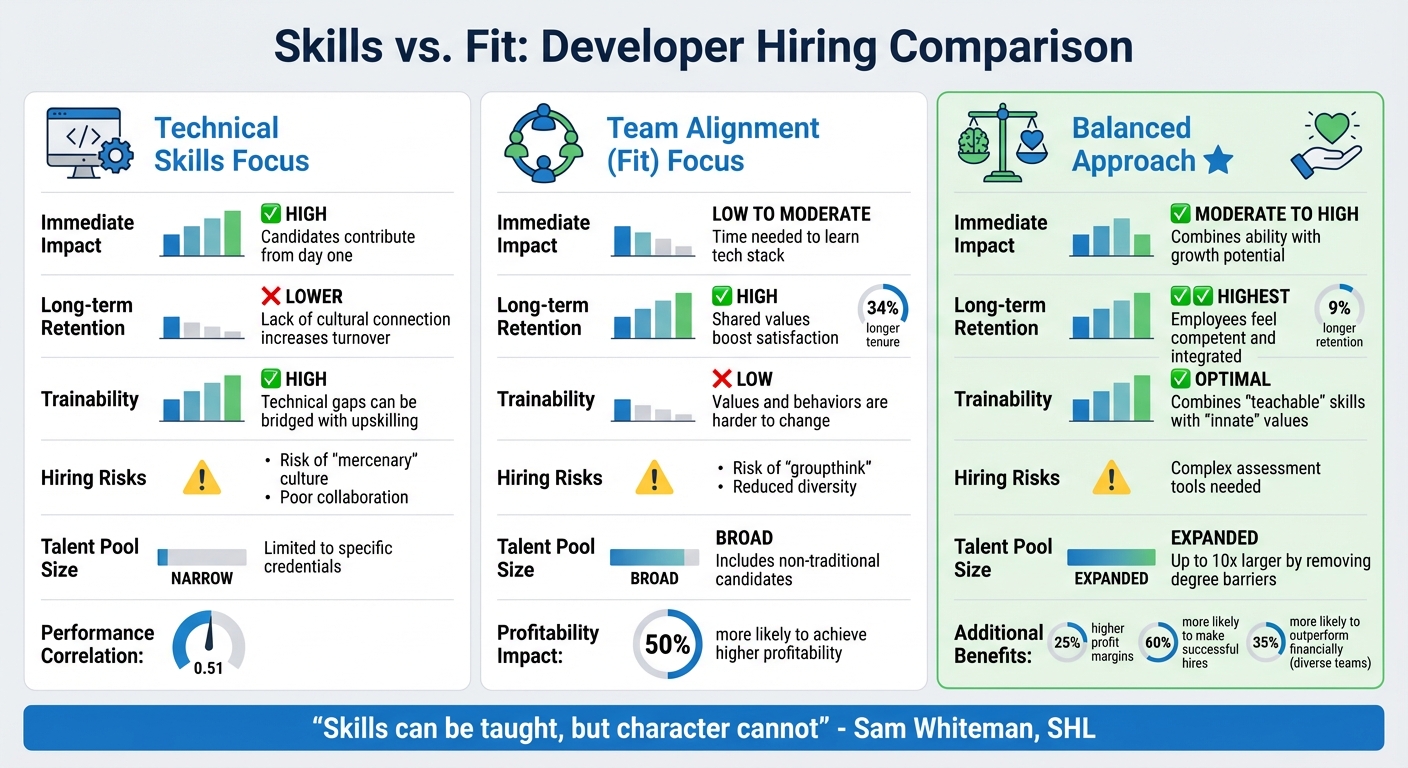 {Developer Hiring: Skills vs Fit vs Balanced Approach Comparison}
When it comes to hiring developers, the decision isn’t as simple as choosing between technical skills and team fit. Both have distinct benefits and risks, and understanding these trade-offs is key to making smarter hiring choices. Let’s break down how these factors compare and how they influence hiring outcomes.
Technical skills drive immediate results. Research shows that cognitive ability and job-specific skills have a strong correlation with job performance (0.51), far outpacing the impact of cultural fit alone . A developer with the right technical expertise can dive into your codebase right away, speeding up projects and reducing onboarding time. But there’s a downside - developers without growth opportunities or meaningful work are more likely to leave, with 40% planning to move on within a year .
Team alignment supports long-term success. Companies that prioritize team alignment are 50% more likely to achieve higher profitability compared to their peers . Employees hired through methods that include fit assessments tend to stay 34% longer than those chosen based on traditional credentials alone . However, overemphasizing fit can lead to homogeneity, with teams becoming vulnerable to groupthink. On the flip side, diverse teams are 35% more likely to outperform financially .
To clarify these trade-offs, the table below highlights how focusing on technical skills, team alignment, or a balanced approach can impact hiring outcomes:
Comparison Table
| Dimension | Technical Skills Focus | Team Alignment (Fit) Focus | Balanced Approach |
|---|---|---|---|
| Immediate Impact | High; candidates contribute from day one . | Low to Moderate; time needed to learn tech stack . | Moderate to High; combines ability with growth potential. |
| Long-term Retention | Lower; lack of cultural connection increases turnover . | High; shared values boost satisfaction . | Highest; employees feel competent and integrated . |
| Trainability | High; technical gaps can be bridged with upskilling . | Low; values and behaviors are harder to change . | Combines "teachable" skills with "innate" values. |
| Hiring Risks | Risk of "mercenary" culture; poor collaboration . | Risk of "groupthink"; reduced diversity . | Complex assessment tools needed . |
| Talent Pool Size | Narrow; limited to specific credentials . | Broad; includes non-traditional candidates . | Expands pool by up to 10x by removing degree barriers . |
The takeaway? A balanced approach offers the best of both worlds. By recognizing that technical skills are teachable and core values are more ingrained, you can build a team that’s not only skilled but also deeply committed to your organization’s goals.
How to Balance Skills and Fit
Finding the right balance between technical expertise and team compatibility involves a thoughtful evaluation of both aspects. The secret lies in designing a hiring process that focuses on what truly matters while minimizing bias.
Define Role-Specific Benchmarks
Begin by establishing clear, measurable criteria for both technical skills and alignment with your team's values before posting the job. For technical benchmarks, evaluate problem-solving skills (accuracy and efficiency), practical application (code structure, debugging, test-driven development), and systems design (scalability and familiarity with tools) . On the team alignment side, outline your company’s core values and pinpoint the behaviors that reflect them .
Customize these benchmarks for the role at hand. For instance, a backend-heavy full-stack developer will require a different skill set than someone focused on frontend development . Companies that prioritize soft skills like adaptability and collaboration alongside technical expertise report 25% higher profit margins . To respect candidates’ time, limit initial pre-screening tasks to 30 minutes and later-stage technical assignments to no more than three hours .
Once your benchmarks are clearly defined, evaluate candidates consistently against them.
Use Structured Interviews
Adopt standardized questions to ensure fairness and consistency in your evaluations. Using a pre-defined set of questions for all candidates helps reduce bias . Design your questions to align closely with the job’s requirements, incorporating a mix of situational questions (hypothetical scenarios), behavioral questions (using the STAR method to discuss past experiences), and skills-based questions (technical abilities specific to the role) .
This structured approach is crucial because unstructured interviews can cut hiring accuracy by more than 50% compared to structured methods . To further improve fairness, train interviewers with interactive workshops and mock interviews, ensuring they stick to templates and avoid subjective judgments . Move away from outdated methods like whiteboard puzzles and instead use hands-on exercises, such as pair programming in the candidate’s preferred IDE, to create a more authentic and productive assessment environment .
A structured interview process ensures that you're engaging with candidates who already meet your initial criteria.
Connect with Pre-Qualified Developers
After filtering candidates through benchmarks and structured interviews, focus on pre-qualified developers to streamline the process. Platforms like daily.dev Recruiter offer a warm, double opt-in model, connecting you with developers who are genuinely interested in your opportunity. This ensures initial alignment with your company’s values and the role’s expectations even before the interview stage. The platform leverages its active developer community to provide real-time insights into candidates’ skills and interests based on their engagement and learning patterns.
This method replaces impersonal cold outreach with tailored engagement, allowing you to connect with developers who are actively refining their skills and open to the right opportunity. Research shows that employers using skills-based hiring are 60% more likely to make successful hires , and these hires tend to stay with the organization 9% longer . By focusing on candidates who are already upskilling and aligned with your needs, you gain a head start in assessing both technical proficiency and team fit.
Conclusion
Building high-performing teams takes more than just technical know-how - it’s about finding the right balance between skills and alignment with team values. As Sam Whiteman, Managing Director at SHL, aptly says:
"Skills can be taught, but character cannot" .
The numbers back this up: blending soft skills with technical expertise can lead to 25% higher profit margins, extend employee retention by 9%, and help 75.4% of tech recruiters uncover exceptional talent beyond just resumes . These stats highlight why a well-rounded hiring strategy is so important.
To make this work, start by setting clear benchmarks for both technical abilities and team values before advertising a role. Structured interviews with standardized questions can help reduce bias , often including specific questions to test developer soft skills, while practical assessments like pair programming give a real sense of how candidates operate in action. And with nine out of ten global executives emphasizing the rising importance of soft skills , involving your current team in the interview process can offer valuable insights into collaboration potential.
For an edge in hiring, consider tools like daily.dev Recruiter, which connects you with pre-qualified developers who are actively learning, engaged, and aligned with your team’s values.
Ultimately, successful hiring hinges on balancing technical skills with cultural fit - this approach builds stronger teams, boosts retention, and drives long-term success.
FAQs
How can companies find the right balance between technical skills and team fit when hiring developers?
Building a strong development team requires finding the right mix of technical expertise and compatibility with the team. Start by assessing candidates' technical skills. You can do this by reviewing GitHub portfolios, conducting coding challenges, or using project-based assessments tailored to your tech stack. This ensures candidates have the technical know-how needed for the role.
Equally important is evaluating how well a candidate fits within the team. Use behavioral interviews, value-based assessments, or collaborative exercises like pair programming with potential teammates. These approaches provide insight into soft skills like communication, adaptability, and teamwork - qualities that are essential for long-term success.
A tool like daily.dev Recruiter can make this process more efficient. It connects you with pre-qualified developers who are already engaged, offering double opt-in introductions that streamline the evaluation of both technical skills and team compatibility from the very beginning.
What are the downsides of focusing only on technical skills when hiring developers?
Hiring based solely on technical skills without considering how well someone fits with the team can create big problems. Imagine a developer who’s great at coding but struggles to mesh with your team’s way of working. This mismatch can lead to poor collaboration, miscommunication, and frustration for everyone involved. Over time, these issues can drag down morale, increase burnout, and even push team members to leave.
On top of that, if a developer doesn’t align with your team’s values or dynamics, it can create ongoing tension. This disconnect might harm productivity, disrupt the workplace atmosphere, and make early departures more likely. Striking the right balance between technical know-how and team compatibility is key to building a cohesive, motivated, and long-lasting development team.
Why is it important to balance technical skills and cultural fit when hiring developers?
Hiring developers is all about finding the sweet spot between technical skills and team compatibility. Both play a crucial role in ensuring long-term success.
When it comes to technical skills, a developer needs to have the expertise to contribute to building and maintaining the product effectively. But if you focus only on their abilities, you might miss out on candidates who, while not proficient in every tool or framework, have the potential to learn quickly. Plus, overemphasizing skills can sometimes disrupt team dynamics, lead to higher turnover, or even cause you to overlook incredible talent.
On the flip side, prioritizing how well someone fits with the team’s values and communication style - often referred to as "cultural fit" - can backfire if their technical skills aren’t up to par. Skill gaps can slow progress or require expensive training to get them up to speed.
The best strategy? Evaluate both. Look for developers who not only have the technical expertise to deliver but also align with your team’s collaborative habits and values. This balanced approach helps create a strong team culture, improves retention, and builds diverse, high-performing teams that thrive together.
.png)