

In 2026, software engineer compensation is driven by specialization, skills-based hiring, and transparency. Here's what you need to know:
- Median Total Compensation: $190,417 in the U.S., with specialized roles (like AI/ML) earning 30%-50% more.
- Key Trends:
- AI/ML engineers see total packages exceeding $500,000.
- Regional pay differences remain vast, with no-income-tax states boosting purchasing power by 35%-50%.
- Remote roles typically pay 8%-12% less than in-office positions.
- Negotiation Insights:
- Candidates who negotiate secure 10%-20% higher pay.
- Signing bonuses, equity, and performance-based bonuses are critical for competitive offers.
- Geographic Pay Gaps: Salaries vary by nearly 98% between high-paying states like California and lower-paying states like Mississippi.
- Experience Levels:
- Junior engineers: $80,000–$140,000 base.
- Senior engineers: $150,000–$280,000 base, with total compensation often exceeding $500,000.
Specialized skills, like AI/ML, cybersecurity, and backend engineering, command higher pay due to demand and impact. Recruiters must use data-driven strategies and tools like Levels.fyi to align offers with developer goals and market standards.
::: @figure 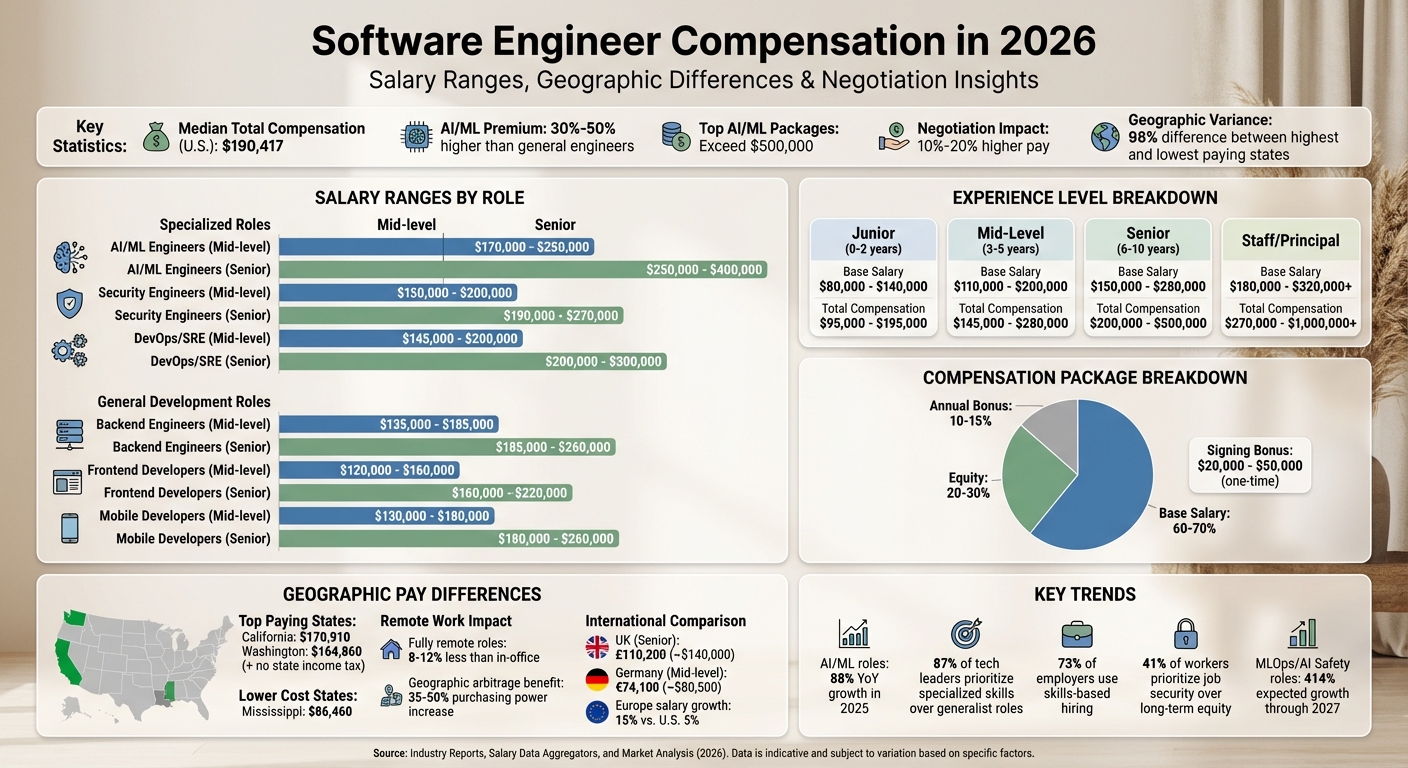 {Software Engineer Compensation Breakdown by Role and Experience Level 2026}
Software Engineer Salaries in 2026: Market Overview
Salary Growth Rates and Trends
By 2026, base salaries for software engineers have largely leveled off, with growth trends varying significantly between generalist and specialized roles . General engineering positions experienced modest growth of 1.6% in 2025 . Meanwhile, roles in AI and machine learning saw explosive growth, with an 88% year-over-year increase in the same period .
The national median salary for software engineers in the U.S. currently stands at $133,080, a figure that is 169% higher than the national average wage . Senior AI/ML engineers, in particular, have seen their median base salaries climb to $236,875 as of Q1 2026 - a 12% to 15% premium over generalist roles . Total compensation for these specialized positions often exceeds $500,000, thanks to equity and bonuses, which can add an additional 30% to 60% on top of base pay .
Geographic salary trends also highlight significant shifts. While U.S. salaries grew by 5% in 2026, European developer salaries rose by 15%, narrowing the global pay gap . Fully remote roles generally offer 8% to 12% less in base pay compared to in-office positions. However, engineers who relocate to states with no income tax, such as Washington, Texas, and Florida, often see their purchasing power increase by 35% to 50% . These regional differences underscore the evolving dynamics of compensation strategies.
These numbers paint a clear picture of how market forces are reshaping the compensation landscape.
What's Driving Compensation Changes
The hiring market has shifted away from the sweeping corrections of 2023–2024 and the efficiency-driven focus of 2025. According to Jeffrey Reynolds of Bytexel, hiring strategies in 2026 are now "surgical and data-driven", with 87% of tech leaders channeling budgets toward specialized skill sets instead of generalist roles .
"The era of the 'blind bidding' for senior engineering talent has officially ended, replaced by a surgical, data-driven market."
– Jeffrey Reynolds
The rise of AI continues to be the biggest factor influencing compensation. Engineers skilled in creating agentic workflows and integrating autonomous agents into SaaS platforms are commanding higher salaries . Demand for Applied AI engineers has grown by 9.2% since early 2025, while MLOps and AI Safety roles are expected to expand by 414% through 2027 - resulting in an estimated talent gap of 115,000 professionals .
This shift toward skills-based hiring is redefining how companies approach pay structures. Around 73% of tech employers now prioritize measurable results and tangible impact over traditional qualifications . Late-stage startups (Series C+) are offering 31% more for senior engineering leaders compared to seed-stage companies, reflecting a strategic focus on high-impact talent .
"Companies now pay for strategic architecture that enables safe, automated code generation."
– Jeffrey Reynolds
Economic caution also plays a role in shaping compensation strategies. Sixty-six percent of employers cite economic stability as a key concern, leading to more conservative base salary increases . Instead, negotiators are emphasizing performance-based equity refreshers and sign-on bonuses, often funded through separate talent acquisition budgets. Additionally, 41% of tech workers are now prioritizing job security and immediate liquidity over long-term equity grants, a response to past market volatility .
Hiring engineers?
Connect with developers where they actually hang out. No cold outreach, just real conversations.
Salary Ranges by Engineering Role
Frontend and Backend Engineer Salaries
In 2026, frontend developers at the mid-level typically earn salaries between $120,000 and $160,000, while senior-level roles command pay ranging from $160,000 to $220,000. On the other hand, backend engineers often earn more, especially at senior levels, where salaries are $10,000 to $20,000 higher than their frontend counterparts due to the technical challenges of scalability and distributed systems. Mid-level backend engineers see compensation ranging from $135,000 to $185,000, with senior roles offering between $185,000 and $260,000.
This difference in pay reflects the higher demand for backend expertise, which involves critical skills like database optimization, API design, and ensuring system reliability. These responsibilities are essential for scaling and maintaining infrastructure, whereas frontend roles, while crucial for user experience, are less directly tied to core system stability.
Beyond web development, other specialized roles such as mobile, DevOps, and AI/ML engineering show distinct salary trends.
Mobile, DevOps, and AI/ML Engineer Salaries
Mobile developers earn mid-level salaries between $130,000 and $180,000, with senior roles offering $180,000 to $260,000. DevOps and Site Reliability Engineers (SREs) see higher pay, reflecting the increasing importance of systems operations. Mid-level roles in these areas range from $145,000 to $200,000, while senior positions pay $200,000 to $300,000.
The highest salaries in this category belong to AI/ML engineers, who earn $170,000 to $250,000 at the mid-level and $250,000 to $400,000 in senior roles. These specialists consistently earn 30% to 50% more than general software engineers, as their work often addresses a company’s most critical challenges and opportunities.
"A specialist is often brought in to solve a company's most expensive problems or to unlock its most profitable opportunities." – Underdog.io Team
Another area with unique compensation patterns is security engineering, where demand is driven by the growing need to address cyber threats.
Security Engineer Salaries and Demand
Security engineers earn mid-level salaries between $150,000 and $200,000, with senior-level roles offering $190,000 to $270,000. These figures represent a 25% to 35% premium over general engineering roles due to the critical importance of cybersecurity. Organizations in industries like finance and healthcare, which handle sensitive data, often offer an additional $20,000 to $30,000 beyond standard tech-sector salaries to attract top-tier security talent. The rising number of cyber threats has made this specialization increasingly valuable across both tech and non-tech sectors.
Salaries by Experience Level
Junior and Mid-Level Engineer Salaries
For engineers just starting out (0–2 years), base salaries generally fall between $80,000 and $140,000, with total compensation (including bonuses and stock) ranging from $95,000 to $195,000 . These roles are focused on learning, skill development, and handling well-defined tasks.
Mid-level engineers, with 3–5 years of experience, see a bump in pay, earning base salaries between $110,000 and $200,000 and total compensation of $145,000 to $280,000 . At this stage, engineers are expected to work more independently, often managing complex system designs. For instance, a mid-level engineer (L4) at Google can earn a base salary of about $175,000, with total compensation reaching $280,000 when factoring in bonuses and stock options .
These roles set the stage for senior-level positions, where technical leadership and a broader impact become key.
Senior, Staff, and Principal Engineer Salaries
As engineers advance in their careers, their responsibilities expand significantly, along with their paychecks.
Senior engineers, typically with 6–10 years of experience, earn base salaries ranging from $150,000 to $280,000, with total compensation falling between $200,000 and $500,000 . These roles require expertise in designing major system features and leading teams through technical challenges.
At the top of the individual contributor ladder are staff and principal engineers, who take on responsibilities that include technical oversight and cross-team strategy. Base salaries for these roles begin at $180,000 and can exceed $320,000 , while total compensation ranges from $270,000 to over $1,000,000 . At major tech companies, principal engineers (L7) often surpass $820,000 in total pay, with approximately $320,000 in base salary, $400,000 in stock, and $100,000 in bonuses .
"At the staff level and above, total compensation at major tech companies regularly exceeds $500,000... These roles require deep technical expertise and the ability to drive architecture decisions across entire product areas." – HackerX
Climbing from senior to staff or principal roles isn't just about logging years of experience. It also demands a proven ability to influence technical strategy across teams and make a measurable organizational impact.
Geographic Pay Differences and Remote Work
Salary Differences by Region
When it comes to software engineer salaries, the United States remains at the forefront, especially in senior roles within major tech hubs. Compensation packages for these positions can range from $300,000 to $450,000 . California stands out, offering salaries as high as $170,910, while states with lower living costs, like Mississippi, provide averages closer to $86,460 .
Meanwhile, Europe is steadily closing the gap. While U.S. salaries grew by just 5% recently, European compensation saw a 15% increase . In the UK, mid-level engineers earn a median of £70,500 (roughly $89,500), with senior roles averaging £110,200 (around $140,000) . Germany offers mid-level engineers salaries near €74,100 (approximately $80,500) .
However, raw salary figures don’t tell the full story. For instance, a salary of $155,000 in Raleigh, NC, offers more purchasing power than $210,000 in San Francisco due to significant cost-of-living differences . Washington state adds another layer of appeal with a median salary of $164,860 and no state income tax, maximizing take-home pay .
"The cost advantages of hiring engineering hubs in lower-cost countries like Poland or Romania are still very attractive. But we're also seeing an increase in startups deliberately keeping their hiring local in the early days." – Andrew Duncan, Talent Director, Atomico
These variations emphasize how local economic factors shape competitive pay packages.
How Remote Work Affects Salaries
The rise of remote work has further complicated the salary landscape, blending traditional location-based pay with newer remote compensation models. Understanding these nuances is key to making informed decisions. For companies, following a guide to hiring remote developers can help navigate these complexities.
Remote work has reached what some call a "new equilibrium." On average, salaries for remote roles stabilize at 70–90% of U.S. on-site rates, regardless of the worker's location . Fully remote positions often pay 8–12% less than their in-office counterparts .
Three main models now dominate remote pay structures:
- Location-agnostic: Companies like Basecamp set salaries based on top-tier benchmarks, such as the 90th percentile for San Francisco, where senior roles average around $205,000 .
- Tiered: Employers like GitLab adjust pay based on cost-of-living. For example, a role paying $190,000 in San Francisco might pay $120,000 in a mid-tier U.S. city .
- Local-market benchmarked: Compensation aligns with the economic conditions of the employee's specific location.
Many engineers are leveraging geographic arbitrage to maximize their earnings. By securing high coastal salaries while living in lower-cost regions like Texas or Tennessee, they can boost their effective income by 35–50% . States with no income tax, such as Florida or Nevada, can save workers $15,000–$40,000 annually compared to California .
Before accepting a remote position, it’s essential to clarify the pay model. For example, under a tiered system, moving to a different city could result in a 15–25% pay reduction . Knowing these details upfront can help avoid surprises and ensure better financial planning.
Total Compensation Package Breakdown
Base Salary, Equity, and Bonus Structure
When evaluating a job offer, it's essential to break down the different components of compensation. In 2026, the median total compensation for software engineers in the U.S. hit $190,417 . This figure highlights the importance of understanding all the elements that contribute to your total earnings.
"Think of your total compensation offer as a three-legged stool: a steady base, a performance-based reward, and a long-term investment in the company's success." – Underdog.io Team
Typically, compensation is divided into three parts: 60–70% base salary, 20–30% equity, and 10–15% annual bonuses . The base salary is the foundation - it covers daily expenses and serves as the basis for raises and other benefits. Equity, which could be Restricted Stock Units (RSUs) at established companies or stock options at startups, represents potential long-term wealth. Bonuses, often 5–20% of your base salary , reward individual performance and company achievements.
Signing bonuses are another key component, often ranging from $20,000 to $50,000 . These one-time payments are common tools to offset unvested equity or a lower base salary. At top companies, these figures can soar. For example, in early 2026, OpenAI offered senior software engineers total compensation packages between $620,000 and $730,000, including $210,000–$250,000 base salary, $300,000–$400,000 in profit participation units annually, and $50,000–$80,000 in bonuses . Meta's Senior (E5) engineers earned $450,000–$550,000, with $210,000–$240,000 as base salary, $170,000–$250,000 in annual equity, and $30,000–$55,000 in bonuses .
Startups, on the other hand, often grant higher equity percentages, but this equity remains illiquid until an exit event, unlike the liquid RSUs offered by larger tech companies. On average, equity grants at the 50th percentile are 8.6% of base salary, though they can exceed 20% for critical roles like Cybersecurity or SRE .
To fully understand an offer, use this formula: Base + Annual Equity Vesting + Bonus Target + Benefits Value = Real Value . Don’t just take a "target" bonus at face value - ask recruiters for historical payout data over the last two years to see if it aligns with expectations .
While monetary elements are vital, benefits significantly enhance the overall value of a compensation package.
Benefits and Perks
Benefits play a crucial role in rounding out your total compensation. Standard offerings like medical, dental, and vision insurance are common, but the extras - like retirement matching and professional development - often set companies apart.
For instance, 401(k) matching at established companies typically adds between $3,000 and $15,000 annually . Professional development budgets for senior engineers now average $5,000 to $7,500 per year , covering certifications, conferences, and courses. These stipends have become increasingly important as engineers look for opportunities to grow their skills.
Remote work perks are now a standard part of many offers. Home office stipends range from $1,000 to $3,000 , with some companies also covering monthly internet or co-working space fees. Employees who transition from office-based to remote work can save an additional $3,000 to $8,000 annually in commuting costs .
Specialized roles, such as AI/ML Engineers, often come with added perks like expanded professional development budgets. This aligns with a shift toward compensating employees based on the complexity of the problems they solve rather than just their years of experience.
"The era of the 'blind bidding' for senior engineering talent has officially ended, replaced by a surgical, data-driven market." – Jeffrey Reynolds, Bytexel
A thorough review of benefits is essential when evaluating an offer. If a company can’t increase the base salary, candidates often negotiate for larger signing bonuses, additional equity, or accelerated vesting schedules . Benefits can make up 15–25% of your total compensation, so they’re a critical factor in assessing the overall value of an offer.
How to Benchmark Competitive Offers
Getting your offers right can be the difference between attracting top talent or losing them to competitors. By 2026, candidates are doing their homework on compensation well before engaging with recruiters. They’re diving into data from platforms like Levels.fyi and Glassdoor, checking conversations on Blind, and scrutinizing total compensation packages. If your offer doesn’t measure up, they’ll know - and they might walk away.
The trick? Use the same tools candidates rely on, but approach them from a recruiter’s perspective. Focus on total compensation, not just base salary. For example, when comparing roles like L5 at Google or E5 at Meta, you’re aligning on specific levels rather than relying on broad job titles . This data-driven strategy provides a solid foundation for refining offers with your company’s internal analytics.
Using Levels.fyi and Glassdoor for Salary Data
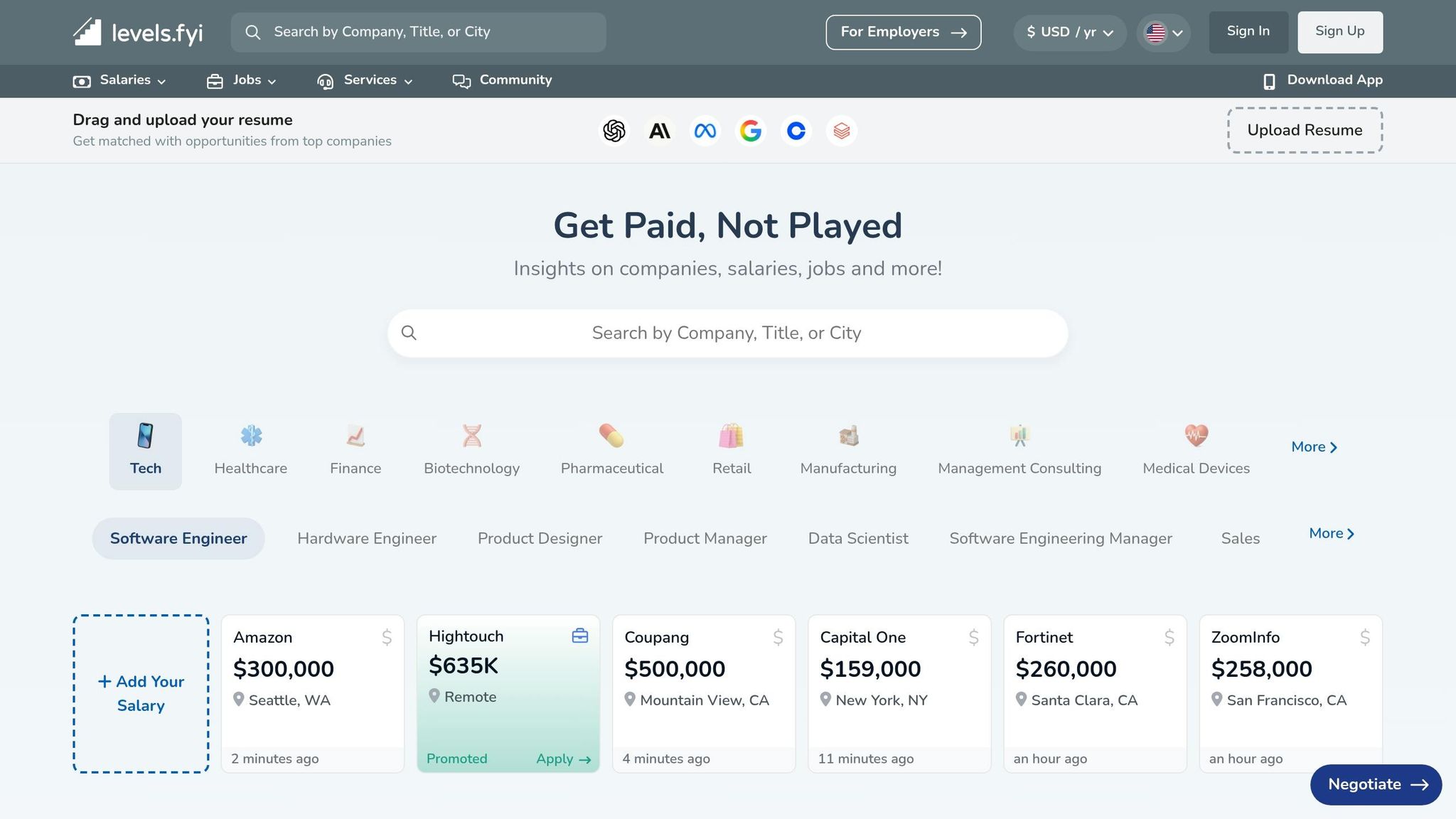
Platforms like Levels.fyi give you a clear snapshot of compensation when you filter by metro area, company stage, and job level. A Senior Software Engineer in San Francisco, for instance, typically earns 40–60% more than someone in Austin or Denver . Instead of relying on national averages, zero in on the exact market where you’re hiring. For remote roles, consider how competitors handle location-based pay - some stick to flat global rates, while others use tiered compensation based on geographic zones .
Specialized skills also carry premiums. Engineers with expertise in Rust or Go can earn 10–20% more than those using more common programming languages . Similarly, AI/ML engineers often command a 30–50% premium over general software engineers . Glassdoor can serve as a backup to validate these ranges and provide company-specific insights into compensation expectations .
"My research on Levels.fyi for [your role/stack] at this company stage puts the market at [range]. I'm not trying to be difficult - I just want to make sure we're aligned on what the role is worth in the current market."
This is the kind of data candidates bring to the table during negotiations. By coming prepared with the same insights, you’ll avoid being caught off guard. From there, you can integrate your company’s internal metrics to tailor offers even further.
Using Internal Data to Refine Offers
External benchmarks set the context, but internal data determines what’s realistic for your company. Start by reviewing your budgeted salary ranges and bonus history to ensure offers align with market data without exceeding internal constraints . For example, if your team consistently pays out bonuses below the target percentage, your cash offer should compensate for that shortfall to stay competitive.
Aligning your internal levels with industry standards is another key step. Using the Levels.fyi framework, you can translate a candidate’s current level at a FAANG company to your internal structure . For instance, if you’re recruiting someone at Google’s L5 level, figure out how that maps to your Senior or Staff roles and adjust compensation accordingly. Reviewing past hiring data can also reveal whether your equity grants need adjustments to attract top-tier talent .
When base salary bands are fixed, consider using signing bonuses to close the gap . For high-impact roles like AI/ML engineers - where their contributions directly influence revenue - documenting the return on investment can justify offering top-of-market pay . Tying compensation to measurable business outcomes can make premium offers easier to defend internally.
Negotiation Strategies for Recruiters
Gone are the days when recruiters could make offers without considering the wealth of compensation data candidates now have at their fingertips . Today’s candidates come prepared with real-time salary benchmarks, and if your offer doesn’t align with their research, they might walk away. To stay ahead, recruiters should focus on crafting offers that anticipate objections, using the same market data candidates rely on. This approach shifts negotiations from reactive to proactive, ensuring offers are competitive from the start.
Using Market Data to Anchor Offers
Leverage detailed salary data to frame discussions around Total Compensation right from the beginning. Focusing solely on base salary can come across as inexperienced or suggest a weaker equity package. Instead, highlight the full picture: Base Salary + Annual Equity Vesting + Bonus Target + Benefits Value . For instance, when structuring a Senior AI Engineer's package, ensure it aligns with current industry benchmarks for 2026.
Platforms like Levels.fyi can be invaluable for contextualizing your offer. By referencing the same data candidates use, you can turn negotiations into a collaborative, transparent conversation.
For highly specialized roles - such as AI/ML, Cybersecurity, or SRE - consider offering premium packages. Senior AI Engineers, for example, often command a 12–15% premium, with total compensation ranging from $273,000 to over $459,000 . If tight salary bands limit flexibility, build a business case. For example, an SRE who prevents downtime (saving up to $9,000 per minute) could justify a package exceeding $300,000 .
Structuring Equity and Bonus Packages
When internal salary bands cap base pay, equity and bonuses become critical tools for negotiation. On average, equity grants for senior hires are about 8.6% of base salary, but for roles like Cybersecurity, they can exceed 20% . Highlighting equity value can help balance offers that may seem less competitive on base salary alone.
To address concerns about bonuses, share historical payout data. For instance, a "15% target bonus" could realistically yield around 105% of the target amount - turning a $30,000 target bonus into approximately $31,500 . This level of transparency can make variable pay feel more dependable as part of the overall package.
For startups, clearly explain the equity story. Break down details like the cap table, liquidation preferences, and potential liquidity paths . This clarity can make equity offers more compelling, even if the base salary is lower.
If increasing base salary isn’t an option, signing bonuses can be a strategic workaround. For example, offering a $30,000 signing bonus could help offset unvested equity a candidate might forfeit by leaving their current role . Other creative options include accelerated equity vesting schedules or look-back clauses on RSUs to protect against stock price volatility .
Speed is another critical factor in securing top talent. While Big Tech interview processes can take 4–6 weeks, completing your process in just two weeks can give you a significant advantage, allowing you to lock in candidates before competitors make their move .
How daily.dev Recruiter Matches Compensation Expectations
daily.dev Recruiter takes a data-driven approach to simplify the process of aligning compensation expectations right from the start.
One of the biggest headaches in tech recruiting is dealing with mismatched compensation expectations, which can waste time for both recruiters and candidates. By focusing on connecting you with candidates who already have clear, pre-set compensation expectations, daily.dev Recruiter ensures smoother interactions from the very first introduction. These introductions are warm and double opt-in, meaning both parties agree to connect before any conversation begins.
Aligning Compensation Through Candidate Signals
The platform leverages warm, double opt-in introductions to ensure both recruiters and candidates are on the same page before any discussions take place. Developers on daily.dev can specify their area of expertise, seniority level, and willingness to explore new opportunities. These details act as key signals for compensation expectations. For instance, a developer specializing in AI/ML with over five years of experience might indicate a target salary range of $180,000–$230,000+ in major tech markets.
This early transparency allows recruiters to share tech hiring budget ranges during the initial pre-screening phase, helping to manage expectations and avoid surprises later on.
Reducing Offer Mismatches with Pre-Qualified Candidates
daily.dev Recruiter connects you with developers who are actively signaling their career interests on the platform. This means every introduction is not only warm but also backed by context, ensuring that candidates are genuinely interested in engaging with recruiters.
The platform also offers robust targeting options, enabling you to filter candidates by their tech stack, years of experience, and location. This level of pre-qualification minimizes the chances of mismatched offers. By the time you’re ready to extend an offer, it’s already in line with the candidate’s expectations, cutting down on lengthy negotiations and paving the way for a smoother hiring process.
Conclusion
By 2026, software engineer compensation revolves around specialization, transparency, and comprehensive rewards. The national median total compensation hit $190,417 that year. But averages can be misleading. In high-demand areas, like AI and machine learning, engineers earn 30% to 50% more than general software engineers. Geographic differences also play a huge role, with compensation varying by nearly 98% between states like California and Mississippi.
Generic benchmarks don’t cut it anymore. Tools like Levels.fyi and Glassdoor provide role-specific, seniority-adjusted data reflecting current market trends. Negotiation can also make a big difference - potentially increasing offers by 10%–20%. And if higher base salaries aren’t an option, recruiters can sweeten the deal with signing bonuses, accelerated vesting schedules, or additional equity.
This shift emphasizes the importance of clarity and alignment early in the hiring process.
"Negotiating a senior developer salary in 2026 is no longer about winning a battle of wills; it is about proving a mathematical necessity." - Bytexel
As discussed earlier, the key isn’t just knowing the numbers - it’s about setting clear expectations from the start. Lowball offers or mismatched expectations waste time and damage trust, especially since candidates can quickly verify compensation data. Platforms like daily.dev Recruiter help solve this issue by connecting you with developers who’ve already signaled their salary expectations and seniority. Every introduction is double opt-in, ensuring you only engage with candidates aligned with your budget.
With 129,200 annual job openings for specialized talent, speed and precision are non-negotiable. By leveraging pre-qualified matches and clear candidate signals, daily.dev Recruiter helps you make competitive offers that close faster and fit your budget.
FAQs
How do I compare offers using total compensation, not just base pay?
When comparing job offers, it's important to look beyond just the base salary. Take into account the bonuses and equity that come with the role. These additional components can greatly influence the total value of an offer, sometimes outweighing the base pay alone. By evaluating the entire package, you can get a clearer picture of the full worth of each opportunity.
What’s the best way to adjust salary expectations for remote vs. in-office roles?
Remote tech workers often see a base salary that's about 5–15% lower than their on-site counterparts. However, they can make up for this difference through major savings on living costs, especially when they live in more affordable areas while earning salaries tied to higher-cost regions. This concept, often called geographic arbitrage, can be a game-changer for financial planning.
Fully remote positions at leading companies typically offer 85–95% of the total compensation of on-site roles. Geographic pay adjustments are another factor to consider - they can help you maximize your earnings depending on where you choose to live. Keep these points in mind when weighing remote versus in-office opportunities.
Which skills are most likely to boost my pay in 2026?
Skills that can lead to higher earnings in 2026 include proficiency in cloud computing, artificial intelligence (AI), machine learning, backend development, and DevOps. These fields are projected to offer increased salaries and bonuses as demand rises and their importance in technology continues to grow.
.png)


