Platform engineers are in high demand in 2026, as 80% of large software organizations now rely on dedicated platform teams to streamline development processes. These professionals create Internal Developer Platforms (IDPs) that simplify workflows, reduce developer cognitive load, and improve software delivery speed by up to 40%. However, finding the right talent is challenging due to the specialized mix of infrastructure expertise and product-focused thinking required.
Key Takeaways:
- Role Focus: Platform engineers build self-service tools and "golden paths" to improve developer experience, distinct from DevOps and SRE roles.
- Skills Needed: Proficiency in Kubernetes, Terraform, CI/CD, developer portals, and security governance. A product mindset is essential.
- Salary Trends: Median salaries in North America are $178,000, with senior roles exceeding $300,000 at top companies.
- Where to Recruit: Focus on cloud-native communities like CNCF, KubeCon, and PlatformCon, or use tools like daily.dev Recruiter for warm leads.
- Interview Focus: Test for technical expertise (IaC, automation, security) and the ability to design developer-friendly systems.
Platform engineers are transforming how teams build and deliver software, and hiring the right talent requires a clear strategy, competitive offers, and targeted recruitment efforts.
What Platform Engineers Do: Roles and Responsibilities
::: @figure 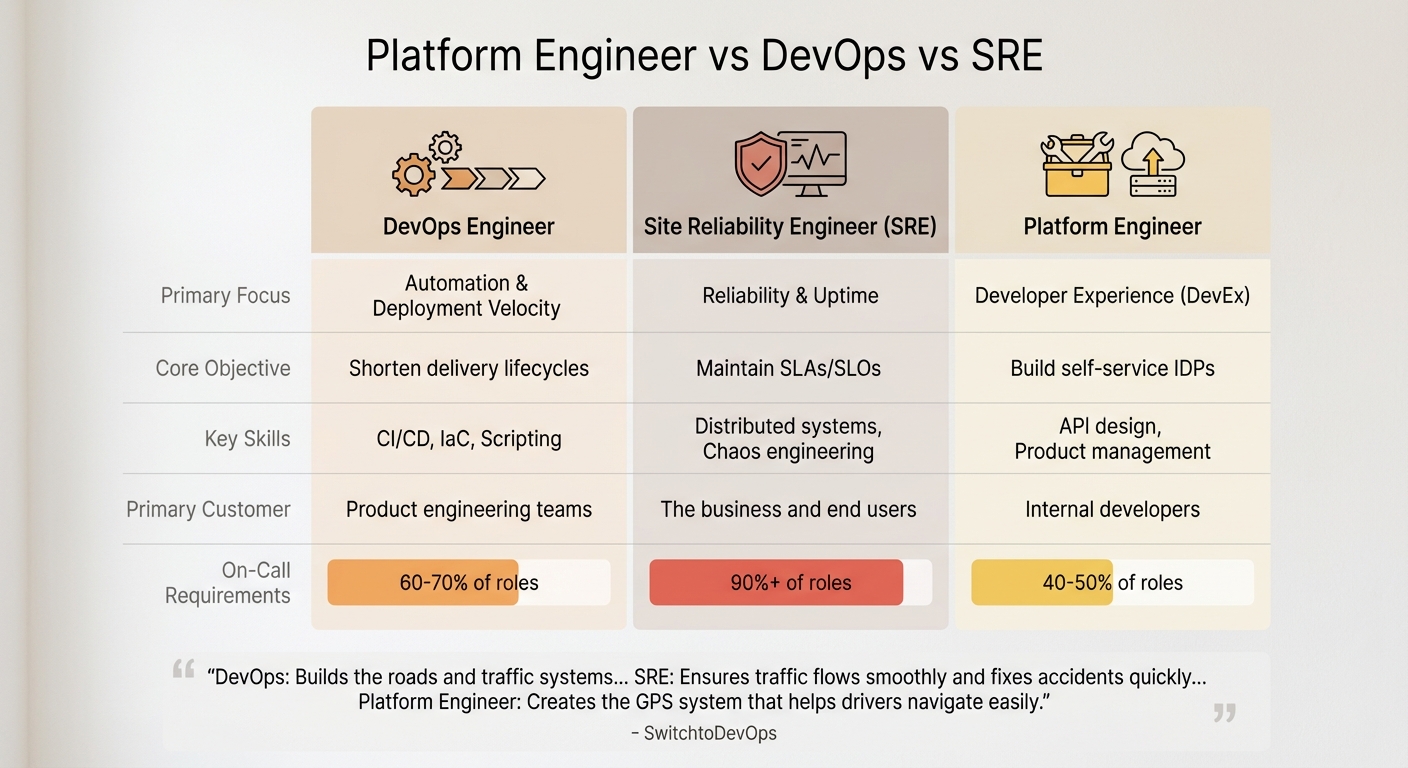 {Platform Engineer vs DevOps vs SRE: Key Differences in Roles and Responsibilities}
Platform engineers are responsible for designing and maintaining Internal Developer Platforms (IDPs) that simplify the work of internal development teams. Their main goal is to create self-service infrastructure that reduces the mental overhead for developers. This means taking care of complex tasks like managing Kubernetes configurations, IAM policies, and cloud networking, so product teams can focus on coding rather than wrestling with configuration files.
To succeed, platform engineers adopt a platform-as-a-product mindset. They actively gather feedback from developers, plan targeted improvements, and monitor how well the platform is being adopted. A key tool in their arsenal is the creation of "Golden Paths" - predefined templates for common tasks, such as launching new services. These templates often come pre-equipped with built-in CI/CD, monitoring, security, and backup features. The result? Developers can complete routine tasks with far less effort. In fact, effective Golden Paths can reduce cognitive load by a factor of 10 and accelerate delivery speeds by 3 to 7 times .
Unlike product developers, platform engineers carry some responsibility for the reliability of shared infrastructure used across teams. However, their on-call duties are lighter compared to Site Reliability Engineers (SREs). Only 40-50% of platform engineering roles involve on-call rotations, whereas more than 90% of SRE positions require them . Platform engineers ensure the uptime of critical tools like developer portals, deployment pipelines, and APIs that allow developers to provision resources - databases, caches, environments - without needing to submit manual requests.
This unique blend of responsibilities highlights how platform engineers differ from other roles in the tech landscape.
Platform Engineer vs DevOps vs SRE
While platform engineers, DevOps engineers, and SREs are often grouped together, their roles are distinct. DevOps engineers focus on improving automation and speeding up deployment processes. SREs are tasked with ensuring system reliability and uptime, often through managing SLAs and responding to incidents. Platform engineers, on the other hand, concentrate on improving the developer experience by building infrastructure that empowers internal teams.
| Dimension | DevOps Engineer | Site Reliability Engineer (SRE) | Platform Engineer |
|---|---|---|---|
| Primary Focus | Automation & Deployment Velocity | Reliability & Uptime | Developer Experience (DevEx) |
| Core Objective | Shorten delivery lifecycles | Maintain SLAs/SLOs | Build self-service IDPs |
| Key Skills | CI/CD, IaC, Scripting | Distributed systems, Chaos engineering | API design, Product management |
| Primary Customer | Product engineering teams | The business and end users | Internal developers |
| On-Call Requirements | 60-70% of roles | 90%+ of roles | 40-50% of roles |
"DevOps: Builds the roads and traffic systems... SRE: Ensures traffic flows smoothly and fixes accidents quickly... Platform Engineer: Creates the GPS system that helps drivers navigate easily." - SwitchtoDevOps
The evolution from DevOps to platform engineering reflects how organizations mature over time. DevOps popularized the idea of "you build it, you run it", but platform engineering introduces a new concept: "we build the platform, you build the product" . This shift becomes essential when teams experience high levels of developer friction, face onboarding processes that drag on for weeks, or struggle with a chaotic sprawl of tools. By 2026, 80% of large software organizations are expected to have platform teams in place , acknowledging that the traditional DevOps model struggles to scale effectively.
Next, we’ll dive into the technical expertise platform engineers need to bring this vision to life.
Hiring engineers?
Connect with developers where they actually hang out. No cold outreach, just real conversations.
Required Skills for Platform Engineers
Platform engineers bring together advanced technical skills and a product-oriented mindset to design self-service infrastructure that streamlines workflows for developers. Unlike traditional infrastructure roles, their work focuses on reducing barriers for developers while maintaining technical excellence. This unique combination of skills allows them to create platforms that cut down operational complexity.
By 2026, the tools and practices in platform engineering have matured significantly. While DevOps engineers often concentrate on individual CI/CD pipelines, platform engineers build broader systems - entire control planes that let developers provision resources independently, without needing to submit support tickets. Achieving this requires expertise in five critical areas: developer portals, infrastructure-as-code, delivery automation, observability, and security governance .
"The most important shift in platform engineering is treating your platform as a product with internal customers (your developers)" - Marcus Rodriguez, Lead DevOps Engineer, ZeonEdge
Technical Skills: Kubernetes, Terraform, CI/CD, and Developer Portals
Platform engineering relies on four main technical pillars. Kubernetes remains the go-to solution for container orchestration, but platform engineers need to dive deeper than basic pod management. They must grasp advanced concepts like Custom Resource Definitions (CRDs), operators, and tools like Kyverno or Open Policy Agent (OPA) to enforce automated safeguards without slowing down workflows .
Infrastructure-as-code (IaC) tools form the backbone of resource management. Terraform continues to lead in multi-cloud provisioning, while Crossplane is increasingly vital for Kubernetes-native infrastructure. Crossplane allows developers to provision cloud resources - like databases or storage buckets - using kubectl commands and GitOps workflows, all tied to version-controlled processes .
Developer portals act as the interface for internal platforms. Solutions like Backstage, Port, and Cortex provide a centralized hub for service catalogs, documentation, and self-service tools. These portals often include scaffolding templates that enable teams to launch new microservices - complete with pre-configured CI/CD pipelines, logging, and security - in under 30 minutes .
GitOps-driven CI/CD tools round out the delivery automation layer. Mastery of tools like ArgoCD and Flux is essential for declarative deployments, alongside pipeline engines such as GitHub Actions. For instance, a mid-sized organization with 100 engineers implemented an internal developer platform (IDP) using Backstage, ArgoCD, and Crossplane in early 2026. Over six months, they reduced environment provisioning time from 3 days to just 12 minutes, while cutting new developer onboarding from 2 weeks to 2 hours. Their developer Net Promoter Score also jumped from -15 to +42 .
| IDP Layer | Core Technologies | Purpose |
|---|---|---|
| Developer Portal | Backstage, Port, Cortex | Service catalog, scaffolding, self-service UI |
| Infrastructure | Terraform, Crossplane, Pulumi | Cloud resource provisioning and IaC |
| Delivery (CI/CD) | ArgoCD, Flux, GitHub Actions | GitOps-based deployment and automation |
| Observability | Prometheus, Grafana, OpenTelemetry | Metrics, logs, and distributed tracing |
| Security & Governance | OPA, Kyverno, Trivy | Policy enforcement and vulnerability scanning |
For observability, tools like Prometheus, Grafana, and OpenTelemetry automate service monitoring, while policy-as-code tools like OPA and Kyverno ensure security and compliance without requiring manual intervention . This blend of technical expertise and user-centered design is key to building platforms that enhance productivity.
Developer Experience and Infrastructure-as-Code Thinking
Beyond technical skills, platform engineers excel in creating systems that developers actually want to use. Their role shifts from reactive operations to proactive product development, with the understanding that developers are their primary customers. Success is measured by how willingly developers adopt the platform, not by enforcing its use.
"If developers don't use your platform voluntarily, you have failed - mandating usage is an anti-pattern that breeds resentment and workarounds" - Marcus Rodriguez, Lead DevOps Engineer, ZeonEdge
Golden Paths, which provide pre-configured workflows with built-in CI/CD and security, make it easier for developers to follow best practices without additional effort . Another key concept is progressive disclosure - platforms should be simple and intuitive by default but allow developers to access deeper infrastructure details when troubleshooting.
Adopting an infrastructure-as-code mindset means treating infrastructure like a product feature. This involves gathering feedback from internal developers and iterating quickly. For example, platform engineers might interview 5-10 developers to identify the top 3-5 pain points, such as slow service setup or manual deployment steps. They then create a minimum viable product (MVP) to address the biggest issue within 4-6 weeks, measuring success by how widely the solution is adopted .
This approach not only improves developer workflows but also contributes to higher salaries for platform engineers - up to 27% more than traditional DevOps roles . By 2026, 80% of large software engineering organizations have established dedicated platform teams , highlighting the growing importance of these skills in scaling engineering operations efficiently.
Where to Find Platform Engineering Candidates
Platform engineers tend to gather in communities where cloud-native technologies and developer experience are key topics of discussion. By understanding where these professionals engage, recruiters can connect with the right talent more effectively.
One of the primary hubs for platform engineers is the Cloud Native Computing Foundation (CNCF). Its Platform Engineering Technical Community Group boasts over 650 active members focused on advancing cloud-native platform practices. Engaging with this group can help identify contributors and thought leaders in the field. Beyond this, there are several key communities and events that serve as hotspots for platform engineering talent.
Communities and Events: CNCF, KubeCon, and Platform Engineering Meetups
KubeCon + CloudNativeCon is a standout event for platform engineering professionals. In 2026, the conference featured "Platform Engineering Day" events, with major gatherings in Amsterdam in March and Mumbai on June 18–19 .
Another major event is PlatformCon, which has grown into the largest platform engineering-focused conference. The 2026 Flagship Week, running from June 22–26, is expected to attract over 50,000 virtual attendees. The event also includes in-person "Live Days" in London (June 23, with over 1,000 practitioners) and New York City (June 25, with 750+ practitioners). Following this, a global World Tour will make stops in Paris (September), Sydney (October), and São Paulo (November) . Additionally, the PlatformEngineering.org community now connects more than 320,000 platform engineers, architects, and practitioners globally .
CNCF also organizes regional virtual meetups with tracks adapted for different time zones, including APAC, Americas, and EMEA . Subscribing to newsletters like Platform Weekly is another way to keep up with emerging leaders and active contributors .
"Cloud native platforms have reached a point where developers are not just experimenting but standardizing on CNCF projects that make software delivery reliable at scale."
– Chris Aniszczyk, CTO, CNCF
Finding Pre-Qualified Platform Engineering Candidates
Platforms like daily.dev Recruiter specialize in connecting recruiters with platform engineers using developer sourcing tools by tracking their engagement with core technologies. By monitoring interest in tools like Kubernetes, Terraform, Backstage, and others, recruiters can identify candidates who are actively learning and working in the field.
This platform ensures every introduction is warm and double opt-in, meaning candidates have already shown interest in relevant opportunities. Recruiters can also filter candidates by their focus on specific tools, such as ArgoCD or Crossplane, and send tailored messages that align with their expertise in developer experience.
Both in-person and virtual events provide excellent opportunities to connect with talent, making them essential for sourcing candidates.
| Event/Platform | Date | Unique Value |
|---|---|---|
| KubeCon India | June 18–19, 2026 | In-person networking in Mumbai |
| PlatformCon Flagship Week | June 22–26, 2026 | Virtual sourcing at scale |
| PlatformCon Live Day London | June 23, 2026 | Face-to-face UK/Europe talent |
| PlatformCon Live Day NYC | June 25, 2026 | Face-to-face US talent |
| PlatformCon Paris | September 2026 | Regional European hiring |
| CNCF Virtual Meetups | Monthly | Ongoing relationship building |
How to Assess Platform Engineers During Interviews
Interviewing platform engineers requires a different approach compared to traditional DevOps roles. You're not just seeking someone who can churn out Terraform scripts - you need someone who sees developer experience as a product. This means they should be capable of building systems that simplify workflows and reduce the mental overhead for your engineering teams.
The best interviews blend technical assessments with questions that probe whether the candidate embraces the platform-as-a-product mindset. When evaluating their technical skills, focus on how they apply this philosophy to minimize friction for developers. This approach helps you gauge both their technical expertise and their commitment to improving developer workflows.
Testing Infrastructure-as-Code and Automation Skills
A practical take-home assignment can be an effective way to assess real-world infrastructure-as-code skills. For example, ask candidates to create a Terraform or OpenTofu module for a specific resource - like an AWS S3 bucket or an Azure App Service - with production-grade security defaults. Pay close attention to their documentation. If they fail to include a detailed README with variable descriptions and usage instructions, that’s a warning sign.
In technical discussions, dive into state management expertise. Ask how they handle remote state locking, recover from state corruption, and manage environment separation (e.g., using workspaces versus distinct state files). Senior candidates should be familiar with tools like Terragrunt for keeping configurations DRY or policy-as-code frameworks like OPA or Sentinel.
Security is another critical area. Present a code snippet with a hardcoded password and ask the candidate to refactor it using an external secrets manager such as HashiCorp Vault or AWS Secrets Manager. Strong candidates will also highlight the importance of Terraform's sensitive outputs and avoiding overly permissive security groups (e.g., 0.0.0.0/0).
When it comes to CI/CD pipeline design, assess whether candidates understand pull-request-driven automation. For instance, tools like Atlantis or Terraform Cloud can automatically comment terraform plan outputs on pull requests, enabling teams to review infrastructure changes before merging. Ask candidates how they would build a pipeline that integrates building, testing, and security scanning. They should mention tools like Semgrep for static analysis (SAST), OWASP ZAP for dynamic testing (DAST), Gitleaks for secret detection, and Trivy for dependency auditing - all without requiring developers to write configurations from scratch.
| Assessment Area | Senior Level Signal | Red Flag |
|---|---|---|
| IaC Design | Uses Terragrunt; implements OPA or Sentinel | No module abstraction |
| Security | Integrates Vault or AWS Secrets Manager | Hardcoded credentials |
| Workflow | Automates plan outputs on pull requests | Manual terraform apply from local machines |
| DevEx | Conducts user research; reduces cognitive load | Mandates platform usage without feedback |
Beyond technical skills, it's essential to assess whether the candidate prioritizes improving developer workflows.
Evaluating Developer Experience Focus
A platform engineer must embrace the idea that their success is measured not just by infrastructure reliability but by how much time they save developers. To assess this, ask candidates how they would design a "Golden Path" using a tool like Backstage. This path should enable developers to deploy production-ready services, including CI/CD, observability, and security.
Strong candidates should reference metrics like the DORA metrics: Lead Time for Changes (elite teams achieve under 1 hour), Deployment Frequency, Change Failure Rate, and Mean Time to Recovery. They might also discuss platform-specific metrics, such as time to first deployment, platform adoption rates, and even Net Promoter Scores (NPS) for internal developers.
Test their understanding of "progressive disclosure" by asking how they would balance simple defaults for new users with the flexibility for power users to troubleshoot or customize infrastructure. The best platform engineers know that abstraction without transparency can lead to frustration.
"The best IDPs feel invisible: developers push code, and things just work." - Marcus Rodriguez, Lead DevOps Engineer, ZeonEdge
You can also use scenario-based challenges to dig deeper. For instance, ask how they would design a self-service flow for provisioning a PostgreSQL database. The solution should avoid manual ticketing while ensuring automated backups, encryption, and compliance with security policies. This exercise reveals whether the candidate can create pre-approved, curated resource types instead of granting unrestricted access to cloud consoles.
Lastly, evaluate their awareness of emerging tools and trends. For example, ask about their familiarity with tools like Crossplane for Kubernetes-native infrastructure or newer Terraform alternatives such as Formae. A strong candidate will demonstrate a commitment to staying up-to-date with the latest technologies.
Platform Engineer Salary Ranges in 2026
When it comes to hiring platform engineers, offering competitive pay is essential to attract top talent. These professionals often earn a premium compared to traditional DevOps roles, with salaries typically 20–27% higher due to the specialized skills required to build internal developer platforms .
At leading cloud-native companies, where salaries tend to be 10–20% above standard DevOps compensation, senior platform engineers can see total packages exceeding $300,000 when equity is factored in . Certifications like the Certified Kubernetes Administrator (CKA) and Certified Kubernetes Security Specialist (CKS) often help candidates reach the higher end of these pay scales .
For recruiters, understanding these salary trends and developer sourcing channels is critical. It not only helps create competitive offers but also supports effective budget planning.
Salaries in North America and Other Regions
North America offers the highest salaries for platform engineers globally. In the United States, mid-level engineers with 3–5 years of experience earn between $150,000 and $200,000 annually. Senior engineers with over six years of experience can command $200,000 to $270,000. Entry-level engineers, with 0–2 years of experience, typically earn between $110,000 and $150,000 .
| Region | Junior (0–2 yrs) | Mid-Level (3–5 yrs) | Senior (6+ yrs) |
|---|---|---|---|
| United States | $110,000–$150,000 | $150,000–$200,000 | $200,000–$270,000 |
| Canada | CAD $88,000–$120,000 | CAD $120,000–$165,000 | CAD $165,000–$222,000 |
| Western Europe | €62,000–€84,000 | €84,000–€118,000 | €118,000–€162,000 |
| Eastern Europe | $38,000–$58,000 | $58,000–$82,000 | $82,000–$115,000 |
| Latin America | $35,000–$52,000 | $52,000–$75,000 | $75,000–$102,000 |
| Asia | $22,000–$36,000 | $36,000–$54,000 | $54,000–$78,000 |
The average salary for platform engineers in North America is $160,000, compared to $104,000 in Europe . These regional differences highlight the importance of tailoring compensation packages based on location. For companies looking to save costs, hiring from regions like Eastern Europe or Latin America can reduce expenses by 55–65% compared to U.S.-based senior engineers. For example, while a senior engineer in the U.S. might cost $284,000–$362,000 in total first-year expenses, a vetted senior engineer from Eastern Europe could cost between $72,000 and $105,000 .
Another factor that makes platform engineering roles appealing is that only 40–50% of these positions involve on-call rotations. This offers a better work-life balance compared to traditional Site Reliability Engineer (SRE) roles, even when salaries are comparable . This balance can play a major role in a candidate's decision-making process.
Addressing the Platform Engineering Talent Shortage
Despite offering competitive salaries and facing growing demand, platform engineering still grapples with a talent shortage. Since this field is relatively new, finding candidates with the exact title of "platform engineer" can be challenging. To bridge the gap, focus on professionals with adjacent skills from roles like DevOps, SRE, cloud architecture, and DevSecOps.
DevOps engineers are often well-suited for platform roles, especially those who have experience building self-service platforms. Look for DevOps professionals who act as bottlenecks by manually granting access, troubleshooting pipelines, or repeatedly addressing the same issues. These "human API gateways" are prime candidates for roles that emphasize automation .
Site Reliability Engineers (SREs) bring expertise in automating repetitive tasks and ensuring system reliability - key components for creating stable internal platforms . As Vladimir Mikhalev, Docker Captain, aptly puts it:
"If your uptime depends on courage, experience, and availability of specific people - you don't have a system. You have hero-driven engineering" .
Shifting away from reliance on "hero-driven" solutions is critical for effective platform engineering.
Cloud architects offer strategic insights into cloud services, which are essential for creating "golden paths" that streamline development. Meanwhile, DevSecOps engineers contribute by integrating security measures like secrets management and automated scanning into CI/CD pipelines . Recognizing these transferable skills is just as important as evaluating technical expertise during the hiring process.
Hiring DevOps and SRE Professionals with Transferable Skills
When recruiting, prioritize candidates who have an "enabler" mindset - those who focus on building tools that empower teams . A great question to ask is whether they’ve ever developed a "golden path" or a standardized template that multiple teams willingly adopted. This helps identify candidates who think in terms of self-service platforms rather than one-off fixes.
Platform engineers need to excel at creating reliable internal tools and APIs, often using languages like Go, Python, or TypeScript . You can assess their skills in Infrastructure as Code (IaC) by asking them to design reusable Terraform or Pulumi modules that could be adopted as organizational standards.
The financial incentive for this career shift is significant, with platform engineers earning up to 27% more than DevOps engineers . To attract top talent, position the role as an opportunity to build an internal product with a clear roadmap and dedicated internal customers - not just a job focused on writing scripts . This product-oriented perspective is what differentiates platform engineering from traditional operations roles.
daily.dev Recruiter can help you find these candidates by analyzing their engagement with relevant technologies. Instead of relying on outdated LinkedIn profiles or cold outreach, this tool connects you with DevOps and SRE professionals who are actively exploring content on Kubernetes, Terraform, and developer experience. Every introduction is warm and double opt-in, ensuring that you're speaking with individuals genuinely interested in platform engineering. This approach not only expands your talent pool but also aligns with the goal of building exceptional internal developer platforms.
Conclusion
Think of platform engineers as internal product builders, not just script writers. By 2026, 80% of large software engineering organizations are expected to have dedicated platform teams , making this one of the most competitive hiring markets in tech. To thrive in this environment, it's essential to define role expectations clearly, refine automated candidate sourcing strategies, and evaluate candidates effectively.
Platform engineers are the architects of self-service platforms that empower developers to focus on innovation. They create "golden paths" - streamlined workflows that can take a team from concept to production in under 30 minutes. Don't get hung up on job titles alone. Professionals like DevOps engineers, SREs, and cloud architects who have experience building tools that teams genuinely want to use can excel in these roles.
To find the right talent, focus on communities such as CNCF and KubeCon, where engaged professionals gather. But don't stop there. Tools like daily.dev Recruiter can connect you with developers already immersed in platforms like Kubernetes and Terraform, offering warm leads to candidates who are passionate about this kind of work. Once you identify potential hires, it's critical to thoroughly assess their technical skills and alignment with your platform vision.
When interviewing, look for a balance of technical expertise and a deep understanding of developer experience. Ask candidates if they've created a "golden path" that teams adopted voluntarily - that's a key indicator of success. A great platform engineer knows that true impact comes from creating solutions teams want to use, not ones they’re forced to adopt.
Competitive compensation is also crucial. Platform engineers can earn up to 27% more than traditional DevOps professionals , and for good reason. Organizations with effective platform teams report deployment frequency increases of 3–5× and a 30–50% reduction in change failure rates . The right hire doesn’t just improve workflows - they revolutionize how your engineering team delivers software, paving the way for faster, more reliable releases. This role is about transformation, not just maintenance.
FAQs
When should my company hire its first platform engineer?
When deploying and managing services starts to feel slow and overly complicated, it might be time to bring in your first platform engineer. Key signs include tasks like spinning up new services taking days instead of hours, disjointed infrastructure processes, and growing inefficiencies as your team scales. A platform engineer can help by creating internal developer platforms that simplify and unify workflows, easing the burden on developers and speeding up delivery.
What should a platform engineer build in the first 90 days?
In the first 90 days, platform engineers should prioritize building a self-service internal developer platform (IDP) that simplifies infrastructure management and gives developers more autonomy. Start by identifying the pain points developers face - what slows them down or complicates their workflows? Use this understanding to design key features, such as deployment automation and streamlined processes.
Next, focus on creating foundational tools like Kubernetes and CI/CD pipelines to support development and deployment. To improve usability, implement developer portals that centralize access to tools and resources. These portals make it easier for developers to navigate the platform and get their work done efficiently.
Consistently gathering feedback from the development team is crucial. This ensures the platform remains user-friendly and genuinely accelerates development speed.
How can I tell if a candidate has a real platform-as-a-product mindset?
To spot a platform-as-a-product mindset, pay attention to whether the candidate prioritizes creating value for internal users - particularly developers. Look for signs of a product management approach, like identifying user needs, tracking success through measurable outcomes, and refining solutions based on feedback. You might ask about experiences in building self-service tools, enhancing developer productivity, or leveraging engagement metrics to gauge success. Knowledge of user research and experience with roadmap planning can also signal this mindset.
.png)