Senior developers are critical to a company's success, and offering the right compensation is key to attracting and retaining them. In 2025, the median total compensation for senior engineers in the U.S. reached $312,600, a 4.2% increase from the previous year. Here's a breakdown of what goes into structuring competitive pay:
- Base Salary: Forms 40–60% of total compensation. Use standardized leveling systems and metro-specific benchmarks to stay competitive. For example, median pay in the San Francisco Bay Area is $278,000, compared to $250,000 in Seattle.
- Performance Bonuses: Typically range from 0.5% to 15% of base pay, tied to clear goals at the company, team, and individual levels.
- Equity: Senior engineers at major tech firms can earn $130,000–$309,000 annually in stock grants. Startups often offer higher equity percentages to offset lower base salaries.
- Benefits and Perks: Health insurance, PTO, retirement plans, and professional development budgets are essential. Remote work flexibility and signing bonuses (up to $100,000) are also highly valued.
A well-structured package balances these elements, aligning personal success with company performance. Tools like daily.dev Recruiter can help you connect with top talent efficiently by offering warm, double opt-in introductions and pre-qualification.
This guide simplifies the process of building competitive offers while ensuring your company stays ahead in the race for senior engineering talent.
::: @figure 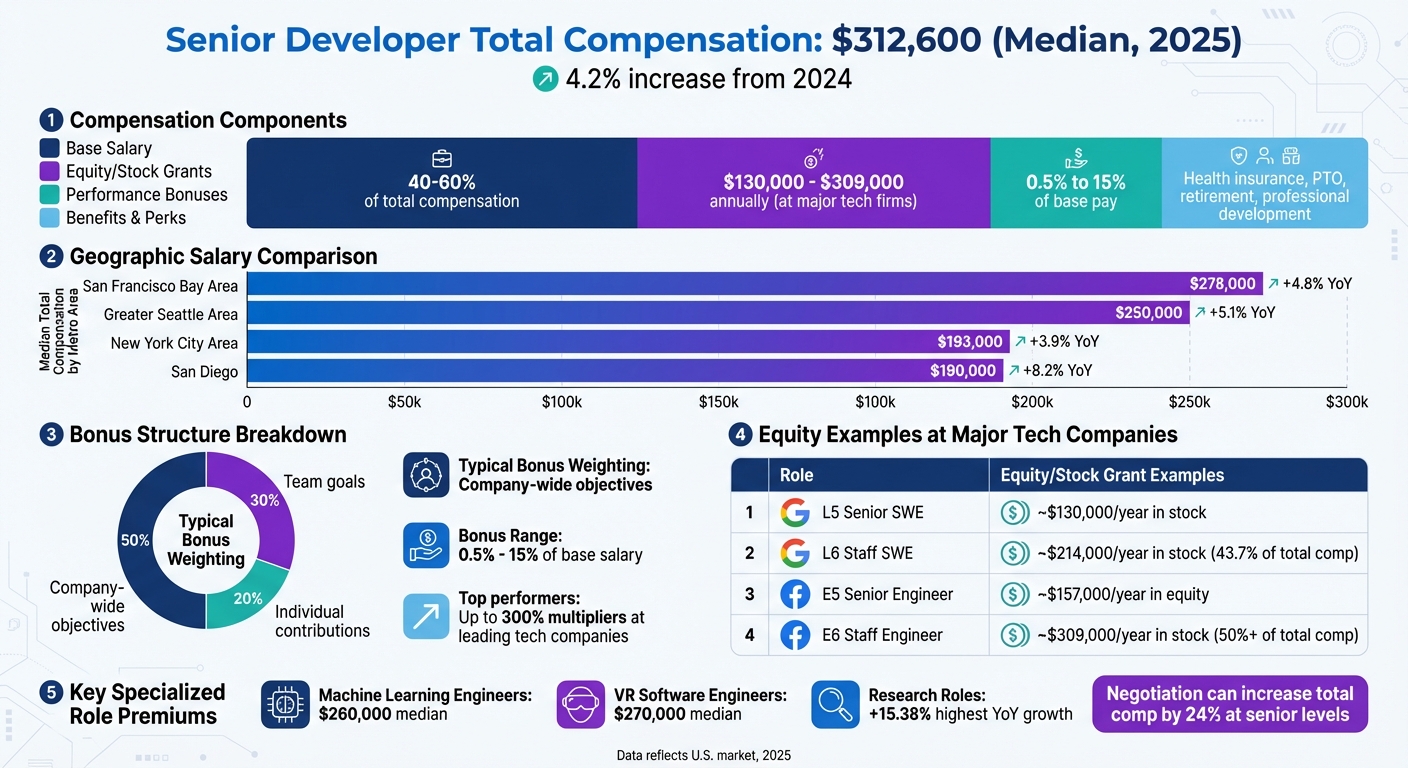 {Senior Developer Compensation Breakdown 2025: Salary, Equity, and Benefits}
Base Salary Fundamentals for Senior Developers
Base salary, the fixed part of a developer's pay, provides financial stability and forms the foundation of a senior developer's overall compensation. For 2025, setting the right base salary for senior developers requires a careful mix of market research, geographic considerations, and an understanding of the candidate's expertise.
The key is using accurate benchmarks. Instead of relying on internal job titles - which can vary widely between companies - organizations should use standardized leveling systems such as L1 to L6. For example, a "Senior Engineer" at one company might be equivalent to a "Staff Engineer" at another. Standardized systems allow for better comparisons by focusing on the scope of responsibilities and impact rather than just the title .
Total compensation data also plays a crucial role in structuring the base salary. It’s important to understand how the fixed base fits into the larger compensation package, ensuring competitiveness without committing too much to fixed costs. This balance is a core component of retaining top engineering talent in high-growth environments. Next, let’s explore how geography influences salary benchmarks.
How to Benchmark Salaries by Location
Geography significantly influences pay. For instance, the median total compensation for senior developers in the San Francisco Bay Area is $278,000, compared to $250,000 in the Greater Seattle Area and $193,000 in New York City . These differences stem from variations in local talent pools, cost of living, and the competitive landscape.
Instead of using state averages, focus on metro-specific data. For example, while California’s median pay might be $250,000, the San Francisco Bay Area stands out with a higher benchmark of $278,000 . This level of precision is crucial for competing in specific cities, as compensation expectations can differ greatly between places like Austin and San Diego.
The shift back to in-office work also affects pay strategies. With a 12% increase in return-to-office trends in 2025, companies requiring on-site work should align their salaries with local competitors rather than relying on national averages for remote roles .
| Metro Area | Median Total Compensation | YoY Change |
|---|---|---|
| San Francisco Bay Area | $278,000 | +4.8% |
| Greater Seattle Area | $250,000 | +5.1% |
| New York City Area | $193,000 | +3.9% |
| San Diego | $190,000 | +8.2% |
For companies aiming to attract top-tier talent, it’s wise to consider the 75th or even 90th percentile in compensation data. For example, in New York City, the 75th percentile for Senior Software Engineers is $345,000, while the 90th percentile reaches $450,000 . Relying solely on median figures may not be enough to secure the best candidates.
Beyond location, a developer's skill set and experience further refine these benchmarks.
Adjusting Pay for Experience and Technical Skills
When it comes to senior developers, the impact they can deliver often outweighs the length of their experience. For instance, a developer with seven years of experience building core infrastructure at a fast-growing startup might command a higher salary than someone with a decade of experience maintaining older systems. Employers increasingly value measurable contributions and the ability to handle complex challenges over simple tenure.
Specialized skills, particularly when recruiting machine learning experts, come with noticeable pay premiums. For example, Machine Learning Engineers have a median total compensation of $260,000, while Virtual Reality Software Engineers earn $270,000 . These higher salaries reflect the growing demand for skills that are both rare and critical to modern business needs.
"AI/ML is now core engineering. From niche specialty to one of the largest and highest-paid SWE tracks in 2025."
– Levels.fyi
The market also shows shifting trends. Research roles saw the highest year-over-year pay growth at 15.38%, while traditional networking roles experienced a decline of 2.7% . These trends highlight the importance of keeping salary structures aligned with evolving market demands.
Another key factor is negotiation. Data reveals that senior-level candidates often secure a 24% boost in total compensation through negotiation . For example, if an initial offer is set at the median (50th percentile), skilled candidates may negotiate their way closer to the 75th percentile. Including negotiation buffers in initial offers ensures the overall package remains competitive while leaving room for adjustments during the hiring process.
Performance Bonuses for Senior Developers
Performance bonuses are a way to directly connect an employee's achievements to the company's success, rewarding measurable results. For senior developers, this type of variable pay becomes a key part of their compensation package, complementing base salary, equity, and other benefits as they advance in their careers.
The most effective bonuses are tied to clear, measurable goals rather than vague evaluations. This not only boosts motivation but also builds trust between the employee and the organization. Annual bonuses for senior developers typically range from 0.5% to 7.5% of their base salary, with exceptional performers earning up to 15% . At leading tech companies, top engineers can even see performance multipliers that reach as high as 300% .
"As employees become increasingly senior within the company, the higher the proportion of their compensation comes from company-dependent factors such as bonus and equity."
– Yangshun Tay, Author of Tech Interview Handbook
As developers climb the ladder to senior and staff levels, their bonuses increasingly reflect the company's overall performance, aligning with their broader responsibilities [3, 11].
Common Bonus Structures
Effective bonus structures often balance company, team, and individual goals. A common approach splits bonuses into three weighted categories:
- 50% tied to company-wide objectives (like revenue or growth targets)
- 30% linked to team goals (such as meeting a project deadline)
- 20% based on individual contributions (like technical achievements)
This transparent system helps employees understand how their efforts translate into rewards.
For instance, at Google, an L6 Staff Software Engineer earned an annual bonus of around $50,000 on a $223,000 base salary - approximately 22.4%. At the L7 (Senior Staff) level, that bonus increased to roughly $79,000, showing how bonuses grow with seniority . Similarly, a Facebook E5 Senior Software Engineer received a $35,000 bonus on a $197,000 base salary, equating to about 17.7% .
Beyond annual bonuses, project-based incentives are a great fit for senior developers working on critical initiatives, linking payouts to specific milestones. Spot bonuses, such as gift cards or small cash rewards, are another option to celebrate achievements during key project phases [10, 11].
Some companies stagger bonus payouts - for example, 75% in January and 25% in July - to manage budgets and encourage retention . Peer nomination programs, where employees nominate colleagues for quarterly bonuses, are another way to foster recognition and highlight leadership within teams.
| Role Level | Individual Performance Weight | Company Performance Weight |
|---|---|---|
| Individual Contributor | 90% | 10% |
| Manager Level | 85% | 15% |
| Director Level | 75% | 25% |
| VP / SVP | 50% | 50% |
| C-Level Executive | 0% | 100% |
With these structures in mind, let’s dive into how performance metrics are defined to justify such incentives.
Defining Performance Metrics
A well-rounded bonus plan needs metrics that align with both individual contributions and company goals. For senior developers, this means focusing on areas like code quality, timely project delivery, technical leadership, and innovation. Unlike entry-level engineers, who are often evaluated on task completion, senior developers are measured by their ability to influence the company’s direction and success [1, 3].
Key performance indicators (KPIs) for senior developers include:
- Code quality: Assessed through metrics like code reviews and bug rates.
- Project delivery: Meeting deadlines and fulfilling sprint commitments.
- Technical leadership: Mentoring junior developers and making architectural decisions.
- Innovation: Proposing new product ideas or technical solutions .
These metrics should adhere to the SMART framework - Specific, Measurable, Achievable, Relevant, and Time-bound.
"A killer bonus plan might be weighted like this: 50% is tied to a clear company-wide goal, 30% to a team objective, and the final 20% to individual performance metrics."
– The Crypto Recruiters
It’s crucial to avoid metrics that could lead to unintended consequences. For instance, rewarding a low number of production incidents might push developers to under-report issues. Instead, focus on metrics that encourage meaningful contributions, such as problem-solving, knowledge sharing, and collaboration across teams - alongside traditional delivery goals .
Tiered payouts, such as 85% for partial achievement, 100% for meeting expectations, and 120% for exceeding them, provide a clear link between performance and rewards .
Equity and Stock Options for Long-Term Retention
Equity compensation has become a powerful tool for turning senior developers into stakeholders rather than just employees. Many companies are now using equity to replace a larger portion of fixed salaries, aligning individual success with company performance. As a company’s valuation grows, so does the value of equity, creating a strong incentive for long-term commitment and decisions that prioritize the company’s well-being. For example, senior engineers at major tech companies benefit significantly from this structure - Google's Level 5 Senior Software Engineers receive about $130,000 annually in stock grants, while Facebook's E5 Senior Engineers earn around $157,000 per year in equity .
In early-stage startups, equity compensation plays an even bigger role. To offset lower base salaries and the inherent risks of joining a young company, startups often offer higher equity percentages. A senior engineer at a post-Series A company might receive between 0.33% and 0.66% equity, while lead engineers could secure 0.5% to 1% . As companies mature and their valuations climb, the equity percentages offered tend to shrink, but the absolute dollar value often increases.
The type of equity offered also varies depending on the company’s stage. Early-stage startups typically provide stock options - either Incentive Stock Options (ISOs) or Non-Qualified Stock Options (NSOs) - which give employees the right to purchase shares at a fixed price. In contrast, late-stage and public companies usually grant Restricted Stock Units (RSUs), which represent actual shares and don’t require upfront payment . Tailoring the type of equity to match your company’s stage and the candidate’s expectations is crucial for structuring competitive offers.
Equity Vesting Schedule Comparison
The way equity vests plays a big role in retention and employee satisfaction. Vesting schedules outline when employees gain full ownership of their equity:
| Feature | 4-Year Vesting with 1-Year Cliff | Monthly Vesting (No Cliff) |
|---|---|---|
| Initial Vesting | No equity vests for the first 12 months; 25% vests at the 1-year mark | A small portion (e.g., 1/48th) vests every month starting from day one |
| Retention Impact | Strong; employees leaving before 12 months receive no equity | Weaker; employees gain equity immediately, reducing the "lock-in" effect during the first year |
| Employee Risk | Higher; being terminated before the cliff results in forfeiting all equity | Lower; employees keep whatever has vested by their departure date |
| Standard Usage | Common among Silicon Valley tech companies and startups | Less common; often reserved for executive hires or refresher grants |
The 4-year vesting schedule with a 1-year cliff is the go-to model in the tech world. It ensures that new hires demonstrate commitment before gaining ownership, and the monthly vesting that follows the cliff encourages them to stay long-term .
"The intention of a cliff is to make sure new hires are committed to staying with the company for a significant period of time."
– Holloway Guide
Some companies, including Amplitude, Coinbase, and Pinterest, are exploring more flexible options. For instance, they’ve extended the standard 90-day post-termination exercise window to as long as 7–10 years. This gives former employees more time to exercise their stock options without immediate financial strain, making these offers more appealing to top-tier talent .
Once the vesting structure is set, the next step is determining how much equity to offer.
How to Determine Stock Grant Amounts
Equity allocation depends on factors like company stage, the timing of the hire, role seniority, and overall valuation. In early-stage startups, where cash is tight, equity often makes up a significant portion of compensation. For example, the very first engineer might receive 2%–3% ownership, while employees hired later - around the sixth or seventh position - are typically granted 0.5%–1% . By the time the company is hiring its 28th to 34th employees, equity offers generally fall to 0.25%–0.5% .
As companies grow, the percentage of equity offered decreases, but the absolute dollar value often rises. For instance, Google’s Staff Software Engineers (Level 6) receive about $214,000 annually in stock grants, which make up 43.7% of their total $489,000 compensation package . Similarly, Facebook’s Staff Engineers (E6) earn roughly $309,000 in stock, accounting for over 50% of their $598,000 total compensation .
When making equity offers, it’s better to present them as a percentage of ownership rather than as a raw share count. For example, stating that a grant equals 0.5% of the company gives candidates a clearer sense of its value. Share counts alone can be meaningless without context, such as the total number of fully diluted shares outstanding (FDSO) . Providing transparency about the strike price and the timing of the most recent 409A valuation also helps candidates understand their potential costs and the difference between the strike price and the current fair market value. For RSUs at established companies, the valuation is more straightforward, as the shares have an immediate, measurable value based on the current stock price.
Senior roles often come with larger equity stakes due to their greater responsibilities and impact. For instance, Engineering Managers at companies raising $3–$10 million may secure about 1.36% ownership . This reflects their importance in driving company-wide success.
Hiring engineers?
Connect with developers where they actually hang out. No cold outreach, just real conversations.
Benefits and Perks Beyond Base Salary
When it comes to attracting senior developers, a well-rounded compensation package goes beyond just base salary, bonuses, and equity. Benefits play a key role in sweetening the deal. As of March 2024, employers in private industries spend an average of $2.65 per hour worked on health insurance alone, with retirement and savings benefits adding another $0.86 per hour . These are substantial investments that candidates genuinely value.
To highlight the full scope of what they’re offering, many companies provide "Total Compensation" statements. These break down everything from health insurance premiums and 401(k) matching contributions to wellness programs and professional development allowances. When financial benefits are paired with strong perks, they significantly enhance the overall appeal of an offer.
Core Benefits to Include
Health, dental, and vision insurance remain non-negotiable for senior-level roles. Retirement plans are another cornerstone, often including a 100% match on contributions up to 3% of salary after the first year, with some competitive packages extending matches up to 10% . Paid time off (PTO) is also a must, with senior developers typically receiving between 15 and 30 days annually. Additionally, wellness programs have proven to reduce absenteeism by 14–19% - a win for both companies and employees .
For senior engineers who take on on-call responsibilities, additional compensation is becoming standard. Companies now offer flat rates ranging from $500 to $2,000 per week or hourly incident rates between $50 and $150 . These measures acknowledge the extra demands of the role and help ensure fairness.
Developer-Focused Perks
Professional growth and flexibility are top priorities for senior developers. Offering a dedicated annual budget for conferences, certifications, books, and courses demonstrates a commitment to their continuous learning . Clear pay structures also help attract the right talent and encourage long-term retention . Linking professional development - such as earning new certifications - to pay increases can further clarify career advancement opportunities.
Remote work and flexible schedules are no longer just nice-to-haves; they’re expected. While office-based roles saw a 12% uptick in 2025 as part of the broader Return to Office movement , the most competitive offers continue to emphasize remote-first or hybrid arrangements . For remote or hybrid workers, providing a home office stipend ensures they can maintain a comfortable and productive workspace .
Other perks that resonate with developers include free meals, which can save thousands of dollars annually, and shuttle services in high-traffic areas like the San Francisco Bay Area, where commuting costs can quickly pile up . At major tech firms, signing bonuses can climb as high as $100,000 , and relocation assistance is another way to attract top-tier talent.
"Sometimes benefits like work-life balance can be just as enticing as a high salary."
– Teamcubate
When companies emphasize autonomy, growth opportunities, and work-life balance, their offers become far more compelling. These benefits and perks round out a comprehensive compensation package, making it clear why senior developers would choose to join - and stay with - a company.
How daily.dev Recruiter Helps You Hire Senior Developers
Once you've nailed down a competitive compensation package, the next hurdle is finding the right senior developers. Pairing a solid pay structure with targeted recruiting not only helps you offer attractive salaries but also ensures you connect with top talent. Traditional methods like cold emails, scraped databases, and static job boards often miss the mark when it comes to reaching passive developers who might be open to the right opportunity. That's where daily.dev Recruiter steps in to change the game.
With a foundation built on a thriving network of over 1 million software engineers, daily.dev Recruiter connects you with developers where they already engage - through industry content. Instead of chasing outdated profiles or sending cold outreach, you get warm, double opt-in introductions that feel natural and respectful. This approach makes it easier to connect with passive talent effectively.
Reaching Passive Developer Candidates
The platform uses a double opt-in system that ensures every conversation begins with genuine interest. Developers first review a concise technical brief outlining the challenges and architectural decisions they'd encounter in the role. Only after they express interest does the conversation move forward. This respectful process values developers' time and avoids the spammy feel of traditional recruiting tactics.
Job opportunities are seamlessly integrated into the professional content developers already consume daily, making the interactions feel natural and relevant. Instead of interrupting their workflow with unsolicited messages, you present roles to engineers when they’re already in a mindset of learning and growth. This makes them more open to opportunities that align with their career path. Plus, by relying on self-provided data, daily.dev Recruiter ensures compliance with U.S. data privacy laws, steering clear of unauthorized data harvesting. The result? A smoother, more efficient candidate search process.
Faster Hiring with Better Targeting
daily.dev Recruiter simplifies the hiring process with custom screening questions that verify technical qualifications upfront. This way, you avoid wasting time on candidates who lack essential skills that might not be obvious from a standard resume. The platform also uses AI-driven matching to analyze real-time data, such as side projects and ongoing learning habits, instead of just relying on keywords. This helps surface candidates who are a strong fit based on their current activity, not just their past experience.
To further streamline the process, Developer hiring platforms vs ATS integration takes care of candidate deduplication and automatically routes introduction details into your existing workflow. This reduces manual effort and boosts efficiency, leading to higher response rates and a quicker hiring process.
| Feature | daily.dev Recruiter Approach | Traditional Sourcing |
|---|---|---|
| Outreach Type | Warm, double opt-in introductions | Cold emails and InMails |
| Candidate Source | Active community members (1M+) | Scraped databases and static resumes |
| Candidate Context | Based on real-time reading and learning habits | Based on historical work history only |
| Screening | Integrated custom questions before introduction | Manual screening after initial contact |
Conclusion
Crafting competitive salaries for senior developers requires a careful balance of four key elements: a market-competitive base salary, performance-based bonuses, meaningful equity, and comprehensive benefits. With the median total compensation for Senior Engineers expected to hit $312,600 in 2025 - a 4.2% increase from the previous year - this balance is crucial for attracting and retaining top talent .
Base salary typically makes up 40–60% of the total compensation package . As Yangshun Tay aptly puts it, "Equity is what differentiates a tech job from a non-tech one... this signifies ownership and motivates employees to work in the best interests of the company" . This highlights the importance of equity and other variable components in creating a package that not only appeals to skilled professionals but also encourages long-term commitment and alignment with company goals.
Once a competitive compensation package is in place, the next challenge is connecting with the right candidates. Tools like daily.dev Recruiter simplify this process by offering warm, double opt-in introductions to pre-qualified developers and integrating seamlessly with applicant tracking systems (ATS) for custom screening. This approach saves time, improves candidate quality, and ensures every conversation starts with genuine interest.
In a labor market projected to grow by over 410,000 new software engineering positions by 2032 , combining a well-thought-out compensation strategy with efficient recruiting tools gives your company a significant edge. Top developers look beyond just the paycheck - they evaluate the entire package and the professionalism of your approach. By integrating these strategies, you position your company to attract and secure the best senior developer talent, setting the stage for long-term success.
FAQs
How does location affect senior developer salaries in the U.S.?
Location has a major impact on senior developer salaries across the United States. Nationwide, the median total compensation for a senior software engineer is about $240,000, with most salaries falling between $170,000 and $350,000. In high-cost tech hubs like the San Francisco Bay Area, those numbers climb significantly, with a median of $341,000 and a range of $250,000–$460,000. California as a whole also surpasses the national average, boasting a median salary of $317,000.
These variations are largely influenced by the cost of living and the presence of major, equity-rich companies. Cities such as San Francisco, New York, and Washington, D.C., frequently top the charts for compensation, while places like Chicago, Houston, and Atlanta tend to hover closer to the national median. To stay competitive, employers often tailor their compensation packages with a combination of base salary, bonuses, and equity, adjusted to reflect local market dynamics.
Platforms like daily.dev Recruiter can help companies strategically connect with senior developers in specific regions, ensuring their offers remain competitive and aligned with local salary trends.
How does equity factor into a senior developer's compensation package?
Equity plays a significant role in a senior developer's overall compensation package. It offers a non-cash ownership stake in the company, typically in the form of stock options or restricted stock units (RSUs). This element goes beyond base salary and bonuses, tying the developer’s financial gains directly to the company’s growth and success.
For senior developers, equity is particularly attractive because it represents both long-term financial potential and a deeper connection to the company’s future. By aligning their personal success with the organization’s achievements, this structure not only rewards their efforts but also motivates them to contribute to the company’s ongoing progress.
What’s the best way to structure performance bonuses for senior developers?
To design an effective performance bonus system for senior developers, aim for a structure that is clear, motivating, and equitable. Start by establishing a consistent payout schedule - quarterly bonuses, for example - so developers know when to expect rewards. Link these bonuses to measurable achievements that reflect both individual efforts and broader company objectives, such as delivering critical features or maintaining uptime goals.
Set a target bonus percentage based on the developer’s base salary (e.g., 15%) and adjust payouts according to performance metrics. To encourage long-term commitment, you might require developers to remain employed through a specific date to qualify for their bonus. Additionally, ensure bonus caps are in line with market salary benchmarks to remain competitive while managing expenses effectively.
A transparent, performance-based bonus system not only motivates senior developers but also aligns their efforts with the company’s goals.
.png)