Startups face intense competition when hiring developers, especially in the U.S., where tech job postings exceeded 7 million in 2025, and software engineer salaries hit a median of $172,049. For small teams with limited resources, leveraging hiring tools is critical to staying competitive. Understanding the difference between hiring platforms and ATS helps startups automate tasks, manage pipelines, and identify top talent efficiently. Here are four popular tools startups rely on:
- Lever: Combines ATS and CRM to manage active and passive candidates. Automates repetitive tasks, integrates with 300+ tools, and offers budget-friendly pricing for small teams.
- Greenhouse: Offers structured hiring processes, AI-powered features, and 500+ integrations. Ideal for startups scaling operations, though it may have a learning curve.
- HackerRank: Focuses on technical assessments, providing coding tests and collaborative IDEs. It integrates with ATS platforms but is assessment-specific.
- daily.dev Recruiter: Connects startups with developers through warm, double opt-in introductions. Focuses on active, engaged talent within tech communities.
Quick Comparison:
| Tool | Key Features | Best For | Cost Considerations |
|---|---|---|---|
| Lever | ATS + CRM, automation, integrations | Scaling teams, pipeline management | Budget-friendly "Essential" tier |
| Greenhouse | AI tools, structured pipelines | Structured hiring, large teams | Higher cost, steep learning curve |
| HackerRank | Technical assessments, IDE | Developer hiring | $165/month, additional fees for volume |
| daily.dev Recruiter | Developer-focused introductions | Engaging passive talent | Transparent pricing, no wasted leads |
Each tool addresses specific hiring challenges, from managing pipelines to evaluating technical skills. Startups should choose tools based on their size, growth stage, and hiring priorities.
::: @figure 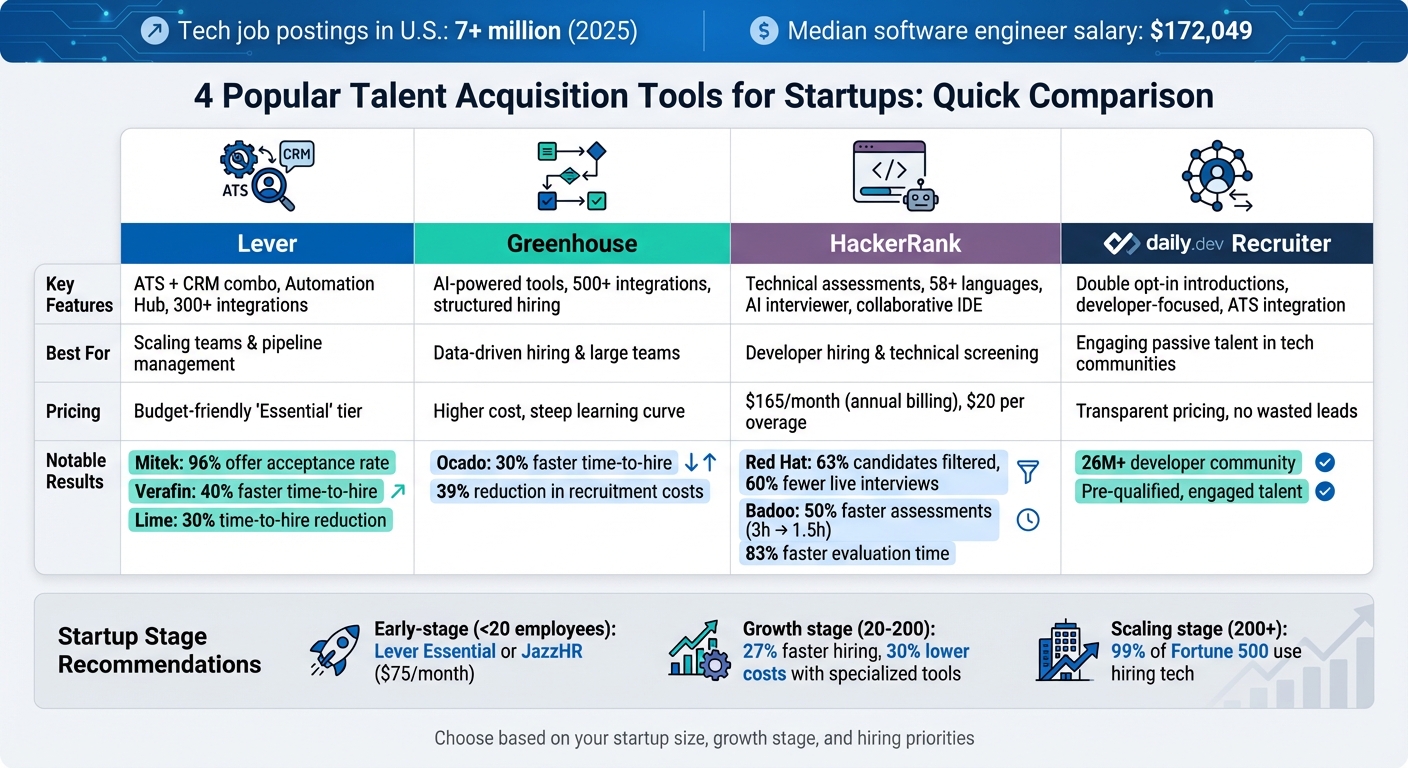 {Comparison of Top 4 Talent Acquisition Tools for Startups}
1. Lever
Lever combines an applicant tracking system (ATS) and candidate relationship management (CRM) into one streamlined platform. This gives startups a clear view of both active applicants and passive talent pools, making it easier to manage hiring efficiently. For startups, where speed and precision are critical, missing out on qualified candidates during fast hiring cycles can be costly. Lever eliminates the need for manual tracking by keeping everything in one place, simplifying pipeline management and ensuring no candidate slips through the cracks.
Pipeline Management
Lever’s Automation Hub takes care of repetitive tasks, allowing hiring teams to focus on what matters most. For example, once a developer completes a technical assessment, the platform automatically archives, tags, or advances the candidate in the pipeline - no manual input needed. This kind of efficiency has delivered impressive results for companies like Mitek Systems, which saw their job offer acceptance rate soar to 96% after adopting Lever’s tools. Similarly, Verafin managed to reduce their time-to-hire by an impressive 40%.
"With Lever, we can identify where candidates are sitting too long and streamline our process. It helps us standardize across locations and strategize to get the best talent in the door as quickly as possible." - Anthony Buatti, Sr. Director of Recruitment Operations, Mastery Charter Schools
In addition to automating workflows, Lever integrates seamlessly with other recruitment tools, ensuring a smooth hiring process from start to finish.
Integration Capabilities
Lever connects with nearly 300 partners, making it a highly versatile tool for recruiters. It integrates with platforms like Codility, Hired Assessments, HireEZ, and ContactOut, as well as communication tools like Slack and BrightHire, which offer AI-generated interview transcripts. These integrations also extend to sourcing tools, helping automate outbound campaigns. Companies have seen tangible benefits: Entrata saved $40,000 in recruiting costs after adopting Lever, while Lime cut their time-to-hire by 30%.
Cost Efficiency
For startups, Lever’s "Essential" tier is designed to be budget-friendly while offering integrated CRM features that help re-engage qualified candidates, ultimately reducing sourcing expenses. One standout feature is the ability to build "silver medalist" pipelines - leveraging qualified candidates from previous roles who may be a great fit for new positions. This approach has proven effective for companies like Secure Code Warrior, which scaled their recruiting operations by 80% after implementing Lever.
2. Greenhouse
Greenhouse is an all-in-one hiring platform designed to simplify developer recruitment for startups. Known for being a leader in hiring technology, the platform has delivered impressive results for its users. For example, Ocado Group managed to cut its time-to-hire by nearly 30% after adopting Greenhouse. By focusing on efficient pipeline management and offering a host of advanced features, Greenhouse ensures startups can recruit smarter and faster.
Pipeline Management
Greenhouse offers tools that give startups a clear picture of their recruitment pipeline, including insights into pipeline health, offer activity, and sourcing performance. This allows teams to tweak their hiring strategies in real time. The platform's AI-powered features help by summarizing candidate profiles and filtering applications to highlight the best fits. Additionally, structured interview kits - complete with role-specific talking points and tailored scorecards - help ensure fair and thorough evaluations of technical skills. These tools have proven to be cost-effective, with some users reporting a reduction in recruitment expenses by up to 39%.
"Greenhouse has made a real difference to how we hire at Ocado Group. It's helped us simplify our recruitment processes, cutting our time-to-hire by nearly 30%." – Peter Tam, Talent Acquisition Enablement Manager, Ocado Group
Integration Capabilities
Greenhouse stands out with its ability to integrate seamlessly into existing workflows. It supports over 500 pre-built integrations, connecting with popular tools like LinkedIn, Slack, Zoom, and Calendly. For startups seeking deeper analytics, it offers compatibility with platforms like Power BI and Looker, or the option to customize via its open API. Greenhouse also integrates with HackerRank, making it easy to administer technical assessments and review results directly within candidate profiles. Plus, with the ability to distribute job postings to over 1,000 job boards, startups can tap into a global talent pool with minimal effort.
Developer-Centric Features
Greenhouse goes beyond standard recruitment tools by offering features specifically designed for developer hiring. To promote fairness, it provides anonymized take-home tests, reducing unconscious bias in the evaluation process. Its AI tools also assist in creating interview questions and defining scorecard criteria, lightening the workload for hiring managers. By centralizing sourcing, interviewing, and onboarding in one platform, Greenhouse eliminates the need for juggling multiple tools. This streamlined approach allows startups to scale their hiring efforts without significantly increasing their recruitment team size.
3. HackerRank
When it comes to technical hiring, using the best developer assessment tools is crucial for identifying top talent. HackerRank stands out by offering real-world coding challenges that evaluate developer skills in meaningful ways. With a community of over 26 million developers worldwide , it has become a favored tool for streamlining the hiring process. Take Red Hat, for example: they used HackerRank to filter out 63% of initial candidates, which led to a 60% reduction in live technical interviews .
Developer-Centric Features
HackerRank focuses on practical coding assessments rather than abstract algorithm puzzles, aligning with the preferences of 66% of developers . Its browser-based IDE supports over 58 programming languages and integrates AI tools like Copilot and ChatGPT. For live interviews, the platform provides a collaborative IDE with features like tagged cursors, a console, and detailed logs. Additionally, an AI interviewer can handle the first round of screening, asking progressively harder questions and offering real-time hints. This automation allows engineering teams to concentrate on later stages of the hiring process .
"HackerRank disqualified 63% of phase one candidates, which greatly reduced the number of overall candidates who needed phase two review." – Red Hat Case Study
Integration Capabilities
HackerRank integrates directly with applicant tracking systems (ATS), syncing test scores to candidate profiles and cutting evaluation time by 83% . Startups can automate assessments as candidates move through the hiring process . These integrations save companies an average of 4 hours per candidate interviewed . Plus, there’s no implementation fee for integrating with systems like Greenhouse . These features make it easier for companies to reduce time-to-hire within their recruitment pipelines.
Cost Efficiency
HackerRank’s Starter plan, priced at $165 per month with annual billing, includes both automated testing and live collaborative coding features . This pricing model helps startups avoid the hidden fees often associated with similar platforms . However, companies should keep an eye on overage costs - $20 per additional attempt - if candidate volume increases . The platform also offers a robust AI-powered plagiarism detection feature with 93% accuracy . For instance, Badoo was able to cut their technical assessment time in half, reducing it from 3 hours to just 1.5 hours after adopting HackerRank .
Hiring engineers?
Connect with developers where they actually hang out. No cold outreach, just real conversations.
4. daily.dev Recruiter
daily.dev Recruiter is a platform designed to connect startups with developers who are actively engaged in tech communities and content. It operates through warm, double opt-in introductions, ensuring that developers only connect with recruiters when they are genuinely interested in exploring new roles. Each introduction comes with detailed information about the developer's technical expertise and interests, helping startups quickly identify candidates who align with their needs.
Developer-Centric Features
Built with a developer-first approach, daily.dev Recruiter taps into an active network of pre-qualified, engaged talent. These developers are continuously learning and staying updated on the latest in tech. Startups can set custom criteria to screen candidates before reaching out, cutting down on reliance on generic profiles. This ensures that conversations begin with a clear alignment between both parties.
Integration Capabilities
daily.dev Recruiter integrates seamlessly with existing applicant tracking systems, making it easy for startups to manage their hiring pipelines. Recruiters can sync candidate data, update statuses, send scheduling links, and move candidates through the hiring process - all without juggling multiple tools . Additionally, the platform targets job visibility to developers with the right technical skills and career aspirations, streamlining the entire recruitment workflow .
Cost Efficiency
With transparent and predictable pricing, daily.dev Recruiter focuses on delivering tangible hiring results. This approach eliminates wasted time on cold leads, allowing teams to concentrate on meaningful conversations with developers who are genuinely open to new opportunities. It’s a smarter way to hire, saving both time and resources.
Advantages and Disadvantages
Every tool brings its own strengths and challenges, tailored to startups at various stages of growth. Let’s break it down:
Lever stands out when it comes to scaling. For example, Coupa increased their headcount by 40% in just six months using Lever’s combined ATS and CRM capabilities . Lime saw a 30% improvement in time-to-hire, while Xepelin slashed reporting time by 85% with the platform . That said, its extensive features might feel overwhelming for very early-stage teams.
Greenhouse is a great fit for startups that prioritize structured, data-focused hiring processes. It’s known for reducing recruitment costs by 39% and boasts over 500 integrations. However, its steep learning curve and pricing could pose challenges for startups operating on tight budgets.
HackerRank simplifies technical assessments, saving recruiters up to 40% of their time through automation . It’s perfect for startups hiring developers at scale, but since it focuses solely on assessments, additional tools may be needed to handle candidate pipelines and relationships. This highlights how technical assessment tools can complement broader recruitment platforms, helping you avoid common mistakes when hiring technical talent.
daily.dev Recruiter tackles the challenge of engaging passive talent by offering warm, double opt-in introductions within a vibrant developer network. With transparent pricing and smooth ATS integration, it’s a solid choice for teams with limited resources.
For startups with fewer than 20 employees, affordable options like JazzHR or Lever’s Essential tier provide an easy way to get started. Scaling startups (20–200 employees) can take advantage of the advanced analytics and workflow automation offered by Lever or Greenhouse. Meanwhile, technical-focused startups can pair tools like HackerRank with an ATS for a more comprehensive solution. daily.dev Recruiter remains a versatile option across all stages for startups targeting engaged developers.
Conclusion
Building an effective hiring stack means aligning your tools with your startup's current stage and priorities. For early-stage startups with fewer than 20 employees, the focus should be on affordable and easy-to-use solutions. Tools like Dover or JazzHR (starting at $75/month) can provide essential tracking features to manage your initial hiring pipeline with minimal effort - typically requiring less than an hour of weekly maintenance . These lightweight solutions help you stay organized without stretching your budget too thin.
As your company enters the growth stage (20–200 employees), your hiring needs become more complex. This is the time to invest in scalable platforms that bring structure to your recruitment process. Using purpose-built recruitment tools can speed up hiring cycles by 27% and cut acquisition costs by 30% . These efficiencies are critical as you scale your team.
For scaling startups with even larger teams, advanced capabilities like enterprise-level analytics, high-volume automation, and complex workflows become essential. At this stage, nearly 99% of Fortune 500 companies rely on hiring technology to stay competitive . To attract top talent on a global scale, you’ll need similar tools to handle the demands of a growing workforce.
When hiring developers, pairing your ATS with specialized assessment tools can make a significant difference. For instance, HackerRank can reduce time spent on live technical interviews by 60% , and daily.dev Recruiter offers warm, double opt-in introductions to developers already active in professional networks. Integrating these tools with your ATS ensures it remains your central hub for recruitment .
Start with the basics and expand your toolkit as your needs grow. The right mix of tools will help you hire faster, spend smarter, and build meaningful connections with candidates at every stage of your startup’s journey.
FAQs
How can startups select the best talent acquisition tools for hiring developers?
Startups aiming to select the best talent acquisition tools should begin by pinpointing their unique hiring challenges. Are they dealing with an overwhelming number of applications? Do they need to automate repetitive tasks? Or is improving the candidate experience a priority? Tools equipped with features like AI-powered screening, role-specific assessments, and real-time analytics can be game-changers, especially when hiring developers.
When assessing these tools, startups should weigh critical factors such as budget, scalability, compatibility with existing systems, and automation features. It’s equally important to focus on tools that improve the candidate experience - think mobile-friendly platforms and clear, consistent communication. By matching a tool’s capabilities to their immediate hiring needs and long-term growth plans, startups can simplify their recruitment process and successfully attract top-tier tech talent.
How do Lever and Greenhouse differ in their approach to hiring?
Greenhouse and Lever serve distinct hiring objectives, tailored to different organizational needs. Greenhouse shines when it comes to supporting larger teams that demand flexible workflows, comprehensive interview kits, and a well-structured approach to hiring. These features make it particularly suitable for enterprises managing intricate recruitment processes.
Meanwhile, Lever stands out by blending an applicant tracking system (ATS) with CRM-like tools, AI-powered functionalities, and recruitment marketing features. Its main focus is on nurturing candidate relationships, automating communication, and simplifying hiring for companies dealing with high-volume recruitment or rapid scaling.
To put it simply, Greenhouse is all about customization and detailed processes, while Lever zeroes in on relationship-building and automation to speed up hiring.
How does daily.dev Recruiter help startups connect with passive tech talent?
daily.dev Recruiter gives startups a powerful way to connect with passive tech talent by simplifying outreach and fostering genuine relationships. With access to a vast developer community, the platform helps startups find and engage with skilled professionals who aren’t actively job hunting.
Using customized engagement tools and actionable insights, daily.dev Recruiter enables startups to create personalized messages that catch the attention of passive candidates. This method addresses typical hiring hurdles, like tight budgets and the pressure to scale fast, while helping startups attract high-caliber tech professionals.
.png)