The hiring landscape for tech roles in 2025 has shifted dramatically. Companies now focus on skills over formal degrees, rely on AI tools for efficiency, and prioritize candidate expectations like remote work, salary transparency, and streamlined processes. Developers demand meaningful, respectful hiring experiences, and outdated methods like cold emails and generic job posts no longer work.
Key Takeaways:
- Skills Over Credentials: GitHub portfolios and hands-on assessments matter more than degrees.
- AI in Hiring: Automates tasks like screening, scheduling, and matching candidates but must be used responsibly.
- Developer Expectations: Remote work, transparent salary ranges, and timely feedback are dealbreakers.
- Outreach Evolution: Generic emails fail; engaging with developers in niche communities is key.
- Efficient Processes: Shorter interview rounds and practical assessments save time for both sides.
- Data-Driven Hiring: Metrics like offer acceptance rates and time-to-hire guide better decisions.
To succeed, companies must focus on skills-based hiring, adopt AI tools carefully, and create a process that respects developers' time and needs.
What Changed in Technical Hiring Since 2023
Technical hiring has undergone a noticeable transformation since 2023. Outdated recruitment strategies are no longer effective, leaving companies that haven't adjusted struggling to attract top talent. Here's a closer look at how the landscape has shifted, from market dynamics to developer expectations.
Market Adjustments and New Hiring Priorities
The tech industry saw major market corrections in 2023 and 2024, reshaping hiring strategies across the board. The days of rapid, unchecked expansion are over. Companies are now focused on strategic, budget-conscious hiring that prioritizes quality over quantity.
Instead of mass hiring for junior roles, organizations are targeting senior and specialized positions - roles that can make an immediate and measurable impact. With tighter budgets, hiring managers are under pressure to select candidates who bring proven expertise, rather than opting for high-volume hires. This shift underscores a broader industry trend: efficiency and results now take precedence in technical hiring.
These changes have also altered the dynamics of recruiting. While there are fewer job openings compared to the hiring boom of 2021-2022, competition for highly skilled developers remains intense. Companies can't afford to waste time on vague job descriptions or strategies for reducing time to hire in tech roles. The focus has shifted to precision hiring - finding the right person with the exact skills needed for the role. This approach naturally leans on evaluating demonstrable abilities rather than relying on superficial criteria.
What Developers Expect in 2025
Developer expectations have evolved just as much as hiring practices. Companies that fail to meet these shifting priorities risk losing top candidates early in the process.
Transparency is now a baseline requirement. Developers expect job postings to include clear salary ranges, stated in USD, rather than vague terms like "competitive compensation." A lack of salary details is increasingly seen as a red flag.
The interview process itself has come under scrutiny. Developers are no longer willing to endure drawn-out, multi-round interviews that can stretch on for weeks. Instead, they expect streamlined hiring processes, typically limited to three or four rounds. Anything longer needs a compelling reason, or candidates are likely to drop out and look elsewhere.
Remote work has become a standard expectation. While not every role can be fully remote, flexible or hybrid arrangements are a major draw for candidates. Developers who experienced the benefits of remote work during the pandemic are hesitant to return to rigid office schedules without a strong justification.
Communication has also become a critical factor. Candidates expect regular updates throughout the hiring process, even if there’s no new information to share. Silence after an interview is no longer acceptable - it damages a company’s reputation and often gets discussed in developer communities. Providing clear timelines and next steps is essential to maintaining trust.
Finally, developers have grown increasingly skeptical of generic outreach. Mass emails that fail to reference a candidate’s specific skills or projects are ignored or deleted. This copy-paste approach to recruitment is seen as lazy and unprofessional. Personalized communication that demonstrates genuine interest in a candidate’s work is now the gold standard.
From Credentials to Skills: The New Evaluation Model
The way candidates are evaluated has shifted dramatically, with a focus on real-world skills over traditional credentials. Take-home challenges, pair programming sessions, and strong GitHub portfolios now carry more weight than degrees or formal education.
This change has opened doors for a broader range of candidates, including self-taught developers, bootcamp graduates, and career changers. Companies are moving away from evaluating candidates based on where they went to school or what degrees they hold. Instead, they’re adopting skills-based assessments that test abilities directly relevant to the job. These might include coding challenges, architectural design discussions, or collaborative programming exercises that reveal how a candidate approaches problems.
Work samples have become a critical part of the process. When candidates can showcase production code, systems they’ve designed, or specific problems they’ve solved, it provides concrete evidence of their abilities. This approach benefits both sides: candidates get to highlight their strengths, and companies gain a clearer understanding of what a candidate can deliver.
As companies move away from generic algorithm-based questions, assessments are becoming more practical and tailored to the role. The emphasis is on testing the technologies and challenges candidates will face on the job, making the evaluation process more relevant and effective. This shift ensures that hiring decisions are based on real capabilities, not just academic achievements or theoretical knowledge.
How to Source and Reach Developers in 2025
The way we source and connect with top tech talent is changing fast, and traditional methods just aren’t cutting it anymore. To stay ahead, recruiters need to rethink their strategies entirely.
Why Job Boards and Cold Emails Are Losing Their Edge
Job boards are overcrowded with generic listings, making it hard for any single opportunity to stand out. They mainly attract active job seekers, who represent just a small slice of the talent pool. Meanwhile, skilled developers already thriving in their roles are unlikely to browse these platforms unless the opportunity aligns perfectly with their career goals.
Then there’s cold outreach. Mass-sent, impersonal emails rarely grab attention. If you’re not referencing specific aspects of a developer’s work, your message is probably ending up ignored - or worse, in the spam folder. It wastes time for everyone involved.
Another issue? Generic platforms don’t provide the technical depth that matters. A LinkedIn profile might say someone knows "JavaScript", but it won’t tell you if they’re contributing to open-source projects or diving into the latest frameworks. Without this context, recruiters risk pitching roles that don’t match a developer’s interests or expertise.
This is why we need a new approach - one that prioritizes meaningful, opt-in engagement.
How daily.dev Recruiter Bridges the Gap
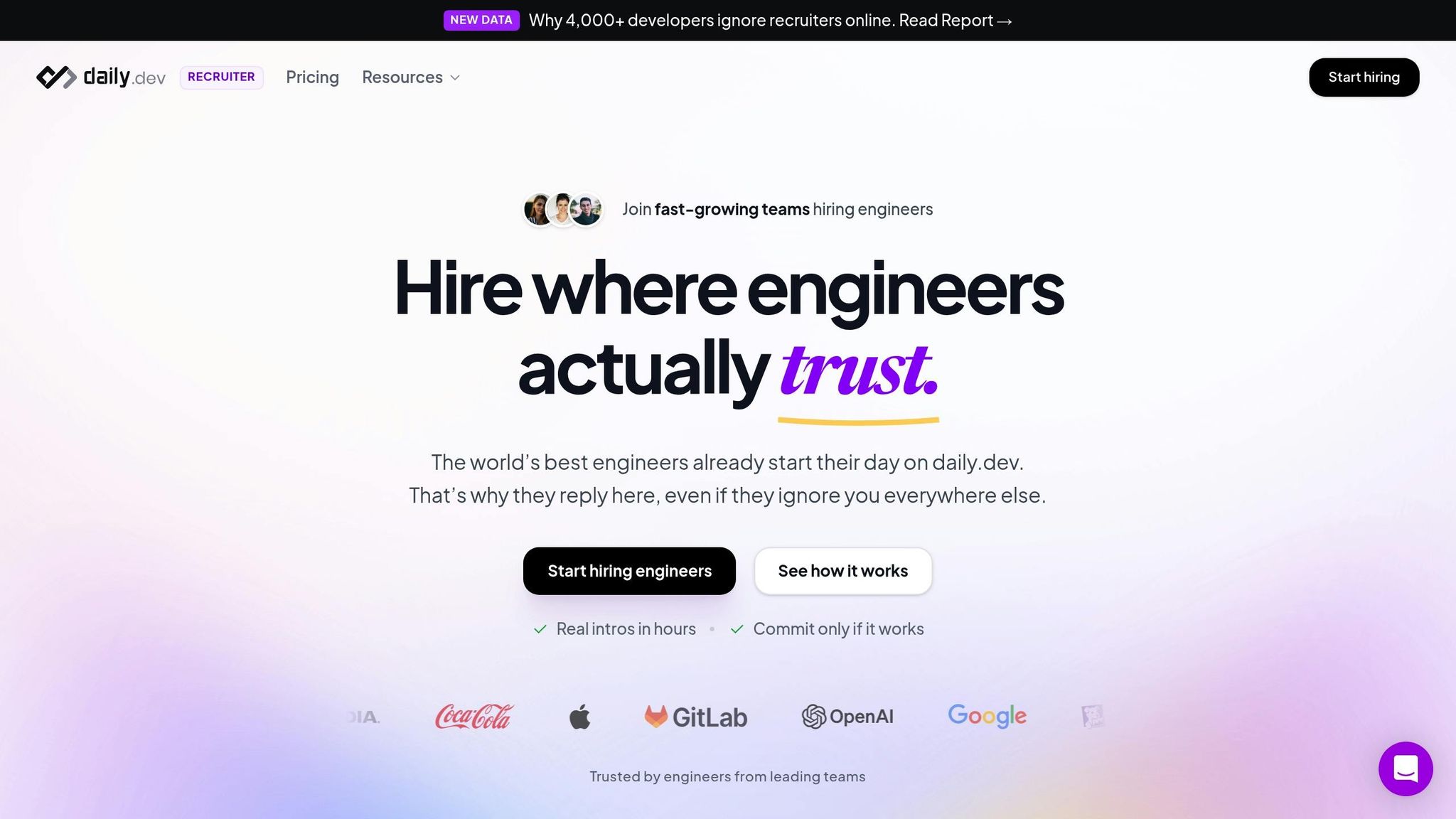
The solution isn’t about sending more messages; it’s about connecting with developers where they already are. That’s where daily.dev Recruiter comes in. It’s built into a platform developers use daily to stay updated on tech news, sharpen their skills, and connect with their peers.
With over 1,000,000 developers actively using daily.dev, the platform has become a go-to hub for technical talent. Unlike outdated databases or scraped profiles, daily.dev connects recruiters with developers who are current, engaged, and passionate about their work.
A standout feature is its warm, double opt-in model. Developers only engage with opportunities that genuinely interest them. When you post a role, it’s presented in a way that respects their time and preferences. Developers opt in if they’re interested, creating connections based on mutual interest rather than unsolicited outreach.
This flips the script on traditional recruiting. Instead of chasing candidates who may not even be open to new roles, you’re connecting with developers who’ve already shown interest. The result? Better response rates and more meaningful conversations from the get-go.
Plus, daily.dev gives recruiters real-time insights into what technologies and topics developers are engaging with. This means you can tailor your outreach to align with their current interests. And with seamless integration into ATS systems and other sourcing tools, it’s easy to access this talent pool through a platform developers trust and actively use.
Once you’ve found the right candidates, the next step is making sure your job descriptions resonate.
Writing Job Descriptions That Developers Actually Read
Even with the perfect platform, a poorly written job description can undo all your hard work. Developers are quick to spot red flags and won’t hesitate to move on if something feels off.
Here’s how to get it right:
- Be transparent about salary. Don’t hide behind vague phrases like "competitive salary." If the range is $120,000–$150,000, say so upfront. Clear numbers build trust.
- Lead with impact. Developers want to know what they’ll be working on and why it matters. Instead of starting with "We need a Senior Backend Engineer with 5+ years of experience", try "You’ll design the API infrastructure powering real-time collaboration for 50,000+ users."
- Get specific about your tech stack. Don’t just list tools like "React and TypeScript." Explain how you’re using them: "Our frontend is built with React 18 and TypeScript, leveraging Next.js for server-side rendering and Tailwind for styling." If you’re transitioning to a new stack, mention it - many developers love the challenge of modernization.
- Keep it concise. Aim for 300–500 words that cover responsibilities, technologies, team details, and compensation. If you need to include more, link to a detailed document or your careers page.
- Address flexibility upfront. Clearly state whether the role is remote, hybrid, or on-site. If it’s remote, specify time zones or core hours to avoid misunderstandings.
- Avoid clichés. Phrases like "fast-paced environment" or "rockstar developer" can be red flags. Focus on concrete details about the work, the team, and your company’s mission.
The goal is to create job descriptions that respect developers’ time and show you understand what they’re looking for. When done right, this approach not only attracts more candidates but also ensures you’re connecting with the right ones.
Building Skills-Based Evaluation Processes
After crafting job descriptions that truly connect with potential candidates, the next step is to assess them through skill-based methods that mirror the actual work they'd be doing.
Attracting the right talent is only half the battle - the real challenge lies in evaluating candidates in a way that's both fair and efficient. Traditional hiring often leans heavily on credentials, which don’t always reflect a person’s true abilities. But in 2025, skills-based evaluation is taking center stage. This means focusing on what candidates can actually do, rather than just what’s on their resume. By using this approach, you can reshape the way you identify and select top technical talent.
This shift requires rethinking everything - from how assessments are designed to how success is measured. When done well, it creates a fairer, more respectful process for candidates and helps you find the best match for your team.
Designing Technical Assessments That Respect Candidate Time
Technical assessments are vital when hiring developers, but they can also be a major source of frustration. Overly long or irrelevant assessments can drive candidates away, while tasks that are too simple may not reveal their true abilities.
The key is to assess technical skills using tasks that reflect real work without overwhelming candidates. Start by asking yourself: What skills does this role genuinely require? For instance, if you’re hiring a backend engineer to optimize API performance, don’t focus on abstract algorithm puzzles. Instead, present a realistic scenario - like debugging a slow endpoint or creating an effective caching strategy - that mirrors the challenges they’d face on the job.
Here are a few tips for creating effective assessments:
- Keep coding challenges short and focused. Aim for tasks that take 60–90 minutes to complete. For more complex problems, consider using pair programming sessions. These allow you to observe how candidates solve problems in real time and collaborate with others.
- Offer take-home assignments - within reason. If you’re asking candidates to build something from scratch, ensure it takes no more than three hours. Alternatively, review work they’ve already completed, such as contributions to open-source projects or personal portfolios, to gauge their skills without adding extra workload.
- Be transparent. Let candidates know upfront how long each task should take, what you’re evaluating, and how the assessment fits into the hiring process. This clarity builds trust and reduces drop-off rates.
With practical assessments in place, the next step is to ensure interviews are consistent and free from bias.
Using Structured Interviews to Reduce Bias
Unstructured interviews - where interviewers ask whatever comes to mind - are notorious for introducing bias. Without a clear framework, evaluations can become subjective, often favoring candidates who share similar backgrounds or communication styles with the interviewer. That’s why structured interviews are becoming the standard in 2025.
Structured interviews use a consistent set of questions and scoring criteria for every candidate. This ensures that everyone is evaluated on the same skills and qualities. For example, when assessing problem-solving abilities, ask all candidates the same technical question and score their responses based on predefined criteria like clarity of thought and how well they address edge cases.
"AI will transform how we think about quality of hire by enabling more data-driven, predictive, and unbiased decision-making." – Fabien Desmangles, Talent Acquisition Manager at Dassault Systemes
Here’s how to make structured interviews work for you:
- Use calibrated rubrics. Define clear performance benchmarks before interviews begin. Train interviewers to apply these standards consistently to minimize personal biases.
- Diversify your interview panels. Including team members with varied perspectives reduces the likelihood of individual biases influencing decisions. It also gives candidates a broader view of your team’s dynamics.
- Debrief promptly. Schedule feedback sessions within 24–48 hours to capture objective impressions while they’re still fresh. If someone says a candidate "wasn’t a good fit", ask for specific examples tied to the role’s requirements.
Some companies are even experimenting with AI tools to refine their interview processes. For instance, LinkedIn is testing systems that analyze interview transcripts to identify areas where bias may creep in or evaluation criteria may be inconsistently applied . While AI isn’t a substitute for human judgment, it can help highlight patterns and areas for improvement.
"Choose tools that align with your company's values, focus on bias mitigation, and ensure your team understands AI's limitations." – Jackye Clayton, VP of Talent and DEIB at Textio
The goal? To ensure decisions are guided by objective, skills-based criteria rather than subjective impressions.
Tracking Metrics to Improve Your Hiring Process
Once your assessments and interviews are standardized, the next step is to measure their effectiveness. In 2025, hiring teams are relying more on data to fine-tune their processes. But with so many metrics available, it’s important to focus on the ones that matter most.
Here are some key metrics to track:
- Quality of hire. This remains a top priority for 42% of tech hiring teams . It measures how well new hires perform and integrate into the team. Performance reviews, retention rates, and early feedback can all provide insights into the success of your hiring process.
- Time-to-hire. With 69% of technology companies reporting an increase in this metric in 2024 , it’s clear that speed is a growing concern. However, moving too quickly can compromise quality. Look for inefficiencies - like excessive interview rounds or delayed feedback - and address them to strike the right balance.
- Offer acceptance rate. Tracked by 39% of teams , this metric shows whether candidates are accepting your offers. A low rate might signal issues like unclear job descriptions or a poor candidate experience.
- Application completion rate. Also tracked by 39% of teams , this metric can indicate whether your application process is too cumbersome.
- Employee turnover rate. With 35% of teams tracking this , it’s a valuable indicator of long-term retention. High first-year turnover often points to mismatched expectations or flaws in the evaluation process.
Interestingly, only 27% of tech companies currently measure candidate interview experience . Since this experience can significantly impact your employer brand and candidates’ decisions, consider gathering feedback through post-interview surveys.
"Focusing on measurable outcomes: Tracking key metrics such as quality of hire, time-to-hire, and candidate experience will provide actionable insights, helping tech hiring teams refine strategies and stay ahead in an increasingly dynamic talent landscape." – Jake Link, Director of Content for GoodTime
Additionally, tracking metrics like onsite-to-offer rates and source of hire can help you allocate resources effectively and identify the channels that bring in the best candidates.
By regularly reviewing these metrics - monthly or quarterly - you can pinpoint areas for improvement and refine your process. While data alone won’t solve every problem, it gives you a clear roadmap for where to focus your efforts.
Creating a skills-based evaluation process isn’t just about fairness; it’s about finding the right people more efficiently and with greater confidence. By designing thoughtful assessments, standardizing interviews, and tracking meaningful metrics, you’ll build a hiring process that works for everyone involved.
Using AI in Technical Hiring: Guidelines and Compliance
With skills-based evaluation processes becoming the norm, many hiring teams are now turning to AI to handle repetitive tasks and simplify workflows. As AI becomes a more common tool in recruiting, it's important to balance its benefits with an understanding of its limitations - especially when it comes to compliance and earning candidate trust.
By 2025, AI has proven to be a practical tool for recruiting. It helps teams source candidates faster, screen resumes more consistently, and schedule interviews without the usual back-and-forth. However, using AI effectively means deploying it responsibly, monitoring its performance, and being transparent with candidates. AI should support human decision-making, adhere to US regulations, and operate with clarity. Below, we’ll explore how AI enhances sourcing, screening, and scheduling while providing guidelines for its responsible use.
AI Tools for Sourcing, Screening, and Scheduling
AI shines when it comes to automating repetitive tasks that often slow down recruiting teams. By taking over these processes, recruiters have more time to focus on building relationships with candidates and making thoughtful hiring decisions.
Sourcing is one area where AI has made a real impact. Instead of manually combing through profiles on various platforms, AI tools can scan massive databases to find candidates whose skills align with your needs. These tools analyze factors like programming languages, project experience, and technical contributions to surface relevant profiles. The main advantage here is speed - what might take a recruiter hours to do manually can be accomplished in minutes with AI.
Screening is another area where AI proves useful. Resume screening tools can sift through hundreds of applications to identify candidates who meet specific technical criteria. For example, AI can flag skills like Kubernetes and AWS for DevOps roles. That said, AI screening should work alongside human review. Automated systems often miss contextual details, such as transferable skills or unconventional career paths, that a human recruiter might catch.
Scheduling is perhaps the simplest and most straightforward use of AI in recruiting. Tools that automatically coordinate interview times across multiple calendars eliminate the need for lengthy email chains, which can delay hiring. These systems can propose available time slots, send reminders, and even handle rescheduling when conflicts arise. This not only saves time but also creates a smoother experience for candidates who appreciate the efficiency.
Best Practices for Responsible AI Use in Recruiting
To use AI responsibly, it’s essential to be intentional about how these tools are implemented and monitored. Without proper oversight, AI systems can unintentionally perpetuate biases, make unclear decisions, or negatively affect the candidate experience.
Audit for bias regularly. AI systems often learn from historical data, which can carry existing biases. For instance, if past hiring data shows a preference for candidates from specific educational backgrounds, the AI may favor similar profiles. Regularly review the recommendations your AI tools make and check for patterns that indicate bias. If certain groups are being excluded at higher rates, investigate and adjust the system’s parameters to ensure fairness.
Be transparent with candidates. Inform candidates when AI is part of your hiring process. Including this information in job postings or initial communications builds trust and gives candidates the chance to ask questions or voice concerns.
Keep humans involved. AI should act as a tool to assist, not replace, human decision-making. Use AI as an initial filter but ensure final decisions are made by people. This approach combines the efficiency of AI with the nuanced judgment that only humans can provide.
Train your team on AI limitations. Not everyone on your hiring team may fully understand how AI works or where it might fall short. Provide training to help recruiters and hiring managers recognize both the strengths and weaknesses of these tools. For example, AI may struggle to evaluate candidates who have taken non-traditional paths, like bootcamps or self-teaching. Awareness of these limitations helps your team make more informed decisions.
Document your AI usage. Keep detailed records of which AI tools you’re using, their functions, and how they’re configured. This documentation is essential for compliance and can be helpful if a candidate questions why they were screened out. Transparent records make it easier to address concerns and demonstrate accountability.
When used responsibly, AI can improve efficiency while maintaining fairness and transparency. Up next, we’ll delve into the critical aspects of data privacy and US compliance when leveraging these tools.
Data Privacy and US Compliance Requirements
While transparency and efficiency are key to building trust in AI, data privacy is equally important. As you collect and process candidate information with AI tools, safeguarding that data becomes a top priority. By 2025, stricter US regulations make compliance essential - not just to avoid legal trouble, but also to protect your employer brand.
Understand applicable laws. Although the US doesn’t have a single federal data privacy law, various state-level regulations govern how you handle candidate data. For instance, California’s Consumer Privacy Act (CCPA) gives applicants the right to know what personal information is being collected and how it’s used. Other states have similar laws in place or in development. Make sure you understand which regulations apply based on your company’s location and where your candidates are based.
Collect only what you need. Only gather information that’s essential for making a hiring decision. This practice, known as data minimization, is often a legal requirement. Focus on collecting details like technical skills and work history while avoiding unnecessary questions about age, marital status, or health, which can be intrusive and legally risky.
Secure candidate data properly. Protecting candidate information is non-negotiable. Use encryption for data in transit and at rest, limit access to sensitive information, and ensure any third-party tools meet high security standards. Candidates notice when companies take data security seriously, and it can leave a lasting positive impression.
Be clear about data retention. Establish a clear policy for how long you’ll keep candidate information after the hiring process ends. For example, you might retain data for one year in case similar roles open up, then delete it afterward. Communicate this policy to candidates and have a process in place to honor any requests for immediate data deletion.
Give candidates control over their data. Laws like the CCPA grant candidates the right to access, correct, or delete their personal information. Make it easy for candidates to exercise these rights by providing clear contact information and responding promptly to their requests.
Stay updated on regulations. Data privacy laws are constantly evolving. Assign someone in HR, legal, or compliance to monitor changes and ensure your practices remain up-to-date.
Protecting candidate data isn’t just about avoiding legal trouble; it’s about building trust. When candidates see that you prioritize their privacy, they’re more likely to view your company positively - even if they don’t get the job. In today’s competitive hiring landscape, that trust can set you apart.
Creating a Better Candidate Experience for Developers
To attract top technical talent by 2025, you need to ensure your hiring process meets developers' expectations. These professionals have plenty of options and are evaluating your company just as much as you're evaluating them. A slow or disorganized process can frustrate candidates and push them toward other opportunities.
Developers value efficiency, transparency, and respect for their time. They want to understand your expectations, see how their skills align with your needs, and move through the hiring process without unnecessary delays or confusion. Optimizing candidate experience isn’t about flashy perks - it’s about creating a hiring process that reflects how developers work, what they prioritize, and how they prefer to engage.
Streamlining Interviews and Reducing Candidate Fatigue
One of the biggest complaints developers have about hiring processes is the sheer number of interview rounds. Each additional round means more time away from work, scheduling headaches, and, ultimately, frustration. For candidates who are already employed, this can be a major obstacle.
The solution? Simplify where you can. For instance, combine a technical screen with a cultural fit discussion in one session involving multiple interviewers. If input from multiple team members is necessary, consider a panel interview instead of separate one-on-one meetings.
When additional rounds are unavoidable, make sure each serves a distinct purpose. A streamlined three-step process works well: an initial screening with a recruiter, a technical assessment or pair programming session, and a final discussion with the hiring manager and team. This approach respects the candidate’s time while providing you with all the information needed to make an informed decision.
Be mindful of the total time commitment you’re asking for. For example, take-home assignments should take no more than two to three hours to complete. Some companies even allow candidates to complete technical assessments during work hours - whether on-site or via video call - so they don’t have to sacrifice personal time.
Also, consider candidates’ time zones and local holidays when scheduling interviews. Thoughtful planning goes a long way in demonstrating respect for their time.
Aligning Your Process with Developer Expectations
Developers often have a distinct way of working, and your hiring process should reflect that. Standard corporate formats may not resonate with them, so tailoring your approach can make a big difference.
Involve engineers in the interviews, not just HR or hiring managers. Candidates want to interact with the people they’ll work with daily. These conversations provide insights into the team’s technical expertise, collaboration style, and challenges, while also helping your team evaluate how well the candidate fits into your engineering environment.
When assessing technical skills, opt for realistic challenges over abstract problems. For example, if you’re hiring a frontend developer, ask them to create a small UI component or debug an existing feature. For a DevOps role, discuss a real infrastructure issue your team recently solved. These practical tasks not only give you a clearer picture of the candidate’s abilities but also offer them a better understanding of the work they’d be doing.
Use clear, technical language in your job descriptions and interviews. Avoid generic phrases like “rockstar” or “fast-paced environment.” Instead, be specific: “You’ll work on our core API platform using Go and Kubernetes, collaborating closely with the infrastructure team.” Developers appreciate straightforward, technical communication that shows you understand the role.
This tailored approach not only evaluates candidates more effectively but also helps build a stronger connection, setting the stage for open communication moving forward.
Clear Communication Throughout the Hiring Process
Once your interviews are streamlined and aligned with developer expectations, maintaining clear and consistent communication is key. While developers don’t expect constant updates, they do value honesty, clarity, and respect for their time.
Always include time zones when scheduling (e.g., “2:00 p.m. ET”). This small detail can prevent scheduling mishaps, especially when candidates are in different locations.
Provide feedback after every stage. For example, after a technical assessment, let candidates know how they performed and what the next steps are. If they’re not moving forward, offer constructive feedback. Instead of saying, “We’ve decided to go with other candidates,” try something like, “We appreciated your problem-solving approach, but we’re looking for more experience in distributed systems.” This kind of feedback helps candidates grow and leaves a positive impression of your company.
Set clear expectations from the beginning. During the first conversation, outline the number of interview rounds, what each will cover, and how long the process typically takes. If you promise a decision within two weeks, stick to that timeline - or communicate promptly if delays arise.
Be upfront about compensation early in the process. With salary transparency becoming more common in many U.S. states, developers expect to see salary ranges in job postings and discuss pay early on. Waiting until the final round to bring up compensation can lead to misaligned expectations.
Finally, make it easy for candidates to reach you. Provide a direct contact method - whether it’s an email address, Slack channel, or phone number - so candidates can ask questions or get updates without navigating a generic HR portal. Aim to respond promptly, ideally within 24 hours, even if it’s just to acknowledge their inquiry and let them know when to expect a full response.
Clear, respectful communication builds trust. Developers remember how they were treated during the hiring process, and that experience shapes their view of your company. Even if they don’t accept an offer, a positive experience can lead to referrals, future applications, or good word-of-mouth within their network. In a competitive talent market, that goodwill can make all the difference.
Conclusion: Your 2025 Technical Hiring Playbook
Technical hiring has changed significantly. The old methods - posting on job boards, sending out cold emails, and relying heavily on credentials - just don’t cut it anymore. Developers today have more choices, and their expectations have shifted. If you’re still hiring the way you did in 2023, you’re already falling behind.
The changes we’ve discussed aren’t passing fads. Skills-based evaluation has become the norm. Developers want to be assessed on what they can actually do, not just on their resumes. Your hiring process needs to reflect this by incorporating technical assessments that are practical, respectful of candidates' time, and directly tied to the job they’ll be performing.
AI can be a powerful ally in streamlining your process, but it should complement - not replace - human expertise. It’s also critical to prioritize data privacy and compliance, especially as regulations across the U.S. continue to evolve. Using AI responsibly means being transparent about its role in your hiring process and ensuring it minimizes, rather than reinforces, bias.
Outreach strategies also need a refresh. Generic job boards and cold emails no longer stand out. Developers are looking for opportunities through trusted, personalized channels. Platforms like daily.dev Recruiter are designed for this, offering warm, double opt-in introductions to connect you with engaged developers who are open to opportunities.
Equally important is the candidate experience. A smooth, well-communicated process - from fixing pipeline drop-offs to clear updates at every stage - can make or break a developer's perception of your company. How candidates feel during the hiring process directly impacts whether they accept your offer, refer others, or speak positively about your brand. This experience is a cornerstone of a strong hiring strategy.
Take these insights and build a structured, repeatable hiring process. Using a developer hiring checklist can help you stay organized. Document each stage, set measurable goals, and continuously refine your approach. Create a playbook that your entire team can rely on - one that evolves with the market while staying rooted in respect for developers' time, skills, and expectations.
The companies that thrive in 2025 will be those that genuinely understand what developers need and act on it. Start implementing these practices now to secure the talent that will drive your success.
FAQs
How can companies use AI in hiring while avoiding bias and protecting candidate privacy?
To responsibly integrate AI into hiring practices, companies should prioritize clarity, equity, and adherence to regulations. Begin by thoroughly evaluating AI tools to confirm they don’t unintentionally favor specific groups or embed biases. Keep algorithms and datasets updated to ensure they reflect diverse and current information.
Equipping recruiters and hiring teams with proper training is equally important. They should understand how AI systems function and recognize potential risks associated with their use. Moreover, safeguarding candidate information is essential - ensure compliance with data privacy laws and use data strictly for its intended purpose. These measures help companies maintain a balance between efficiency and fairness, fostering trust with potential hires.
How can recruiters effectively engage with developers in niche communities to enhance outreach efforts?
To connect meaningfully with developers in niche communities, it’s all about building real relationships and understanding what drives them. Start by joining the forums, social media groups, or online spaces where they already hang out. Don’t just show up to promote something - get involved in discussions, share helpful insights, and contribute without pushing an agenda.
When you do reach out, make it personal. Address the specific challenges or goals that matter to the community. Show how what you’re offering aligns with their interests or career paths. Hosting or sponsoring events like webinars, hackathons, or meetups can also go a long way. These events give you a chance to interact directly and show your genuine investment in their world.
By earning trust and offering real value, you’ll not only build stronger connections but also stand out as someone worth engaging with in these specialized circles.
How can companies streamline their hiring process while ensuring a positive and respectful experience for candidates?
Balancing efficiency with a positive candidate experience takes careful planning and clear communication. Start by streamlining your application process - make it straightforward and quick to complete. Use clear, concise job descriptions and set practical timelines for each stage of the hiring process to ensure everyone knows what to expect.
Keep candidates in the loop throughout. Send prompt updates about their application status and, when possible, offer constructive feedback. Show respect for their time by scheduling interviews at convenient moments and sticking to the agreed schedule. These thoughtful touches demonstrate that you value their efforts and time, even if they don't ultimately get the job.
.png)