Technical recruiting in 2026 demands precise tools to attract and evaluate developer talent. Traditional methods like job boards and generic Applicant Tracking Systems (ATS) are no longer enough. Instead, modern hiring relies on purpose-built tools that streamline sourcing, engagement, evaluation, and analytics. Here's what you need to know:
- Sourcing Tools: Platforms like daily.dev Recruiter, SeekOut, and HireEZ help find passive developer candidates by analyzing GitHub activity, open-source contributions, and other technical signals.
- Engagement Tools: Tools such as Gem and hireEZ enable personalized outreach, increasing response rates with AI-driven sequences and multi-channel communication.
- ATS/CRM: Systems like Greenhouse and Lever serve as the central hub for candidate data, ensuring compliance and workflow management.
- Technical Assessment: Platforms like Codility and HackerRank focus on realistic coding tasks, reducing time spent on unqualified candidates.
- Analytics: Tools like Visier and MokaHR provide insights into hiring bottlenecks, ROI, and process improvements.
The Layers of a Technical Recruiting Tech Stack
::: @figure 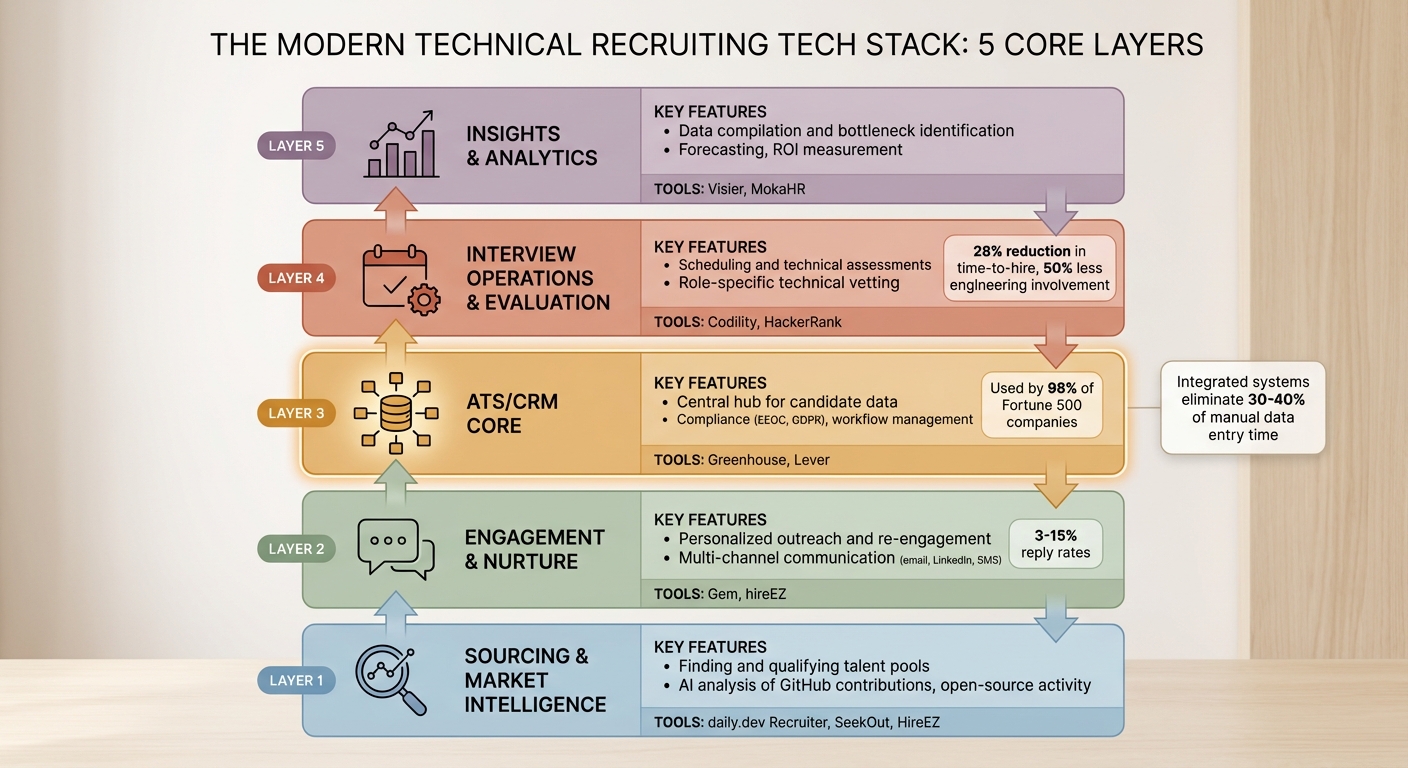 {The 5 Core Layers of a Technical Recruiting Tech Stack}
The 5 Core Layers
A recruiting tech stack isn’t just a collection of tools - it’s a well-organized system designed to streamline your hiring process. Picture it as the lifeblood of your recruitment efforts, ensuring data flows efficiently between each stage. This interconnected approach tackles inefficiencies head-on. While over 98% of Fortune 500 companies rely on an Applicant Tracking System (ATS), the real edge lies in how effectively these tools work together .
Layer 1: Sourcing & Market Intelligence
This layer is all about finding and qualifying talent pools before making any contact. Modern sourcing tools leverage AI to analyze technical signals, such as GitHub contributions and open-source activity. The goal? To locate the right talent and understand what will appeal to them.
Layer 2: Engagement & Nurture
Here, the focus shifts to personalized outreach. Tools in this layer handle multi-step communication via email, LinkedIn, and SMS. They also re-engage dormant candidates, keeping them in the loop. With the right setup, reply rates can range between 3% and 15% .
Layer 3: ATS/CRM Core
This is the backbone of your recruiting process. It serves as the central hub for candidate data, compliance (like EEOC and GDPR), and workflow management . Every candidate interaction, evaluation, and offer detail is stored here, making it the "operating system" of hiring.
Layer 4: Interview Operations & Evaluation
This layer streamlines scheduling and includes tools for technical assessment tools tailored to specific roles. For instance, in 2025, Finastra integrated Codility into their hiring stack, cutting their time-to-hire by 28% while reducing engineering team involvement in initial screenings by 50% . It ensures technical skills are vetted before advancing candidates further.
Layer 5: Insights & Analytics
This final layer compiles data from across the stack to identify bottlenecks, forecast hiring needs, and measure ROI. Without this, finding quality candidate sources or pinpointing process issues becomes a guessing game.
The upcoming sections will dive deeper into each layer, offering examples of tools, integration strategies, and success stories.
Why Layered Architecture Works
A layered approach ensures seamless communication between tools, addressing the inefficiencies of disconnected systems. For example, a job opening in your ATS can automatically trigger AI-powered sourcing, feeding directly into engagement workflows. Interested candidates are then seamlessly moved to scheduling and assessments, with results synced back to the ATS . This eliminates the chaos of a "Frankenstack", where recruiters might spend 30–40% of their time manually entering data or juggling multiple tools .
Take Sodexo as an example: by implementing a conversational AI engagement tool, they hired over 40,000 people in just seven months. This led to a 60% reduction in time-to-hire and a 21% increase in applications . Similarly, Compass Group leverages automation to hire 160,000 workers annually with only 20 recruiters. Their system automates screening, FAQs, and scheduling, cutting time-to-apply by 58% .
The cost of disconnected tools is steep. For a three-person recruiting team, inefficiencies can result in $42,000 wasted annually . When tools don’t integrate, data silos form, follow-ups are missed, and it’s hard to track what’s working. On the other hand, a well-structured stack reduces manual effort, accelerates hiring, and provides technical candidates with a smooth and timely experience, even across time zones .
Hiring engineers?
Connect with developers where they actually hang out. No cold outreach, just real conversations.
Sourcing & Market Intelligence Tools
Reaching Passive Developer Talent
The top technical talent isn’t actively scrolling through job boards. Studies show that 70–85% of the best developers are passive candidates - they’re already employed and not actively searching, but they’re open to the right opportunity. That’s why sourcing tools are a must-have for technical recruiting in 2026.
daily.dev Recruiter takes a unique approach by enabling warm, double opt-in introductions. Developers on the platform pre-qualify themselves by opting in, ensuring outreach is targeted and well-received. This method can increase response rates to an impressive 30–50%.
Other tools tackle passive sourcing in different ways. SeekOut (rated 4.5/5 on G2) excels in market-driven sourcing with built-in diversity insights. HireEZ uses AI to scan over 800 million profiles, powering multi-channel campaigns for outreach. Meanwhile, Gem (rated 4.8/5 on G2) combines sourcing with pipeline management, tracking engagement across all touchpoints. These tools focus on identifying developers who may not be job hunting but are open to the right opportunity.
By pinpointing the right candidates, these tools also lay the foundation for better market insights, helping you zero in on the talent that matters most.
Developer Data and Market Intelligence
Modern sourcing tools go beyond resumes, analyzing behavioral signals like GitHub activity, Stack Overflow contributions, and even technical reading habits. Findem specializes in mapping talent based on attributes, allowing you to create highly targeted talent pools based on specific technical skills. Similarly, Eightfold.ai uses AI to focus on skills-based matches, prioritizing demonstrated abilities over job titles.
Beyond sourcing, market intelligence features provide insights into compensation trends, skill availability, and location preferences. For example, Terminal creates specialized developer databases with real-time data on skills and compensation, helping to fill difficult roles faster - some users report time-to-fill reductions of 25–30%. These tools also support "talent rediscovery", scanning your ATS for overlooked candidates (often called "silver medalists") who have gained valuable experience since their last interaction.
Skill-based filtering is now a game-changer. Tools can narrow searches by frameworks (like React vs. Angular), years of experience, or open-source contributions. This level of precision can improve match rates by 20–40% compared to more generic HR software.
With these insights and detailed profiles in hand, the next step is ensuring seamless integration with your ATS.
Connecting Sourcing Tools to Your ATS
Integrating sourcing tools with your ATS streamlines the process, eliminating manual data entry. Many leading platforms, like Greenhouse and Lever, connect to sourcing tools via native APIs. For instance, when a developer opts in through daily.dev Recruiter, their enriched profile syncs directly to your ATS - no copy-pasting required. This kind of integration ensures that daily.dev Recruiter fits seamlessly into your recruiting workflow.
Recruiterflow (rated 4.7/5 on G2, priced at $99 per user per month) offers bi-directional syncing, keeping data between your sourcing tools and ATS updated in real time. For more custom needs, platforms like Zapier can help bridge gaps between systems. The goal is to maintain a single, reliable source of candidate data while letting each tool do what it does best - sourcing platforms find the talent, and your ATS manages the hiring process.
For startups on a budget, it’s smart to prioritize tools with strong integration capabilities from the beginning. Entry-level sourcing tools typically cost between $5,000 and $15,000 per user annually. Mid-tier options with robust ATS integrations range from $20,000 to $50,000. For developer-specific needs, daily.dev Recruiter offers startup-friendly plans starting around $10,000, with scalable pricing as your team grows.
Engagement & Nurture Tools
Outreach That Developers Actually Respond To
Once you've nailed sourcing and integrated your ATS, the next step is engaging candidates with messages that resonate. This phase builds on precise sourcing efforts, ensuring that qualified developers receive communication that feels both relevant and timely.
Developers tend to ignore generic mass emails. To grab their attention, personalize your outreach by mentioning specific GitHub contributions, shared technical interests, or relevant projects. Tools like Gem (rated 4.6/5 on G2) focus on developer-friendly channels like LinkedIn and email. A/B testing shows that personalized sequences can boost response rates by up to three times compared to generic templates .
hireEZ (rated 4.5/5 on G2) takes it a step further with AI-driven engagement sequences, perfect for reaching passive candidates. For instance, one tech company achieved a 40% reply rate by using LinkedIn personalization strategies in their outreach . Best practices include keeping messages under 100 words, sending them mid-week, and focusing on career growth opportunities. Research also shows that developers respond better to outreach sequences with 3–5 touches rather than overly persistent follow-ups .
Teamtailor offers features like automated chats and personalized career sites, creating a conversational tone that feels more engaging and less transactional . These tools also integrate with ATS platforms, ensuring a unified approach to tracking your talent pipeline.
Automation and Pipeline Management
Automation plays a key role in keeping candidates engaged while seamlessly connecting with your recruiting tech stack. It not only keeps your talent pipeline active but also reduces manual tasks, giving recruiters more time to focus on strategic interactions.
For example, TurboHire (rated 4.8/5 on G2) automates 85% of recruitment workflows, with 98% accuracy in resume parsing. This allows for automated follow-ups and enriched candidate profiles. It even pulls data from platforms like GitHub and Stack Overflow to craft hyper-personalized messages and send timely nudges based on candidate activity .
Users of Gem report a 25% reduction in time-to-fill thanks to its streamlined CRM and outreach capabilities . Its talent rediscovery feature is particularly useful, scanning your ATS for candidates who have gained new, relevant experience and automatically launching re-engagement campaigns. Similarly, SeekOut provides diversity insights and helps re-engage dormant candidates, with users reporting reactivation rates of 20–30% .
ATS & CRM: The Center of Your Stack
Your Applicant Tracking System (ATS) and Candidate Relationship Management (CRM) tools form the core of your recruiting tech stack. These systems centralize all candidate data - like notes, scorecards, and offers - ensuring smooth collaboration across sourcing, engagement, and interviewing tools . Without this central hub, recruiters spend an average of 17.7 hours per vacancy on administrative tasks, like copying data between systems . A well-integrated ATS and CRM not only save time but also allow every other tool in your stack to function effectively.
ATS Features for Technical Hiring
Generic HR software often falls short when it comes to hiring for technical roles. For developer-focused recruiting, look for ATS platforms equipped with GitHub integration. This enables recruiters to assess real contributions rather than relying on keyword-heavy resumes. With the rise of AI-generated resumes, recruiters are shifting toward "evidence sourcing", where actual work output is prioritized over buzzwords .
Key features to prioritize include:
- Skill-matching algorithms: These tools can identify technical career paths more effectively. For instance, contributing to open-source Kubernetes projects demonstrates cloud-native expertise far better than a resume listing "Docker" repeatedly.
- AI-assisted screening: Systems that evaluate candidates based on structured criteria - like years of experience with frameworks or activity on platforms like Stack Overflow - help streamline the pipeline.
- Role-based access and compliance: Advanced ATS platforms protect sensitive data, such as compensation details, while staying compliant with regulations .
- Automation and self-scheduling: Features like automated nudges and developer-friendly self-scheduling reduce delays and eliminate unnecessary back-and-forth emails .
These capabilities ensure your ATS goes beyond data management, actively enhancing your recruitment process.
How daily.dev Recruiter Connects to Your ATS
daily.dev Recruiter integrates seamlessly with your ATS, bridging the gap between sourcing, engagement, and evaluation. Unlike cold outreach or scraped databases, daily.dev connects you with developers in their natural environment - where they’re learning, reading, and engaging. Every connection is warm and double opt-in, meaning developers show interest before you reach out [recruiter.daily.dev].
When a developer expresses interest, their profile, including insights like reading habits and technical interests, syncs directly to your ATS. This ensures your pipeline is filled with candidates who are genuinely interested in your opportunities. Plus, all communication history is tracked in one timeline, so your team avoids duplicate outreach or losing track of conversations .
ATS Comparison for Technical Recruiting
Choosing the right ATS for technical recruiting depends on your team's size, budget, and hiring goals. Here's a comparison of leading platforms tailored for technical hiring in 2026:
| ATS Platform | Best For | Key Technical Features | Pricing (Indicative) | G2 Rating |
|---|---|---|---|---|
| Greenhouse | Enterprise teams | Structured hiring, 400+ integrations | $6,000+/year | 5/5 |
| Lever | Data-driven teams | Unified ATS + CRM, nurture campaigns | Custom pricing | 4/5 |
| Workable | Mid-market companies | AI sourcing, 200+ job board integrations | From $149/month | 4/5 |
| Ashby | Analytics-focused teams | API-first, deep custom reporting | From $300/month | - |
| Recruiterflow | Agencies | AI-first sequencing, built-in job posting | Custom pricing | 4.7/5 |
| JuggleHire | Startups/SMBs | Simple UI, unlimited team members | From $19/month | 5/5 |
- Greenhouse is ideal for enterprise teams, offering structured hiring frameworks and compliance features .
- Lever combines ATS and CRM capabilities, making it great for nurturing passive talent over time .
- Workable is a solid choice for mid-market companies, with AI-powered sourcing and mobile apps starting at $149/month .
- JuggleHire is perfect for startups, offering affordability ($19/month) and unlimited team members .
- Ashby appeals to analytics-focused teams with its customizable API-first architecture .
- Recruiterflow stands out for agencies with its AI-driven sequencing and built-in job posting tools .
To optimize your stack, follow the "1 Core + 2 Enablers" rule: select one robust ATS as your primary system and supplement it with two specialized tools, like a scheduling app or a technical assessment platform, that directly impact your key metrics . Before integrating new tools, audit your ATS for duplicate records and inconsistent data fields to maintain accurate AI insights and reporting .
Interview Operations and Evaluation Tools
Once candidates reach the interview stage, having the right tools in place can make all the difference. These tools not only help assess technical skills effectively but also streamline scheduling and ensure compliance. Did you know the average recruiter spends around 14 hours a week just on scheduling tasks? . That’s valuable time that could be better spent elsewhere. On top of that, poorly structured evaluations can lead to inconsistent hiring decisions, making the right tools even more critical.
Technical Skill Assessment Tools
The days of relying on algorithmic puzzles are fading. Today’s technical assessments focus on tasks that feel more like actual work - like debugging APIs or fixing vulnerabilities. And developers have made it clear: 97% prefer realistic assessments, which are completed 60% more often on platforms that simulate real-world tasks .
Platforms like CoderPad allow live collaborative coding interviews, giving recruiters a front-row seat to watch candidates in action. For instance, McAfee adopted CoderPad and saw a 22% improvement in time-to-accept, along with a 35% boost in assessment completion rates . If you’re dealing with high-volume hiring, tools like HackerRank (4.2/5 on G2, 1,200+ reviews) and Codility (4.5/5 on G2, 800+ reviews) offer vast question libraries, automated scoring, and even plagiarism detection .
There’s also a growing trend toward pre-ATS screenings. Code Assess AI offers "QuickScreen" tests - short, 10- to 15-minute assessments embedded right in job postings. These help weed out unqualified candidates before they even enter your pipeline. Pricing starts at $1 for a trial, with plans like $49/month for 50 assessments or $299/month for 150 assessments . Some tools are even integrating AI assistants directly into coding environments, letting recruiters see how candidates use AI to validate and ship code .
Interview Scheduling Automation
When it comes to scheduling interviews, automation is a game-changer. Tools like GoodTime handle complex panel scheduling, instantly finding overlapping availability across multiple calendars. This is especially helpful when senior engineers and hiring managers need to coordinate interviews. GoodTime’s pricing ranges from $150 to $250 per user/month .
For simpler needs, Calendly offers plans starting at $8/user/month . The key feature to look for? Bidirectional syncing. During a demo, try modifying a test interview in your native calendar (Google or Outlook) to ensure the changes are reflected instantly in the scheduling tool . Companies that automate scheduling often see a 40% reduction in time-to-hire .
To maintain consistency, set up multi-stage templates tailored to specific technical stages - like a 30-minute phone screen, a 90-minute live coding session, or a 2-hour panel interview. Don’t forget to build in 10–15 minutes between interviews to prevent burnout and allow time for feedback . For global teams, timezone intelligence is a must. Automated detection and conversion help avoid missed meetings due to errors in manual calculations .
Feedback and Compliance Tracking
Streamlining scheduling is only part of the equation. To make fair and legally sound hiring decisions, you need strong feedback and compliance systems. Standardized scorecards are a must, ensuring every candidate is evaluated using the same criteria . Tools like BrightHire and Metaview record live interviews, offering searchable transcripts and AI-generated summaries that reduce bias .
To keep feedback timely and data clean, automate reminders for evaluations . For compliance, enforce role-based access control (RBAC) to hide sensitive details - like compensation or personal identifiers - from unauthorized viewers . Keep a log of all changes for legal audits, and automate consent capture to simplify compliance with regional data retention policies . Platforms like Code Assess AI and Codility even monitor for AI-generated solutions and plagiarism, helping you maintain integrity in technical assessments .
Finally, ensure your background check providers follow "ban-the-box" laws, embedding these regulations directly into their reporting processes. This ensures compliance during the final stages of hiring .
Analytics: Measuring Your Stack's Performance
Analytics is the final piece of your tech stack, transforming raw data from your tools into actionable insights. Without it, you're essentially flying blind, relying more on gut feelings than hard data. Did you know that 70% of recruitment data often goes unused in hiring decisions ? That’s a staggering amount of missed opportunities to improve your hiring process.
Modern analytics tools are changing the game by offering conversational interfaces. Instead of poring over spreadsheets, you can simply ask, “Where are we losing qualified candidates?” These tools also bring in predictive intelligence, helping you anticipate pipeline challenges and offering suggestions to fix issues before they escalate .
Key Metrics for Technical Recruiting
Not all metrics carry the same weight. Focus on those that pinpoint bottlenecks and lead to meaningful improvements. For example:
- Time-to-hire: A critical metric, especially in the race for top technical talent.
- Source of Hire: Helps you identify which channels are worth your time and budget, like developer-focused platforms or employee referrals, rather than underperforming job boards .
- Candidate Net Promoter Score (cNPS): Tracks how your tech stack impacts the candidate experience, which plays a big role in closing offers .
For technical roles, two specific metrics stand out: assessment completion rates and funnel drop-off points. If candidates are dropping out during technical assessments, that’s your signal to reevaluate the process . And don’t overlook quality of hire - this connects recruiting data to actual performance outcomes. Tools like Visier (rated 4.6/5) can merge data from your ATS, HRIS, and payroll systems to measure long-term success .
Need to justify the cost of your tech stack? Use this simple ROI formula:
ROI = (hours saved × hourly rate × 12) ÷ annual software cost .
It’s a straightforward way to show value during budget conversations.
These metrics can be tracked and visualized in real-time through specialized dashboard tools.
Dashboards and Reporting Tools
Dashboards bring all your stack’s data together, offering real-time insights into your recruitment performance. Here are some standout tools:
- MokaHR (4.9/5 rating): Known for live KPI dashboards, it’s been shown to cut time-to-hire by 63% while maintaining 87% screening accuracy .
- Greenhouse (4.8/5 rating): Offers over 40 pre-built reports, including DE&I analytics, making it a great choice for teams focused on structured hiring .
- Lever (4.7/5 rating): Specializes in visualizing candidate engagement and pipeline performance. For example, Talend used Lever to reduce time-to-fill by nearly 46%, and Mitek Systems boosted their offer acceptance rate to 96% .
For larger teams, Workday (4.6/5 to 4.8/5 rating) connects recruiting data to key business outcomes like payroll and retention . If workforce planning is a priority, Visier (4.6/5 rating) provides advanced forecasting and predictive analytics across multiple HR systems .
To get the most out of your analytics tools, align them with your core ATS to ensure consistent and reliable data. Follow the "1 Core + 2 Enablers" Rule: one system of record (your ATS) and two additional tools that directly impact your key metrics . Also, standardize definitions for stages, sources, and locations across all tools to avoid data silos . For seamless integration, prioritize native connections or consider middleware solutions like Zapier .
Budget Planning and Implementation
Now that your integrated recruiting tech stack design is ready, it’s time to tackle the budget and implementation strategy. Building a tech stack doesn’t mean you have to buy everything at once. The smartest move is incremental deployment - start with the essentials and add layers as you demonstrate ROI. In fact, organizations that upgrade their recruitment systems report an average 340% ROI within 18 months just from AI recruitment tools alone , though it's vital to balance automation with authentic tech recruiting . But achieving those results requires a strategic approach.
Before you spend anything, take a close look at your hiring process. Map out the entire candidate journey to identify manual inefficiencies. This will help you determine which tools genuinely address your challenges rather than simply looking impressive during demos. As Abhishek Sharma, SEO Lead at Recruiterflow, says:
"The right recruitment technology eliminates human effort involved in basic but necessary tasks such as downloading resumes, moving data between sheets, and resending invites" .
Budget Tiers by Team Size
Your budget should align with your team size and hiring goals. Here’s a breakdown of what tech stacks typically cost across different scales:
| Team Size | Monthly Budget | Core Tools | What You Get |
|---|---|---|---|
| Startup (1-2 recruiters) | $300-$600 | Basic ATS ($25/user), sourcing tool ($49), outreach platform ($30), AI assistant ($20) | Foundation for 10-20 hires/year with manual workflows |
| Growth (3-10 recruiters) | $800-$1,500 | Mid-tier ATS, Clay enrichment ($149), n8n Pro automation ($60), multi-channel outreach ($130) | Automated workflows for 50-100 hires/year |
| Enterprise (10+ recruiters) | $1,500+ | Enterprise ATS (custom pricing), self-hosted automation, AI-native CRM, advanced analytics | Full integration for 100+ hires/year with predictive intelligence |
For startups, tools like RecruitCRM at $25 per user per month provide a solid foundation . Growth-stage teams benefit from tools like Clay ($149/month) for data enrichment and n8n Pro ($60/month) for connecting workflows . Enterprise teams often require custom solutions with AI copilots, such as Claude Pro starting at $20/month, scaling up to Claude Max for heavy usage .
To justify your budget, calculate ROI using this formula: (hours saved × hourly rate × 12) ÷ annual software cost . For example, if a $600/month tool saves 20 hours per week at $50/hour, the ROI is (20×50×12) ÷ 7,200, or 722% ROI. Use this calculation to present a strong case to leadership.
Step-by-Step Implementation Plan
A phased implementation ensures a smooth rollout and measurable ROI. Here’s how to approach it:
Month 1 (Foundation): Start with an ATS as your central system and one outreach channel. This allows you to validate messaging and processes while keeping things simple. Focus on getting your team comfortable with the core workflow .
Month 2 (Enrichment): Add tools for sourcing and data enrichment. For example, Prospeo ($39/month) and BetterContact ($49/month) can automatically fill in candidate details, saving time on manual research .
Month 3 (Orchestration): Introduce workflow automation to connect your tools, eliminating manual data entry - a task that wastes 17 hours weekly per recruiter . Integration is key, as 28% of recruiters cite tool integration as their biggest challenge .
Month 4 (Multi-channel): Expand your outreach beyond email to include LinkedIn and SMS. Companies with connected tech stacks see 3-15% reply rates, compared to less than 1% for disconnected tools . One agency using this approach generated 146 interested leads and a $184,000 pipeline in six months .
Month 5+ (AI Copilot): Add AI capabilities to handle administrative tasks like document management and reporting. As Niklas Huetzen, CEO of Automindz, explains:
"The agencies winning in 2026 are the ones building AI copilots into every layer of their operations" .
To avoid overspending and tool sprawl, stick to one primary ATS and two key enablers. Run a 21-to-30-day pilot with active requirements before a full rollout. This will help you measure friction and validate ROI using real data .
Conclusion
Building a technical recruiting tech stack in 2026 isn’t about collecting tools - it’s about creating a streamlined system that avoids the chaos of a "Frankenstack." When recruiters spend 30–40% of their time on manual tasks like data entry and switching between tools , it’s not just inefficient - it puts your ability to attract top developer talent at risk.
The foundation of this system starts with a reliable ATS as your System of Record. From there, you can layer tools to tackle specific bottlenecks, from sourcing to assessment. This is where daily.dev Recruiter plays a key role. Unlike generic sourcing platforms, it connects you with passive developer talent by understanding developer needs through warm, double opt-in introductions within a trusted community. Plus, it integrates smoothly with your ATS, ensuring you maintain a single source of truth.
The results speak for themselves. Companies like Sodexo and Finastra have reported a 60% reduction in time-to-hire and a 50% cut in engineering screening time by using a well-structured tech stack . These outcomes aren’t about spending more - they’re about spending wisely.
Niklas Huetzen, CEO & Co-Founder of Automindz, sums it up perfectly:
"It is not your people, it is your system. The agencies winning in 2026 are the ones building AI copilots into every layer of their operations" .
This approach is clear: success lies in building a deliberate, layered system. Start by auditing your hiring process to pinpoint bottlenecks, from ATS integration vs. manual processes to candidate engagement. The talent you’re looking for is out there - your tech stack just needs to be smart in sourcing and personal in its approach.
FAQs
What’s the minimum technical recruiting software stack I need to start?
To kick off your recruiting efforts, you'll need two essential tools: an applicant tracking system (ATS) and a sourcing tool. The ATS helps you manage candidates and workflows efficiently, while the sourcing tool is key for finding and connecting with potential talent. For instance, daily.dev Recruiter works effortlessly with existing ATS platforms, making the technical recruiting process smoother and more efficient.
How do I integrate sourcing and outreach tools with my ATS without creating a “Frankenstack”?
To keep your system organized and efficient, rely on API-based integrations to link your sourcing and outreach tools with your ATS. This approach allows for real-time data synchronization, minimizes manual data entry, and ensures your candidate database stays consistent and up-to-date. Prioritize tools that integrate smoothly and can automate repetitive tasks like updating profiles or managing outreach efforts. With thoughtful planning and scalable tools, you can simplify your workflows without adding unnecessary complications.
How can I prove the ROI of my recruiting tech stack to leadership?
To show ROI effectively, zero in on measurable metrics like time-to-hire, cost-per-hire, and quality-of-hire. Take a straightforward approach: compare recruitment costs and timelines from before and after implementing your tech stack. Then, translate those improvements into clear dollar savings.
Begin with small steps - integrate tools into your existing ATS and track results over a 30-day period. Focus on outcomes such as shorter time-to-interview and better candidate quality. These data points can help you build a solid, numbers-backed case to present to leadership.
.png)