Recruiting developer talent in 2026 requires more than job boards - it demands an integrated, AI-powered system to save time and improve hiring outcomes. Here's what you need to know:
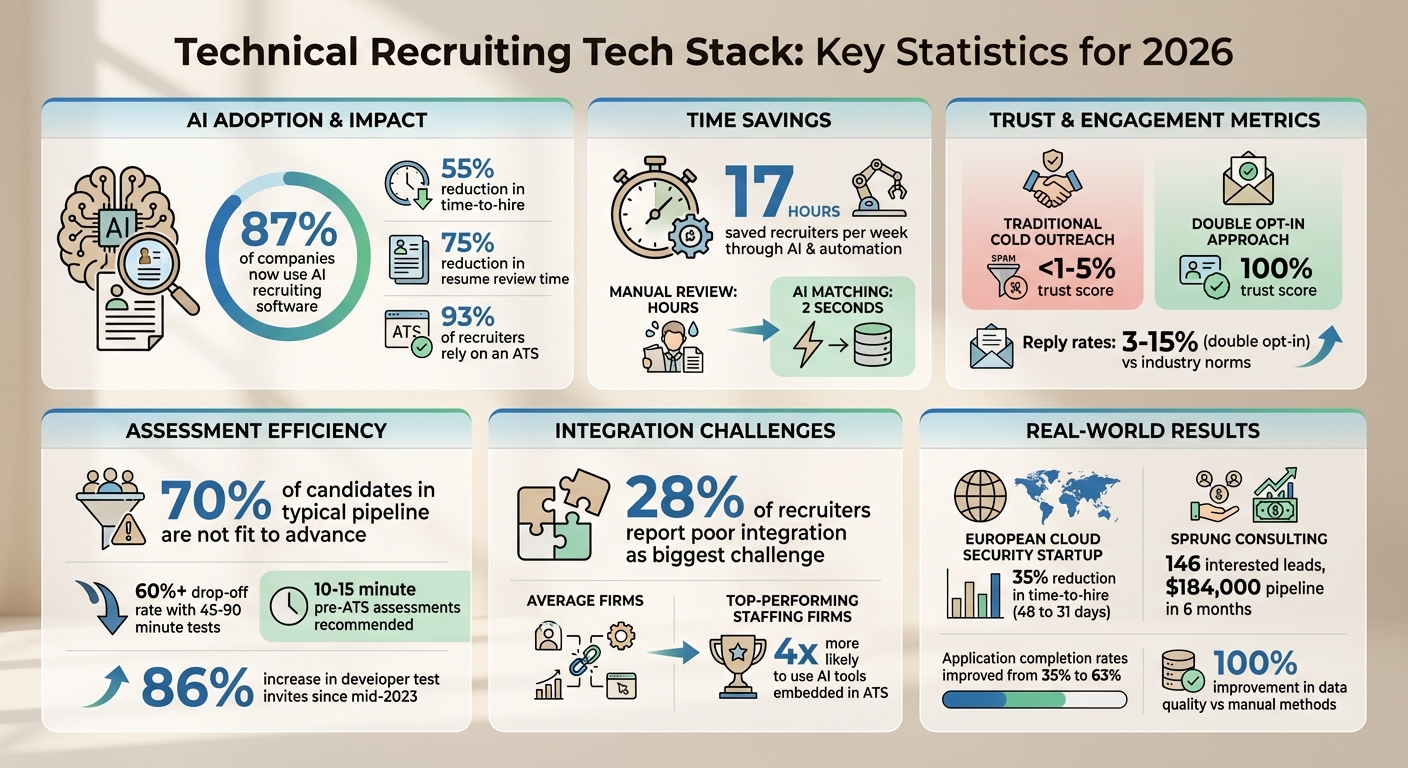
- AI-Powered Tools Dominate: 87% of companies now use AI recruiting software platforms, reducing time-to-hire by up to 55% and resume review time by 75%.
- Key Components: A strong tech stack includes an Applicant Tracking System (ATS), sourcing tools, engagement platforms, and screening/assessment tools.
- Efficiency Focus: Modular tools with seamless integration are preferred over all-in-one platforms. The "1 Core + 2 Enablers" approach (1 ATS + 2 specialized tools) ensures better workflow alignment.
- Automation is Essential: AI handles repetitive tasks like resume parsing, candidate ranking, and contact verification, saving recruiters up to 17 hours weekly.
- Candidate Experience Matters: Modern tools prioritize trust with features like double opt-in communication, short assessments, and AI-driven evaluations.
1. Applicant Tracking Systems (ATS)
What features should technical recruiters look for in an ATS designed for developer hiring?
An Applicant Tracking System (ATS) is the backbone of modern recruiting - 93% of recruiters rely on one to manage their processes effectively . But when it comes to technical hiring, an ATS needs to go beyond just storing resumes. It should function as a central hub that connects seamlessly with AI sourcing tools, technical assessment platforms, and developer networks .
Here’s what to look for:
- AI-Powered Resume Parsing: Look for parsing tools with accuracy rates of 95% or higher. These can significantly speed up the screening process, cutting review times by as much as 75% .
- Automated Screening: The ability to automate candidate shortlisting ensures recruiters spend less time on repetitive tasks and more on engaging top talent.
- Structured Evaluation Tools: Features like standardized scorecards and interview kits help ensure fair and consistent technical assessments while reducing the impact of unconscious bias .
Seamless integration is just as crucial. In fact, 28% of recruiters report that poor integration is their biggest challenge . A good example of integration in action comes from a European cloud security startup. By using an ATS with AI-powered parsing and mobile-friendly applications, they cut their time-to-hire by 35% - from 48 days to 31 - and boosted application completion rates from 35% to 63% .
"It is not your people, it is your system. The agencies winning in 2026 are the ones building AI copilots into every layer of their operations." – Niklas Huetzen, CEO & Co-Founder, Automindz
To streamline your hiring process, consider the "1 Core + 2 Enablers" approach. This means selecting one reliable ATS as your primary system and pairing it with two specialized tools, such as a developer-focused sourcing platform and an automated scheduling assistant. Test your setup by running a pilot with two active technical roles and 50 candidates over a 21–30 day period. This will help you identify any friction points and evaluate the return on investment .
2. Sourcing Tools
How can sourcing tools streamline the process of identifying qualified developers?
Once you've got an effective ATS in place, top platforms for hiring software developers are the next piece of the puzzle. By 2026, these tools have evolved beyond manual keyword searches. Modern AI-powered platforms now analyze real-time developer behavior, tracking what developers are learning, reading, and building in the moment . This shift to behavioral data has proven far more effective than traditional methods.
For instance, traditional sourcing methods like LinkedIn or job boards often result in trust scores of less than 1% to 5% through cold emails or InMails . On the other hand, behavioral sourcing tools, which rely on developer opt-in networks, achieve full trust scores because developers actively express interest before any outreach happens . This approach not only boosts trust but also saves recruiters a huge amount of time.
"Resumes lie. Behavior doesn't. Our AI matches based on what developers are actually learning and building right now." - daily.dev Recruiter
When choosing a sourcing tool, look for features like automated enrichment and verification. These tools can automatically locate and verify contact details, helping protect your sender reputation by reducing bounce rates . On average, AI and automation save recruiters 17 hours per week. To maximize this time savings, ensure your sourcing tool integrates seamlessly with your CRM and ATS, providing a unified view of candidates . It's worth noting that top-performing staffing firms are four times more likely to use AI tools embedded in their ATS .
The future of sourcing is also leaning into agentic AI, which can autonomously manage tasks like custom web scraping and document handling . This allows recruiters to focus on building relationships and crafting compelling narratives, while automation takes care of repetitive tasks like profile enrichment and scheduling .
Once you've identified qualified developers, engagement platforms become essential for nurturing these valuable connections.
3. Engagement Platforms
What features should technical recruiters look for in an engagement platform in 2026?
Once you've nailed down candidate tracking and sourcing, the next step is effective communication. Engagement platforms play a key role here by facilitating genuine conversations. By 2026, top-tier platforms will rely on a warm, double opt-in approach (like TinDev), where both parties consent before engaging. This method not only reduces ghosting but also builds trust.
Why does this matter? Traditional cold outreach methods often have trust scores below 1%, while double opt-in approaches boast 100% trust scores and reply rates between 3–15%. That’s a huge leap compared to industry norms. These platforms make it easier to connect with candidates and maintain communication, ensuring smoother interactions.
When choosing an engagement platform, prioritize tools that offer automated, multi-channel outreach - think email, SMS, and even social media. Another must-have feature is real-time integration with developer hiring platforms and ATS systems like Greenhouse, Lever, or Ashby. This ensures updates happen automatically, eliminating the need for manual input and saving valuable time.
To see the impact of these features in action, consider this example: In February 2026, Lukas from Sprung Consulting in Switzerland adopted a fully integrated recruitment system. His team automated the process from data scraping to verified outreach. Over six months, they generated 146 interested leads and built a $184,000 pipeline. Notably, data quality improved by 100% compared to manual methods.
Another trend to watch is the rise of human-in-the-loop models. While AI can assist with candidate suggestions and message drafts, recruiters still make the final call. This approach ensures that communications remain personal and authentic.
4. Screening and Assessment Tools
What features should technical recruiters prioritize in screening and assessment tools for 2026?
Once candidates are engaged, recruiters need to quickly and effectively evaluate technical and soft skills using advanced screening tools. By 2026, these tools have evolved far beyond basic coding tests. The top platforms now use AI-powered evaluations to analyze code quality, efficiency, and reasoning, providing a deeper understanding of a candidate's abilities rather than just a pass/fail result. Some tools even integrate AI assistants, like Copilot, directly into the testing environment. This allows companies to monitor how candidates interact with these tools while controlling their access during assessments.
One standout improvement is the use of short pre-ATS assessments - lasting just 10 to 15 minutes - to filter out unqualified candidates early in the process. This is especially important given that 70% of candidates in a typical pipeline are not fit to advance. These shorter tests also address a major issue: the high drop-off rates (over 60%) seen with longer 45–90 minute tests.
Another critical focus is assessment integrity. With 76% of developers using tools like ChatGPT in their work, modern systems have introduced multiple layers of security. These include AI-driven plagiarism detection (capable of identifying answers generated by language models), keystroke analysis, tab-switch monitoring, and session replays. For example, in 2024, Atlassian’s campus recruiting team reduced plagiarism flags from 10% to 4% across 35,000 applicants by using HackerRank’s AI-enabled integrity features. This shift significantly cut down on the time spent manually reviewing flagged assessments.
Additionally, platforms are now offering AI interviewers that conduct dynamic, two-way technical assessments. These tools instantly capture candidates’ thought processes, making them especially valuable for evaluating real-world debugging and system design skills. The demand for such automation is evident - developer test invites have increased by 86% since mid-2023, highlighting the growing reliance on these tools to streamline technical screening.
5. Automation and AI Solutions
How can automation and AI improve the efficiency of technical recruiting in 2026?
Once assessments are streamlined, automation and AI take recruiting efficiency to the next level. Predictive AI ranking evaluates skills, identifies patterns, and tracks growth trends to highlight candidates with strong future potential. This approach relies on data, delivering results instantly and cutting down on the need for tedious manual reviews.
One standout innovation is behavioral verification. AI-powered tools can analyze real-time developer activities - like GitHub contributions, code commits, and even reading habits - to validate skills far more quickly than traditional static profiles.
When it comes to costs, AI recruiting tools offer a range of pricing options. For instance:
- HireEZ: Starts at $149 per month
- Manatal: Offers plans at $15, $35, and $55 per user per month
- Workable: The Starter plan begins at $149 per month, while the Standard plan starts at $299 per month
- Codility: Technical assessment tools start at $1,200 annually
| Feature | Traditional Ranking | Predictive AI Ranking |
|---|---|---|
| Primary Data Source | Keywords and Job Titles | Skills, Patterns, and Growth Trends |
| Decision Basis | Subjective Intuition | Data-Driven Profiles |
| Focus | Past Experience | Future Potential and Fit |
| Speed | Manual and Time-Consuming | Automated and Instant |
This blend of predictive ranking and advanced feature comparisons creates a highly efficient, tech-focused recruiting system for 2026. The biggest win? Speed and precision - allowing recruiters to focus on building relationships and making impactful hires.
Conclusion
Creating an integrated recruiting tech stack turns technical recruiting from a scattered, manual effort into a connected system where every tool works together seamlessly . When your ATS, sourcing platforms, screening tools, and AI solutions share data effortlessly, you establish a single source of truth that keeps everyone on the same page regarding candidate status, interview feedback, and next steps . This streamlined approach not only improves collaboration but also drives measurable efficiency.
The efficiency benefits are immediate. AI matching can reduce hours of manual review to a quick, 2-second score . Time-to-hire drops significantly when your stack eliminates repetitive workflows, ensures timely feedback, and lowers overall operational costs . To calculate the impact, try this formula: ROI = (hours saved × hourly rate × 12) ÷ annual software cost .
But it’s not just about efficiency - it’s about the candidate experience, too. Developers can reschedule interviews with just a few clicks, receive timely updates, and interact through platforms they already trust. By 2026, developers will favor employers that emphasize data ethics and use AI transparently . A thoughtful tech stack respects their time and reflects your commitment to a professional, developer-focused process.
A good starting point? Follow the "1 Core + 2 Enablers" rule: choose one system of record and integrate two impactful tools that directly influence your key metrics . Aim for a modular, API-connected stack that automates repetitive tasks while leaving room for human judgment in complex decisions. The result? A unified, technology-powered recruiting system that delivers measurable outcomes and an outstanding candidate experience .
.png)