Hiring for a startup? Every dollar and hour counts. LinkedIn Recruiter and daily.dev Recruiter are two platforms that can help, but their pricing models and effectiveness differ significantly. Here's the bottom line:
- LinkedIn Recruiter charges per recruiter seat, with costs ranging from $1,680 to $12,960 annually per user. It’s great for accessing a large professional network, but it can be pricey, time-consuming, and inefficient for startups hiring only a few roles.
- daily.dev Recruiter charges per open role, starting at $350/month, with unlimited recruiter seats. It focuses on pre-qualified matches, saving time and offering flexibility with month-to-month billing.
Key Differences:
- Costs: LinkedIn's per-seat model can quickly add up, while daily.dev’s per-role pricing scales better for startups.
- Time: LinkedIn requires hours of manual searching, while daily.dev delivers pre-vetted candidates.
- Flexibility: LinkedIn locks you into annual contracts; daily.dev offers monthly plans with no long-term commitments.
Quick Comparison:
| Metric | LinkedIn Recruiter | daily.dev Recruiter |
|---|---|---|
| Cost (1 seat/role) | $8,999–$12,960 annually | $4,200–$12,000 annually |
| Pricing Model | Per recruiter seat | Per open role |
| Time Spent Searching | ~7.3 hours/week per recruiter | Minimal |
| Contract Terms | Annual | Month-to-month |
| Candidate Quality | Mixed, often outdated profiles | Pre-qualified matches |
| Scalability | Costs rise with team size | Unlimited recruiter seats |
For startups, daily.dev Recruiter offers a more cost-effective and efficient solution, especially for tech hiring. If your team values flexibility and reduced time spent searching, it’s worth exploring.
::: @figure 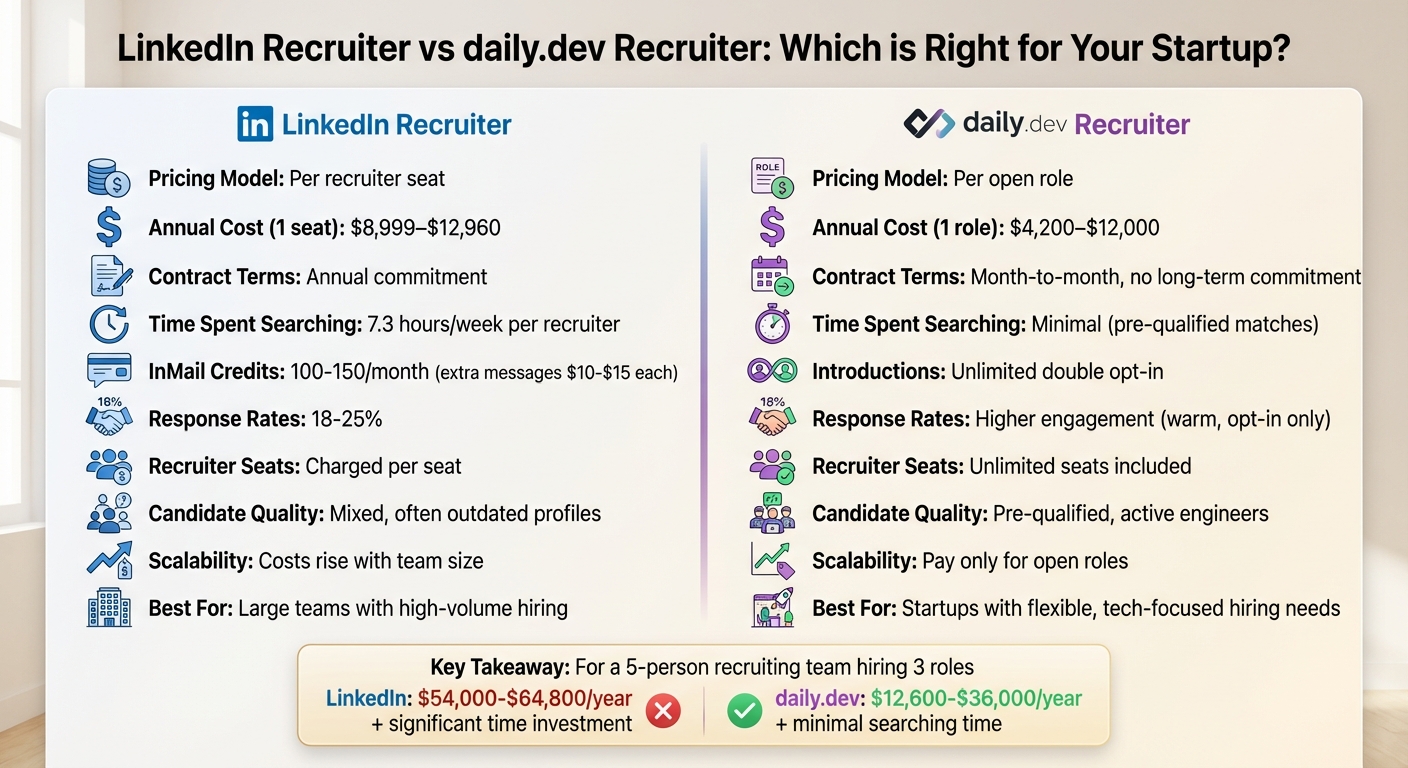 {LinkedIn Recruiter vs daily.dev Recruiter: Cost and Features Comparison for Startups}
1. LinkedIn Recruiter
Cost
LinkedIn Recruiter operates on a per-seat licensing model, which means you’re charged for each recruiter on your team, regardless of how much they use the platform. For startups hiring just a handful of engineers annually, this pricing structure can quickly become a burden.
| Plan Type | Annual Cost (per seat) | InMail Credits |
|---|---|---|
| Recruiter Lite | $1,680 – $2,040 | 30/month |
| Recruiter Professional | ~$8,999 | 100/month |
| Recruiter Corporate | $10,800 – $12,960 | 150/month |
These figures only represent the base costs. LinkedIn has been increasing prices by roughly 15% every year , and contracts often come with "take-or-pay" terms. This means you can’t cancel early or reduce the number of seats even if your team shrinks . If your team exceeds its monthly InMail credits, additional messages cost between $10 and $15 each . For example, a five-person team using Corporate licenses could spend anywhere from $54,000 to $64,800 annually - just for access to the platform.
"LinkedIn Recruiter's advertised price is just the entry fee. The real cost includes the extra InMails at $10 each when your monthly allowance disappears." – HootRecruit
And that’s just the subscription fees. The labor costs associated with using the platform add another layer of expense.
Time Investment
Beyond the subscription, there’s the hidden cost of time. Labor costs for a recruiter using LinkedIn Recruiter can add up to nearly $13,900 per year . Finding 10 qualified candidates for a single role often requires 8 to 12 hours of manual screening . Why? The platform’s filters prioritize profile completeness and recent activity rather than actual job fit. This means recruiters often sift through outdated or irrelevant profiles, further increasing the time spent.
Effectiveness in Tech Talent Acquisition
Even with LinkedIn’s massive database, finding the right tech talent isn’t easy. Only about 18% of the workforce is actively looking for jobs, while 70% are passive candidates who may not have updated profiles . InMail response rates are typically between 18% and 25% , so recruiters often have to send dozens of messages to secure just a few interviews. For specialized tech roles, Recruiter Lite’s third-degree connection limit can block access to 30% to 50% of potential candidates . Considering that hiring a software developer in the U.S. can cost up to $35,000 , these inefficiencies make the process even more expensive.
Scalability for Startups
For startups operating on tight budgets, LinkedIn’s per-seat model becomes a significant hurdle. Scaling to a 10-person recruiting team could mean spending $90,000 to $129,600 annually on Corporate licenses . These costs could easily cover several new hires instead. Worse, during hiring freezes or layoffs, startups locked into annual contracts are forced to keep paying for unused licenses , making the platform even harder to justify financially.
Hiring engineers?
Connect with developers where they actually hang out. No cold outreach, just real conversations.
2. daily.dev Recruiter
Cost
daily.dev Recruiter uses a per-role pricing model instead of charging per recruiter seat. The Agent plan is priced at $350 per month per open role, while the Super Agent plan costs $1,000 per month per role. The Super Agent plan offers a 3× faster matching speed and includes features like ATS integrations . Both plans allow unlimited recruiter seats, meaning your entire team can collaborate without additional costs. Plus, there are no placement fees and no long-term contracts - billing is handled month-to-month, giving startups the flexibility they often need .
For instance, if a startup is hiring for five roles at the same time, the Agent plan would cost $1,750 per month, or $21,000 annually if those roles remain open throughout the year. This straightforward pricing eliminates surprises and helps save time during the recruitment process.
Time Investment
The platform not only saves money but also reduces the time spent on recruitment. By matching job requirements with developers already active on daily.dev, it removes the need for manual candidate searches. The Super Agent plan speeds things up even more with its 3× faster matching pace, allowing teams to focus on connecting with pre-qualified candidates instead of sifting through resumes.
Effectiveness in Tech Talent Acquisition
daily.dev Recruiter taps into a global network of millions of active engineers from over 150 countries, with a strong presence in the US, Europe, and Latin America . Since the platform is built around a vibrant developer community where engineers are already learning and engaging, it connects you with the 70% of passive candidates - those who aren’t actively job hunting but are open to the right opportunity . Every introduction is a double opt-in, ensuring developers aren’t spammed and that recruiters only interact with genuinely interested candidates.
Scalability for Startups
The per-role pricing model and unlimited recruiter seats make it easy to scale. Whether you’re a small startup hiring one developer or a larger operation filling multiple roles, you only pay for the positions you’re actively recruiting for . Startups can also preview the talent pool for their specific tech stack before committing to a paid plan. This transparency ensures you know whether the platform can meet your hiring needs, which is especially helpful for early-stage companies with fluctuating hiring demands.
Advantages and Disadvantages
When it comes to startup hiring, balancing cost, time, and candidate engagement is crucial. Let’s break down how LinkedIn Recruiter and daily.dev Recruiter stack up, based on these factors.
LinkedIn Recruiter provides access to a massive network of professionals, which can be appealing. But for startups, the pricing model can be a hurdle. The per-seat pricing structure leads to steep costs, as outlined earlier. On top of that, recruiters spend an average of 7.3 hours per week searching, and additional expenses can pile up quickly when InMail limits are exceeded. InMail response rates range from 5% to 25% , making it tough to connect with passive candidates who might not be actively job hunting.
"The real cost includes the extra InMails at $10 each when your monthly allowance disappears by mid-month." - HootRecruit Blog
daily.dev Recruiter, on the other hand, approaches hiring differently. For $350 per month per open role (or $1,000 for the Super Agent plan), you pay based on your hiring needs, not per recruiter seat. There are no placement fees or long-term commitments. The platform connects you with millions of active engineers already using daily.dev, ensuring you're reaching engaged, pre-qualified candidates. This pricing model also includes unlimited recruiter seats, making it easy to scale your efforts whether you're hiring one developer or a whole team.
| Metric | LinkedIn Recruiter | daily.dev Recruiter |
|---|---|---|
| Annual Cost (1 seat/role) | ~$8,999–$10,800 per seat | $4,200–$12,000 per role (Agent/Super Agent) |
| Time Spent Searching | 7.3 hours/week per recruiter | Minimal (pre-qualified matches) |
| InMail/Introduction Model | 150 InMails/month; $10 per extra | Unlimited double opt-in introductions |
| Response Rates | 5%–25% | Higher engagement (warm, opt-in only) |
| Contracts | Typically annual | Month-to-month |
| Recruiter Seats | Per-seat pricing | Unlimited seats included |
The choice boils down to priorities. LinkedIn offers a broader network, but it requires more time and can be costly. Meanwhile, daily.dev focuses on targeted, efficient matches, offering a pricing model that scales easily for startups. By considering these trade-offs, hiring teams can align their strategy with their budget and efficiency goals.
Conclusion
For startups looking to hire developers, the decision between developer-centric platforms vs traditional hiring tools boils down to how you allocate your budget and your team's time. LinkedIn Recruiter comes with fixed subscription fees that increase over time, along with significant recruiter time investments - both of which can stretch a startup's resources. This highlights the importance of a pricing model that matches actual hiring activity.
On the other hand, daily.dev Recruiter offers a different approach. For $350 per month per role (or $1,000 for the Super Agent plan), costs are tied to open positions, and you get unlimited recruiter seats. Instead of relying on cold outreach, the platform provides double opt-in introductions with developers already engaged on daily.dev.
For startups focused on efficiency and scalability, daily.dev’s role-based pricing can help maximize your recruitment ROI. By spending less time searching and more time connecting with qualified candidates, budget-conscious teams can better achieve their hiring goals without overspending.
While a seat-based model might suit companies with consistent, high-volume hiring needs, a developer-first platform centered on engagement offers a more practical fit for startups balancing financial constraints and candidate expectations.
FAQs
What makes daily.dev Recruiter a cost-effective choice for startups?
daily.dev Recruiter offers startups a pricing model that's both clear and consistent, with flat monthly fees based on the role. Pricing starts at $350 for the Agent plan and $1,000 for the Super Agent plan. There are no hidden fees, placement charges, or restrictions on the number of hires, giving startups a break from the unpredictable costs of traditional recruiting platforms.
One standout feature is unlimited hiring per role, which allows startups to expand their teams without worrying about extra charges. On top of that, the option to cancel anytime - without being tied to long-term contracts - gives startups the flexibility they need to manage their budgets effectively. By keeping costs straightforward and offering maximum hiring potential, daily.dev Recruiter helps startups reduce their cost per hire and make their recruitment process smoother.
How does daily.dev Recruiter make hiring more efficient for startups?
daily.dev Recruiter takes the hassle out of hiring by directly connecting recruiters with developers who are pre-qualified and genuinely interested in new opportunities. Thanks to its double opt-in system, you can skip the time-consuming cold outreach and focus on candidates who are actively engaged.
This platform caters to both active and passive developer talent, cutting down the time spent on sourcing and initial communication. For startups, this means more time to focus on top-tier candidates. The result? Faster hiring cycles and better matches - a game-changer for teams with limited resources.
Why is a per-role pricing model better for startup hiring teams?
Per-role pricing is an ideal fit for startups because it combines affordability and adaptability - two essential qualities for small teams operating on limited budgets. Rather than committing to a flat-rate plan that often includes features or seats you might never use, this model allows you to pay solely for the roles you're actively hiring.
This means your recruitment expenses are directly tied to your actual hiring needs. It helps you cut out wasteful spending and channel your resources into areas that truly matter. For startups, this creates a way to manage costs smartly without compromising the efficiency of your hiring process.
.png)