Recruitment in 2026 has transformed with AI tools and agents taking over repetitive tasks, allowing recruiters to focus on connecting with top talent. Here’s how these technologies are reshaping hiring:
- AI Tools: Automate resume screening, candidate matching, scheduling, and outreach. Tools like TurboHire and Gem reduce sourcing time by 70% and time-to-fill by 25%.
- AI Agents: Handle entire workflows autonomously, from sourcing candidates to scheduling interviews, using platforms like Metaview and HeyMilo.
- Personalized Engagement: AI analyzes candidate data to craft tailored outreach, improving response rates and engagement.
- daily.dev Recruiter: Connects with over 1 million developers in spaces they trust, achieving response rates of 85–90%, compared to <5% with traditional methods.
Quick Tip: Start by identifying bottlenecks in your hiring process, test AI tools with a pilot program, and integrate them with platforms like daily.dev to engage passive candidates effectively. This combination shortens hiring timelines, improves efficiency, and ensures better connections with top talent.
::: @figure 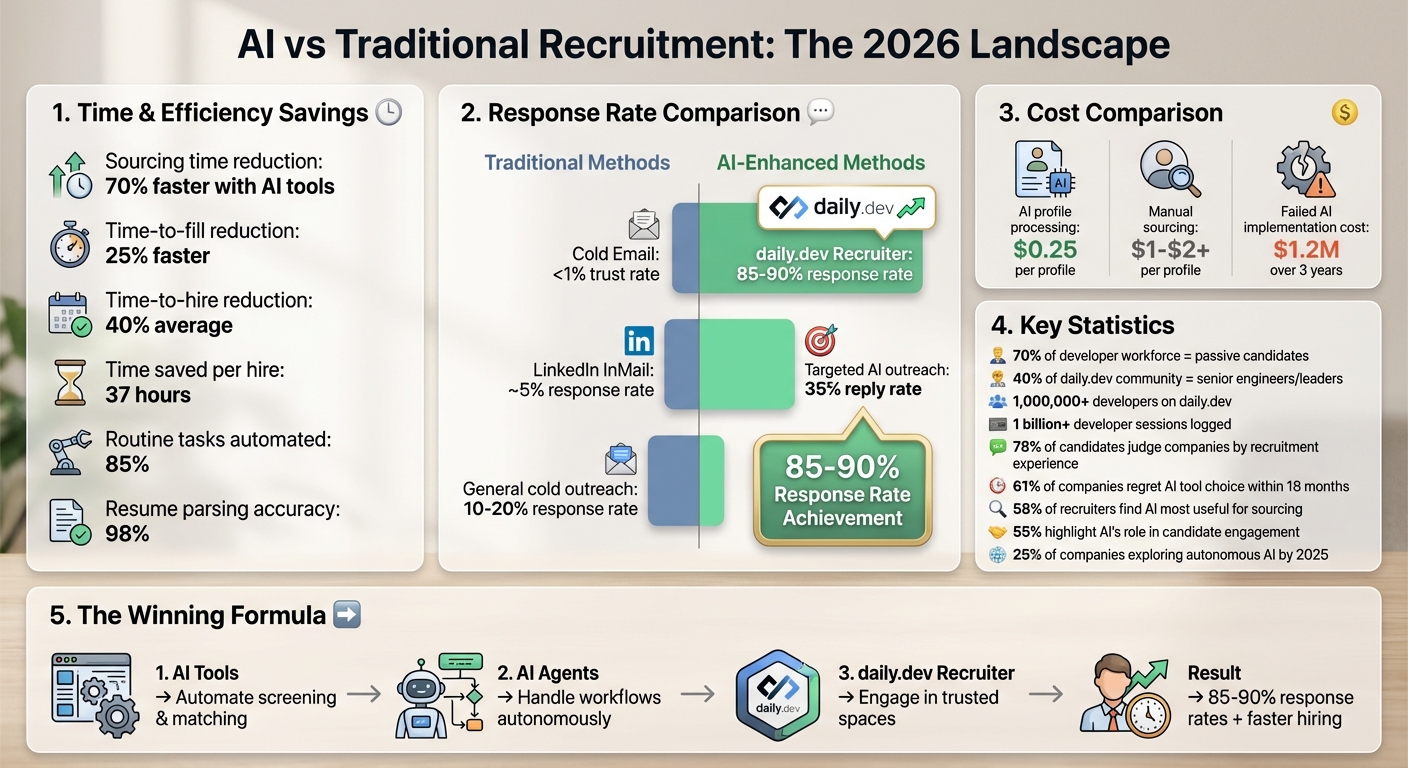 {AI Recruitment Tools vs Traditional Methods: Response Rates and Efficiency Comparison 2026}
How to Use AI and Agents in Recruitment
AI and agents are revolutionizing recruitment by taking over the repetitive tasks that used to fill a recruiter’s day. From screening resumes to scheduling interviews and engaging with candidates, these tools allow recruiters to focus on building relationships instead of wrestling with administrative work. Let’s break down how AI is reshaping three key aspects of the hiring process.
Resume Screening and Candidate Matching
AI goes beyond basic keyword searches by using natural language processing (NLP) to understand the context and intent behind resumes. Machine learning models analyze historical hiring data to assign dynamic "fit scores" based on skills, career paths, and future potential.
One standout feature is talent rediscovery. AI can comb through your existing applicant tracking system (ATS) to find "silver-medal" candidates - those who were great but didn’t land a previous role - who might be perfect for new openings. This approach not only saves on sourcing costs but also leverages talent you’ve already vetted. AI even tracks candidates’ online behavior, like GitHub activity or profile updates, to identify passive developer candidates who may be ready for a career move, even if they haven’t updated their resumes. According to Deloitte, by 2025, 25% of companies using AI will be exploring autonomous "agentic" AI solutions.
To maximize AI’s potential, use "What Good Looks Like" (WGLL) rubrics to define your ideal candidate. These rubrics guide AI agents in evaluating thousands of profiles quickly and consistently. However, it’s critical to audit your AI systems regularly to ensure they aren’t unintentionally replicating biases from past hiring data. Integrating AI with platforms like Greenhouse or Lever can also eliminate manual data entry, keeping the process efficient and accurate.
Automating Interview Scheduling and Initial Screening
Once you’ve identified strong candidates, AI steps in to streamline scheduling and initial screenings. AI agents can sync calendars and automatically book interview slots, saving hours of back-and-forth emails. Tools like Paradox’s Olivia use conversational AI to greet candidates, answer common questions, and even conduct initial screenings through SMS, WhatsApp, or web chat. Automated video interviews can cut the time spent on initial screenings by as much as 60%.
More advanced AI tools can handle first-round interviews using phone bots or video avatars. These systems adapt their questions in real time and use scoring rubrics to evaluate candidates. Simple "knockout" questions - like confirming work authorization or required certifications - help filter out unqualified applicants instantly. The cost savings are clear: AI processes profiles for as little as $0.25 each, compared to $1–$2 or more for manual sourcing.
AI also keeps candidates engaged by sending real-time updates about their application status, reducing the frustration of being "ghosted." All interactions are automatically logged in your ATS, ensuring your pipeline stays organized and up-to-date. Once these early stages are automated, AI shifts its focus to creating personalized interactions with candidates.
Personalized Outreach and Candidate Engagement
AI excels at personalizing outreach by analyzing a candidate’s online presence - such as GitHub projects, LinkedIn activity, or even their reading habits. This allows you to craft messages that feel relevant and tailored. For example, referencing a candidate’s recent project or specific skills can make your outreach stand out. It’s no wonder that 58% of recruiters using AI say it’s most useful during sourcing, and 55% highlight its role in candidate engagement.
AI can also monitor external triggers, like funding announcements or product launches, to time outreach when candidates are most likely to consider a new opportunity. Sentiment analysis adds another layer by detecting hesitation or enthusiasm in responses, helping recruiters address concerns more effectively. Automated follow-up systems can even send polite reminders based on whether a candidate has opened an email or clicked on a link.
That said, traditional outreach methods have their challenges. Cold emails, for instance, often have a trust rate of less than 1%, and LinkedIn InMail fares only slightly better at around 5%. While AI makes it easier to send personalized messages at scale, it also means candidates are bombarded with similar messages. The real bottleneck isn’t finding talent - it’s getting them to respond. Platforms like daily.dev Recruiter offer a fresh solution by connecting with engineers in spaces where they’re already actively engaged, cutting through the noise of traditional outreach methods.
Hiring engineers?
Connect with developers where they actually hang out. No cold outreach, just real conversations.
Getting Started with AI in Recruitment
Finding Recruitment Problems AI Can Fix
Before diving into AI solutions, take a step back and pinpoint where your recruitment process is hitting roadblocks. Are you spending hours manually sorting through resumes that don’t match your job descriptions? Or is your team bogged down by endless email threads just to set up one interview? Maybe the sheer volume of applicants is causing great candidates to slip through unnoticed.
Start by mapping out your entire hiring process - from posting the job to sending out offers. Track how much time each step takes and identify where candidates tend to drop off. These time-consuming or high-dropout areas are where AI can make the biggest difference. Once you’ve spotted these pain points, you’ll be better equipped to find AI tools that address your specific challenges.
Picking the Right AI Tools
After identifying your recruitment hurdles, the next step is choosing tools that can solve them effectively. The stakes are high - poor AI tool decisions can rack up costs of $1.2 million over three years due to failed implementations and lost productivity. Even worse, 61% of companies regret their AI recruitment tools within the first 18 months.
To avoid this, start by defining what success looks like. Do you have a target time-to-hire? What’s an acceptable cost-per-hire? How will you gauge candidate satisfaction? With clear goals in mind, look for tools that offer no-code customization - features like drag-and-drop builders that let your HR team tweak workflows without relying on IT. This ensures smoother processes and eliminates manual data entry.
Before committing to a long-term contract, run a 30-day pilot with one or two vendors. Use actual job openings to test how well the tools meet your criteria. Keep in mind that 78% of candidates judge the recruitment experience as a reflection of how your company values its people - clunky or inefficient systems can scare off top talent.
Making Implementation Work
Selecting the right tool is just the first step - implementation is where many companies stumble. To avoid this, integrate your AI platform directly with your existing ATS (Applicant Tracking System). This prevents the creation of redundant systems and keeps everything streamlined. Make sure your team is trained not only on how to use the tool but also on when human judgment is still essential.
Start small. Focus on one job opening or a specific part of the process, like resume screening. As you monitor the results, tweak the AI settings based on what you learn. When done right, AI can lead to an average 40% reduction in time-to-hire. But this only happens when the tools are properly implemented and your team fully understands how to use them.
To go beyond the usual LinkedIn or email noise, consider tools like daily.dev Recruiter to engage engineers where they’re most active and attentive. It’s all about meeting talent where they are and making the process seamless for everyone involved.
Why daily.dev Recruiter Changes How You Hire Developers
Even with personalized LinkedIn messages and polished email sequences, your outreach can still feel like just another drop in the ocean. Developers are inundated with generic messages, so it’s no surprise they often ignore them.
The real challenge isn’t finding qualified developers - it’s getting them to respond. In fact, 90% of developers on daily.dev don’t reply to recruiters through traditional channels. Even advanced AI tools struggle to break through the noise of impersonal outreach.
Reaching Developers Where They’re Active
To stand out, you need to connect with developers in the spaces where they’re already engaged.
daily.dev isn’t just another sourcing tool. It’s a platform where over 1,000,000 developers start their day by diving into tech articles, exploring frameworks, and staying updated on industry trends. With more than 1 billion developer sessions logged, daily.dev has become a go-to destination for engineers worldwide.
When you post a role on daily.dev Recruiter, you’re not sending cold messages to developers. Instead, you’re placing opportunities in front of them as they engage with content they already trust and enjoy. This approach fosters a more natural and meaningful connection.
The Power of Warm, Double Opt-In Introductions
daily.dev Recruiter uses a unique mutual opt-in system called "TinDev", ensuring both you and the developer agree to connect before any interaction begins. This isn’t the typical cold outreach with a low trust factor. It’s a 100% trust-based introduction.
"We built a place where engineers can turn off the noise. To enter this space, you don't need a hack. You need trust."
- Nimrod Kramer, CEO & Co-Founder, daily.dev
To streamline the process further, you can create up to three custom screening questions for candidates to answer during the opt-in stage. This ensures a technical fit before you even schedule a call. Plus, the platform integrates seamlessly with popular ATS tools like Greenhouse, Lever, and Ashby, automatically syncing candidate profiles and updates - eliminating the hassle of manual data entry.
Higher Response Rates and Exceptional Talent
The results speak for themselves. While traditional InMail struggles with response rates below 5%, daily.dev’s warm introductions achieve engagement rates of 85% to 90%. This approach saves recruiters 37 hours per hire and significantly improves hiring speed.
What’s more, 40% of daily.dev’s community consists of senior engineers and engineering leaders - the kind of passive talent that’s notoriously hard to reach. These developers are focused on honing their craft, so when the right opportunity arises in a trusted environment, they’re far more likely to respond.
daily.dev Recruiter operates on a pay-for-results model. There are no hidden fees, monthly subscriptions, or seat-based pricing - you only pay when you successfully connect with a qualified candidate. With a 4.8/5 rating on Product Hunt and recognition as "Product of the Year", daily.dev Recruiter proves that meeting developers where they’re already engaged can make all the difference in hiring success.
How to Combine AI with New Recruitment Channels
AI is great at simplifying the sourcing and matching process, but the real hurdle lies in getting candidates to respond. That’s where exploring fresh engagement channels can make all the difference.
Standing Out from the Crowd on LinkedIn and Email
AI can help craft personalized messages at scale, but relying solely on automated outreach through LinkedIn and email often leads to diminishing returns. Response rates for cold outreach through these platforms hover around 10–20% at best. Why? Because messages start to blend together, making it hard to stand out.
Instead, let AI handle the heavy lifting of sourcing and matching candidates based on skills and experience, and then shift your focus to platforms where developers are already engaged. For example, daily.dev connects you with engineers in a space where they’re naturally consuming tech content and exploring frameworks, rather than being bombarded with generic recruitment messages. This approach helps you cut through the noise and connect with talent on their terms, creating a more meaningful engagement.
Engaging Passive Talent Effectively
Did you know that about 70% of the developer workforce consists of passive candidates? These are professionals who aren’t actively job hunting, making them harder to reach through traditional channels. While AI tools can quickly identify qualified individuals, the key to engaging them lies in meeting them where they already spend their time - and offering something of value before pitching a job.
Platforms like daily.dev allow developers to opt into conversations, showing genuine interest in exploring opportunities. This opens the door for tailored outreach. For instance, you can reference the technical articles they’re reading or the projects they’re exploring. Recruiters who pair AI-driven sourcing with targeted communication on daily.dev have seen reply rates soar to 35%, compared to just 8% with cold emails. Even better, they’ve reported a 25% faster time-to-fill. These results highlight how the right platform and context can transform passive talent engagement.
Balancing Automation with Personal Touch
AI is fantastic for automating repetitive tasks like screening resumes, matching candidates, or drafting initial outreach messages. But to truly connect, a human touch is vital. While AI can generate candidate shortlists and message templates, it’s up to you to add that personal element. This could mean tailoring messages with role-specific insights, referencing a candidate’s recent work, or even including a short video introduction.
Conclusion
Key Takeaways
AI tools can drastically cut sourcing time by up to 70%, shorten time-to-fill by 25%, and automate as much as 85% of routine tasks - all while achieving 98% accuracy in resume parsing. This frees up time for what truly matters: building meaningful relationships with candidates.
But here’s the catch: finding profiles is only half the battle. The real challenge lies in getting developers to respond. Traditional outreach methods like LinkedIn and email often fall flat, with reply rates hovering below 5%. Why? Because everyone is using the same playbook, creating a tidal wave of noise. While AI can help you send more messages, it can also contribute to this overwhelming chatter.
That’s where daily.dev Recruiter stands out. Instead of adding to the noise, it connects you with over 1 million developers who are already engaged - reading tech articles, exploring frameworks, and staying informed. With warm, double opt-in introductions, you’re not just cold-emailing; you’re reaching out to engineers who’ve shown genuine interest. The result? Reply rates that soar to 85–90%, far outpacing traditional methods.
By combining AI for smarter screening and matching with daily.dev Recruiter for meaningful outreach, you can strike the perfect balance. This approach ensures you connect with passive talent - the kind of candidates who can make a real impact.
Next Steps for Recruiters
Turn these insights into action with a simple plan.
Start by pinpointing a recruitment challenge - whether it’s managing a high volume of resumes, streamlining interview scheduling, or speeding up sourcing. Choose an AI tool tailored to that problem, test it on 10–20 roles, and measure the results in terms of time saved and candidate quality. Once you’ve fine-tuned your process, integrate daily.dev Recruiter to amplify your developer engagement - sometimes yielding results in just a week.
To make things even smoother, connect daily.dev Recruiter directly to your ATS (like Greenhouse, Lever, or Ashby). This eliminates manual data entry and keeps your pipeline updated in real-time. Plus, with its pay-for-results model - no placement fees or long-term contracts - you can experiment without any major risks. If you want to stand out in 2026, go where developers actually spend their time - not where everyone else is shouting for attention.
FAQs
What’s the difference between AI tools and AI agents in recruiting?
The core distinction lies in how independently they operate. AI tools are designed to assist with particular tasks - think resume analysis or crafting messages - but they still rely on human input to function. On the other hand, AI agents take things up a notch with their ability to operate autonomously. They can adapt to live data, make decisions, and handle complex processes with little to no human guidance.
In recruiting, this difference becomes especially clear. AI agents can take on tasks like sourcing, screening, and engaging candidates all on their own. Meanwhile, AI tools are there to boost a recruiter’s efforts but still need someone at the helm to guide them.
How do I start using AI in hiring without disrupting my current process?
Start by incorporating AI tools into specific tasks such as sourcing candidates, screening resumes, or scheduling interviews. This allows you to maintain your current workflow while boosting efficiency. AI can also enhance outreach efforts by personalizing messages, which often leads to better response rates. For example, platforms like daily.dev Recruiter help you connect with active developer communities, making your outreach more targeted and impactful. By gradually introducing AI, you can streamline operations without disrupting existing processes.
How can daily.dev Recruiter help passive developers actually reply?
daily.dev Recruiter bridges the gap between recruiters and developers by tapping into a trusted community that developers engage with daily. What sets this platform apart is that developers opt in to receive job opportunities, ensuring every outreach begins with genuine interest.
With the help of AI-driven behavioral matching and personalized messaging, recruiters can cut through the noise and connect more meaningfully. The platform’s double opt-in introductions further boost response rates, making it an effective tool for reaching even passive developers. This approach not only streamlines engagement but also builds trust on both sides.
.png)