Hiring developers through cold outreach often fails because it feels impersonal and lacks trust. Warm introductions, on the other hand, leverage mutual connections to establish credibility and context from the start. This approach significantly boosts response rates, improves engagement, and reduces hiring time.
Key Takeaways:
- Cold outreach issues: Generic emails, low response rates (1-5%), and lack of trust.
- Warm introductions benefits: 5x higher meeting likelihood, faster hiring (38% quicker), and better-qualified candidates.
- How it works: Trust is transferred via mutual connections, creating personalized and relevant conversations.
- Practical methods: Use employee referrals, engage in developer communities, and adopt double opt-in introductions.
Warm introductions save time, improve outcomes, and align with developers' preferences for trust and relevance in hiring.
Why Cold Outreach Doesn't Work for Developer Recruitment
Developers Ignore Generic Emails
Top developers are inundated with emails - sometimes dozens each week. This constant stream of messages often leads to what can only be described as inbox fatigue. When emails are little more than copy-paste templates with a few swapped-out names or company details, they don’t stand a chance. Even though 60% of developers are open to new opportunities, the reality is that these cookie-cutter emails rarely hit the mark. As a result, recruiters typically only engage with about 15% of developers who are actively job hunting . That leaves a massive gap in connecting with the right talent and sets the tone for deeper challenges around trust.
Cold Outreach Lacks Trust
The problem goes beyond developers simply ignoring messages - cold outreach often feels impersonal and untrustworthy. When recruiters send irrelevant roles, like pitching a Java position to a Python developer, or rely on outdated information scraped from old profiles, it sends a clear message: "We didn’t do our homework." Even basic attempts at personalization, such as addressing someone by their first name, can feel hollow if the rest of the message screams “mass email.”
What’s worse, leaving out key details - like salary ranges or the specific tech stack - raises red flags about whether the job is even real. With the growing prevalence of over-automated outreach and "AI-generated noise", developers are quick to dismiss these messages as spam or, worse, scams. This approach doesn’t just fail to engage - it can harm a recruiter’s reputation within the tightly connected developer community. A single careless email can snowball into a broader loss of trust, making it even harder to build relationships in the future.
How Warm Introductions Build Trust and Increase Engagement
Trust Transfer Through Mutual Connections
Warm introductions have a unique way of breaking through the barriers that cold emails often face. While cold emails can activate our brain's natural defense mechanisms - like the amygdala, which heightens skepticism - warm introductions do the opposite. They tap into the power of trust by leveraging the reputation of the person making the introduction. This transfer of trust helps lower defenses and makes the recipient more open to the conversation.
Interestingly, warm introductions can even trigger the release of oxytocin, a hormone associated with trust and reduced defensiveness. This creates an environment where meaningful conversations are more likely to happen. In fact, warm introductions are five times more likely to lead to meetings, with 92% of people trusting recommendations from someone they know .
But the benefits don’t stop at trust. Warm introductions also allow for a highly personalized approach, making the outreach feel relevant and thoughtful.
Personalized Outreach That Resonates
One of the biggest strengths of warm introductions is the context they provide. They bridge the gap between recruiters and developers, making it clear why a specific opportunity aligns with the developer’s skills, interests, and career goals. Instead of starting with a generic message about "exciting opportunities", recruiters can dive straight into meaningful discussions about technical challenges or career aspirations.
This personalized approach is amplified by the use of a double opt-in process. Both parties agree to the introduction beforehand, ensuring that the contact is welcome and relevant. Platforms like daily.dev Recruiter are built around this principle. Every introduction is warm, double opt-in, and tailored to the developer’s interests, ensuring a higher likelihood of engagement.
The impact of this approach is clear: 83% of people are more likely to act on a referral from someone they know , and recipients of warm introductions are three times more likely to engage in meaningful business discussions .
Measuring the Difference: Warm Intros vs. Cold Outreach
::: @figure 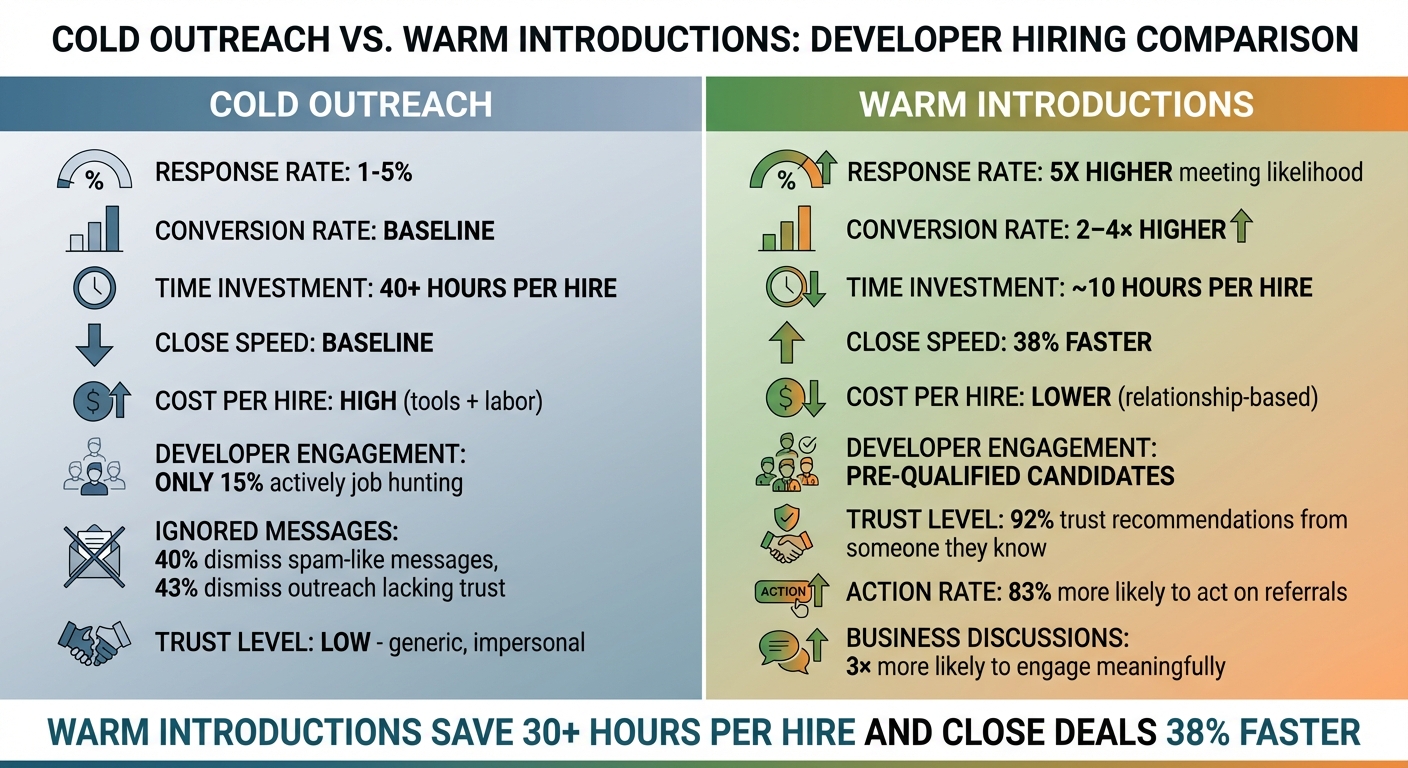 {Cold Outreach vs Warm Introductions: Developer Hiring Metrics Comparison}
Better Response and Conversion Rates
Warm introductions consistently outperform cold outreach in terms of response and conversion rates. For instance, candidates approached through warm channels are up to four times more likely to engage in recruitment conversations . On the flip side, about 40% of developers ignore spam-like messages, and 43% dismiss outreach that lacks trust . When someone trusted facilitates the introduction, it creates a positive first impression, making candidates more open to the opportunity.
Additionally, warm referrals speed up the process significantly, closing deals 38% faster than cold leads . This advantage can make all the difference in competitive hiring environments.
Better ROI for Developer Hiring
The benefits of warm introductions extend beyond engagement - they directly impact your recruitment ROI. Higher engagement rates mean more efficient hiring processes, which translates into reduced time and costs.
Cold outreach can take 40+ hours per hire , as recruiters often spend considerable time filtering through unqualified candidates. In contrast, warm introductions cut that time down to roughly 10 hours per hire . Why? Because referred candidates are typically pre-qualified. The referrer already understands both the candidate's skills and the job requirements, eliminating the need for lengthy screening calls and saving precious recruiting resources.
| Metric | Cold Outreach | Warm Introductions |
|---|---|---|
| Conversion Rate | Baseline | 2–4× higher |
| Time Investment | 40+ hours per hire | ~10 hours per hire |
| Close Speed | Baseline | 38% faster |
| Cost per Hire | High (tools + labor) | Lower (relationship-based) |
With 92% of people trusting recommendations from someone they know , warm introductions not only save time and money but also help establish a dependable recruiting pipeline. Plus, they reduce the strain on your hiring team, making the process smoother and more effective.
Using Networks for Warm Introductions
Connecting Through Developer Communities
Engage with developers in spaces where they’re already active. Platforms like daily.dev Recruiter offer a unique way to connect with developers in an environment they trust and engage with naturally.
Unlike traditional recruiting methods, daily.dev Recruiter integrates seamlessly into the developer ecosystem. As Nimrod Kramer, CEO & Co-Founder of daily.dev, explains:
"Trust is the only hack. Engineers already come to daily.dev to grow. They already trust the platform... When your role shows up inside that flow, it doesn't feel like outreach. It feels like an opportunity" .
This platform uses behavioral matching to analyze real-time signals - like what developers are reading or coding - so you can connect with candidates based on their current technical interests and career goals . It’s a smarter way to recruit, stepping away from outdated resumes and focusing on what developers are actively working on.
By leveraging this network-driven approach, you eliminate the cold, impersonal nature of traditional outreach and build trust from the beginning. Beyond digital platforms, warm introductions can also come from tapping into your personal network.
Building and Growing Referral Networks
Take it a step further by leaning on your internal networks for even more meaningful connections. Start with your current employees, especially your engineering team - they’re often the best source for referrals. They can vouch for a candidate’s technical skills and provide insight into how well they might fit into your company culture.
For example, in 2023, Zevi Reinitz from Livecycle demonstrated the power of authentic networking while promoting Preevy. By following developers on GitHub, acknowledging their contributions, and starting genuine, plain-text conversations about shared technical interests, he achieved a ~60% open rate and a ~30% click rate . This approach highlights the importance of building relationships first - engage with developers’ work, contribute to their projects, and establish a genuine connection before discussing hiring opportunities.
This method of connecting through networks and referrals not only builds trust but also creates a more personalized and effective recruiting experience.
Scaling Warm Introductions While Maintaining Quality
Avoiding Network Fatigue
Expanding warm introductions can be tricky - it’s easy to overwhelm your network if you’re not careful. To keep things efficient, try segmenting your network based on factors like seniority, technical expertise, and personal interests. This way, every referral request feels intentional and reaches the right person at the right time, avoiding unnecessary strain on your contacts’ goodwill .
Another smart move? Build a "warm bench" of pre-qualified engineers before roles even open up. This proactive approach, often called "Talent Architecture", shifts your hiring process from reactive to strategic. While automation tools can help with repetitive tasks like syncing data or scoring activities, don’t underestimate the value of human interaction. Regular check-ins - ideally done quarterly by a recruiter or hiring manager - help keep those relationships personal and meaningful .
Tracking and Improving Warm Introduction Requests
Once you’ve streamlined your outreach, tracking and measuring its success becomes essential. A CRM can be a game-changer here. Use it to monitor candidate engagement and identify those who’ve responded meaningfully at least twice in the past six months. These are the individuals you want to keep on your warm bench - they’re more likely to be genuinely interested and engaged .
To further refine your efforts, pay attention to engagement scores. Focus on candidates who show real interest rather than those who reply out of politeness. Strengthen these connections by sharing technical deep dives, inviting them to exclusive groups, or reviewing their pull requests. These gestures build trust and foster authentic engagement . Tools like daily.dev Recruiter can simplify these processes, helping you keep your network active and your introductions impactful.
Conclusion
Cold outreach often misses the mark because it lacks the one thing developers value most: trust. A trusted introduction can fast-track the hiring process, while warm introductions completely change the game. They bring credibility, context, and genuine interest to every interaction, making conversations more meaningful from the start.
The challenge is finding the right balance between scaling your efforts and maintaining authenticity. Spamming your network won’t work, but manually nurturing every connection isn’t realistic either. That’s where developer-focused platforms like daily.dev Recruiter come in. These tools connect you with engineers in spaces where they’re already learning and growing - without disruptive cold messages. Instead, you meet them in their own environment, fostering connections that feel natural and mutually beneficial.
With this approach, you’re not chasing outdated resumes or profiles. Instead, you’re engaging with active developers in real time, based on what they’re reading, learning, and building. This not only speeds up the hiring process but also ensures the quality and personalization that warm introductions demand. The results? Higher response rates, access to top-tier candidates, and a hiring process that values everyone’s time.
FAQs
Why are warm introductions more effective for hiring developers?
Warm introductions can dramatically increase response rates when recruiting developers by building trust and adding a personal touch. Unlike cold outreach, which often comes across as impersonal or even spammy, warm introductions leverage existing relationships and mutual agreement, making developers more receptive to the conversation.
This method can elevate reply rates from the usual 1–5% for cold emails to an impressive 21–34%. And if you use a double opt-in process, those rates can soar past 85%. By focusing on trust and context, warm introductions create a more engaging and effective hiring process for both recruiters and developers.
Why are warm introductions more effective than cold outreach when hiring developers?
Warm introductions work better because they rely on existing trust and mutual connections, setting the stage for credibility and relevance right from the beginning. Unlike cold outreach, which can come across as impersonal or even unwelcome, warm introductions use a double-opt-in process. This means both parties agree to connect beforehand, ensuring there's genuine interest and willingness to engage.
The results speak for themselves: response rates for warm introductions typically range from 21% to 34%, and in some cases, they can soar beyond 85%. Compare that to the meager 1% to 5% response rate common with cold outreach, and the difference is clear. By focusing on trust and meaningful connections, warm introductions provide real value for both recruiters and developers.
How can companies build a strong referral network to hire developers effectively?
Building a strong referral network begins with tapping into trusted connections for warm introductions. Look for internal advocates - engineers, hiring managers, or alumni - who are already active in developer communities like GitHub or daily.dev. Encourage them to share job openings and facilitate double opt-in introductions, where both the referrer and the candidate agree before any outreach happens. This method often leads to much better response rates than cold emails.
To keep your network engaged, offer meaningful perks. These could include referral bonuses, public recognition, or even exclusive invites to developer events. Keep referrers in the loop by providing updates on their recommendations and sharing valuable resources like blog posts or webinars to maintain their interest. Using a developer-first hiring platform within a trusted network ensures that these introductions feel genuine and natural.
Remember, referrals aren’t just a short-term fix - they’re a long-term strategy. Track important metrics like conversion rates and time-to-hire, and look for ways to improve the process with automation and regular feedback. A well-maintained referral network doesn’t just cut hiring costs; it creates a thriving community of developers eager for future opportunities.
.png)