

Job boards can still work for hiring developers, but their effectiveness depends on the situation. They’re best for quickly filling junior roles, reaching active job seekers, or hiring in less competitive markets. However, they often bring in too many unqualified applicants, inflate costs, and fail to deliver quality hires for specialized or senior positions.
Key takeaways:
- Job boards excel when speed and volume are priorities, especially for entry-level roles.
- Red flags: Rising costs, low hire rates, and overwhelmed recruiters signal inefficiency.
- Better alternatives: Direct sourcing and platforms like developer networks often yield higher-quality candidates with fewer resources.
The solution? Track metrics like cost-per-hire, applicant-to-hire rates, and response rates. Use this data to decide when to scale back on job boards and explore smarter options like job boards vs. developer networks for better results.
When Job Boards Still Work for Developer Recruitment
Even with the evolving recruitment landscape, job boards can still deliver results in situations where speed, volume, and accessibility take priority over precise targeting.
Hiring Multiple Entry-Level Developers Quickly
If you’re scaling up junior teams, job boards can build a tech talent pipeline fast . A great example? In January 2020, Twilio revamped its hiring strategy to focus on early-career developers, boosting their junior hires from 5% to 25%. Why? Junior developers offer a high growth potential and are often more loyal over time .
To handle the influx of applications, use pre-qualification filters to weed out unqualified candidates . And when crafting job posts, focus on what matters most to junior developers: mentorship opportunities, regular 1-on-1 check-ins, and clear growth paths. As Jannelle Sanchez from Atlassian notes:
"Junior developers are eager to learn, they will give their all on projects and they have the capacity to grow into your strongest and most loyal developers" .
Reaching Junior Developers Actively Job Hunting
Job boards are great for connecting with active job seekers - people who are 70% more likely to leave their current roles . But here’s the catch: your job descriptions need to be crystal clear. A study found that 59% of applicants are swayed by how well a job ad aligns with their skills . Skip the jargon and focus on the essentials: key responsibilities, required technical skills, and growth opportunities. This clarity can turn casual browsers into serious applicants.
Casting a Wide Net in Less Competitive Markets
In regions where tech talent isn’t as fiercely contested, job boards can be a cost-effective tool. For example, the Cost per Application (CPA) in New York is about 30% higher than in Oklahoma .
To make the most of your budget, calculate your CPA by dividing your total job board spend by the number of applications from each region . Use UTM codes to track which areas deliver the best results . If you’re hiring outside of major hubs like San Francisco or Seattle, job boards can help you attract plenty of candidates without the hefty price tag tied to competitive markets.
These scenarios show how job boards can shine when volume and speed are the priorities. But they also set the stage for recognizing when job board spending starts to lose its efficiency.
Red Flags That Job Boards Are Draining Your Budget
Job boards can bring in high volumes of candidates, but not all traffic is good traffic. Here’s how to recognize when they’re doing more harm than good for your recruiting efforts.
Too Many Unqualified Applications and Spam
If your recruiters are drowning in irrelevant applications and spam, it’s a clear sign of inefficiency. The numbers paint a concerning picture: recruiters are now managing 93% more applications than in 2021, yet hires per recruiter have dropped by 43% . This imbalance reveals a major time sink - sorting through unqualified submissions instead of focusing on viable candidates.
The hidden cost here is significant. Your team might be spending hours sifting through resumes that seem promising at first but fail basic screening. For example, candidates applying for senior roles with no relevant experience waste precious time and resources. This inefficiency inflates your hiring costs and leaves recruiters overwhelmed, dealing with noise rather than finding talent.
Rising Cost-Per-Hire With Fewer Quality Hires
Your cost-per-hire (CPH) is a key metric that should reflect the value of your recruitment efforts. If your CPH is climbing while the quality of hires is dropping, it’s a red flag. For technical roles, the process now averages 35-36 interviews and 26 interviewer hours just to make a single hire . If job board candidates are consistently failing at later stages of the process, it’s clear you’re spending money on the wrong sourcing channel.
The data doesn’t lie: candidates sourced directly are eight times more likely to land an offer compared to those from general job boards . If your best hires are coming from referrals or direct sourcing while job board spending eats up your budget, you’re essentially subsidizing a channel that isn’t delivering results—making it critical to explore alternative developer sourcing channels. Peter Cappelli, a Professor of Management at the Wharton School, sums it up perfectly:
"Businesses have never done as much hiring as they do today. They've never spent as much money doing it. And they've never done a worse job of it."
Low Response Rates and High Candidate Drop-Off
A flood of applications means little if candidates aren’t engaged. If job board applicants ignore outreach or drop off after the first call, you’re likely dealing with people who applied without genuine interest or fit.
Monitor your passthrough rates at each stage of the hiring process. If candidates are abandoning early, it’s a sign your job board is attracting casual applicants rather than serious prospects. This is especially problematic when recruitment teams - 14% smaller than in 2021 - are juggling 40% more open roles .
To assess the impact, calculate your cost-per-application (CPA) by dividing your total job board spend by the number of applicants. Then compare it to your actual hire rate. If you’re paying for thousands of applications but making only a handful of hires, the numbers simply don’t add up. Such inefficiencies highlight the importance of taking a hard, data-driven look at your job board’s performance.
Measuring Job Board Performance With Data
::: @figure 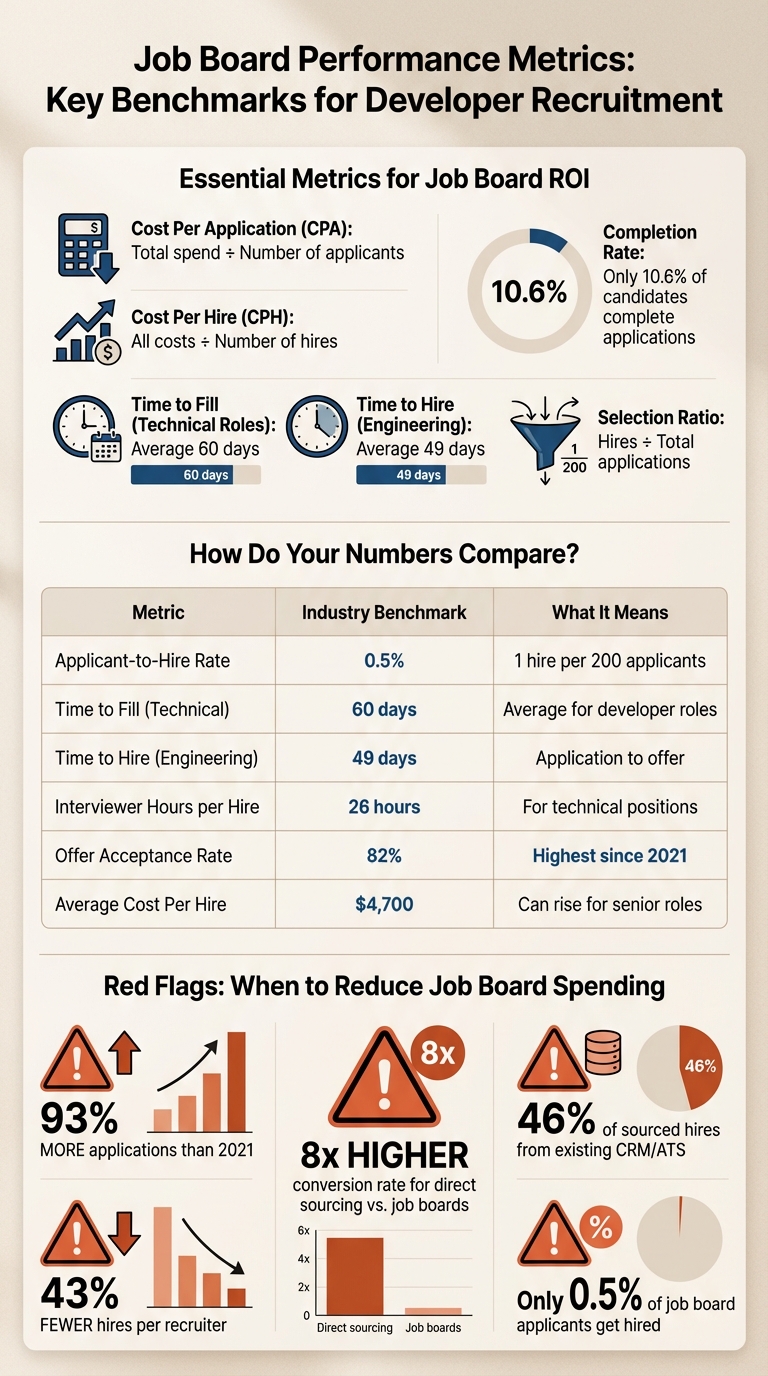 {Job Board Performance Metrics and Industry Benchmarks for Developer Recruitment}
Tracking the right metrics is like having a compass - it keeps your recruitment strategy on course. By focusing on specific numbers, you can identify when it’s time to pivot or cut losses. Let’s dive into the key metrics that can turn raw data into actionable insights.
Core Metrics for Tracking Job Board Results
Start with Cost Per Application (CPA) - this is your total job board spend divided by the number of applicants you receive . For example, if you spend $500 on a job posting and receive 100 applications, your CPA comes out to $5. Next, there’s Cost Per Hire (CPH), which includes all internal and external costs - think recruiter salaries, overhead, job board fees, and agency expenses - divided by the number of hires .
Time to Fill measures how long a position stays open, from posting to acceptance, while Time to Hire focuses on the time between application and offer. For context, technical roles typically take about 60 days to fill, while general business roles average closer to 50 days . Another key metric is the completion rate - the percentage of candidates who finish the application process. Alarmingly, only about 10.6% of candidates complete application forms , signaling a potential talent loss if this rate dips too low.
The selection ratio - hires divided by total applications - offers insight into how competitive or qualified your applicant pool is. With only 0.5% of applicants ultimately hired , a low selection ratio might indicate an influx of unqualified candidates.
When to Reduce or Stop Job Board Spending
Deciding when to scale back on job boards should be based on data. For instance, if your Cost Per Hire is climbing while candidate quality declines, that’s a red flag. Let’s say technical candidates sourced from job boards consistently require more than the typical 26 interviewer hours per hire yet fail to convert into offers - this suggests resources are being wasted.
Direct sourcing often delivers better results than job boards . In fact, 46% of sourced hires now come from rediscovered candidates already in your CRM or ATS . If your top hires are coming from referrals or direct outreach, it’s worth reconsidering the value of job board investments. A data-driven strategy allows you to redirect funds to channels that yield better results.
You can also implement programmatic rules to pause spending once you’ve hit your target number of qualified applications .
Comparing Your Results to Industry Standards
Once you’ve gathered your data, compare your metrics to industry benchmarks to identify potential inefficiencies. Here are some key benchmarks to keep in mind:
| Metric | Industry Benchmark | What It Means |
|---|---|---|
| Applicant-to-Hire Rate | 0.5% | Roughly 1 hire for every 200 applicants |
| Time to Fill (Technical) | 60 days | Average duration to fill developer roles |
| Time to Hire (Engineering) | 49 days | Time from application to offer acceptance |
| Interviewer Hours per Hire | 26 hours | Typical for technical positions |
| Offer Acceptance Rate | 82% | Highest levels since 2021 |
| Average Cost Per Hire | $4,700 | Can rise significantly for senior roles |
If your metrics - like cost per hire or time to fill - stray far from these benchmarks, dig deeper. Breaking down performance by platform can help pinpoint inefficiencies.
"You can't improve what you don't measure." - Lorelei Trisca, Content Marketing Manager, Deel
Finally, don’t overlook your cost of vacancy - a critical metric for understanding the financial impact of delays. Use this formula: (annual revenue ÷ total employees) ÷ 220 working days . Even seemingly small daily vacancy costs can add up quickly, highlighting the importance of keeping your hiring process efficient and timely.
Hiring engineers?
Connect with developers where they actually hang out. No cold outreach, just real conversations.
Moving to Developer Networks Like daily.dev Recruiter
When job board performance starts to dip, it’s time to rethink where you’re looking for talent. Developer networks, like daily.dev Recruiter, provide a smarter way to connect with developers by meeting them where they already spend their time. Let’s break down why this approach delivers better results.
Why Developer Networks Deliver Better Results Than Job Boards
Job boards mostly attract active job seekers, but here’s the thing - most top developers aren’t actively looking. They’re already employed and only passively open to new opportunities. These developers often spend their time engaging with technical content and staying on top of industry trends. Developer networks embed recruitment into these everyday activities, creating a more natural and engaging experience.
This approach shifts the dynamic from cold outreach to warm, well-timed introductions. The result? Higher response rates, better-aligned candidates, and less time wasted on applicants who aren’t the right fit. Instead of interrupting someone’s job search, you’re presenting opportunities to professionals already thinking about growth and innovation.
What Sets daily.dev Recruiter Apart
daily.dev Recruiter operates within a vibrant professional network where developers are already active. The platform redefines traditional job postings by turning them into developer-friendly job briefs. These briefs cut through corporate jargon and focus on what developers care about most - like the tech stack, architectural challenges, and opportunities for professional growth.
Another standout feature is the double opt-in system. This ensures that both parties - recruiters and developers - express mutual interest before any conversations take place. Developers review roles and choose to engage, eliminating the need for cold outreach. Plus, daily.dev Recruiter integrates seamlessly with your existing ATS (Applicant Tracking System), so you don’t have to overhaul your entire recruitment process to get started.
Transitioning From Job Boards to Developer Networks
Start by auditing your current job board performance. Look at key metrics like Cost Per Hire, Time to Fill, and your applicant-to-hire rate. Identify roles - especially senior or specialized positions - that aren’t performing well. These are ideal candidates for a trial run with a developer network.
Next, update your job descriptions. Focus on the elements that resonate with developers: technical challenges, essential tools and technologies, and what makes your engineering culture stand out. The goal is to craft postings that feel relevant and specific to their interests.
Finally, run a 30–60 day test. Keep using job boards for roles that perform well, like junior positions that attract lots of applicants. At the same time, allocate part of your budget to developer networks for harder-to-fill senior or specialized roles. Track the same metrics - response rates, time to hire, and candidate quality - and use the data to decide how to adjust your budget moving forward. This measured approach ensures you get the most out of your recruitment spend without taking unnecessary risks.
Conclusion: Building a Smarter Recruitment Strategy
Job boards aren't a universal fix anymore. They might work well for quickly filling multiple junior roles, but they can also drain your budget when misused. If you're seeing an influx of unqualified applications, rising costs per hire, or low response rates, it’s a clear sign to rethink where your recruitment dollars are going.
The data speaks volumes. While only 0.5% of applicants from job boards get hired, sourced candidates convert at a rate eight times higher . This makes it crucial to regularly evaluate metrics like cost-per-acquisition (CPA) and the quality of candidates. If a recruitment channel consistently underperforms, it’s time to cut it and invest in smarter options.
One such option is transitioning to platforms like daily.dev Recruiter. These networks connect you with passive talent - developers who are already engaged in their field but open to the right opportunities. Instead of competing with countless other postings, you’re presenting roles directly to qualified candidates who have opted in to hear from you. This double opt-in approach ensures you're speaking with individuals genuinely interested in exploring new opportunities.
Start by testing these strategies on roles that traditional boards struggle to fill, such as senior or highly specialized positions. Run a 30–60 day trial and monitor key metrics like response rates, time to hire, and candidate quality. Let the results guide your next steps. After all, 87% of recruiters agree that talent acquisition has evolved into a more strategic function .
The takeaway? Base your recruitment strategy on solid data and real candidate behavior, not outdated practices. Every decision - and every dollar - should count.
FAQs
How do I know when to stop using job boards to hire developers?
You might want to rethink your reliance on job boards if they’re no longer worth the investment. Signs include struggling to attract skilled developers, low engagement levels, or spending more time and money than the outcomes warrant.
Take a step back and assess your hiring strategy by focusing on metrics like cost per hire, applicant quality, and time-to-fill. If job boards aren’t cutting it, consider shifting to recruitment methods that resonate more with developers' habits and preferences.
How can I evaluate if job boards are worth the investment in my hiring process?
To figure out if job boards are pulling their weight in your hiring process, you’ll want to focus on a few key metrics that show their impact. Start with the offer acceptance rate and application completion rate - these can tell you how well job boards are attracting candidates and getting them to follow through.
Next, keep an eye on time-to-hire and cost-per-hire. These metrics help you gauge how efficient and cost-effective job boards are compared to other options. To dig deeper, evaluate candidate quality by looking at post-hire performance and retention rates. Also, check source effectiveness to see how job boards stack up against other recruitment methods.
Don’t forget to monitor application drop-off rates and gather feedback on the candidate experience. These insights can uncover potential roadblocks that might be hurting your results. By staying on top of these metrics, you’ll be in a better position to decide whether job boards are worth the investment or if it’s time to explore other hiring strategies.
What makes developer networks a better option than traditional job boards?
Developer networks bring a fresh approach to tech hiring, offering clear benefits over traditional job boards. These platforms excel at connecting with skilled developers, including those who aren’t actively job hunting but are engaged in niche communities. By enabling direct interaction through personalized messages, community discussions, and visible contributions, recruiters can build genuine connections that often lead to better response rates.
What sets developer networks apart is their ability to highlight a candidate's technical abilities through their actual contributions to projects and discussions. This gives recruiters a clearer picture of a developer’s expertise, making it easier to pinpoint top talent without wading through the flood of less-qualified applications that often come with job boards. For companies looking to hire in tech, developer networks offer a more targeted and effective way to find specialized candidates.
.png)


