AI recruiting tools often fall short because they miss one key element: intent signals. These are behavioral clues that show whether a candidate is genuinely interested in new opportunities. Without intent signals, tools rely on outdated resumes and generic keyword matching, leading to wasted outreach and poor results.
Key Takeaways:
- Intent signals matter: Updated profiles, GitHub activity, or recent certifications reveal job-seeking interest.
- Mass outreach fails: Generic messages alienate candidates and harm employer reputation.
- Behavioral data improves targeting: Real-time insights help recruiters focus on high-intent candidates.
By incorporating intent signals, recruiters can shift from inefficient, broad strategies to precise, meaningful engagement with candidates who are ready for new roles.
The Limitations of AI Recruiting Tools Without Intent Data
AI recruiting tools may seem powerful, but without intent data, they miss a critical piece of the puzzle: behavioral context. Sure, these tools can sift through resumes and pick out keywords, but they fall short when it comes to answering three key questions: Is the candidate actually skilled? Are they even looking for a new position? And, most importantly, are they interested in your company? Without behavioral signals to fill in these blanks, AI tools often resort to shallow methods that lead to underwhelming outcomes. This sets the stage for a deeper look at the challenges, from poor data capture to ineffective outreach strategies .
Keyword Matching and Resume Parsing Fall Short
Resume parsing might sound like an efficient way to identify talent, but it rarely delivers meaningful results. Aline Lerner, Founder of interviewing.io, describes the issue perfectly:
Extracting meaningful insights in this case is like squeezing water from a stone. Having a robot hand will not save you .
The problem lies in the fact that both humans and AI struggle to accurately gauge an engineer's quality based solely on a resume. In fact, the odds of success are about as good as flipping a coin. Metrics like prestigious schools or big-name employers often fail to predict actual performance .
Adding to the problem, candidates have learned to game the system. AI-driven tools encourage over-optimization, where resumes are padded with keywords to pass automated filters. This makes it nearly impossible to differentiate between someone who used React to build a full-scale application and someone who merely added it to their resume after a quick weekend tutorial . The result? Recruiters waste time on candidates who look great on paper but lack the skills to back it up.
Mass Outreach Leads to Poor Engagement
The flaws in data extraction are only part of the issue. When AI tools lack intent signals, they often default to a scattershot approach: mass outreach. The thinking is simple - if you can’t pinpoint who’s interested, just contact as many people as possible and hope for the best. Unfortunately, this strategy often backfires.
High-volume, automated outreach turns into what some call a "ghosting machine" - systems that are great at sending messages but terrible at fostering meaningful connections . Candidates are bombarded with generic, impersonal emails that fail to resonate. Unsurprisingly, response rates plummet, and recruiting teams waste valuable resources chasing leads that go nowhere.
But the damage doesn’t stop there. Poorly targeted outreach can harm your employer brand. When candidates receive irrelevant messages about roles that don’t align with their skills or career goals, they’re more likely to ignore future communication. Instead of building trust, you’re training potential hires to tune you out.
Lack of Behavioral Context Results in Generic Targeting
Without behavioral data, AI tools create incomplete candidate profiles. They might flag developers with the right skills on paper, but they can’t tell if those developers are actively engaged in their field, exploring new technologies, or showing signs of professional growth. This lack of context makes personalized and relevant outreach nearly impossible.
For example, a study on open-source language models used in recruiting found that, without behavioral context, algorithms tended to reproduce historical biases. In fact, they favored certain names 85% of the time, even when qualifications were identical . When intent data is missing, AI tools often rely on patterns from their training data - patterns that can reflect outdated biases rather than actual talent or interest.
Ultimately, the absence of intent data limits AI recruiting tools to surface-level insights, leaving recruiters with fragmented profiles and ineffective strategies. It’s a recipe for missed opportunities and wasted effort.
3 Ways Missing Intent Signals Cause Recruitment Failures
::: @figure 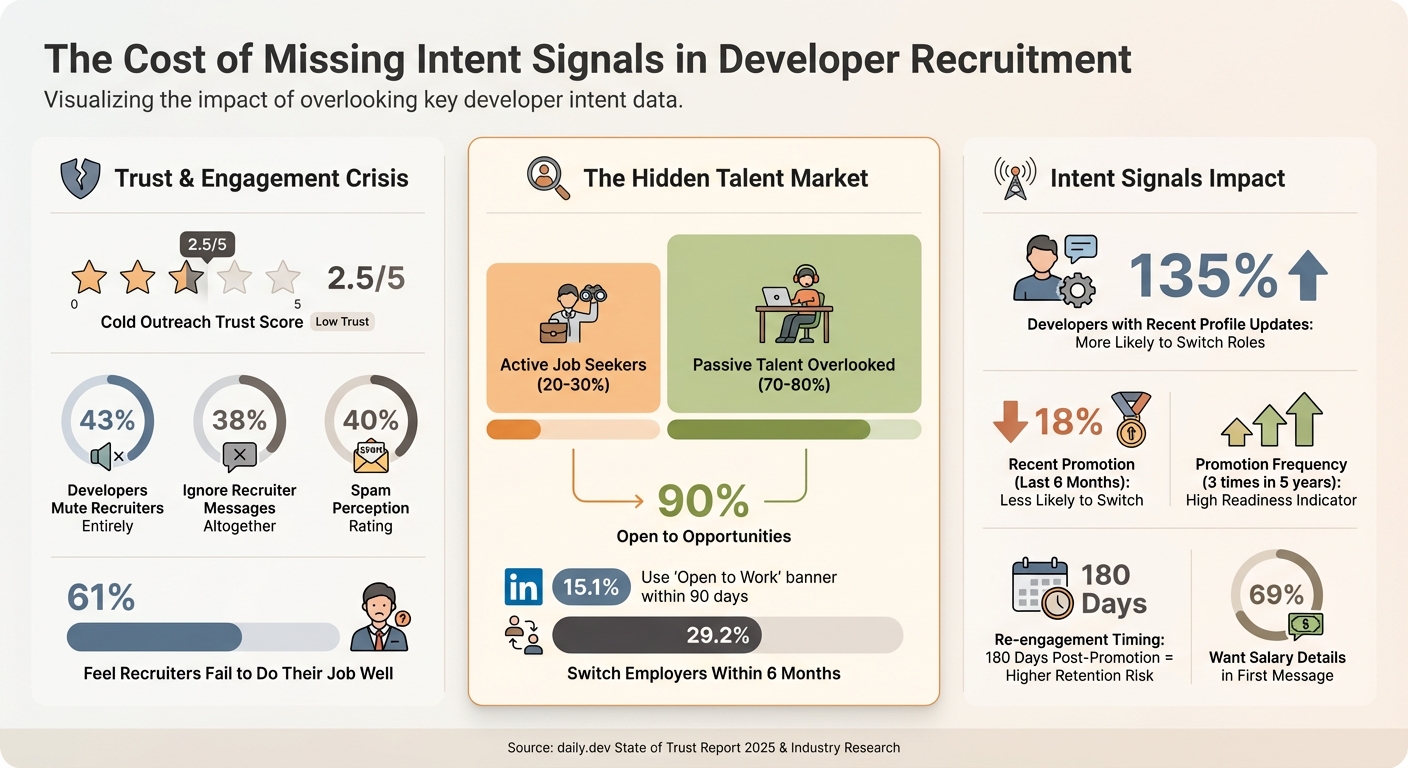 {Developer Recruitment Statistics: Intent Signals vs Traditional Outreach}
When AI recruiting tools lack intent signals, they don’t just miss opportunities - they waste valuable time and money while potentially harming your employer brand. Here’s a closer look at how the absence of behavioral data leads to specific recruitment failures.
Contacting Developers Who Aren’t Looking for Jobs
One of the biggest inefficiencies in recruiting is reaching out to developers who have no interest in changing jobs. Without intent signals, AI tools can’t differentiate between someone casually exploring opportunities and someone completely content in their current role. This creates what the daily.dev State of Trust Report 2025 describes as a trust problem:
This isn't a sourcing problem. It's a trust problem .
The statistics are telling. Cold outreach to developers not actively seeking jobs starts with a low trust score of 2.5 out of 5. Worse yet, 43% of developers mute recruiters entirely, and 38% ignore recruiter messages altogether . Unfocused outreach doesn’t just waste effort - it harms your reputation. With a 40% spam perception rating , and 61% of developers feeling recruiters fail to do their job well, impersonal and irrelevant messages are doing more harm than good .
Poor Candidate-Role Alignment
Surface-level filters often give the illusion of good matches, but they fall short in practice. Why? AI tools without intent data only focus on the 20-30% of candidates actively job hunting, ignoring the 70-80% of passive talent who could be ideal for the role but aren’t openly looking . These passive candidates are part of a hidden market where 90% are open to hearing about new opportunities , but generic targeting fails to reach them.
Without real-time behavioral insights - like what projects developers are currently working on - AI tools often rely on outdated information. For example, a programming language used daily two years ago might still reflect current skills, but a certification from a decade ago without recent practice? That’s just noise. This mismatch between what candidates want and what you’re offering leads to wasted screening calls and frustrated hiring managers.
Treating All Candidates the Same
When intent signals are missing, AI tools can’t tell the difference between highly engaged candidates and disengaged ones. Developers actively learning new technologies, contributing to open-source projects, or engaging with technical content are fundamentally different from those who haven’t updated their GitHub in months. Without this differentiation, your recruitment process becomes a one-size-fits-all approach.
This inefficiency costs time and trust. Hours are wasted on candidates with no real interest in switching roles, while high-intent prospects - those ready to engage - get overlooked. Generic, automated outreach further erodes trust. Developers can quickly spot when they’re receiving impersonal messages, and their response is to tune out. Instead of building meaningful connections, you risk alienating your talent pool entirely.
These challenges highlight why incorporating intent signals is essential for improving recruitment strategies.
How Intent Signals Improve Developer Recruitment
Intent signals shift AI-driven recruitment from a hit-or-miss approach to one with laser-focused accuracy. Instead of sending out mass messages that often fall flat, you can zero in on developers who are genuinely ready to explore new opportunities. This change isn't just about efficiency - it reshapes how developers view your outreach. Let’s dive into how real-time behavioral insights refine targeting strategies.
Real-Time Data on Candidate Interest
Intent signals provide a snapshot of what developers are actively doing right now, rather than relying on outdated information from a years-old resume. For instance, when a developer updates their profile, adds new skills, or becomes more active on technical platforms, they’re signaling their current mindset. Developers who recently update their profiles are 135% more likely to consider switching roles . This kind of real-time data forms the backbone of smarter, more relevant outreach strategies.
Better Targeting and Less Wasted Outreach
With intent signals, you can create a Candidate Readiness Score - a system that ranks potential hires based on factors like status updates, profile edits, or recent promotions . This scoring system lets you prioritize candidates who show clear signs of readiness, saving time and effort. By focusing on those who are actively signaling interest, you avoid wasting resources on candidates unlikely to move. Developers identified as ready to switch roles are far more likely to engage with your outreach .
Personalized Outreach Based on Candidate Behavior
Intent signals also open the door to highly personalized communication. For example, if a developer has been engaging with specific technical topics, you can craft messages that align with their current interests. This level of personalization makes your outreach stand out. Consider this: 69% of developers want salary details included in the very first recruitment message . Combining insights like recent activity with transparent details about the role - such as salary range, tech stack, and work model - shows candidates that you’ve done your research. This thoughtful, tailored approach turns cold outreach into meaningful, trust-building conversations.
How to Add Intent Signals to Your Recruitment Process
To incorporate intent signals into your hiring process, you need to combine behavioral insights with your existing ATS, CRM, and sourcing tools. This approach helps you move from broad, impersonal outreach to focused, meaningful engagement. The key is tracking the right signals, integrating them into your workflow, and channeling your efforts toward candidates who show genuine interest. Here's how to make it happen.
Track Behavioral Indicators to Find High-Intent Candidates
The most reliable signals of interest don't come from resumes - they're reflected in actions. For example, when candidates update their profiles with new skills or projects, it shows they're actively engaged. A spike in activity, such as consuming more technical content, receiving endorsements, or sending connection requests, can indicate shifting priorities. External events, like a company securing funding or undergoing a liquidity event, often make candidates more open to new opportunities within 30–60 days .
Promotion trends also offer valuable insights. Candidates who have been promoted frequently - say, three times in five years - might be ready for their next challenge . On the flip side, those promoted in the last six months are 18% less likely to switch jobs . Interestingly, LinkedIn's "Open to Work" banner captures only about 15% of engineers considering a move . By monitoring these behavioral signals, you can identify candidates who are open to new roles without relying solely on what they say publicly.
Connect Intent Data With Your Existing Systems
Once you've identified the right signals, the next step is connecting them to your recruitment tools for smarter decision-making. Assign weighted scores to various signals - like +3 for "Open to Work", +2 for recent profile updates, and -1 for a promotion within the last six months - to create a Candidate Readiness Score . Automating this scoring system within your ATS or CRM ensures that every candidate's profile includes a readiness metric alongside their resume.
To keep your data relevant, use signal decay modeling. For instance, a GitHub commit made last week should carry more weight than a certification earned three years ago . Group signals into time categories, such as less than one year, one to three years, and older, and reduce their weight as they age . This keeps your targeting precise and prevents outreach to candidates whose circumstances may no longer align with your needs. Additionally, by feeding hiring outcomes - like performance ratings and tenure - back into your system, you can refine which signals are the most predictive of success .
Focus on Quality Over Quantity in Outreach
Segment your candidate pipeline into categories like "Hot Leads", "Warm Leads", and "Watchlists" to prioritize your efforts . For hot leads, personalize your outreach by referencing their recent technical activities that indicate readiness. For warm leads, consider re-engaging at strategic moments, such as 180 days after their last promotion, when retention risks tend to rise . Test different messaging strategies - like highlighting equity packages versus growth opportunities - to see what resonates most with your audience .
Conclusion
AI recruiting tools often fall short when they rely solely on static resumes and keyword matching, overlooking the behavioral context that indicates job readiness. This is where intent signals come into play. These behavioral cues - like profile updates, activity surges, and tenure milestones - fill the gaps, shifting recruitment from broad, impersonal outreach to focused, well-timed engagement with candidates who are genuinely interested.
The statistics paint a clear picture: only 15.1% of engineers display the "Open to Work" banner within 90 days of leaving a job, yet 29.2% actually switch employers within six months . This means more than half of active job seekers aren't flagged by traditional methods. By monitoring subtle signals like promotion trends, recruiters can identify potential candidates before they explicitly announce their availability, often predicting career moves months ahead. Industry experts echo this sentiment.
As one expert put it, "The hard part about hiring isn't the tech. It's having the data to make good hiring decisions in the first place" . Intent signals provide that data. They allow recruiters to assess the three key factors: technical skills, openness to new opportunities, and alignment with the company's needs . Without these insights, hiring becomes a guessing game; with them, it becomes a data-driven process.
FAQs
What are intent signals, and why do they matter in AI recruiting?
Intent signals are behavioral clues that reveal when candidates are genuinely interested in exploring new job opportunities. These might include actions like updating their professional profiles, engaging on coding platforms, receiving endorsements, or hitting career milestones like promotions or role changes. Essentially, these signals help recruiters pinpoint candidates who are open to new roles, rather than those simply maintaining their current positions.
In AI-driven recruiting, intent signals play a key role by refining how candidates are targeted. They cut down on irrelevant outreach and create opportunities for more meaningful interactions. Traditional methods, which often rely on static profiles or job titles, tend to overlook these subtle indicators of interest. By leveraging intent signals, AI tools can zero in on candidates who are actively motivated, streamlining recruitment efforts and boosting the likelihood of successful hires.
How can recruiters use intent signals to improve their hiring process?
Recruiters can refine their hiring strategies by leveraging intent signals - behavioral clues that indicate a candidate's interest in exploring new opportunities. These signals often emerge through online activities, such as updating professional profiles, contributing to projects, or engaging on industry platforms.
For instance, monitoring recent actions like coding contributions or receiving endorsements can highlight candidates who are actively engaged in their profession. By using AI-powered tools to analyze these behaviors, recruiters can better time their outreach and craft personalized communication. This not only minimizes irrelevant contact but also builds stronger, more meaningful connections, streamlining the talent acquisition process.
What are the downsides of relying only on keyword matching and resume parsing in recruitment?
Relying only on keyword matching and resume parsing can create big hurdles in the hiring process. These methods tend to focus on superficial details, like specific keywords or structured resume data, which don’t always capture a candidate’s real skills, interest, or readiness for the job. Because of this, recruiters often face high false-positive rates - candidates may look great on paper but lack the actual fit for the role.
What’s more, traditional methods often overlook behavioral signals and digital activity patterns that can highlight a candidate’s motivation. Things like profile updates, engaging with relevant industry content, or contributing to platforms like GitHub can provide valuable clues about a candidate’s interest and drive. Ignoring these intent signals means recruiters might miss out on connecting with highly motivated candidates. By digging deeper and looking beyond keywords, recruiters can better identify individuals who are not only qualified but also genuinely interested and aligned with the role.
.png)