Hiring senior backend developers is tough. Boolean search, the traditional method of finding candidates, relies on static keywords and often misses skilled developers who describe their work conceptually. Behavioral signals, however, track real-time developer activity - like reading habits and engagement with technical content - offering a more accurate way to identify active and skilled candidates.
Key Takeaways:
Boolean Search Limitations:
- Relies on specific keywords, missing candidates with conceptual descriptions.
- Depends on outdated profiles and static data.
- Time-consuming and less effective for senior roles.
- Low reply rates (8%) due to irrelevant outreach.
Behavioral Signals Advantages:
- Tracks real-time activity, like learning and engagement patterns.
- Highlights candidates actively improving relevant skills.
- Improves outreach response rates (22%) with mutual-interest connections.
- Simplifies shortlisting by automating candidate identification.
Quick Comparison:
| Criteria | Boolean Search | Behavioral Signals |
|---|---|---|
| Data Source | Static profiles (e.g., LinkedIn) | Real-time activity (e.g., reading habits) |
| Candidate Accuracy | Low (keyword-dependent) | High (based on current engagement) |
| Speed | Slow and manual | Fast and automated |
| Response Rates | Low (8%) | Higher (22%) |
Behavioral signals provide a smarter, faster, and more precise way to connect with senior backend developers by focusing on what they’re actively doing, not just what’s on their static profiles.
::: @figure 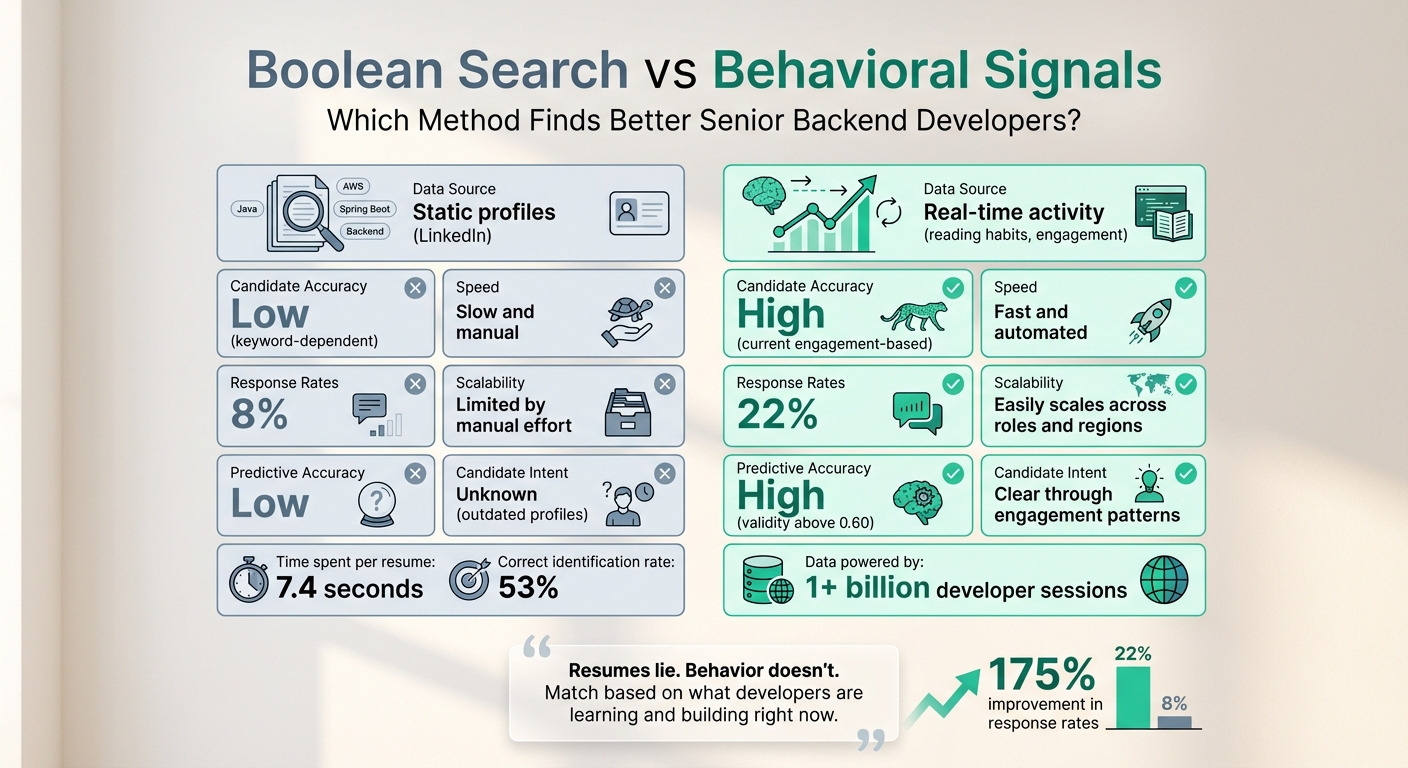 {Boolean Search vs Behavioral Signals: Key Differences in Backend Developer Hiring}
1. Boolean Search
Boolean search has been a fundamental tool in technical recruiting for years. It uses logical operators - AND, OR, and NOT - to filter candidate profiles by specific keywords. For example, a typical string for senior backend roles might look like this:("backend engineer" OR "software developer") AND (Java OR Python) AND (microservices OR distributed systems). The concept is simple: match keywords to find relevant candidates.
However, Boolean search is more about extracting data than truly understanding it . For instance, if a senior developer describes their work as "building server-side architecture" instead of explicitly using the term "backend", they could be missed entirely. This keyword dependency becomes a real challenge for identifying senior talent, as they often describe their work conceptually - like "developed a distributed caching layer" - rather than relying on specific buzzwords . This approach lacks the adaptability of more dynamic methods, such as analyzing behavioral signals.
Precision in Skill Assessment
One major limitation of Boolean search is its inability to weigh the importance of keywords. All mentions are treated equally, which can lead to irrelevant results. For example, searching for "Redis" on LinkedIn might pull up a candidate who only mentioned Redis in a blog post, rather than someone with hands-on professional experience .
Studies show that recruiters and engineers correctly identify strong candidates from resumes only 53% of the time. Adding to this challenge, most recruiters spend just 7.4 seconds scanning a resume before making a decision . Titles like "Platform Engineer", "Site Reliability Engineer", or "DevOps Lead" are common for senior backend developers, but a Boolean string focused on "Backend Developer" might miss these candidates entirely . Without relevance ranking, the best candidates could be buried deep in the search results, making it harder to connect with them .
Detection of Recent Activity
Another drawback of Boolean search is its reliance on static profile snapshots. For example, a developer who transitioned from Java to Python months ago may not have updated their LinkedIn profile yet . This outdated information can lead to mismatches and missed opportunities. Traditional "spray-and-pray" sourcing - sending broad Boolean-based messages - often results in low response rates. One study found that this approach yields only an 8% reply rate, compared to 22% for outreach based on behavioral signals . This reliance on outdated data not only reduces relevance but also increases the time needed to build a qualified candidate list.
Time to Shortlist
Crafting and refining complex Boolean strings is a time-consuming and error-prone process . Broad queries like "Java Developer" can return thousands of profiles, requiring significant manual effort to filter for seniority and relevance . Each adjustment - whether it's adding exclusions, testing nested groups, or incorporating new tools - slows down the hiring process. This takes valuable time away from engaging with candidates meaningfully.
Passive Talent Reach
Boolean search also falls short when it comes to understanding a candidate's openness to new opportunities. A candidate with a perfect keyword match might be completely satisfied in their current role and uninterested in making a move. On the other hand, Boolean search misses behavioral cues - like recent profile updates, skill-building activities, or engagement with relevant content - that signal a candidate's readiness to explore new roles. This blind approach often results in wasted time reaching out to uninterested candidates while overlooking those actively seeking opportunities.
2. Behavioral Signals via daily.dev Recruiter
Behavioral signals focus on what candidates actually do rather than what they claim to know. This approach addresses the limitations of static keyword searches. With daily.dev Recruiter, live developer activity is analyzed - tracking reading habits, engagement with technical content, and learning behaviors - to identify candidates actively working with the technologies you need. As Nimrod Kramer, CEO & Co-Founder of daily.dev, explains:
"We built a place where engineers can turn off the noise. To enter this space, you don't need a hack. You need trust" .
Precision in Skill Assessment
Static profiles can quickly become outdated, but daily.dev Recruiter provides a dynamic alternative. By monitoring the technical content developers interact with - like articles, documentation, and trending topics - it verifies real-world tech stack usage. Powered by over 1 billion logged developer sessions , the platform highlights candidates actively refining their skills. For instance, if a backend engineer is delving into scalable architecture content, they may be preparing for their next big challenge . This creates a more accurate and current picture of a candidate's expertise.
Detection of Recent Activity
daily.dev Recruiter offers real-time insights into developer activity, such as showing when a candidate was last active (e.g., "Active 2m ago"). This visibility ensures you reach out when candidates are most engaged, removing the uncertainty of whether their profile reflects their current skills .
Response Rates
The platform uses a double opt-in system - often called the "Tindev" approach - where both parties must agree to connect. This method fosters warm, engaged introductions, significantly reducing ghosting and improving response rates compared to traditional cold outreach .
Time to Shortlist
daily.dev Recruiter simplifies the hiring process by eliminating the need for complex Boolean searches and manual filtering. Its AI surfaces pre-qualified candidates and integrates seamlessly with ATS tools like Greenhouse, Lever, and Ashby. Features like Pipeline Intelligence allow recruiters to track candidate progress and measure role ROI in real time .
Passive Talent Reach
Behavioral signals also help identify developers who may not be actively job hunting but show signs of readiness through their engagement with technical content . For example, if a backend engineer suddenly starts exploring advanced microservices topics, they might be preparing for a career move. Unlike static profiles, behavioral analysis captures these subtle yet meaningful signals. As daily.dev Recruiter puts it:
"Resumes lie. Behavior doesn't. Our AI matches based on what developers are actually learning and building right now" .
Hiring engineers?
Connect with developers where they actually hang out. No cold outreach, just real conversations.
Pros and Cons
When hiring senior backend developers, the choice between Boolean search and behavioral signals comes with distinct trade-offs. Boolean search allows recruiters to zero in on specific skills, such as "Kubernetes", or exclude terms like "junior", reducing initial screening time by 28% . However, it can be a slow, manual process that relies heavily on static profile data, which may not reflect a candidate's current capabilities.
On the other hand, behavioral signals tap into real-time activity, identifying candidates based on their current technical engagements and professional interests. This method scales effortlessly across different roles and locations . As Marc Boudria, Chief Innovation Officer at BetterEngineer, explains:
"The best future performance predictor is how candidates think, communicate, and solve problems today, not a list of buzzwords."
For instance, while Boolean search might flag a candidate who lists Golang on their resume, behavioral signals can highlight someone actively improving their Golang skills. This approach achieves a predictive validity above 0.60 , offering a more nuanced and efficient way to identify top talent.
Here’s a breakdown of how each method compares across key hiring criteria:
| Criterion | Boolean Search | Behavioral Signals |
|---|---|---|
| Data Source | Static resumes and LinkedIn profiles | Real-time activity (e.g., reading habits) |
| Speed | Slow and manual | Fast and automated |
| Scalability | Limited by manual recruiter effort | Easily scales across roles and regions |
| Predictive Accuracy | Low (keyword-dependent) | High (validity above 0.60) |
| Candidate Intent | Unknown (profiles may be outdated) | Clear through engagement patterns |
This comparison highlights the strengths of behavioral signals in delivering up-to-date insights that go beyond static keywords. While Boolean search remains a useful filtering tool for narrowing down AI-surfaced candidates, it falls short as the primary method for discovering talent . For senior backend roles, where technical depth and readiness are critical, behavioral signals provide the kind of context that static profiles simply can’t.
Conclusion
Behavioral signals offer a smarter way to hire senior backend developers compared to traditional Boolean search. While Boolean search relies on keywords to filter candidates, it falls short in capturing the context and nuances of a developer's current skills, engagement, and openness to new opportunities.
With daily.dev Recruiter, behavioral signals fill this gap. Instead of wrestling with intricate Boolean strings, recruiters can focus on real-time technical activity to identify candidates. This method provides a clearer and more dynamic picture of a developer's expertise than static profiles ever could.
This streamlined process saves time on queries and candidate screening while ensuring outreach is both respectful and precise. The platform's double opt-in "TinDev" model ensures mutual interest before conversations begin, reducing the chances of ghosting and creating meaningful connections.
For companies looking to improve how they hire senior backend developers, this isn't just a small improvement - it’s a game-changer. By leveraging behavioral signals, you can connect with developers who are actively demonstrating the skills your team needs.
FAQs
What counts as a behavioral signal for backend developers?
Backend developers exhibit certain behavioral signals that can offer insight into their skills and engagement levels. These include activities like updating their profiles, earning technical certifications, engaging with specialized technical content, participating in developer communities, and contributing to GitHub projects. Such actions showcase their interest, motivation, and active involvement with relevant technologies, giving recruiters a clearer picture of their expertise and readiness.
How does daily.dev Recruiter spot senior backend talent faster?
daily.dev Recruiter streamlines the process of finding senior backend talent by focusing on behavioral signals such as developer activity, engagement trends, and professional intent. By leveraging these insights, it allows for proactive sourcing based on intent and ensures precise candidate matching. This eliminates the need for outdated, keyword-focused search methods.
How do behavioral signals improve reply rates to outreach?
Behavioral signals can boost reply rates by allowing recruiters to craft tailored, relevant messages that align with a candidate's skills and interests. By personalizing communication, you demonstrate genuine understanding and build trust, which makes candidates more inclined to respond.
.png)