Developers often ignore recruiter messages not because they aren’t open to new roles, but because most outreach fails to meet their expectations. Here’s the problem: generic, irrelevant, or poorly timed messages dominate their inboxes, making recruiters seem unprepared or impersonal.
Key reasons recruiters struggle to get responses:
- Generic messages feel like spam and lack effort.
- No personalization beyond a name or company.
- Irrelevant roles (e.g., Java jobs sent to Python developers).
- Missing key details like salary, tech stack, or work model.
- Poor timing during work hours or busy periods.
What developers want:
- 69% expect salary ranges upfront, and 19% won’t respond if it’s missing.
- Messages that reference their specific skills, projects, or contributions.
- Respect for their time with clear, concise job briefs and thoughtful timing.
The solution? Recruiters need to ditch the cookie-cutter approach. Personalized outreach that highlights a developer’s work, includes role specifics, and uses platforms like daily.dev Recruiter (with its mutual opt-in system) can drastically improve response rates - up to 30–45%, compared to the average 4.77%.
Developers don’t hate recruiters - they just need proof that you’ve done your homework.
Why Do Developers Ignore Recruiters?
Developers don’t ignore recruiters because they’re uninterested - they’re simply inundated with messages that lack effort and feel impersonal. The sheer volume of uninspired outreach has conditioned many developers to dismiss recruiter messages without a second thought. It’s not that developers don’t want new opportunities; it’s that most messages fail to show even basic preparation or respect for their time. Let’s look at the main reasons why recruiters’ outreach often gets ignored.
Generic Cold Outreach
Messages like, "Hi [Name], I saw your profile and think you'd be a great fit for an exciting opportunity at [Company]," are a major turn-off. Developers can spot these cookie-cutter messages a mile away, and they’ve come to associate phrases like “exciting opportunity” with a lack of authenticity. When it’s clear a message is part of a bulk blast, it’s deleted on sight. Writing non-spammy recruiter emails is the only way to stand out.
Lack of Personalization
Simply mentioning a developer’s name or current company doesn’t count as personalization. True personalization involves referencing specific projects, contributions, or skills that show the recruiter has done their homework. Without this, developers feel like they’re being treated as commodities rather than professionals. Jesse Hogan, Founder & CTO of Semantic Recruitment, sums it up perfectly:
"You're not a person. You're inventory."
This transactional tone makes developers feel undervalued and less likely to engage.
Poor Timing and Volume Overload
Timing matters. Messages sent during deep-focus work hours or morning standups are likely to get buried under other notifications. Combine this with the sheer number of messages developers receive, and most outreach becomes background noise. When recruiters don’t consider timing or the volume of competing messages, even well-written pitches can go unnoticed.
Irrelevant Job Matches
Sending a Java job to a Python expert or confusing Java with JavaScript is a fast way to lose credibility. As Nimrod Kramer from daily.dev explains:
"Nothing kills credibility faster than confusing Java with JavaScript, or asking for 10 years of experience in a framework that's 5 years old."
These kinds of mistakes signal a lack of basic research and waste the developer’s time. On top of that, failing to include details like the tech stack, salary range, or work model makes the opportunity feel vague and unappealing. For example, 19% of developers ignore messages outright if salary information is missing .
| Reason for Disinterest | Developer Perception | Impact on Response |
|---|---|---|
| Mismatched Skillset | Recruiter seems uninformed | Immediate ignore/delete |
| Mismatched Seniority | Profile wasn’t read carefully | Seen as bulk spam |
| Missing Tech/Salary Info | Feels like a "mystery box" job | 19% ignore rate for missing salary |
| Wrong Industry | Misaligned with career goals | Low trust, high friction |
When recruiters don’t take the time to personalize their outreach, get the timing right, or align roles with a developer’s expertise, their messages are likely to be ignored. Developers aren’t against new opportunities - they just need recruiters to show they’ve done the legwork.
Hiring engineers?
Connect with developers where they actually hang out. No cold outreach, just real conversations.
Common Mistakes Recruiters Make
Recruiters often take shortcuts, which can erode trust and drastically lower response rates. With the average recruiter now managing 56% more job openings compared to four years ago, the pressure to keep up has led to rushed practices that developers can spot almost instantly . The fallout? Applicants in 2026 are projected to be three times less likely to receive a response than they were in 2022 . These mistakes not only hinder communication but also further alienate developers.
Ignoring Developer Preferences
Too often, recruiters focus exclusively on resumes and miss what developers are truly about. While a polished resume may highlight achievements, it doesn’t necessarily reflect technical skills. Developers frequently showcase their expertise through GitHub repositories, open-source projects, technical blogs, and personal side projects . When recruiters overlook these resources and rely on outdated CVs or LinkedIn profiles, they miss the chance to fully understand a candidate's abilities. For instance, sending a .NET developer role to someone whose GitHub profile clearly demonstrates expertise in React shows a lack of research and attention to detail .
No Value Proposition
Messages that fail to explain why a role is worth considering often go unread. Developers want more than just a job title - they want to know about the challenges they’ll tackle, the company culture, growth opportunities, and the impact they can make. Generic phrases like "exciting opportunity" don’t cut it. Instead, recruiters should provide concrete details about the tech stack, team structure, and product vision. Without these specifics, developers lose interest. In fact, 69% of developers won’t even respond if key details like salary and tech stack are missing . Addressing these expectations upfront increases engagement and shows respect for the developer’s time.
Automated, Impersonal Templates
Mass messaging is another common pitfall. Developers can easily detect when a message lacks genuine effort. Terms like "rockstar", "ninja", or "synergy" often signal a generic, copy-pasted template, which many developers (55% ) now distrust. Simply adding a name or company to an otherwise impersonal message doesn’t help. To stand out, recruiters need to reference specific details, such as a developer’s GitHub commits, blog posts, or recent conference talks, proving the outreach is tailored and thoughtful.
The table below highlights these common mistakes and suggests better approaches for recruiters:
| Mistake | Impact on Developer | Better Alternative |
|---|---|---|
| Generic Templates | Ignored as "spam" by 40% of devs | Reference specific GitHub/blog work |
| Missing Salary/Stack | 69% won’t engage | Include "Big Three" (Salary, Stack, Remote) |
| Technical Errors | Immediate loss of credibility | Verify tech history before sending |
| High Volume/Low Intent | 2.5/5 trust score | Fewer, high-quality, personalized messages |
How to Improve Developer Response Rates
Developers often feel frustrated by outreach that comes across as generic, poorly timed, or unclear. To turn things around, it's essential to focus on thoughtful, tailored communication that respects developers as skilled professionals, not just potential hires. The strategies below address the key concerns and help rebuild trust and engagement.
Personalize Every Outreach
Developers can easily tell when outreach lacks genuine effort. To stand out, reference their specific work or achievements. For instance, mention a recent GitHub contribution, a blog post they authored, or a talk they gave at a conference. If a developer recently worked on an open-source TypeScript library, acknowledge their contribution and explain how it connects to the opportunity you're presenting. This kind of personalization goes a long way in building trust.
Use Warm Introductions
Cold outreach often feels intrusive, but warm introductions can change the game. Developers are more likely to respond when they've already shown interest in hearing about opportunities. Platforms like daily.dev Recruiter facilitate this by creating double opt-in matches, connecting developers open to new roles with recruiters looking for their skills. This approach removes the "spam" factor, ensuring conversations happen with mutual interest.
### Write Clear Job Briefs
Developers don’t spend much time deciding whether to engage - they’ll make up their minds in seconds. Keep job descriptions concise, ideally under 150 words, and use 2–3 bullet points to outline the tech stack and primary responsibilities. Be specific about the salary range (e.g., $150,000–$180,000), tools (e.g., Next.js, AWS, Kubernetes), and work model (e.g., fully remote or hybrid in Austin, TX). Avoid vague terms like "competitive pay" or "modern framework." As one developer shared:
"If there's no mention of potential pay... I am extremely unlikely to respond." – trykondo.com
Leaving out essential details can make your outreach seem unprofessional or unserious.
Time Outreach Strategically
Timing matters as much as the message itself. Avoid reaching out during peak work hours, when developers are juggling meetings, code reviews, and deadlines. Instead, consider evenings or weekends - times when they’re more likely to have the bandwidth for thoughtful replies. Many recruiters are shifting away from interruptive midday phone calls and opting for email or asynchronous messaging instead . This approach respects developers' focus and work rhythms, showing that you value their time and attention.
How daily.dev Recruiter Improves Response Rates
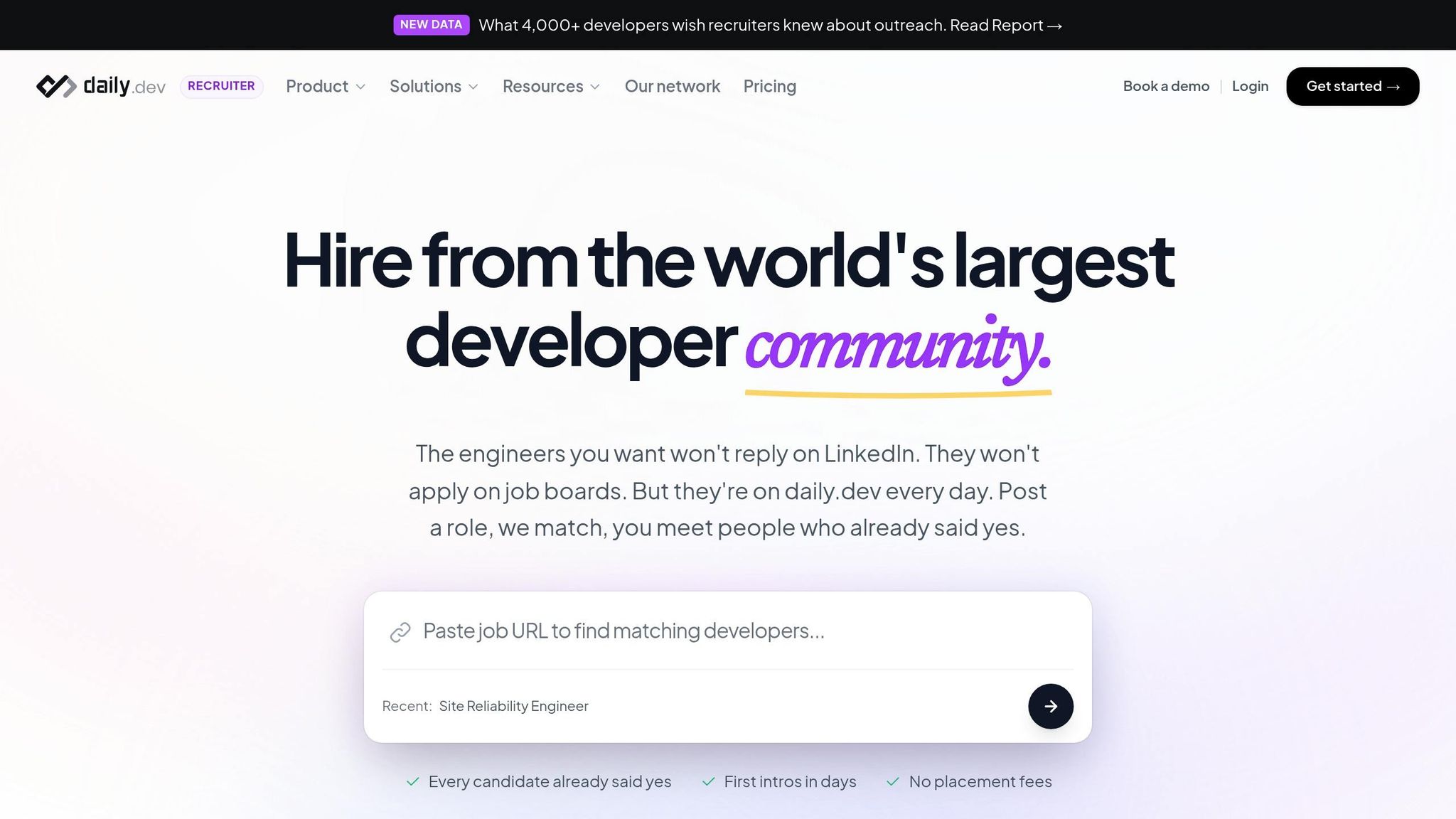
daily.dev Recruiter changes the game for hiring by moving away from outdated, impersonal methods like social media and cold emails and keyword scraping. Instead, it focuses on a consent-based, highly targeted system embedded within the developer's professional network. This approach ensures meaningful, high-context interactions rather than sending out unsolicited messages or chasing resumes. It’s all about connecting with developers where they’re already engaged.
Double Opt-In Warm Matches
Forget cold calls and spammy messages. With daily.dev Recruiter, every interaction starts with mutual interest. The platform uses a double opt-in system, where developers must explicitly agree to a role after reviewing a private pitch. Only then can recruiters reach out. This guarantees that every conversation is purposeful and wanted. Thanks to this system, daily.dev Recruiter boasts a 100% trust score for warm introductions, showing its dedication to respectful, consent-driven communication .
Targeted Role Visibility
Job openings don’t just sit on a job board - they’re seamlessly integrated into the daily.dev network, where developers are already exploring technical content. By analyzing what developers are reading, building, and learning, the platform identifies potential candidates long before they start actively job hunting or updating their resumes . Dafna Ran from daily.dev sums it up perfectly:
"When you reach someone in a place they actually care about and use daily, you're not competing with a wall of noise."
This approach ensures that job opportunities reach the right people at the right time, setting the stage for efficient screening and follow-ups.
Custom Screening and ATS Integration
daily.dev Recruiter also simplifies the hiring process with custom screening tools and ATS integration. Recruiters can include up to three technical screening questions during the opt-in phase, helping to confirm candidates' skills and alignment with the role. Plus, the platform integrates directly with popular ATS systems like Greenhouse, Lever, and Ashby. Candidate profiles and status updates sync automatically, cutting down on manual data entry and freeing up recruiters to focus on meaningful conversations with pre-qualified, interested candidates .
Comparison of Outreach Methods
::: @figure 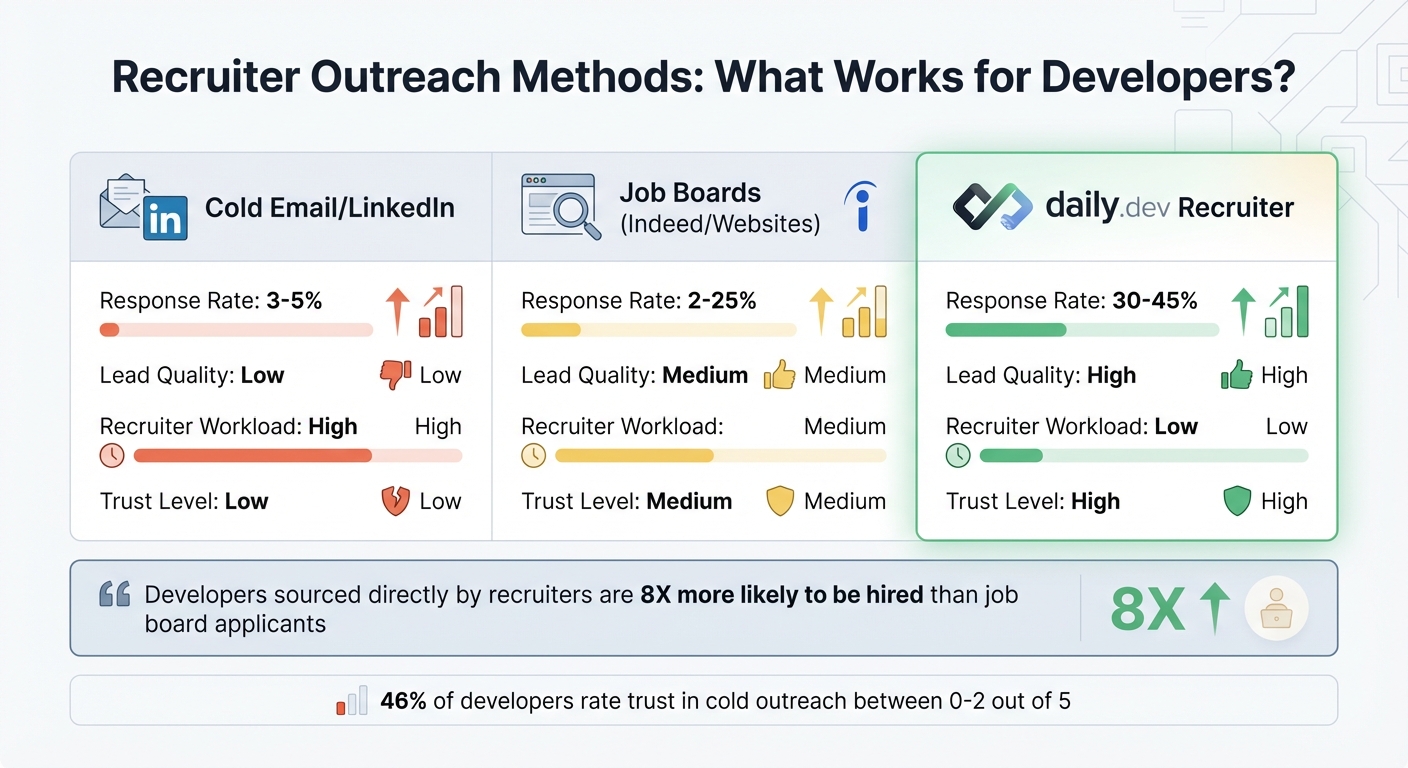 {Recruiter Outreach Methods: Response Rates and Effectiveness Comparison}
Let’s take a closer look at how different outreach methods stack up, especially when focusing on approaches that prioritize trust and consent.
Traditional recruiting methods often struggle to connect with developers. On the flip side, newer trust-based strategies have shown far greater success. The contrast is stark: cold LinkedIn InMails typically achieve a 3% to 5% response rate, while daily.dev Recruiter boasts response rates of 30% to 45% . That’s a huge leap in developer engagement.
Why the difference? The trust gap. As Nimrod Kramer from daily.dev explains:
"Developers don't ignore you because they hate recruiters. They ignore you because they've been conditioned by years of spam."
Beyond response rates, the quality of leads makes a massive difference. Candidates sourced directly by recruiters are 8X more likely to be hired compared to those who apply through job boards . Yet, traditional platforms like LinkedIn generate response rates of just 3% to 13%, and Indeed fares slightly better at 20% to 25% . Direct applications to company websites perform the worst, with only 2% to 5% yielding positive responses . These numbers highlight the importance of personalized, consent-driven outreach.
Here’s a breakdown of how traditional methods compare to daily.dev Recruiter:
Comparison Table
| Method | Response Rate | Lead Quality | Recruiter Workload | Trust Level |
|---|---|---|---|---|
| Cold Email/LinkedIn | 3–5% | Low (outdated profiles, irrelevant matches) | High (manual outreach, low conversion) | Low (community distrust) |
| Job Boards (Indeed/Websites) | 2–25% | Medium (high volume, low intent) | Medium (screening overload) | Medium (transactional) |
| daily.dev Recruiter | 30–45% | High (developers already engaged and pre-qualified) | Low (double opt-in, warm matches) | High (community-driven) |
Another key factor is the workload. Recruiters today are managing 56% more job openings than in previous years . This makes scaling personalized outreach nearly impossible with traditional methods. Cold outreach often means chasing outdated profiles and sending hundreds of messages, only to see minimal results. By contrast, daily.dev Recruiter flips the script - every interaction starts with mutual interest, saving recruiters from wasting time on unqualified or uninterested candidates.
Conclusion
Developers often ignore recruiters due to years of receiving generic, irrelevant pitches and unclear offers. In fact, 46% of developers rate their trust in cold outreach between 0 and 2 out of 5 . The solution isn’t sending more messages - it’s about focusing on improving response rates through quality over quantity.
Be upfront about key role details. Mention a specific project or GitHub contribution to show you’ve done your homework. Keep your outreach limited to a few well-crafted, personalized messages. As Nimrod Kramer from daily.dev wisely says:
"In tech recruiting, attention isn't earned by volume. It's earned by trust."
FAQs
What should I include in the first recruiter message?
When reaching out to a developer, your first message should be short, personal, and clear. Mention something specific about their work or interests to show you’ve done your homework. Include essential details like the tech stack, salary range, and whether the role is remote. Skip the generic templates - developers can spot those a mile away. Keep it to two sentences or a brief paragraph to respect their time and make a strong first impression.
When is the best time to message a developer?
The ideal time to reach out to a developer is between 9 a.m. and 12 p.m. on Tuesday, Wednesday, or Thursday. These mid-morning hours during the middle of the week tend to have the highest engagement rates, giving you a better chance of getting a response.
How can I personalize outreach without sounding fake?
To make outreach feel genuine, start by digging into the developer’s background. Look at their skills, projects, and interests - a quick scan of their GitHub profile or recent work can reveal a lot. Use these details to craft a message that resonates with them on a personal level.
Skip the cookie-cutter templates. Instead, write something that reflects their technical expertise and aligns with their career aspirations. For instance, referencing a specific project they’ve worked on shows you’ve done your homework and aren’t just sending out a mass email.
Be direct and transparent about the essentials. Mention the tech stack, salary range, and other critical job details upfront. And don’t forget to keep your message short and to the point - no one wants to read a novel in their inbox.
Authentic outreach isn’t about flashy tools or superficial tweaks. It’s about putting in the effort to connect meaningfully.
.png)