When hiring developers, resumes often look impressive but fail to reflect actual skills. Studies show recruiters are only 55% accurate in predicting success based on resumes, and just 34% of applicants who seem qualified pass basic coding tests. Buzzword-heavy resumes, automated filters, and overstated skills contribute to this gap, costing U.S. businesses $2.41 trillion in 2022 due to poor hires.
Key reasons candidates fail early screenings:
- Resume optimization tricks: Tailored for ATS systems, not for showcasing real capabilities.
- Overstated skills: Buzzwords and certifications often lack practical backing.
- Poor problem-solving: Many fail simple coding challenges or can’t explain their decisions.
- Communication issues: Struggle to articulate ideas or collaborate effectively.
To improve hiring:
- Use real-world coding tests and pair programming sessions.
- Focus on practical questions like debugging or system design.
- Assess team fit via behavioral interviews and structured rubrics.
Tools like daily.dev Recruiter streamline this process by pre-screening candidates based on actual skills, avoiding reliance on resumes alone. By refining your screening approach, you can reduce bad hires and find developers who deliver results.
::: @figure 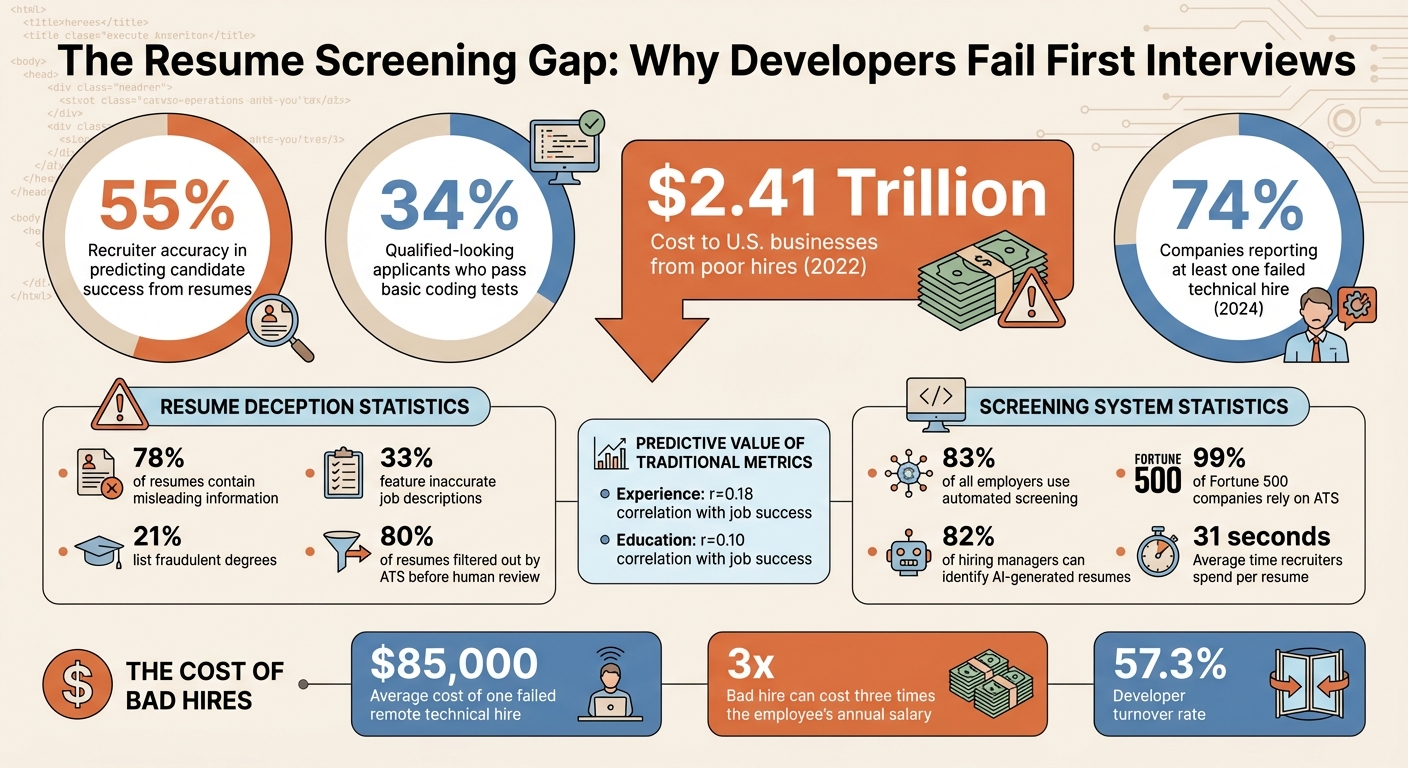 {The Hidden Cost of Resume-Based Hiring: Key Statistics on Developer Screening Failures}
Why Inbound Applicants Appear Qualified on Paper
Optimized resumes may look impressive at first glance, but they often lead to challenges during initial screenings. Today’s resumes are crafted not to showcase genuine skills but to navigate automated filters. With 83% of all employers and 99% of Fortune 500 companies relying on automation to screen applications, candidates have adapted by tailoring their resumes to meet these systems' requirements. The result? Flawless-looking documents that don’t necessarily reflect actual abilities.
Resume Optimization and Buzzwords
To stand out in Applicant Tracking Systems (ATS), applicants meticulously align their resumes with job descriptions. They include both full terms and abbreviations - like "JavaScript (JS)" or "Amazon Web Services (AWS)" - to ensure no keyword goes unnoticed. Many resumes follow a formulaic structure: an action verb, a mention of technology, a quantifiable outcome, and some context. While it reads well, this approach often conceals superficial involvement in projects.
The rise of AI-generated resumes has made this issue even more pronounced. Rob Hosking, Executive Director at Robert Half, highlights the disconnect:
"The resume had it all... Every keyword from the job posting is in the perfect spot... But once the interview started, their story began to fall apart".
Interestingly, 82% of U.S. hiring managers now claim they can identify when AI tools have been used in application materials. However, these polished resumes still manage to pass automated filters.
Skills sections are another area where resumes mislead. Candidates frequently list more than 20 programming languages or frameworks to maximize keyword density, creating a "skills laundry list" that often overstates their expertise. It’s not uncommon to see high-demand skills like Python or AWS mentioned in the skills section without any supporting evidence in the professional experience section. This mismatch paints an inaccurate picture of proficiency.
Beyond keyword strategies, traditional resume metrics also fail to provide an accurate measure of technical competence.
Misleading Indicators of Competence
The metrics recruiters rely on - like experience and education - are poor predictors of actual job performance. Research shows that the correlation between these factors and on-the-job success is weak, with coefficients of just r=0.18 for experience and r=0.10 for education. Despite this, recruiters still prioritize these markers, spending an average of only 31 seconds on each resume.
Certifications, once a gold standard for assessing knowledge, have also lost credibility. The rise of "badge collectors" has created a gap between theoretical knowledge and practical application. Many candidates can regurgitate textbook answers from certification prep but struggle to justify the reasoning behind technical decisions in real-world scenarios. Similarly, a prestigious company name on a resume may signal expertise in navigating corporate structures rather than hands-on problem-solving.
The statistics are telling: 78% of resumes contain misleading information, with 21% listing fraudulent degrees and 33% featuring inaccurate job descriptions. Yet, up to 80% of resumes are filtered out by ATS before reaching a human recruiter. This system favors candidates who excel at resume optimization over those with genuine technical depth, creating a disconnect between what resumes promise and what candidates can deliver.
Why These Applicants Fail During Initial Screening
The initial screening phase often highlights a disconnect between what candidates claim on their resumes and their actual abilities. In 2024, 74% of companies reported at least one failed technical hire, underscoring how common this issue is . Many candidates who seem ideal on paper struggle when asked to discuss or validate the projects and skills they’ve listed. These gaps become clear during real-time conversations, where credentials must align with practical knowledge.
Red Flags in Initial Conversations
A major warning sign? Candidates who can’t confidently explain their own work. For example, when asked about specific architectural decisions from their resume, some resort to vague responses or rely on generic best practices. As Greg T., a Technical Interviewer at Lemon.io, puts it:
"I'm not looking for textbook answers. I want to see how they think, approach problems, and most importantly, handle situations where they don't immediately know the answer."
Another red flag is how candidates react to feedback. Strong candidates approach alternative suggestions with curiosity and open-mindedness. On the other hand, defensive or dismissive responses often indicate a lack of adaptability. Additionally, candidates who overuse "I" instead of "we" when describing team projects may reveal potential collaboration issues .
Overstated Technical Skills
Some candidates inflate their technical expertise, which becomes apparent when they’re asked to apply their knowledge. For instance, those claiming advanced AWS or React skills might deliver rehearsed answers but fail to explain the reasoning behind their choices. When tasked with debugging code or designing a system, these gaps in practical understanding quickly surface.
Another common issue is with "badge collectors" - individuals with an impressive list of certifications but little ability to apply fundamental engineering principles. For example, they might struggle with basic concepts like caching strategies or memory management, exposing a lack of depth in their technical foundation .
Communication and Team Fit Issues
Technical prowess alone doesn’t guarantee a good hire. Candidates who struggle to articulate complex ideas may face challenges working with cross-functional teams. For remote roles, self-organization and independent problem-solving are crucial. If a candidate can’t demonstrate these skills, it raises concerns about their ability to thrive in a remote environment .
The stakes are high. A single failed remote technical hire can cost a company an average of $85,000 . That’s why it’s critical to evaluate more than just technical know-how - assessing how candidates think, communicate, and handle uncertainty is just as important.
How to Improve Your Screening Process
Fine-tuning your evaluation methods is key to identifying developers who can deliver results. This means going beyond just reviewing resumes and incorporating practical, hands-on assessments to see how candidates think and work. Here’s a breakdown of strategies to make your screening process more effective.
Creating Effective Screening Questions
Craft questions that reflect real-world scenarios candidates will encounter on the job. For instance, you could ask: "Walk me through a recent production bug you fixed" or "Why did you choose a specific technology or approach for your last project?" These types of questions dig into a candidate’s thought process and decision-making skills .
Another useful tool is the "tiny problem" test - a short coding challenge designed to filter candidates early in the process. For example, one company used a 20-minute test involving basic C# and JavaScript for a .NET Web Developer role. Out of 415 applicants, only 34% passed . As Imran Gorky explains:
"I've come to discover that people who struggle to code don't just struggle on big problems, or even smallish problems... They struggle with tiny problems."
For senior positions, focus on scaling challenges. Ask how candidates would design systems to handle growth from 100,000 to 1 million users, and have them explain the reasoning behind their choices rather than relying on memorized answers .
Testing Technical Proficiency
Practical assessments are another way to gauge a candidate’s technical abilities. Simulate real work scenarios through pair programming sessions, where you collaborate on solving actual problems. This not only tests problem-solving skills but also reveals how candidates handle feedback .
Keep assessments under 90 minutes to avoid deterring top-tier talent . Allow candidates to use their preferred tools, such as VS Code, and resources like documentation, Google, or AI assistants. This mirrors how developers work in real life and shows how they research and validate solutions .
Before rolling out any assessment, test it with 20 current employees to ensure the difficulty level is appropriate . Platforms like CodeSignal, HackerRank, and Codility can help standardize these assessments while offering features like anti-cheating tools and webcam proctoring . For example, in 2024, Zalora, a fashion e-commerce company, adopted HackerEarth Assessments and managed to cut its recruitment cycle in half while improving candidate quality .
Evaluating Communication and Team Fit
Technical skills alone don’t guarantee success. It’s equally important to assess how well candidates fit within your team. Behavioral questions like "Tell me about a time when..." can reveal patterns from past experiences, while hypothetical questions like "What would you do if..." test their approach to new challenges .
You might also ask candidates to present their take-home projects to the team. This not only showcases their technical decision-making process but also highlights their communication skills .
To ensure fairness, use a grading rubric with clear examples of "poor", "good", and "excellent" responses for each attribute you’re evaluating. This helps reduce bias and keeps the evaluation consistent across interviewers . Dr. Melissa Harrell from Google emphasizes:
"Structured interviews are one of the best tools we have to identify the strongest job candidates... they avoid the pitfalls of some of the other common methods."
Additionally, look for candidates who can articulate the business impact of their technical decisions, such as weighing performance improvements against resource limitations . This demonstrates an understanding of how their work contributes to broader organizational goals - an essential trait for bridging the gap between what’s on a resume and actual on-the-job competence.
Hiring engineers?
Connect with developers where they actually hang out. No cold outreach, just real conversations.
How daily.dev Recruiter Simplifies Screening
daily.dev Recruiter takes the hassle out of traditional resume screening by connecting you with developers who are already active in the daily.dev community. These candidates are pre-screened based on custom criteria and genuinely interested in roles that align with their skills and career goals.
Warm, Double Opt-In Introductions
Forget cold outreach or sifting through generic applications. daily.dev Recruiter introduces you to developers through a warm, double opt-in process. This means candidates are not only pre-screened for technical skills and team compatibility but have also explicitly shown interest in your role. These high-quality, context-rich introductions help avoid situations where candidates ace interviews by memorizing answers but struggle with real-world problem-solving or communication.
Custom Screening Criteria
daily.dev Recruiter lets you set specific technical and team-based filters before any introductions are made. This approach eliminates the "buzzword problem" by focusing on actual skills rather than keyword matches. Considering that 90% of "qualified" applicants fail practical coding tests, this pre-qualification process ensures you're only connecting with the top 10% who can truly perform. By cutting through the noise, it helps you discover talent that might otherwise go unnoticed.
Access to Engaged, Passive Talent
One of the standout features of daily.dev Recruiter is its ability to connect you with developers who are active in the daily.dev community. These candidates are staying up-to-date with industry trends but aren't actively job hunting. Instead, they’re open to opportunities that align with their career aspirations. This is particularly valuable for reaching senior developers who are typically employed and not browsing job boards. By focusing on these passive candidates, daily.dev Recruiter ensures you’re engaging with top-tier talent who bring both expertise and motivation to the table.
Conclusion
The disconnect between polished resumes and underwhelming first interviews remains a persistent challenge. With recruiters only getting it right 55% of the time when predicting a candidate's success, the answer isn’t to double down on flawed methods but to embrace practical validation techniques that reflect real-world work.
The key lies in assessments that simulate actual tasks. As Nimrod Kramer, CEO of daily.dev, aptly states:
"Developers aren't failing your process - your process is failing developers. Trivia-heavy interviews, ghost jobs, vague roles, and silence have torched trust."
Tools designed specifically for developers, like daily.dev Recruiter, offer a refreshing alternative. By leveraging warm, double opt-in connections and real-time behavioral insights, these platforms bypass outdated resume-based screening. Instead, they prioritize evaluating genuine skills and interest, aligning with the practical methods discussed earlier.
The stakes are high. A bad hire can cost three times the employee’s annual salary, and with developer turnover hovering at 57.3%, even small improvements in screening can yield significant long-term benefits. By reshaping your process to reflect actual work, validate skills effectively, and engage developers where they already thrive, you can build a hiring pipeline that identifies true talent.
It’s time to move beyond resumes and outdated methods. Focus on creating a screening process that uncovers real capability.
FAQs
Why don’t resumes always reflect a candidate’s actual skills?
Resumes often present a polished version of a candidate's abilities, designed to highlight strengths and gloss over areas of improvement. In some cases, applicants may even stretch the truth about their qualifications - like exaggerating skills or inflating job responsibilities - to seem more experienced or capable than they actually are.
What’s more, resumes rarely provide insight into practical, hands-on skills or how someone handles high-pressure situations. That’s why thorough screening methods, such as technical tests and behavioral interviews, play a critical role in uncovering a candidate’s genuine potential.
Why do promising developer candidates fail during initial screenings, and how can companies improve their process?
Many developer candidates may seem impressive on paper, but resumes often exaggerate skills or fail to reflect actual experience. This gap becomes evident during initial screenings, making it essential for companies to focus on evaluating practical abilities rather than relying heavily on resumes or outdated interview methods.
One effective approach is to implement technical assessments that mimic real-world challenges. These tests can measure coding ability, problem-solving skills, and familiarity with the tools and technologies that matter most for the role. Combine these with interview questions that explore practical scenarios instead of abstract or overly theoretical puzzles.
Another strategy is to adopt a multi-step screening process. This could include pre-screening filters, technical tests, and behavioral evaluations. A structured approach like this helps identify candidates who excel both technically and in terms of team compatibility. Automating parts of the process can also save time and ensure applicants are evaluated consistently.
By prioritizing hands-on skills and refining the evaluation process, companies can better identify strong developers and reduce the risk of costly hiring mistakes.
Why is communication important in evaluating candidates during the screening process?
Communication plays a crucial role during the candidate screening process. It showcases a person’s ability to clearly share ideas, grasp technical concepts, and work well within a team. These skills are essential in any professional setting, especially where collaboration and problem-solving are key to success.
Conversely, struggles with communication - like giving unclear answers or having trouble explaining thoughts - can hint at potential difficulties in teamwork or adapting to the position. By asking focused questions and carefully listening to how candidates describe their experiences, recruiters gain insight into more than just technical abilities. They can also evaluate how well a candidate might align with the team’s dynamics and expectations. Spotting these qualities early ensures the selection of candidates who genuinely fit the role and the team’s goals.
.png)