Recruiters often find themselves caught between hiring managers' high expectations and candidates' demands for transparency and quick feedback. Misaligned priorities make the hiring process slower and more frustrating for everyone involved:
- Hiring Managers' Focus: Long-term performance and minimizing hiring risks.
- Recruiters' Focus: Speed and maintaining a healthy candidate pipeline.
- Candidates' Expectations: Competitive pay, clear communication, and timely responses.
This disconnect increases hiring delays, with positions often taking 90 days to fill instead of the target 60 days. Recruiters can address these issues by improving communication, sharing market insights, and aligning goals with hiring managers. Focusing on realistic expectations and better candidate experiences can reduce friction and improve outcomes.
The Core Problem: Misaligned Expectations
::: @figure 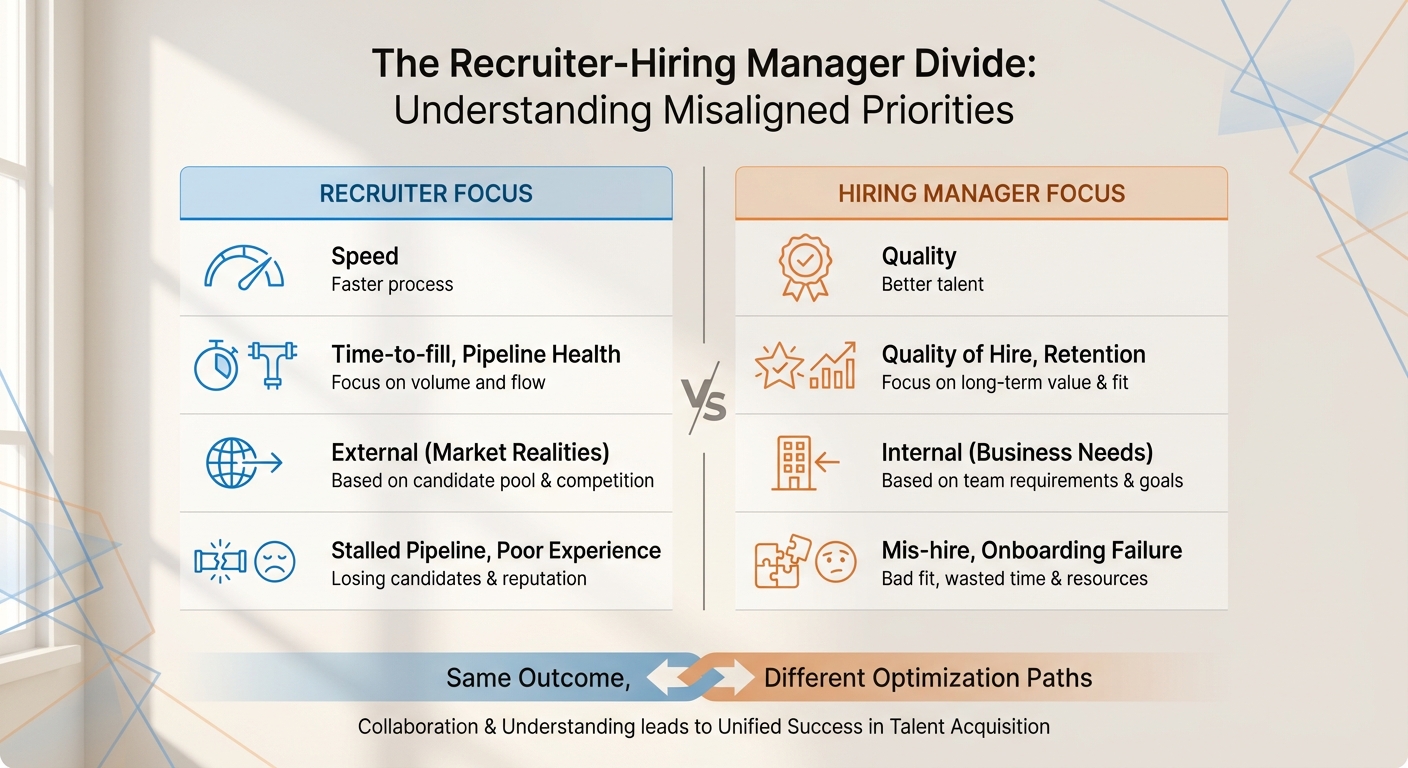 {Recruiter vs Hiring Manager Priorities in Tech Recruitment}
Recruiters and hiring managers often find themselves at odds, driven by different priorities. Recruiters focus on speed and maintaining a robust candidate pipeline, while hiring managers are more concerned with long-term performance and minimizing hiring risks . This natural tension can turn what feels like a win for one side into a setback for the other.
"Recruiters and hiring managers want the same outcome, but optimize for different things. Misalignment comes from misunderstanding these incentives, not from ill intent." - Metaview
The data underscores the challenge. As of late 2022, 86% of CIOs reported greater difficulty finding top tech talent , and 7 out of 10 employers struggle to fill open positions with qualified candidates . This talent shortage magnifies existing misalignments, which we'll explore further by examining the perspectives of hiring managers, candidates, and the ongoing tradeoff between speed and quality.
Hiring Managers Set Unrealistic Requirements
A key misalignment stems from hiring managers setting expectations that don’t align with the realities of today’s job market. Many fall into the "purple squirrel" trap - seeking candidates with an ideal combination of skills that simply isn’t realistic . When role definitions are unclear, hiring managers often shift their expectations after seeing candidates, forcing recruiters to constantly adjust their search . This back-and-forth wastes valuable time and frustrates everyone involved.
For example, three out of four technical recruiters and hiring managers have successfully hired candidates who didn’t initially stand out on paper or meet traditional qualifications . A notable case occurred in 2018, when Randstad’s head of data science hired Adriana Rivera, a software developer returning after a 14-year career break. Despite her unconventional resume, her coding challenge performance outshone other candidates with more polished credentials. This led the company to prioritize skill-based assessments over rigid resume screening .
Candidates Expect More in a Competitive Market
Today’s candidates are setting higher expectations. They want transparency, competitive pay, and a seamless hiring process - expectations that often clash with vague job postings and extended periods of silence. As competition intensifies, frustrations grow when candidates face unclear timelines or unresponsive recruiters.
In the U.S., the average tech salary now stands at $111,193, and the sector is projected to grow by 12.9% . In this environment, top candidates scrutinize employer branding, workplace culture, and growth opportunities just as carefully as hiring managers evaluate their technical skills. When companies treat recruitment as a one-sided evaluation rather than a collaborative process, they risk losing talent to employers who better understand the current job market.
The Speed vs. Quality Tradeoff
Another source of friction lies in how success is measured. Recruiters are judged on metrics like time-to-fill and pipeline health, while hiring managers focus on quality of hire and retention . This creates a tug-of-war: recruiters may push to move candidates through the process quickly, while hiring managers might prefer to leave a position unfilled rather than risk a bad hire .
| Metric | Recruiter Focus | Hiring Manager Focus |
|---|---|---|
| Primary Goal | Speed | Quality |
| Success Metric | Time-to-fill, Pipeline Health | Quality of Hire, Retention |
| Market View | External (Market Realities) | Internal (Business Needs) |
| Risk Concern | Stalled Pipeline, Poor Experience | Mis-hire, Onboarding Failure |
Balancing speed and quality requires strong communication. When feedback is vague - like “didn’t quite click” - or hiring managers are hard to reach, critical details get lost between interviews and debriefs, slowing down the entire process .
"I think of recruiting as the engine and the hiring manager as the driver. I keep things moving and can adjust the speed as needed, but the hiring manager has to steer and pay attention." - Christina Vidauri, Principal Recruiter, SeekOut
How to Align and Improve the Hiring Process
Recruiting challenges often arise not from a lack of talent but from misalignment between teams. Clear communication and shared accountability can address these issues, creating a smoother hiring process. By working together proactively and establishing a unified strategy, recruiters and hiring managers can close the gap and improve efficiency.
Improve Internal Communication and Processes
Start with standardized intake meetings to clarify priorities. Focus on identifying three essential skills and key project deadlines. Instead of asking broad questions like, "What are you looking for?", try more specific ones, such as, "What three skills are absolutely non-negotiable?" or "What project deadlines will this hire impact?" This helps hiring managers prioritize critical needs and avoid chasing an unrealistic "perfect candidate" profile.
"Don't be an order taker. You'll end up searching for a unicorn candidate if you just take down every requirement they list."
- David Li, Principal Talent Advisor, SeekOut
During these meetings, share salary benchmarks, talent availability data, and sample resumes to set realistic expectations right away. Service level agreements (SLAs) can also help - like requiring hiring managers to review resumes within 48 hours to reduce candidate drop-off rates. Tools like applicant tracking systems (ATS) or AI interview platforms can streamline data sharing and feedback in real time.
Feedback is another area to refine. Replace vague comments like "didn't quite click" with specific, evidence-based assessments tied to predefined scorecards. Regular check-ins throughout the hiring process - not just at the beginning and end - allow teams to adapt as market conditions evolve.
Make the Candidate Experience Better
Candidates can tell when they’re being overlooked, and that can hurt your chances of securing top talent. Address potential deal-breakers - like salary expectations, remote work preferences, or relocation needs - during the initial screening to save time for everyone involved.
To represent the role authentically, spend time with the team. Join engineering stand-ups or team meetings to understand their culture and identify potential mismatches early. Equip hiring managers with interview training and sample questions to ensure respectful, unbiased interactions. Platforms like daily.dev Recruiter can facilitate warm, double opt-in introductions, ensuring candidates are genuinely interested in engaging.
Educate Hiring Managers on Market Conditions
In 2025, 74% of employers reported difficulty securing talent, with niche skills and certifications further shrinking the pool of available candidates. Encourage hiring managers to adopt the 70/30 rule: hire candidates who meet 70% of the requirements and provide training for the remaining 30%.
Frame recruitment in terms of business impact. Highlight the cost of vacancy - how much productivity or revenue is lost for every day a critical role stays unfilled. With tech roles taking an average of 47.5 days to fill, this perspective can motivate hiring managers to make quicker decisions.
"You will immediately gain the respect of the hiring manager if they see that you're armed with data about the industry, competitors, geographies and salaries."
- Katrina Collier, Author of The Robot-Proof Recruiter
Given that 87% of companies are struggling with skills gaps, waiting for the "perfect" candidate is no longer a realistic strategy. Help hiring managers adjust their expectations to align with the fast-changing demands of the industry and workforce.
Developer-First Recruitment Approaches
The old method of bombarding developers with generic messages and high-volume outreach has backfired. Developers, on average, give recruiters a trust score of just 2.5 out of 5. A staggering 61% believe recruiters aren’t doing a good job, and 40% outright ignore messages they perceive as spam . With only 15% of developers feeling that recruiters understand the roles they’re hiring for, this isn’t about a lack of talent - it’s about a lack of trust and credibility . To fix this, recruiters need to move away from impersonal tactics and focus on genuine, meaningful interactions.
Replace Cold Outreach with Warm Introductions
Developers are far more likely to respond to personal referrals and connections within their community. That’s why warm, double opt-in introductions - where both parties agree to connect - are so effective . These introductions remove the spammy feel of traditional outreach and build trust from the start. Platforms like daily.dev Recruiter make this process easier by connecting recruiters with developers who are already engaged and interested, ensuring conversations begin on the right foot.
"This isn't a sourcing problem. It's a trust problem."
- Nimrod Kramer, CEO, daily.dev
When reaching out, always include the Big Three: tech stack, salary range, and work model (remote, hybrid, or onsite). Developers value transparency, with 71% wanting details about the tech stack and role scope, 69% expecting salary information, and 63% requiring clarity on work arrangements . In fact, 19% of developers ignore messages that don’t include salary details . Transparency isn’t just appreciated - it’s essential.
Engage Developers Where They Already Spend Time
Once you’ve established warm introductions, go a step further by meeting developers in the spaces they naturally frequent. Many developers criticize LinkedIn for focusing too much on past roles instead of current skills or future potential . Instead, consider checking out GitHub contributions, personal portfolios, or participation in technical communities. For example, joining Discord servers dedicated to specific technologies can be a great way to connect. Directories like Disforge or DiscordMe can help you find relevant communities, but remember: authenticity is key. Mass messaging won’t work here. Instead, engage in discussions and build rapport.
Another option is to involve your engineering team in the process. When technical peers post opportunities or engage directly with developers, it can significantly boost credibility. Alternatively, using "Send on Behalf Of" (SOBO) strategies - where outreach appears to come from a hiring manager or an engineer - can also increase response rates . Just make sure your messages don’t feel copy-pasted; 55% of developers already suspect that even so-called "personalized" messages are AI-generated .
Prioritize Intent Over Volume
Blasting out hundreds of messages isn’t the answer - 43% of developers ignore outreach because of high-volume tactics . Instead, focus on crafting thoughtful, targeted messages for developers who are actively engaged in learning, contributing to open-source projects, or participating in professional communities.
"Java is not like JavaScript, and the senior and lead is not the same thing."
- Senior Backend Engineer (Survey Respondent, daily.dev)
Technical accuracy matters. Developers quickly lose trust when recruiters confuse technologies or misunderstand role hierarchies. Before reaching out, take time to understand the tech stack and the role’s requirements. While 74% of developers are open to new opportunities even if they’re not actively looking, they’ll only engage if the message feels relevant, respectful, and worth their time . By focusing on quality over quantity, recruiters can better align with what developers expect from modern hiring practices.
Metrics for Measuring Recruitment Success
Track These Key Metrics
Recruiters often find themselves stuck between the expectations of hiring managers and candidates. To bridge this gap, tracking the right metrics is essential. These metrics directly address the common misalignments in recruitment priorities.
Start with time-to-hire, which measures the duration from a candidate’s application to their acceptance of an offer. For tech roles, this averages 33 days compared to 41 days across all industries . However, don’t focus on speed alone. As Robert Half explains, "Time to hire is a tool for eliminating snarl-ups from your recruiting process, not as a number to be lowered just for the sake of expedience" . Use this metric to identify bottlenecks like excessive interview rounds or delayed feedback, but avoid rushing decisions.
Next, consider quality of hire (QoH) - arguably more important than speed. This metric evaluates how well new hires perform, fit within the company, and meet expectations over time . To measure QoH, look at first-year performance reviews, engagement levels, retention rates, and technical assessment results. For developers, you can include their scores on technical tests and their ability to adapt to evolving technologies .
Another key metric is offer acceptance rates, which reflect how appealing your hiring process is to candidates. In 2025, the average acceptance rate rose to 84%, up from 81% in 2021 . If your rate is lower, it could signal issues like lack of salary transparency or a process that dragged on too long. Keep in mind that 57% of candidates lose interest if the process takes too much time .
Don’t overlook hiring manager satisfaction scores, which gauge whether new hires meet expectations and if the role was properly understood during recruitment . Pair this with candidate experience scores, collected through post-application surveys. For example, when Paramount Global implemented objective assessment tools in October 2024, they achieved a 95% positive candidate satisfaction rate, reduced time-to-fill by 30%, and lowered attrition by 56% .
Lastly, measure sourcing channel effectiveness (SCE) to determine which platforms - referrals, job boards, or warm introductions - yield the best candidates, not just the highest volume . This helps you focus your efforts on the channels that truly deliver results.
These metrics provide a solid framework for balancing efficiency and quality in your recruitment process.
Balance Speed, Quality, and Retention
Hiring managers often demand speed, but rushing can lead to poor hires and high turnover. The challenge is to balance speed, quality, and retention rather than prioritizing one at the expense of the others.
In 2023, the average time to fill tech roles was 47.5 days, with recruiters interviewing 40% more candidates per hire compared to 2021 . This trend reflects a push for more rigorous evaluations, even when hiring managers say they need someone "yesterday." The answer isn’t lowering standards - it’s eliminating inefficiencies. Standardize intake meetings to clarify "must-have" versus "nice-to-have" skills early on . Use structured scorecards to ensure all interviewers assess candidates consistently .
Monitor new hire retention at the 90-day and one-year marks. High turnover during these periods often points to a mismatch between the role’s expectations and the reality of the job . As Walaa Aljamaat, Global Talent Acquisition Manager at SITA, explains:
"A shorter time to hire often indicates a more streamlined and effective recruitment process... However, it's important to balance speed with quality to ensure that the hiring process adequately evaluates candidates" .
Cost is another factor to consider. On average, hiring in the U.S. costs around $4,683 to $4,700 per hire, but for senior or specialized roles, this can climb to three or four times the employee’s annual salary . A bad hire isn’t just a missed opportunity - it’s a costly mistake that can strain relationships with hiring managers.
To improve outcomes, implement feedback loops to understand why candidates drop out or why new hires leave prematurely . Use these insights to refine sourcing and screening processes. Automating tasks like scheduling and initial screenings through an ATS allows you to focus on building stronger connections with candidates . The goal isn’t perfection - it’s steady, incremental improvement that satisfies both hiring managers and candidates.
Continuously refine these metrics to align recruitment strategies with the expectations of all stakeholders.
Conclusion
Recruiters play a vital role in connecting hiring managers with the right candidates. When they act as market experts and hiring managers trust their insights, the entire hiring process becomes smoother and more effective.
The numbers back this up: strong partnerships between recruiters and hiring managers are the top driver of talent acquisition success, with a reported impact four times greater than the next factor . Achieving this requires shared goals, structured intake meetings, and consistent communication. These steps lay the groundwork for noticeable improvements in both the efficiency and quality of hiring.
Adopting a teamwork approach helps avoid the blame game when challenges arise, like stalled searches or mismatched hires. By focusing on key factors - like growth potential, alignment with team dynamics, and practical skills - both recruiters and hiring managers can broaden their talent options and find stronger candidates.
Consider this: 75.4% of recruiter-manager teams have successfully hired top talent even when candidates had unconventional resumes . The 70/30 rule, where candidates meeting 70% of the job requirements are hired and developed further, only works when both sides agree on priorities from the start. This underscores how aligned strategies can open the door to a wider range of talent.
The aim isn’t to achieve perfection but to continuously improve. Using data, open communication, and shared accountability, teams can balance speed with quality. By treating candidates as partners and sticking to measurable goals, companies can achieve better hiring outcomes.
FAQs
How can recruiters and hiring managers work together to avoid delays in the hiring process?
To keep the hiring process moving smoothly, recruiters and hiring managers need to prioritize clear communication and align their expectations from the outset. Start by clearly outlining the role's top priorities. Break down what skills are absolutely essential versus those that are just nice to have. This ensures everyone is on the same page from the beginning. Incorporating reliable market data, like salary benchmarks and talent availability, can also help set realistic expectations for both sides.
A strong partnership thrives on trust and transparency, which can be built through regular, structured conversations instead of sporadic, last-minute discussions. Sharing real-time feedback on candidates and exchanging insights creates a more collaborative dynamic. Openly talking about shared goals - whether it’s a recruiter aiming for a quick time-to-fill or a manager focused on finding the perfect candidate - helps avoid misunderstandings and keeps the process on track.
By sticking to clear communication, making data-informed decisions, and maintaining consistent dialogue, recruiters and hiring managers can work together more efficiently and cut down on unnecessary delays.
How can recruiters build better communication and trust with candidates?
Building solid communication and trust with candidates is essential for a seamless hiring process. Begin by being clear and upfront about job expectations, timelines, and feedback. Open and honest communication not only respects candidates' time but also enhances your credibility.
Empathy is equally important - take the time to actively listen to candidates' goals and concerns. Offer personalized updates to show you value their unique circumstances. Regular engagement, such as providing timely and constructive feedback, creates a positive impression and builds lasting trust. When expectations are aligned early and dialogue remains open, recruiters can deepen connections and make the hiring process a better experience for everyone involved.
What is the 70/30 rule, and how can it help recruiters find the right candidate?
The 70/30 rule is a practical approach for recruiters and hiring managers to zero in on what truly matters during the hiring process. It suggests focusing 70% of the evaluation on the must-have skills and qualifications essential for the role, while leaving 30% for the less critical, nice-to-have attributes.
This method helps avoid the common trap of chasing an unrealistic "perfect" candidate, which can lead to delays and unnecessary frustration. By prioritizing the core needs of the role, recruiters can simplify the process, set realistic expectations, and communicate more effectively with hiring managers. The result? Faster hires, smoother collaboration, and a better overall experience for everyone involved.
.png)