Recruitment tools often fail because they rely on outdated data and ignore real-time developer signals. These signals - such as coding activity, community contributions, and behavioral patterns - offer a clear view of a developer's skills and job readiness. Without them, tools rely on static resumes, keyword searches, and flawed algorithms, leading to poor matches, wasted time, and low response rates.
Key takeaways:
- Static data fails: Resumes and LinkedIn profiles often miss recent skills and contributions.
- Behavioral signals matter: Real-time data like active coding or engagement predicts job-switch likelihood better than "Open to Work" flags.
- Bias in tools: Algorithms often prioritize company logos or keywords, overlooking skilled candidates with non-traditional backgrounds.
- Poor outcomes: Tools without signals lead to low reply rates (8%) and mismatched hires, compared to signal-based outreach with higher reply (22%) and interview rates (12%).
The solution? Signal-driven sourcing that uses live data to identify engaged, skilled candidates. Start small, track results, and combine automation with human judgment for better hiring outcomes.
Why Sourcing Tools Fail Without Developer Signals
Most sourcing tools approach recruitment as if it's all about numbers. They rely on static resumes, outdated LinkedIn profiles, and basic keyword searches to build candidate lists. But this approach misses the mark entirely. What truly matters is whether a developer is ready, willing, and qualified to make a move. The disconnect between outdated data and real-time insights is a major reason traditional sourcing tools often fall short.
Reliance on Outdated or Incomplete Data
Many sourcing tools depend on outdated databases. Resumes often showcase old skills, leaving out key updates like new frameworks, open-source contributions, or career changes. This mismatch creates a gap between what recruiters are looking for and the actual talent landscape.
The numbers back this up: 66% of executives admit that recent hires didn’t meet expectations, often due to a lack of hands-on experience needed for the role . Without access to real-time data - like a developer's current coding projects or validated skills - these tools are essentially guessing. The result? Candidate pipelines filled with people who may look good on paper but don’t align with the job's real requirements. To avoid these pitfalls, recruiters should follow a checklist for data-driven recruitment.
Missing Real-Time Engagement and Intent Data
Real-time engagement is a game-changer, yet many tools ignore it. Take the "Open to Work" flag, for instance. It’s a poor indicator of whether someone is actually considering a job change. Behavioral signals, on the other hand, tell a much clearer story. For example:
- Developers promoted six months ago are 18% more likely to switch roles .
- Engineers at startups that recently secured funding are more likely to be open to new opportunities .
Without tracking real-time signals - like what technologies developers are exploring, what they’re reading, or how they’re engaging in technical communities - sourcing tools are flying blind. They can’t tell the difference between someone casually browsing and someone actively seeking their next role.
Algorithmic Bias and Oversimplified Matching
Another big issue is how these tools rely on flawed criteria for matching candidates. Without meaningful signals, algorithms fall back on easy-to-measure factors: company logos, years of experience, and keyword matches. As Nimrod Kramer, CEO of daily.dev, points out:
"We screen for what's easy to count - logos, years, acronyms - and miss what actually matters: judgment, collaboration, and the ability to learn on purpose" .
This reliance on surface-level metrics leads to "pedigree bias", where tools prioritize candidates from prestigious companies or universities while ignoring highly skilled, self-taught developers. Vicky Liu from Juicebox sums it up well:
"A keyword search finds people who have done a job; a talent signal search finds people who can do the job" .
The problem gets worse when AI models trained on biased historical data reinforce these patterns. Maria Valero from Workday explains:
"AI is only as objective as the data it's trained on - and if that data reflects historical bias, the AI may reinforce inequities" .
This approach creates pipelines that lack diversity, overlooking candidates with transferable skills or non-traditional backgrounds. Instead of focusing on meaningful engagement, these tools prioritize volume metrics - like how many InMails were sent. The result? A meager 8% reply rate compared to the 22% reply rate achieved through signal-based outreach . Reducing bias in technical hiring is essential to tapping into real developer signals and achieving better hiring outcomes.
The Cost of Ignoring Developer Signals
Overlooking developer signals when using sourcing tools can lead to a cascade of issues - wasting time, draining resources, and damaging both productivity and reputation.
Wasted Time and Resources
When tools lack proper integration, recruiters are forced to rely on manual updates, consuming valuable time . High-volume pipelines filled with low-quality candidates double recruiters' efforts, stretching time-to-hire by as much as 40% . Even AI-powered solutions falter when job descriptions are unclear, leaving teams to handle manual filtering and reduced productivity .
The numbers tell the story: 70% of organizations face delays due to integration issues . Tools that should speed up hiring instead add to workloads, forcing recruiters to sift through irrelevant candidates and extending hiring timelines . Startups using AI for sourcing engineers often find themselves chasing unresponsive candidates because the tools prioritize quantity over meaningful signals like engagement or intent . These inefficiencies create a ripple effect, leading to poor hiring decisions and further setbacks in team performance.
Poor Hiring Outcomes
The resource drain is just the beginning - relying on tools that lack meaningful signals can also compromise hiring quality. Oversimplified matching systems introduce biases, often resulting in poor culture fits and disrupted team dynamics. This is why hiring managers reject 60% of final-round candidates - vague pipelines fail to define requirements early in the process .
The consequences extend to turnover. Teams with onboarding processes longer than 90 days experience first-year attrition rates that are 3.2 times higher than those with 45- to 60-day onboarding periods . When tools fail to assess skills or intent effectively, failing to vet technical skills accurately, new hires struggle to adapt, productivity declines, and turnover rates climb. While AI has the potential to enhance hiring quality by 30% when used effectively, tools that overlook critical factors like motivation and engagement increase the likelihood of long-term hiring failures .
Damaged Candidate Experience
Beyond operational inefficiencies, neglecting developer signals can erode trust with candidates. With 43% of developers muting outreach and an average trust score of just 2.5 out of 5.0 , generic, high-volume messaging often alienates talent. Tools that prioritize quantity over engagement lead recruiters to send impersonal messages that ignore a candidate’s intent or activity. This results in lower response rates and tarnishes a company's reputation .
"This isn't a sourcing problem. It's a trust problem." - daily.dev State of Trust Report 2025
The numbers are stark: 45% of candidates drop off between the phone screen and interview as they accept other offers, often due to delays caused by inefficient processes . Additionally, 58% of software engineers in understaffed teams are actively exploring job opportunities, compared to just 23% in well-staffed teams . Spam-like outreach can permanently alienate these candidates. As Nimrod Kramer notes:
"If your process feels like hazing, great people will self-select out. Not because they can't do it. Because they won't" .
How Signal-Driven Sourcing Improves Recruitment
::: @figure 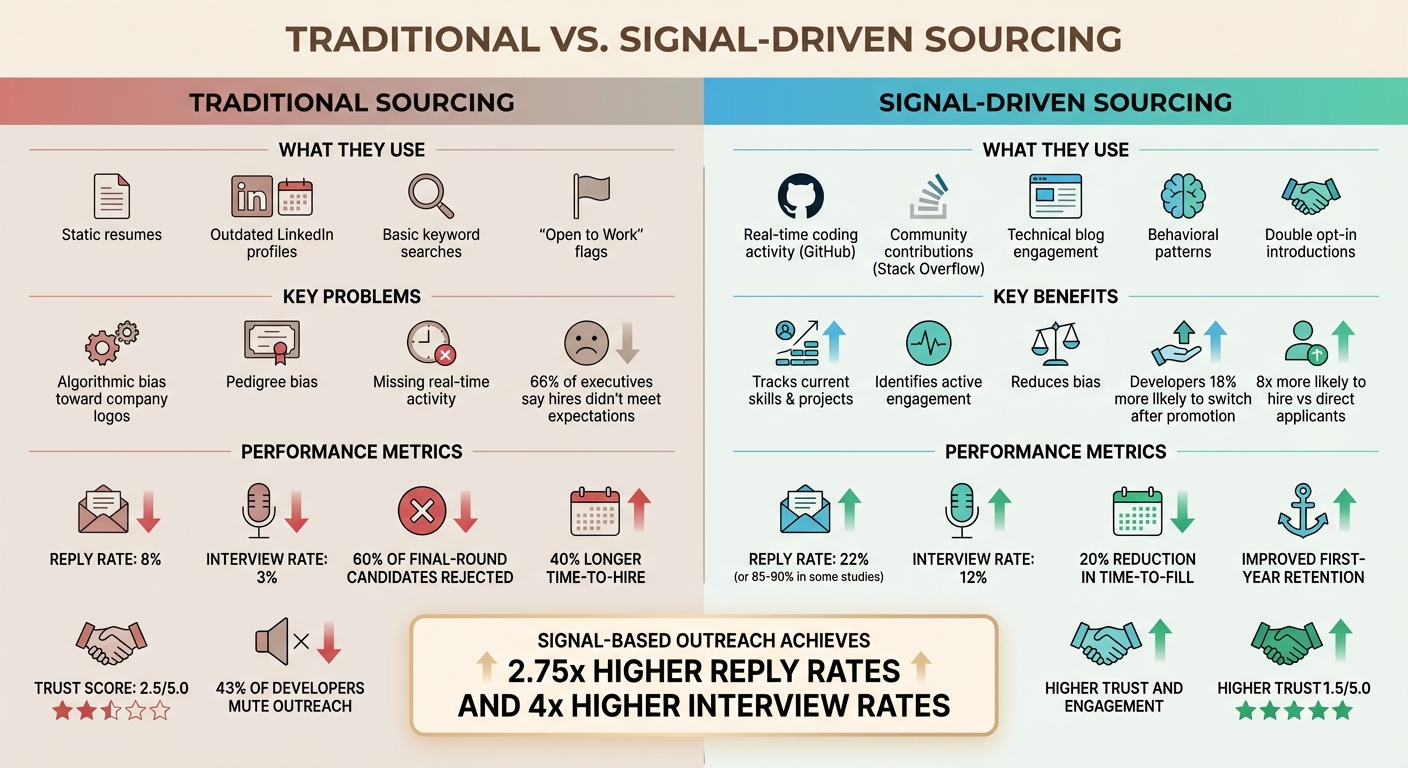 {Signal-Based vs Traditional Sourcing: Performance Comparison}
Signal-driven sourcing replaces outdated resumes with dynamic, real-time insights into developers' skills and activity. By tapping into live data, this method highlights candidates who are not only skilled but also actively engaged and open to new opportunities. Here's a closer look at how this approach works and how to incorporate it into your recruitment process.
Using Real-Time Developer Activity
Traditional resumes often fail to capture a developer's current expertise or interests. Signal-driven platforms change that by tracking developers' active contributions on platforms like GitHub, Stack Overflow, and technical blogs. This shift from static profiles to real-time activity gives recruiters a clearer picture of a candidate's up-to-date skills and engagement patterns. For instance, instead of relying on a resume that lists "Python", these tools can identify developers who are actively writing Python code, contributing to open-source projects, or participating in relevant discussions.
Warm, Double Opt-In Introductions
Double opt-in introductions ensure that both the recruiter and the candidate express interest before any communication begins. This approach removes the impersonal nature of cold outreach and leads to better engagement, with reply rates reaching 22% and interview rates at 12% . Additionally, candidates sourced through this method are eight times more likely to be hired than those who apply directly . By focusing on developers who show active interest - whether through profile updates, engaging with technical content, or participating in relevant communities - recruiters can build trust-based conversations that respect the candidate's time and goals. This method aligns perfectly with the principles of signal-driven sourcing, fostering meaningful and mutually beneficial connections.
Integration with Existing Recruitment Workflows
Modern signal-driven tools are designed to integrate seamlessly with existing recruitment systems. They synchronize bidirectionally with ATS platforms like Greenhouse and Workday, ensuring developer profiles and statuses are updated in real time. This automation eliminates inefficiencies by centralizing candidate data and reducing manual updates. APIs further enhance ATS records with the latest coding activity, skill advancements, and job changes from platforms like GitHub or Stack Overflow. Some tools even offer browser extensions, enabling recruiters to capture and update candidate information directly from online technical communities. This creates a unified, up-to-date source of truth without the hassle of managing multiple systems.
How to Adopt Signal-Driven Sourcing
Shifting to signal-driven sourcing doesn’t mean you have to completely overhaul your recruitment process all at once. The trick is to start with intention, keep human judgment at the forefront, and track outcomes that truly matter.
Start Small and Scale Gradually
Begin with roles that have clear and predictable metrics. For instance, if you’re hiring multiple backend engineers with similar skills, try signal-driven sourcing for this group first. This gives you a chance to test and refine the process before expanding. Once you notice improvements - like higher reply rates or shorter time-to-fill - you can extend the approach to more complex roles, such as staff engineers or technical leads. Rolling out this method in phases helps reduce risks while giving your team time to adjust without interrupting ongoing recruitment efforts. It’s a practical way to address inefficiencies while keeping operations steady.
Maintain Human Oversight for Complex Decisions
While signal-driven tools excel at identifying technical indicators, they can’t replace human insight for nuanced decisions. Factors like culture fit, team collaboration, and long-term career goals require a personal touch. For example, a platform might flag a developer as highly engaged based on recent GitHub contributions or community activity. However, it’s up to the recruiter to determine if that individual aligns with the company’s values and work environment. Use these tools to narrow down your candidate pool and prioritize outreach, but ensure human judgment is central to final decisions. This approach helps you focus on hiring developers who are not only active but also the right fit for your team.
Measure and Optimize Performance
Tracking key metrics helps demonstrate the value of using meaningful developer signals. Focus on outcomes like hires and retention. For example, in a pilot conducted in August 2025 with 200 machine learning engineers, signal-based outreach achieved a 22% reply rate and a 12% interview rate, compared to just 8% and 3% with generic methods. Time-to-fill dropped by 20%, and first-year retention rates improved . Monitor your own metrics, such as reply rates, interview rates, and offer acceptance rates, to see which signals yield the best results. If candidates who recently updated their profiles convert better than those flagged for GitHub activity, adjust your targeting strategy. Regular reviews and adjustments will help fine-tune your approach over time.
Conclusion
Traditional sourcing tools often fall short because they overlook real-time signals that reveal a developer's skills, interests, and readiness for new opportunities. Relying on static resumes and outdated profiles misses out on valuable behavioral data - like recent technical contributions, engagement trends, and career milestones - that provide deeper insights. For instance, recent studies indicate that when developers experience promotion stagnation, their likelihood of seeking a new role rises significantly.
The move to signal-driven sourcing isn’t about sidelining human judgment - it’s about empowering it. As Zhenya Kruglova, Head of Talent Acquisition at Lemon.io, aptly states:
"Automate process, not people. Automate volume, not value" .
While automation helps identify potential candidates, recruiters remain essential for evaluating fit and alignment with long-term goals.
Signal-based approaches dramatically outperform traditional methods, achieving reply rates as high as 85–90%, compared to just 19% with older techniques. These methods also reduce time-to-fill, improve retention rates, and resonate with developers by offering outreach that feels personal and relevant. By combining real-time activity data with double opt-in introductions, companies can not only hire faster but also foster stronger, authentic relationships with talent.
The path forward is clear: start small, focus on measurable outcomes like reply rates and retention, and fine-tune your strategy as you go. Tools that prioritize meaningful, real-time signals over sheer volume are the ones that deliver better results. The real question isn’t whether to embrace signal-driven sourcing - it’s how quickly you can make the transition. This approach aligns perfectly with the earlier evidence that meaningful signals lead to better outcomes than outdated, static data.
FAQs
How does using developer signals improve tech recruitment?
Using developer signals can reshape tech recruitment by helping recruiters pinpoint and engage with top-tier candidates more effectively. These signals - like activity on coding platforms, verified skills, or recent profile updates - offer a glimpse into a developer's engagement, interests, and possible openness to new roles, even if they’re not actively looking. This makes outreach more timely and relevant.
With real-time, data-driven insights, recruiters can move away from outdated information, refine their targeting, and create more personalized connections. This not only speeds up the hiring process but also improves the candidate experience by aligning with what developers value and expect. In the end, signal-based sourcing leads to a more streamlined and respectful recruitment process, resulting in better hires.
What happens when sourcing tools rely on outdated data?
Using outdated data in recruitment tools can cause a lot of headaches. Recruiters might waste time contacting candidates who are no longer available, interested, or even a good fit. This not only slows down the hiring process but can also lead to missed chances to engage with highly qualified candidates who have recently updated their profiles or taken on new roles.
On top of that, outdated information can hurt a recruiter's reputation. Imagine sending a job offer that’s completely irrelevant to someone’s current skills or career goals - it’s a quick way to lose trust. Once that trust is gone, it can be tough to rebuild, making future conversations more challenging. Keeping data accurate and current is key to making smart decisions and creating a more efficient, effective hiring process.
How does bias in AI tools impact hiring decisions?
AI recruitment tools can sometimes skew hiring decisions by unintentionally favoring certain groups or traditional career paths, while overlooking others. This issue often stems from algorithms trained on incomplete or unbalanced data. Instead of focusing on genuine skills or potential, these systems might rely on surface-level indicators like specific keywords or demographic patterns.
The fallout? Qualified candidates with non-traditional career journeys or employment gaps can be unfairly excluded. This not only reduces fairness and diversity in hiring but also weakens the overall talent pool. To address this, it's essential to focus on tools that prioritize evaluating candidates based on meaningful, skills-driven criteria.
.png)