To attract the right developers, focus on clarity, transparency, and realistic expectations in your job descriptions. Here's how:
- Job Titles: Use clear, industry-standard titles like "Senior Python Developer" or "React Engineer." Avoid buzzwords like "ninja" or "guru."
- Introduction: Highlight the role's impact or technical challenges in 2–3 sentences. Avoid lengthy company histories.
- Responsibilities & Requirements: List 5–7 measurable outcomes for responsibilities. Limit must-have skills to 5 and separate them from nice-to-haves.
- Salary Transparency: Include specific salary ranges (e.g., "$155,000–$195,000") to boost applications by 70% and improve applicant quality.
- Tech Stack: Be specific about tools and versions (e.g., "Node.js 18+, PostgreSQL 14"). Avoid vague terms like "modern frameworks."
- Inclusive Language: Replace exclusionary terms with inclusive ones (e.g., "you will manage" instead of "he/she will manage") to attract diverse applicants.
Key Tip: Developers spend just 23 seconds scanning job descriptions. Keep them concise, clear, and focused on what matters most to candidates.
Why Most Developer Job Descriptions Fail
Developer job descriptions often give off the wrong signals, especially to experienced candidates. For example, phrases like "build software" without mentioning the tech stack or vague terms like "current frameworks" make it seem like your company lacks technical direction. And for seasoned developers, that’s a big red flag. Instead of drawing in top talent, these descriptions push them toward other opportunities .
The lack of clarity in job postings creates real headaches. Sure, a generic description might flood your inbox with 300+ applications, but how many of those will actually be qualified? Likely none . Without clear requirements, developers can’t figure out if they’re the right fit. The result? Either everyone applies - wasting your time - or the best candidates skip your listing entirely. Combine this with unrealistic job demands, and you’ve got a recipe for failure.
Unrealistic requirements are a major turn-off. Asking for five years of experience in a technology that’s barely a month old is a classic mistake - and one that senior engineers won’t take lightly. These kinds of posts don’t just make your company look bad; they actively drive away the very talent you’re hoping to attract .
"If your job description mentions 'fast-paced environment' and 'wear many hats' but doesn't specify the tech stack or development methodology, experienced developers will assume you're disorganized or don't have clear technical direction." – Hayden Cohen, Writer, HireWithNear
Transparency is another big issue. When job postings use phrases like "competitive pay" without sharing actual numbers, or talk about "exciting challenges" without explaining what they are, developers lose interest. As one developer, Maksym, put it: "I have no idea why I'd want to work for you. You haven't announced a salary or described the tasks" . On the flip side, job descriptions that clearly outline compensation and benefits see a 38% boost in the quality of applications .
Hiring engineers?
Connect with developers where they actually hang out. No cold outreach, just real conversations.
How to Structure a Developer Job Description That Converts
A good job description does more than just list qualifications - it showcases the opportunity while helping you attract the right candidates. Every section has a purpose, and when done right, it can boost the number of qualified applicants by 42% . Here’s how to craft each part for maximum impact.
Writing Clear Job Titles
The job title is your first chance to grab attention. It needs to be specific and searchable. Developers look for titles like "Senior Python Developer" or "React Engineer." Use industry-standard terms that include both the technology and seniority level, such as "Senior Flutter Backend Developer" or "Lead DevOps Engineer" . Including the technology in the title can increase the apply rate by about 25% . Also, keep titles under 40 characters so they display properly across platforms.
Avoid quirky titles like "Code Ninja" or "Software Wizard." These may come across as unprofessional and make candidates question whether your company understands the role. Stick with straightforward titles like "Frontend Developer", "Backend Engineer", or "Full-Stack Developer", paired with the main language or framework.
Once you’ve nailed the title, the next step is an introduction that grabs attention and highlights the role's impact.
Opening With a Strong Introduction
The opening paragraph is where you hook the reader. Start by emphasizing the technical challenge or impact of the role . For instance, "We're building the infrastructure that processes $43M in payments daily" immediately shows what the role involves and why it’s important.
Keep this section short - just 2–3 sentences. Focus on what the developer will tackle in their first 90 days rather than diving into a lengthy company history.
Defining Responsibilities and Requirements
When listing responsibilities, describe them as measurable outcomes. For example, "Design a caching layer that cuts database load by 60%" . This helps candidates picture the real impact they’ll have. Stick to 5–7 key responsibilities. You can use an engineering role requirements generator to help define these clearly.
Clearly separate must-have skills from nice-to-have ones. Limit essential skills to no more than five to avoid scaring off good candidates who may not meet every requirement . For example, "3+ years of experience with React and TypeScript" is clear and achievable. On the other hand, asking for "10+ years of experience in 15 languages" will likely make even top developers skip your posting .
Presenting Benefits and Compensation
Be upfront about pay. Include a specific salary range - for example, "$155,000–$195,000 base + 0.2% equity + $3,500 learning budget" - instead of vague terms like "competitive salary" . Job postings with clear salary ranges see a 70% boost in applications and a 38% improvement in applicant quality . Plus, 47% of job seekers expect to see compensation details before applying .
Highlight perks like remote work options, learning budgets, and career growth opportunities. Only 20% of developers work fully in an office today , and 94% of employees say they’d stay longer at a company that invests in their professional development .
Describing Your Tech Stack
After outlining the role and benefits, give candidates a clear picture of your tech stack. Be specific with versions and tools. Developers want to know if your stack matches their skills and career ambitions. For example, list "Node.js 18+, React 18, PostgreSQL 14, AWS Lambda" instead of vague terms like "modern JavaScript frameworks" or "current cloud technologies" . Vague descriptions can signal a lack of technical focus, which can be a red flag for experienced developers.
Only include the technologies candidates will use daily. There’s no need to list every tool your company has ever used. If you’re working with cutting-edge tools or tackling complex technical problems, highlight them - these details can make all the difference for developers weighing multiple offers.
Using Inclusive Language to Attract Diverse Candidates
::: @figure 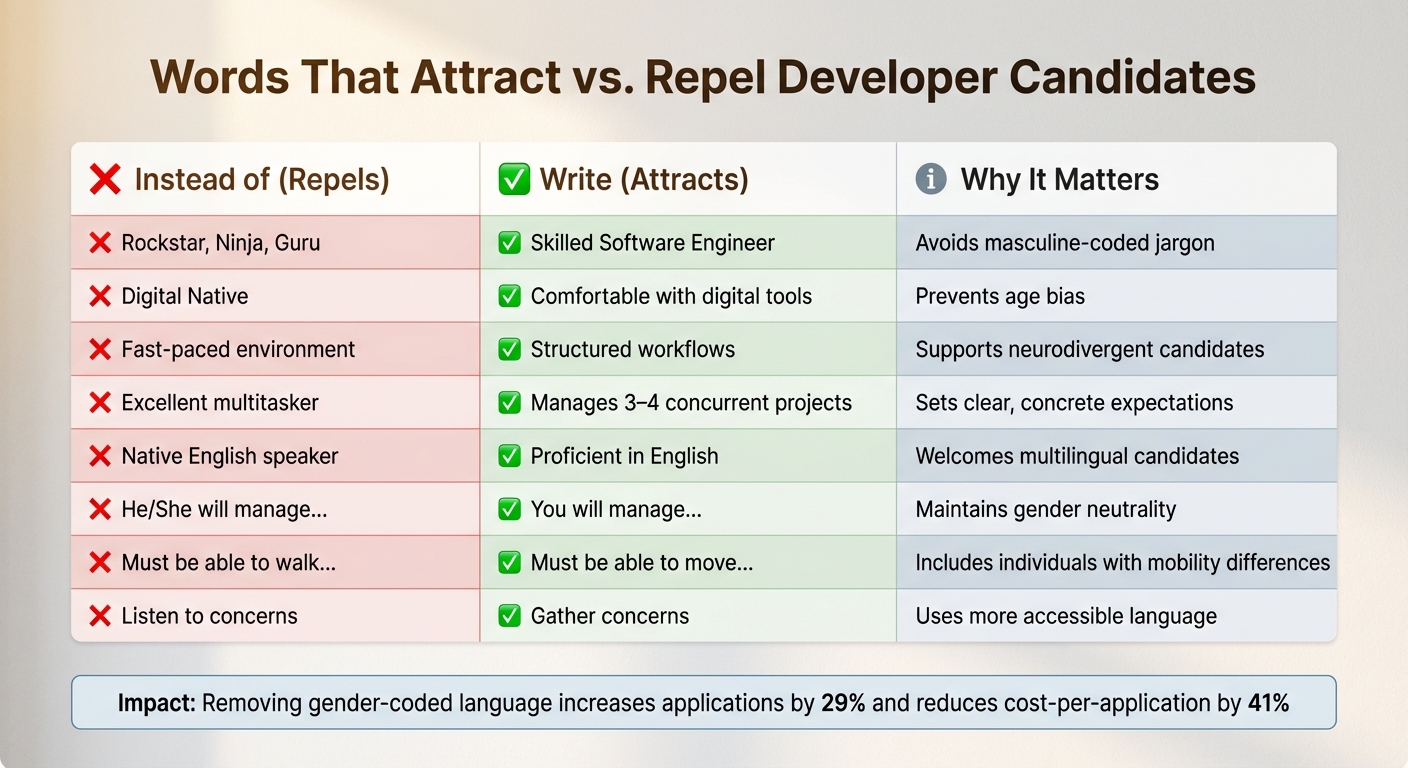 {Inclusive vs Exclusionary Language in Developer Job Descriptions}
The words you use in job descriptions can make a big difference in who applies. Studies reveal that removing gender-coded language can increase application rates by 29% and lower cost-per-application by 41%. On top of that, gender-neutral job postings are typically filled two weeks faster. With 76% of job seekers saying a diverse workforce is important when evaluating companies, using inclusive language isn’t just a good practice - it’s a competitive edge .
Exclusionary language often goes unnoticed but can discourage certain groups. For instance, masculine-coded terms like "aggressive", "fearless", and "dominant" may deter women, while feminine-coded words such as "collaborative" and "supportive" don’t generally discourage men. Similarly, vague phrases like "fast-paced environment" or "excellent multitasker" might signal a lack of structure, which can turn away neurodivergent candidates who thrive with clear expectations. Between 2018 and 2024, job postings in the U.S. that explicitly support neurodiversity nearly tripled .
When it comes to disability inclusion, focus on the outcome of the task rather than how it’s completed. For example, instead of saying "must be able to walk around the office", use "must be able to move around the office" to include wheelchair users. Similarly, replace "makes phone calls to resolve issues" with "communicates with clients via phone or in writing" to accommodate individuals with hearing differences .
Age-neutral language is also crucial. Terms like "digital native" or "recent graduate" can suggest a preference for younger candidates and may even violate age discrimination laws. Instead, use phrases like "comfortable with digital tools" or "entry-level candidates welcome" .
Words That Attract vs. Repel Candidates
Here’s a quick guide to help you replace exclusionary terms with inclusive ones:
| Instead of (Repels) | Write (Attracts) | Why It Matters |
|---|---|---|
| Rockstar, Ninja, Guru | Skilled Software Engineer | Avoids masculine-coded jargon |
| Digital Native | Comfortable with digital tools | Prevents age bias |
| Fast-paced environment | Structured workflows | Supports neurodivergent candidates |
| Excellent multitasker | Manages 3–4 concurrent projects | Sets clear, concrete expectations |
| Native English speaker | Proficient in English | Welcomes multilingual candidates |
| He/She will manage... | You will manage... | Maintains gender neutrality |
| Must be able to walk... | Must be able to move... | Includes individuals with mobility differences |
| Listen to concerns | Gather concerns | Uses more accessible language |
(Source: Research )
Additionally, replace gendered pronouns with "you" or "they" throughout your job descriptions. Swap "cultural fit" for "values alignment" to assess cultural fit properly to reduce bias . These adjustments not only make your postings more inclusive but also ensure they’re clear and precise - qualities we emphasize throughout this guide.
The 5-Requirement Rule for Better Applicant Quality
Adding too many requirements to your job description can shrink your pool of qualified candidates, making it harder to attract the right talent. It's easy to fall into the trap of listing every possible skill, but research shows that candidates spend just 14.6 seconds scanning the requirements before deciding whether to continue reading . A long, overwhelming list often pushes strong candidates to look elsewhere.
The 5-Requirement Rule is a simple fix: stick to a maximum of five essential, non-negotiable qualifications. This approach minimizes "requirement bloat" and ensures you focus on the skills that are absolutely necessary for success from day one. Studies indicate that this focused method significantly improves the quality of applicants . By limiting must-haves, you create a clear distinction between essential skills and those that can be learned on the job.
"Every requirement you add reduces your applicant pool. If it's a learnable skill, don't list it as a hard requirement." - HireFormly
This isn't just about increasing the number of applicants; it's about attracting the right ones. Nearly two-thirds of employers who receive too many unqualified applications blame overly broad or unclear job descriptions . By defining only your five core needs, you help candidates self-assess more accurately and apply with confidence.
How to Separate Must-Have from Nice-to-Have Skills
The 5-Requirement Rule works best when paired with a clear method for categorizing skills. Enter the 90-Day Rule: if a skill can be learned within the first 90 days of employment, it belongs in the "Nice-to-have" category, not as a core requirement . For example, if your team uses Kubernetes and the role's primary focus is backend API development, leave Kubernetes as a "nice-to-have" skill if it can be picked up quickly.
To make this clear, organize your job description into two sections: "What we need" (Required) and "What would make you exceptional" (Nice-to-have) . This layout helps candidates see where they stand. For instance, a frontend developer skilled in React but unfamiliar with TypeScript can see that TypeScript is preferred but not mandatory.
| Feature | Must-Have Skills | Nice-to-Have Skills |
|---|---|---|
| Timeline | Essential on Day 1 or within 90 days | Can be learned on the job |
| Impact | Critical for core role functions | Helpful for specialized projects or growth |
| Examples | Primary language (e.g., React), debugging ability | Secondary tools (e.g., Kubernetes), industry background |
Instead of listing every tool, focus on outcomes to help candidates understand the role's real-world impact. For example, replace "experience with SQL" with "ability to optimize database queries for high-traffic applications." This outcome-based style makes it easier for candidates to see how their skills align with the job .
Up next: how salary transparency can further improve the quality of applicants.
Why Salary Transparency Increases Qualified Applications
Adding a salary range to your developer job postings gives you a clear edge in attracting the right candidates. According to research, 91% of job seekers are influenced by salary details when deciding whether to apply . By including this information upfront, developers can quickly determine if the role aligns with their financial expectations, making the decision to apply much easier.
Salary transparency doesn’t just attract applicants - it simplifies the entire hiring process. When candidates know the pay range, they can self-select based on whether it meets their needs. This reduces the likelihood of interviewing individuals whose salary expectations exceed your budget, saving time for both your team and the applicants.
Transparency also strengthens trust. 82% of professionals believe companies that disclose salary ranges are fairer and more trustworthy . Michelle Cheng, Talent Director at Notion Capital, highlights this point:
"A company that embraces pay transparency conveys so much more than just the salary itself. It's the subtext in treating everyone like an adult and establishing a culture of openness" .
For developers, who may have grown weary of vague or misleading compensation practices, this openness is a refreshing shift.
Another major benefit? Improved diversity outcomes. Publishing clear salary ranges helps close the negotiation gap that often disadvantages women and underrepresented groups. These groups might lack access to market data or face biases when negotiating. A study of 100,000 academics revealed that greater transparency led to a 20% reduction in gender pay inequity . By leveling the playing field, salary transparency promotes fairness and strengthens your ability to attract diverse talent.
The legal landscape is also evolving. By 2026, 15 U.S. states and Washington, D.C., will require employers to disclose salary information in job postings or during interviews . This includes major states like California, Colorado, New York, and Washington. Even if your company operates outside these regions, remote roles may still fall under these laws depending on where candidates are located. This is a critical consideration when implementing best practices for hiring remote technical talent. Meeting these legal standards demonstrates your commitment to fair and transparent hiring practices, aligning with the goal of attracting highly qualified and diverse candidates.
Common Mistakes to Avoid in Developer Job Descriptions
Even with the best intentions, companies can sabotage their hiring efforts by making avoidable mistakes. These errors not only discourage applications but can also drive away the skilled developers you're looking to hire. Once you've nailed the basics of a strong job description, here are some common missteps to steer clear of - and how to fix them.
Avoiding Buzzword Overload
Using terms like "rockstar", "ninja", "wizard", or "guru" might seem catchy to some, but for many developers, these words are off-putting. A Senior Software Engineer put it plainly:
"Most engineers cringe at buzzwords like 'rockstar', 'wizard', 'ninja', etc. Stick to more neutral terms like 'specialist', 'expert', and 'professional'" .
These kinds of buzzwords can signal a lack of understanding about the role and its requirements. Instead of vague or flashy titles, go for something precise, like "Senior Backend Developer (Python/Django)." This approach communicates exactly what the job entails and the skills needed .
Once you've nailed the title, it's essential to ensure your requirements are grounded in reality.
Setting Realistic Requirements
Unrealistic expectations in job postings are a major red flag for candidates. The solution? Keep your focus on the core skills required for the role instead of listing every tool under the sun. For example, instead of asking for "10+ years of experience in all JS frameworks", opt for something achievable like "3+ years of experience with React; Node.js is a plus" .
By being clear and reasonable in your expectations, you'll not only attract better-qualified candidates but also reduce the number of unqualified applications. Inflating requirements won’t help you land top talent - it’ll just drive them away .
Beyond technical skills, how you describe your company culture can also make or break your job listing.
Writing Specific Culture Descriptions
Generic phrases like "fast-paced and collaborative" or "great work-life balance" don’t stand out to candidates. Instead, provide specifics that paint a clear picture. For instance, swap out "collaborative environment" for something like: "Our team prioritizes thoughtful code reviews, comprehensive testing, and deploying multiple times per day" .
Similarly, if you want to highlight work-life balance, back it up with real examples: "Our team members work an average of 40 hours per week" or "there are no weekend on-call requirements" . Including details about your development process - whether you use Agile, Scrum, or Kanban - and how technical decisions are made can demonstrate your company’s technical sophistication and help candidates imagine what it’s like to work with you.
Job Description Templates by Developer Role
A well-designed template offers a structured approach while allowing flexibility to tailor each job posting. Key elements include a clear job title, an engaging summary, primary responsibilities, required and preferred skills, the tech stack, work arrangements, salary range, benefits, and insights into the development process .
For Frontend Developer roles, the focus should be on user experience, responsive design, cross-browser functionality, and adherence to accessibility guidelines like WCAG . Backend Developer templates should highlight API performance, server-side logic, database management, and uptime reliability (e.g., 99.9%) . Full-Stack Developer roles need to emphasize translating user feedback into complete features while balancing frontend and backend work . DevOps Engineer templates should stress managing CI/CD pipelines, ensuring scalability, and automating processes . Data Engineer postings should prioritize building scalable data pipelines, analytics platforms, and managing data growth .
Use this transparent developer job posts checklist to ensure your descriptions include all necessary details. Here’s a breakdown of templates for these common developer roles.
Frontend Developer Job Description Template
Start with a straightforward title like "Senior Frontend Developer (React)". The summary should connect the role to its impact, such as developing a key feature for customer-facing applications. Responsibilities should focus on implementing UI/UX designs, ensuring responsive layouts, and collaborating with design teams . Include a concise list of 5–7 technologies, such as HTML, CSS, JavaScript, React (or Angular/Vue), and Git . Required skills might include "3+ years with React" and "experience implementing WCAG 2.1 standards", while optional skills like TypeScript or familiarity with Figma can be listed as nice-to-have.
Next, let's look at the Backend Developer template.
Backend Developer Job Description Template
Use a clear title like "Python Backend Developer" or "Senior Backend Engineer (Node.js)" . Begin with a technical challenge, such as: "Rebuild our core API to support 10x traffic growth while maintaining sub-200ms response times." Responsibilities should highlight API architecture, database efficiency, and overall system performance . The tech stack might include languages like Python or Node.js, SQL and NoSQL databases, and cloud platforms such as AWS or Azure. Required skills could include "5+ years building RESTful APIs" and "experience with PostgreSQL at scale."
Now, let’s explore the Full-Stack Developer template.
Full-Stack Developer Job Description Template
Choose a title like "Full-Stack Developer (React/Node.js)". The summary should emphasize end-to-end ownership, explaining how the role involves turning user feedback into complete features - from database design to frontend components. Responsibilities should outline the balance between frontend and backend tasks . Include frontend frameworks like React or Vue, backend technologies such as Node.js and Express, and essential DevOps tools like Docker. Keep required skills practical, such as "4+ years with JavaScript" and "experience building REST APIs and modern web interfaces", while placing extras like GraphQL or Kubernetes in the nice-to-have section.
Here’s how to approach the DevOps Engineer description.
DevOps Engineer Job Description Template
Titles like "DevOps Engineer" or "Senior Site Reliability Engineer" work well. Begin with a technical challenge, such as: "Design a CI/CD pipeline that supports frequent deployments while ensuring high system reliability." Responsibilities should focus on pipeline management, automation, and infrastructure as code . Mention tools like Docker, Kubernetes, Jenkins or CircleCI, and cloud services such as AWS, Azure, or GCP. Required skills might include "3+ years managing Kubernetes in production" and "experience automating infrastructure with Terraform." Specify deployment practices and on-call requirements as needed, and avoid overloading the description with buzzwords.
Finally, let’s cover the Data Engineer template.
Data Engineer Job Description Template
Use a descriptive title like "Senior Data Engineer (Python/Spark)". Start with a technical challenge, such as: "Build data pipelines that process 10TB daily to power real-time analytics for 500+ enterprise customers." Responsibilities should focus on creating pipelines, scaling analytics platforms, and maintaining data quality . Include tools like Spark, Hadoop, ETL technologies, and programming languages such as Python or Scala in the tech stack. Required skills could include "5+ years building production data pipelines" and familiarity with distributed systems like Spark or Kafka. Highlight opportunities for professional growth, such as conference budgets or internal tech talks.
How daily.dev Recruiter's Job Description Generator Works
daily.dev Recruiter takes the guesswork out of crafting job descriptions by creating targeted, detailed briefs that resonate with developers. Instead of relying on generic listings, the platform integrates job briefs directly into daily.dev's technical content environment - where developers are already learning and engaging. This approach ensures that your job postings are seen in a space where developers naturally spend their time, making it easier to connect with the right talent.
With the ability to embed custom screening questions, you can filter candidates before any conversations begin. For instance, you can ask about experience with specific technologies like "Node.js 18+" or "PostgreSQL 14", or even inquire about their approach to relevant architectural challenges. This upfront filtering saves time by narrowing the pool to candidates who meet your core requirements.
The platform also eliminates cold outreach with a dual opt-in process. Developers review the full job brief, including details like your tech stack, compensation range, and the specific problems they’d solve in the role. This ensures that only genuinely interested candidates opt in, creating a more efficient and respectful recruiting experience.
On top of that, the generator integrates seamlessly with your existing applicant tracking systems and sourcing tools. It uses data that developers have already shared - like their preferred tech stacks, salary expectations, and remote work preferences - to ensure your job descriptions reach the right audience. Impressively, 40% of daily.dev users are senior individual contributors or leaders, many of whom aren’t actively browsing job boards but are open to the right opportunity.
The tool also promotes salary transparency by default, helping you attract candidates who align with your budget while avoiding mismatched expectations. By focusing on well-crafted briefs and warm, trust-based introductions, daily.dev Recruiter transforms hiring from a noisy process into a meaningful connection between employers and developers.
Conclusion
Crafting a job description that attracts the right talent comes down to three key elements: clarity, transparency, and realism. Start with a title that developers will recognize, like "Backend Developer", instead of using unconventional or creative titles that might confuse candidates. Hook their interest by highlighting the technical challenges or business impact of the role - skip the generic company introduction that often gets ignored.
Once you’ve nailed the title, focus on the essentials. Limit the must-have requirements to five key items. Why? Because candidates only spend about 14.6 seconds skimming through requirements. Make every word count. Clearly distinguish between skills they must have and those they can learn on the job. This approach ensures you don’t scare off qualified talent who could thrive in the role.
Salary transparency is another must. Including a compensation range in your job posting can boost click-through rates by 75% and attract 66% more qualified applicants. Developers want to know upfront if the opportunity meets their expectations, so don’t leave them guessing.
Finally, be upfront about your tech stack and work setup. With only 20% of developers working full-time in an office, it’s crucial to align with their preferences. And don’t just list tools - explain what they’ll be building and the challenges they’ll tackle. That’s what truly excites developers and gets them to hit "Apply."
FAQs
How do I choose the right developer job title?
Picking the right job title for a developer role is crucial for attracting the right candidates and setting clear expectations. Opt for straightforward, industry-recognized titles like "Junior Software Developer", "Front End Developer," or "Senior Software Engineer." These titles give a clear sense of the role's focus and level of expertise.
Steer clear of titles that are too vague or packed with buzzwords - they can confuse candidates or make the role seem less credible. It's also important to align the title with your organization's structure so potential applicants can easily gauge whether the position matches their skills and career goals.
Which 5 requirements should I list (and what becomes nice-to-have)?
When crafting a job description, focus on listing must-have skills and qualifications that are absolutely essential for the role. These typically include core technical skills, relevant experience, and familiarity with specific technologies.
In contrast, nice-to-have items cover additional skills or experiences that, while beneficial, aren't deal-breakers. These might include knowledge of supplementary technologies or certain soft skills.
By sticking to the "5-requirement rule", you can keep your job description streamlined, adaptable, and attractive to a wider pool of candidates.
How can I share a salary range without limiting applicants?
Including a salary range in your job posting can help attract a wider pool of qualified candidates while ensuring expectations are aligned from the start. Being upfront about compensation not only boosts trust but also increases the likelihood of applications from individuals whose expectations match your budget. This approach can also encourage a more diverse group of applicants to consider the opportunity, ultimately broadening your talent pool.
.png)