91% of cold emails go unanswered by developers. Why? Most outreach lacks effort, relevance, and personalization. Developers receive countless cookie-cutter emails that fail to address their skills, interests, or priorities.
If you want developers to respond, here’s what works:
- Personalization: Reference their projects, skills, or interests.
- Transparency: Share salary ranges, tech stack details, and clear role expectations.
- Relevance: Focus on meaningful work, autonomy, and exciting challenges.
- Timing: Send emails midweek, early afternoon, and avoid generic follow-ups.
Platforms like daily.dev Recruiter simplify this process by connecting you with developers already signaling interest, cutting through the noise of cold outreach. Success lies in showing respect for their time and demonstrating genuine interest in their expertise.
::: @figure 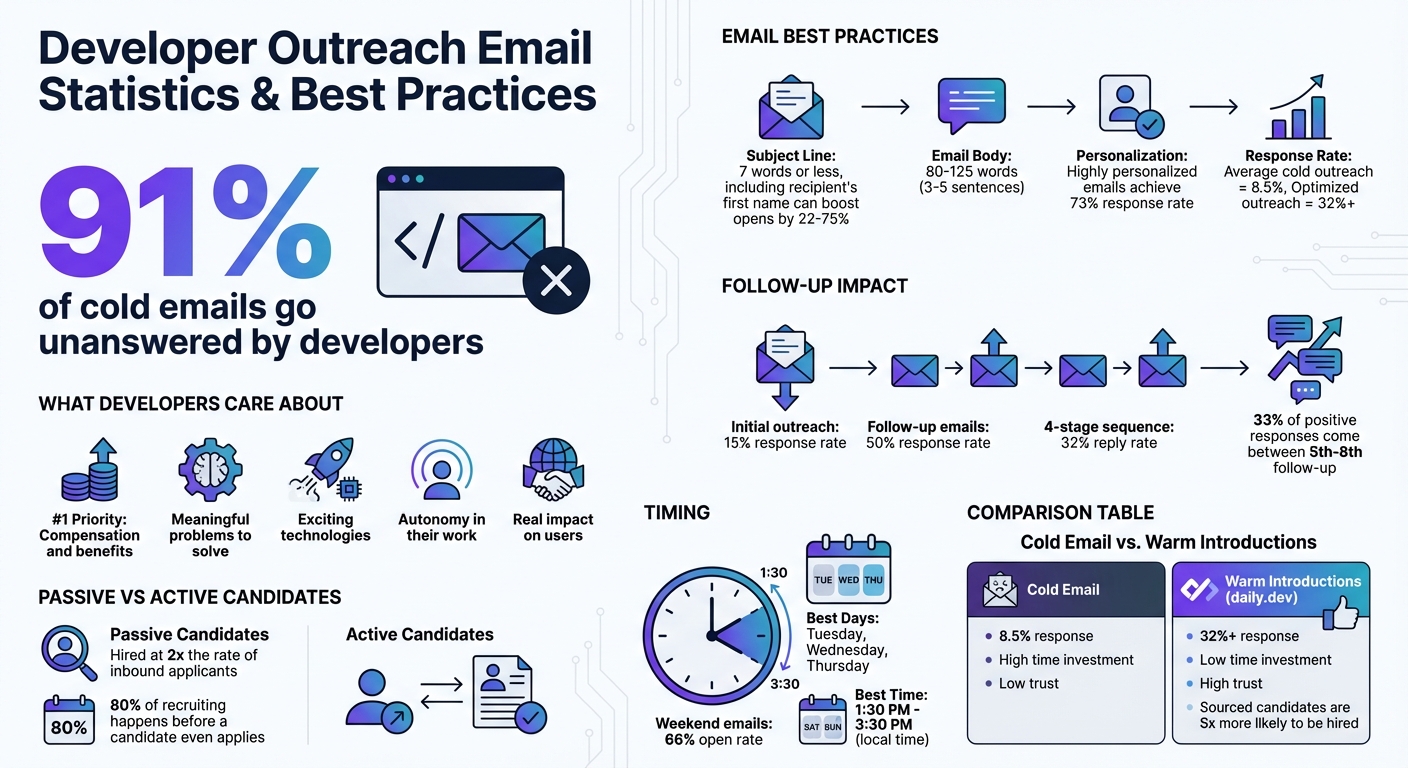 {Developer Outreach Email Statistics and Best Practices}
What Developers Care About
Before reaching out to developers, it’s crucial to understand what truly matters to them. At the top of their list? Compensation and benefits - these are the main factors developers consider when evaluating new opportunities . However, throwing money at a candidate won’t guarantee their interest. Developers are driven by the chance to tackle meaningful problems, work with technologies that excite them, have autonomy, and see their efforts make a real impact on users. They care about the tech stack, the problem they’ll be solving, and whether the role will challenge and grow their skills.
The work environment is just as important. Developers value flat hierarchies, remote flexibility, strong team collaboration, and alignment with causes they care about. These aren’t just optional perks - they’re the elements that can make or break your outreach. If you can show you understand these priorities, you’ll have a much better chance of getting their attention.
What Motivates Developers
Developers are drawn to substance, not fluff. Overused terms like “rockstar” or “ninja” are immediate turn-offs. Instead, focus on specifics. Mention the technologies they’ll use, the challenges they’ll face, and how the role aligns with their skills or interests. Transparency is essential - include salary ranges, describe the tech stack, and explain how their contributions will matter.
Here’s a great example of what resonates. Mike A., a developer, shared this about his favorite recruiting email:
"My favorite recruiting email so far didn't look like a recruiting email. It was just an invitation to chat about some GitHub project that the company works on. And the GitHub project was perfectly aligned with my interests."
This approach works because it’s relevant, clear, and respectful. When developers see that you’ve taken the time to understand their expertise and interests, they’re far more likely to engage.
Active vs. Passive Candidates
Not every developer is actively job hunting. Active candidates are updating resumes and browsing job boards. But passive candidates, who make up the majority of top talent, are content in their current roles and won’t move unless something exceptional catches their eye. Interestingly, passive candidates are hired at more than twice the rate of inbound applicants . But winning them over requires a completely different strategy.
Generic outreach won’t cut it for passive developers, and making personalization mistakes can quickly damage your reputation. They respond to personalized, value-driven communication. In fact, 80% of recruiting happens before a candidate even applies . This means your approach must establish trust and demonstrate value long before asking for a resume. Cold calls? They feel intrusive. Thoughtful, personalized emails referencing their work or interests? Those feel respectful and effective.
How daily.dev Recruiter Works
This is where daily.dev Recruiter steps in to simplify the process. Instead of relying on outdated methods like database scraping or cold emails, the platform connects you with developers who are already active on daily.dev - a space where they engage with technical content daily. Every connection is warm and double opt-in, meaning both you and the developer express interest before any conversation begins.
Rather than interrupting their day with an unsolicited pitch, you’re reaching developers who are already signaling their interests - whether it’s React, cloud architecture, or DevOps tools - through the content they consume. The platform provides detailed insights into their current technical focus, ensuring your outreach aligns perfectly with their career path. Say goodbye to spam and guesswork, and hello to trust-based, meaningful connections.
How to Write Outreach Emails Developers Will Answer
To grab a developer's attention, your outreach email needs to align with their interests and cut through the clutter of endless cold emails. A standout email combines an engaging subject line, a clear and concise body, and straightforward language. Let’s dive into how to get it right.
Writing Subject Lines That Get Opened
Subject lines are make-or-break. Nearly half of recipients decide to open an email based solely on the subject line . Keep it short - seven words or less - to ensure it displays properly on mobile devices . Adding the recipient's first name is another great way to make the email feel more personal and less like a mass message.
Specificity is your secret weapon. Instead of generic lines like "Exciting opportunity at [Company]", go for something tailored, such as "Loved your [Project Name] on GitHub" or "[First Name], question about your React work." In 2022, Outreach tested 2,000 emails and found that including the recipient's company name in the subject line - like "Missing the mark at [Company Name]?" - boosted open rates by 22%. Pairing this with a time-sensitive phrase like "Quick Call" pushed open rates to an impressive 75% .
Avoid overused recruiter jargon like "ninja" or "rockstar", as well as vague phrases like "Job Opportunity." Instead, aim for curiosity and a conversational tone. A subject line that feels thoughtful and spontaneous will stand out in a crowded inbox .
Once the subject line grabs their attention, the body of the email needs to keep them engaged.
How to Structure the Email Body
The ideal email body is short and sweet - three to five sentences, or about 80–125 words . Start by explaining how you found them and why their work caught your eye. For example, mention a specific GitHub project or contribution that impressed you.
From there, focus on the work itself. Developers care about the details - what they’ll be building, the technologies involved, and the impact of their work. Using coding-focused candidate sourcing tools can help you identify these specific details. Be specific. For instance, highlight a Java/Spring role focused on real-time data pipelines rather than listing generic perks.
Wrap up with a single, low-pressure call to action. Offering too many options (like scheduling a call, sending an email, or visiting a link) can overwhelm the recipient and hurt response rates . Instead, keep it simple with a question like, "Are you open to a brief chat next week?" or "Would you like to learn more?" This makes it easier for them to reply positively.
Once your email is well-structured, the next step is to ensure your language is clear and honest.
Using Clear and Direct Language
Transparency is key when reaching out to developers. As Simon, a developer on StackExchange, puts it:
"I receive like five to 10 messages a week from recruiters... less than 5 percent even made the effort to read through my profile to check if I would be a good fit. I answer these messages... The remaining 95 percent are just ignored."
Skip the formalities like "I hope you're well" and get straight to the point. Including salary ranges upfront - like "$140,000–$180,000, depending on experience" - can go a long way in building trust .
Petr Belousov, CEO and Cofounder of CandyJar, explains it perfectly:
"If the recruiter clearly demonstrates that they know what I do and what I can do, then they probably have something genuinely relevant for me."
Emails that are highly personalized - mentioning specific GitHub projects, technical skills, or recent contributions - can achieve a 73% response rate . Doing your homework and speaking directly to a developer’s expertise shows you value their time and talent. That’s how you get noticed.
Personalization, Timing, and Follow-Ups
Personalizing with Specific Details
Generic outreach rarely grabs attention. To stand out, you need to go beyond surface-level personalization. Mentioning a developer's recent LinkedIn post, referencing a specific GitHub commit, or even bringing up a keynote they delivered can significantly increase your chances of a reply - by over 100%, in fact . This approach shows you’ve taken the time to genuinely engage with their work.
Spend time reviewing their GitHub, LinkedIn, Twitter, or personal portfolio to uncover recent projects or technical interests . Look for what excites them. As developer Mike A. shared:
"My favorite recruiting email so far didn't look like a recruiting email. It was just an invitation to chat about some GitHub project that the company works on" .
When developers see that you’ve done your homework, they’re more likely to view your outreach as sincere rather than just another mass email.
Another effective tactic is using Send on Behalf of (SOBO) emails, where a hiring manager or senior engineer reaches out directly. This strategy can boost reply rates by 50% or more .
Once you’ve nailed personalization, the next step is to time your outreach for maximum impact.
When to Send Your Email
The timing of your email plays a bigger role than you might think. Research shows that Tuesday, Wednesday, and Thursday are consistently the best days for technical outreach . For developers and IT professionals, early afternoon - between 1:30 PM and 3:30 PM local time - is ideal. By then, they’ve likely wrapped up morning standups and are in a more responsive frame of mind .
Avoid sending emails at exact top-of-the-hour times like 9:00 AM or 10:00 AM, as these are prone to throttling. Instead, aim for slightly offset times, like 10:07 AM. Always align with the recipient’s local time, and focus on early mornings (8:00–10:00 AM) or early afternoons (1:30–3:30 PM). Steer clear of Monday mornings and Friday afternoons, as these tend to be less effective. Interestingly, weekend emails can perform well, with open rates around 66%, thanks to reduced inbox competition .
Writing Follow-Ups That Add Value
Even with strong personalization and perfect timing, follow-ups are where many outreach efforts succeed or fail. Angela Miller, Head of Talent at Moloco, highlights the importance of persistence:
"Response rates on that initial outreach might be 15%, but they might be 50% on the follow-up" .
A four-stage email sequence can double your response rate compared to a single email .
The secret? Each follow-up should offer something new. Avoid sending generic messages like, "Did you see my last email?" Instead, include fresh insights or resources. Share a link to a recent product launch, highlight employee reviews on Glassdoor, or point to a technical blog post from your engineering team . Heather Morgan, CEO of SalesFolk, emphasizes this approach:
"Every email you send needs to add new and unique value, which gives you an opportunity to convince more people to have a conversation with you, since each email can focus on a different benefit" .
Space your follow-ups 2–4 business days apart to avoid overwhelming the recipient . Mix up the timing - if your first email went out on a Tuesday morning, try sending the next one on a Thursday afternoon. This helps avoid “same-slot blindness,” where recipients tune out emails arriving at the same time . For your final follow-up, consider a polite break-up email. Let them know you’ll stop reaching out but offer a low-pressure way to stay connected, like subscribing to your company’s newsletter.
Hiring engineers?
Connect with developers where they actually hang out. No cold outreach, just real conversations.
Building a Repeatable Outreach System
A well-structured outreach system turns one-off successes into consistent, scalable recruitment results. By using adaptable templates, tracking key metrics, and choosing the right methods, you can balance personalization with efficiency to connect with more qualified candidates.
Creating Reusable Email Templates
Email templates don’t have to feel robotic. The secret lies in creating flexible frameworks that allow for genuine personalization. A great starting point is the C.H.A.M.P. Method - Connect, Help, Adapt, Make it Scannable, and Personalize . This approach keeps your emails purposeful and human.
Keep templates concise - aim for 80 to 125 words . Save them as customizable snippets , and include interchangeable sections tailored to different tech stacks, roles, or company values. This lets you quickly adapt the content to suit each candidate.
Personalization is key. A study of 8,000 recruiting emails revealed that messages with meaningful personalization achieved a 73% response rate . Mention something specific about the candidate, like a GitHub project, a conference talk, or a blog post they wrote. Vikrant Jhala, Content Marketing Specialist at Growfusely, emphasizes this:
"Our outreach goal is specific... This goal-setting brings clarity and focus to our entire team. Based on it, we create dedicated SOPs and playbooks" .
Don’t forget to include salary ranges and tech stack details in your emails - developers often prioritize these when evaluating opportunities .
Once your templates are ready, the next step is to measure their effectiveness and refine them.
Tracking Results and Improving Over Time
Tracking performance is essential for improvement. Start with open rates to gauge how well your subject lines are working. Nearly half of recipients decide whether to open an email based on the subject line alone, and personalized subject lines can boost response rates by 30.5% . Monitor reply rates as your main engagement metric - while the average cold outreach response rate is around 8.5% , personalized outreach to developers often performs much better.
Adding personalization to the email body can increase responses by 32.7% . A well-executed 4-stage email sequence typically achieves a 32% reply rate . Pay attention to follow-ups too - 33% of positive responses come between the fifth and eighth follow-up emails .
Experiment with A/B testing to refine your approach. Test subject line lengths (36–50 characters), optimal send times, and value propositions . Shyamal Parikh, Founder of Smartlinks, shares a useful insight:
"Our team has found that utilizing the company's name in the subject line with a question increased our open rate by 75%" .
If you’re using a tool like daily.dev Recruiter, you’ll likely notice higher engagement rates. Its warm, double opt-in introductions connect you with developers who have already shown interest. This can serve as a benchmark - if your cold outreach isn’t performing as well, it’s time to revisit your templates and personalization strategies.
Finally, evaluate how different outreach methods stack up to refine your overall recruitment strategy.
Comparing Outreach Methods
Different outreach methods yield different results, and understanding their pros and cons helps you use your time wisely:
| Method | Typical Response Rate | Time Spent per Candidate | Candidate Experience | Trust Factor |
|---|---|---|---|---|
| Cold Email Outreach | 8.5% average | High (research, personalization, follow-ups) | Often perceived as spam | Minimal; must be built from scratch |
| daily.dev Recruiter | 32%+ | Low (pre-qualified, mutual interest) | Warm, opt-in, contextual | High; built on a shared network |
Cold email outreach requires significant effort - finding contacts, researching candidates, crafting personalized messages, and managing follow-ups. Even with optimization, over 91% of cold emails go unanswered . On the other hand, platforms like daily.dev Recruiter connect you with developers who are already interested, saving time and cutting through the noise.
The platform’s double opt-in system ensures you’re only reaching out to candidates who want to engage. This shifts recruiting from being a numbers game to a trust-based process, where both sides enter the conversation with genuine interest. Sourced candidates are five times more likely to be hired than inbound applicants , and 80% of recruiting happens before a candidate even applies . This highlights just how important your initial outreach is. A structured system ensures you can make the most of these opportunities and achieve higher response rates.
Conclusion
Reaching out to developers successfully comes down to respecting their time and demonstrating a real understanding of their work. Here's a staggering statistic: 91% of cold emails get ignored by developers . Why? Because recruiters often fail to research whether the role is even relevant. Taking the time to understand what developers want can spark conversations that actually matter.
A structured approach can make all the difference. Keep your outreach short - aim for around 80 words. Lead with technical relevance instead of generic perks, and be upfront about salary ranges . Personalization is crucial; mentioning a specific GitHub project, technical article, or conference talk shows you've done your homework, which helps build trust right from the start.
Platforms like daily.dev Recruiter are great examples of how to make this work. Their double opt-in system ensures that both parties are genuinely interested, creating a recruiting process built on trust. In fact, candidates sourced through this method are five times more likely to be hired than inbound applicants . This trust-based model transforms outreach from a cold sales pitch into a meaningful conversation.
As the Superhuman Team wisely says:
"The goal isn't to sell anything in the first email. The goal is to start a conversation worth having" .
When you focus on trust, demonstrate technical expertise, and show genuine interest in a developer's work, you create opportunities to connect with top talent.
FAQs
How can I make my outreach emails stand out to developers?
To make your outreach emails stand out to developers, focus on being personal and genuine. Start by digging into their recent work - whether it’s their GitHub contributions, blog posts, or open-source projects - and bring up something specific in your email. For instance, referencing a pull request they made or an article they wrote shows that you’ve done your homework and genuinely value their efforts.
Keep your subject line short and tailored, like "Loved your work on [Project] - quick question?" Open with a friendly greeting and a mention of their work, then smoothly transition into how the opportunity you’re presenting matches their skills or interests. Use a conversational tone, skip the heavy technical jargon, and wrap up with a clear, low-pressure next step - like suggesting a quick call or chat.
If possible, mention a shared connection or mutual platform, like interactions on daily.dev, to make your email feel more relatable and trustworthy. This thoughtful and tailored approach can go a long way in building meaningful relationships with developers.
When is the best time to send outreach emails to developers?
The most effective times to send outreach emails to developers fall mid-week, specifically Tuesday through Thursday, between 10:00 AM and 2:00 PM in their local time zone. During these hours, emails tend to get the highest open and reply rates.
While Monday can also yield good reply rates, it's best to steer clear of sending emails late in the week or over the weekend, as developers are generally less responsive during those periods.
Why is it important to understand a developer's work environment when writing outreach emails?
Understanding the details of a developer’s work environment - whether they work remotely or on-site, their preferred tech stack, team size, or the tools they rely on - can completely change how your outreach emails are received. When you demonstrate familiarity with their day-to-day reality, your message feels less like a cookie-cutter cold email and more like a genuine conversation. This personal touch not only grabs attention but also builds trust, which naturally leads to better response rates.
Using platforms like daily.dev Recruiter can give you valuable insights into a developer’s interests and professional activities. By referencing what matters to them - whether it’s their favorite tools or their work preferences - you can move away from generic messaging and create emails that truly connect. This shift transforms cold outreach into meaningful, engaging conversations that developers are far more likely to respond to.
.png)