Hiring developers in 2026 is all about precision. Salaries are stabilizing for general roles, but specialized positions like AI/ML engineers and DevOps demand premium pay. Here's what you need to know:
- Salary Growth: General developer salaries are growing at 2–3% annually, while specialized roles like AI/ML see 15% growth.
- Top Earners: AI/ML engineers in the U.S. can earn up to $280,000 annually, with DevOps roles reaching $198,500.
- Regional Pay Gaps: U.S. developers earn the most globally, followed by Switzerland (89% of U.S. rates). Latin America and India offer significant cost savings, with salaries at 20–23% and 17% of U.S. rates, respectively.
- Remote Work Impact: Fully remote roles pay 8.1% less on average than on-site positions, but savings on expenses can offset this.
- Recruitment Costs: Paid platforms like LinkedIn Recruiter and Hired can cost $25,000+ per hire. Leveraging organic sourcing channels is a cost-effective alternative but requires more effort.
Key Takeaway: Accurate salary data and location-based strategies are critical to securing top talent while managing costs. Implementing proven sourcing strategies can further streamline this process. Specialized skills, hybrid hiring models, and leveraging AI tools are shaping the market.
Want the full breakdown? Keep reading for detailed salary benchmarks, hiring trends, and negotiation tips.
::: @figure 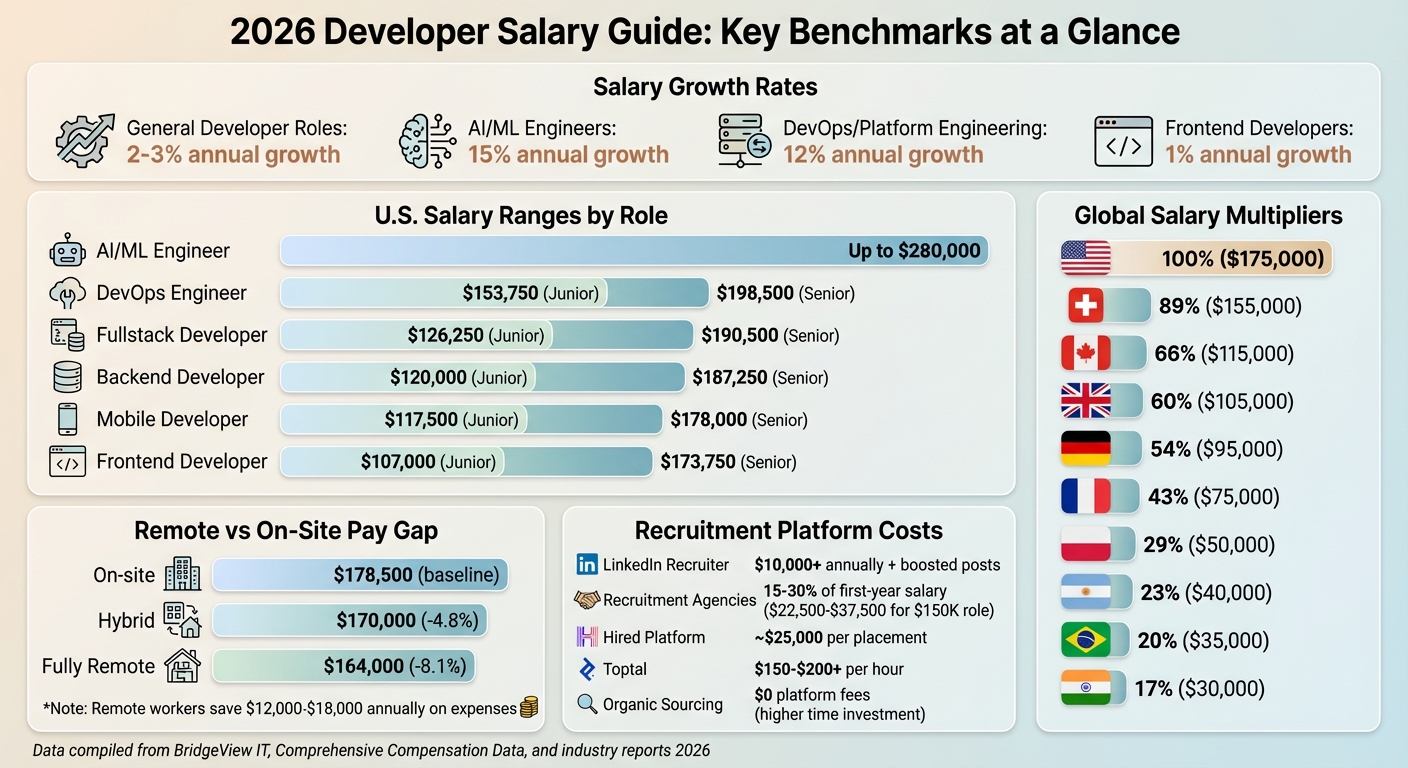 {2026 Developer Salary Benchmarks by Role and Global Location}
Developer Salary Trends from 2024 to 2026
Annual Salary Growth Rates
Developer salaries have entered a phase of steadier growth after the sharp increases seen in prior years. Between 2024 and 2026, global markets reported annual salary increases of 2–3%, a noticeable slowdown compared to the double-digit hikes of the past. This shift signals a more balanced post-pandemic job market.
Europe reflects this trend, with Euro-area hourly labor costs rising by 3.7% in Q4 2024 . For recruiters, this stabilization means salary expectations are now easier to predict, making budget planning much simpler than during the volatility of 2021–2023.
Standard developer roles, such as backend developers and full-stack developers, are seeing modest pay increases, with salaries growing at a steady 3% year-over-year by 2026 . This aligns with inflation-linked adjustments, marking a return to more predictable growth patterns.
However, specialized roles continue to command higher pay increases, standing out from this overall stabilization.
Higher Pay for AI/ML and DevOps Roles
Specialized roles like AI/ML engineering and DevOps are bucking the trend of modest growth, with premiums ranging from 20% to 40% above average developer salaries . AI/ML engineers, in particular, are experiencing 15% annual salary growth , far surpassing the increases seen in generalist positions.
In the U.S., AI/ML roles come with a 25% premium over standard developer jobs, while Security Engineering and Platform/Infrastructure positions offer premiums of 18% and 15%, respectively . These percentages translate into substantial earnings - AI/ML engineers in the U.S. can now earn up to $280,000 annually , highlighting strong demand and a limited talent pool.
DevOps and Platform Engineering roles are also seeing robust growth, with salaries increasing at a rate of 12% per year . This demand is driven by the need for seamless continuous integration and deployment processes. As Anshul V, Business Strategist, explains:
"Specialized roles like AI, Rust, and Cloud Architecture command a market premium due to the current talent scarcity" .
Market Stabilization After 2024
While specialized roles continue to see premium growth, the broader market has entered a more predictable phase. Following the aggressive hiring trends of 2024, companies are now prioritizing roles that deliver strategic value over simple cost-cutting. For example, front-end developer salaries are growing at just 1% per year, reflecting both a higher supply of talent and a shift toward full-stack and specialized skill sets .
This stabilization has also reshaped hiring strategies. Companies are focusing on "best value" rather than "lowest cost", often adopting hybrid models that pair high-cost local experts with nearshore or offshore teams for implementation .
The rise of AI tools like GitHub Copilot, which boosts developer productivity by 55% , is also influencing hiring practices. Employers are now placing greater emphasis on candidates who can effectively leverage these technologies. As the BridgeView Tech Salary Guide puts it:
"AI isn't replacing humans, but it's changing how we hire them. The real battle isn't man vs. machine, it's humans who know how to use AI vs. those who don't" .
Salary Data by Developer Role and Experience Level
Frontend, Backend, and Fullstack Developer Pay
By 2026, salaries for developers show a clear hierarchy, with fullstack developers earning the highest pay across all experience levels. Starting salaries for junior developers are $126,250 for fullstack, $120,000 for backend, and $107,000 for frontend roles. This trend continues at senior levels, where fullstack developers earn $190,500, compared to $187,250 for backend and $173,750 for frontend positions .
These salary differences reflect the growing demand for developers with versatile skills, especially those who can handle both frontend and backend work.
DevOps and Mobile Developer Pay
DevOps engineers remain among the top earners in the developer landscape, with starting salaries of $153,750 for junior roles and reaching $198,500 for senior positions . This high pay aligns with the demand for expertise in continuous integration and deployment practices.
Mobile developers earn salaries ranging from $117,500 for junior roles to $178,000 for senior positions, placing them above frontend but slightly below backend developers . Within the mobile space, native iOS and Swift developers typically command salaries between $150,000 and $200,000, while cross-platform developers working with tools like Flutter or React Native earn slightly less, with ranges of $140,000 to $185,000 .
Interestingly, junior DevOps engineers earn 44% more than their junior frontend counterparts, a premium that reflects the value of specialized skills. In fact, 87% of technology leaders report offering higher salaries to candidates with niche expertise .
For a detailed breakdown, the table below outlines base salaries across key roles and experience levels.
Complete Salary Tables by Role
Base salaries are just one part of the equation. Developers in the U.S. also benefit from an average of $18,090 in additional cash compensation, including bonuses and profit-sharing . Senior and staff-level engineers often receive stock options, which can boost total earnings by 20–30% above their base salary.
| Developer Role | Junior (0–3 yrs) | Mid-Level (4–9 yrs) | Senior (10+ yrs) |
|---|---|---|---|
| Frontend Developer | $107,000 | $144,750 | $173,750 |
| Backend Developer | $120,000 | $162,500 | $187,250 |
| Fullstack Developer | $126,250 | $165,000 | $190,500 |
| DevOps Engineer | $153,750 | $172,500 | $198,500 |
| Mobile Developer | $117,500 | $151,750 | $178,000 |
Source: BridgeView IT . Figures represent median base salaries in the U.S. market for 2026.
Advancing within a company often leads to the biggest pay increases. For example, staff-level engineers earn 78% more than their mid-level peers . This highlights the value of gaining experience and moving up the ranks, rather than switching companies for incremental pay raises. For employers, focusing on career development and retention can be more cost-effective than hiring externally at higher salaries.
These figures provide a foundation for understanding how location impacts developer salaries, which we'll explore next.
How Location Affects Developer Salaries
Regional Salary Multipliers: US, EU, LatAm, and Asia
Where a developer lives has a major impact on their earning potential. In the global market, the United States stands out as the leader in developer salaries, with senior developers earning an average of $175,000 annually . Other regions offer varying percentages of this amount, creating a clear hierarchy in compensation.
Switzerland comes closest to matching US salaries, offering 89% of the US average ($155,000). Canada follows at 66% ($115,000), and the United Kingdom offers 60% ($105,000) . In Western Europe, Germany and France pay 54% and 43% of US salaries, translating to $95,000 and $75,000, respectively .
In Latin America, salaries are considerably lower. Senior developers in Argentina earn just 23% of the US average ($40,000), while Brazil offers 20% ($35,000) . India, another key outsourcing hub, pays 17% of the US rate ($30,000), making it one of the most cost-effective regions for hiring . These regional disparities allow companies to save between 50-70% on labor costs by hiring in lower-cost areas without sacrificing talent quality .
| Region/Country | Multiplier (vs. US) | Avg. Senior Salary (USD) |
|---|---|---|
| United States | 100% | $175,000 |
| Switzerland | 89% | $155,000 |
| Canada | 66% | $115,000 |
| United Kingdom | 60% | $105,000 |
| Germany | 54% | $95,000 |
| France | 43% | $75,000 |
| Poland | 29% | $50,000 |
| Argentina | 23% | $40,000 |
| Brazil | 20% | $35,000 |
| India | 17% | $30,000 |
Source: Comprehensive Compensation Data
For US companies, nearshore markets like Latin America are particularly appealing. These regions offer lower costs while maintaining time-zone alignment, a significant advantage over offshore teams in Asia .
This data highlights a broader trend where global benchmarks and local economies shape salary strategies. These regional differences also contribute to the pay gap seen between remote and on-site positions.
Remote vs On-Site Pay Differences
Beyond location, the way developers work - on-site, hybrid, or fully remote - also plays a role in salary variations. On average, remote developers earn less in base pay compared to their on-site counterparts, though the difference depends on the role and company structure . For example:
- On-site: $178,500
- Hybrid: $170,000 (-4.8%)
- Fully Remote: $164,000 (-8.1%)
This "remote discount" is visible across most developer roles. For instance, software engineers earn $135,000 on-site compared to $125,000 remotely (a 7.4% gap), while DevOps engineers make $125,000 on-site versus $115,000 remotely (8.0% gap) . AI/ML engineers experience the largest difference, with on-site roles paying $155,000 versus $140,000 for remote positions (9.7% gap) .
However, remote workers often save between $12,000 to $18,000 annually on expenses like commuting, parking, professional attire, and meals, which can offset the lower salary . Interestingly, when comparing roles within the same company, location, and level, remote positions may even offer a slight 1.1% premium over on-site roles . The overall data showing lower remote pay often reflects geographic differences rather than intentional pay cuts.
Top companies like Netflix and Meta have embraced location-agnostic pay policies or apply minimal reductions (0-5%) for remote roles. This is especially true for in-demand specializations like AI/ML and Security Engineering, where competition for talent is fierce . By 2026, 42% of tech companies are expected to adopt hybrid models, which currently command higher pay than fully remote positions .
Platform Costs and Organic Sourcing Options
Recruitment in 2026 goes beyond offering competitive salaries. Understanding the costs associated with different recruitment channels is just as crucial for effective hiring strategies.
What Different Platforms Cost
Hiring developers today involves a range of platform expenses that can significantly impact your budget. For instance, a LinkedIn Recruiter subscription starts at over $10,000 annually, with additional costs for boosted job posts - ranging from $10 per day to $100 or even $1,000+ per post . Recruitment agencies typically charge 15%–30% of a candidate's first-year salary. For a senior hire earning $150,000, this translates to $22,500–$37,500 . Meanwhile, platforms like Hired charge roughly $25,000 per placement .
Premium services like Toptal add hourly markups, pushing rates to $150–$200 or more per hour . Freelance platforms, such as Fiverr, take a flat 20% commission on all transactions . On Upwork, bidding systems introduce additional costs. For example, "Connects" (used for proposals) cost $0.15 each, with client acquisitions costing between $6 and $24 in bidding currency .
"Hiring software developers in 2026 has become more than just a hiring challenge; it's a cost strategy." - Anshul V, Business Strategist
On the other hand, organic sourcing through developer communities like daily.dev offers a cost-free way to connect with engaged developers. There are no subscription fees or placement charges, although this method requires more effort in terms of internal engagement. Despite the extra workload, it avoids the upfront costs associated with paid platforms .
Calculating Cost Per Hire by Platform
To fully understand the financial implications, you can calculate the Cost Per Hire (CPH) using this formula:
CPH = (External Costs + Internal Costs) ÷ Total Hires .
External costs include platform fees, job ads, and agency charges. Internal costs cover recruiter salaries, interview time (an average of 15 hours per senior hire), and onboarding expenses, which are approximately $9,200 per hire .
For example, hiring a developer locally in the U.S. with a $110,000 salary can result in Year 1 costs totaling $197,200. This includes 30% for benefits and taxes, $15,000 in recruitment fees, $9,200 for onboarding, and $30,000 in lost productivity . In this case, the base salary accounts for just 65% of the total expense .
If you use LinkedIn Recruiter ($10,000 annually) and pay a $15,000 agency fee for one hire, your platform-related costs alone hit $25,000 - before factoring in internal recruiting hours. In contrast, daily.dev's organic approach eliminates these external fees entirely, though you might invest more in direct outreach and community engagement.
The choice between paid platforms and organic sourcing often comes down to your hiring volume. High-volume recruiters may find the costs of premium platforms justified, while smaller-scale hiring tends to see better returns through organic methods. By crunching the numbers, you can decide which approach delivers the best ROI for your recruitment needs.
How to Negotiate Developer Salaries in 2026
Negotiating developer salaries in 2026 requires a data-driven approach to justify compensation while addressing the key factors that influence pay. With mid-level software engineer salaries increasing only 1.6% in 2025, the market has stabilized, making it essential for recruiters to refine their strategies to attract talent without risking overpayment or losing candidates to competitors .
Using Role and Location Data in Negotiations
Every negotiation should begin with role-specific benchmarks. For example, specialized positions like AI/ML engineers command 12% to 25% higher salaries than general software engineers . Similarly, DevOps engineers typically earn between $150,000 and $210,000 . These benchmarks help justify offers that align with market trends.
Location remains a key variable in determining compensation. For remote candidates, it’s helpful to demonstrate how their salary compares to the local cost of living. For instance, hiring in regions like Eastern Europe and Southeast Asia can result in 50–70% savings compared to U.S. rates , making these areas attractive for budget-conscious teams.
"Hiring a developer is not a transaction; it is a strategic investment that determines your product's time-to-market, scalability, and long-term stability." - Coders.dev
Consider the Total Cost of Ownership (TCO) when calculating compensation. Benefits, taxes, and overhead can increase costs to 1.4× to 2.5× the base salary . This TCO analysis, combined with recruitment fees and internal costs, provides a clearer picture of the overall investment.
Negotiations often result in securing an additional $10,000 to $20,000 for candidates . Be prepared for counteroffers that are 10–20% higher than your initial offer. When base salary expectations are met, shift discussions to total compensation packages, such as signing bonuses, stock options, or performance incentives - valued by 67% of workers . Investing in senior talent can also yield better returns, as staff-level engineers earn 78% more than mid-level engineers, often delivering more impact than hiring multiple junior developers .
Applying Platform Data to Negotiations
Incorporate platform data into your strategy to optimize recruitment budgets. Using organic sourcing channels, like developer communities, can eliminate external fees, freeing up resources to offer more competitive compensation packages.
Speed is crucial when hiring top talent. Senior technical roles take an average of 68 days to fill, with AI/ML positions stretching to 89 days . Companies that streamline their hiring process - from 48 days to 17 days, for example - can secure top candidates before competitors even reach the final stages .
Highlight the cost of a bad hire to justify investing in quality. A failed senior developer hire can cost between $200,000 and $400,000 in recruiting, salary, and lost productivity , or roughly 1.5× to 2× their annual salary. If candidates push back on offers, use data to explain the importance of cultural fit, which accounts for 89% of hiring failures, rather than technical skills . Emphasize your company's stability and people-first approach as key advantages in a market increasingly influenced by AI.
Finally, address the trade-offs between remote and on-site work. While remote workers earn 8% less on average than their office-based counterparts - $164,000 compared to $178,500 in median total compensation - this gap often reflects geographic differences rather than company policy. At the same company and level, remote roles actually command a slight premium of 1.1% . If your budget allows, consider that 66% of tech professionals would be open to working on-site five days a week for higher pay .
What to Expect in 2026 and Key Takeaways
Compensation and Hiring Trends for 2026
The developer job market in 2026 is moving in two clear directions. Roles in specialized areas like AI/ML engineering (with a notable 15% year-over-year growth), platform engineering (12%), and cybersecurity (10%) are seeing strong demand and higher salaries. On the other hand, general software engineering roles are experiencing slower growth, with salaries increasing by just 1.6% . Similarly, demand for frontend-only roles is barely growing (1%), while manual QA positions are actually declining (-5%). This shift highlights the growing preference for full-stack developers and automation-focused roles .
AI is becoming a game-changer in how developers work. A striking 85% of developers now use AI tools regularly, leading to productivity gains of up to 55% . As a result, companies are prioritizing senior developers who can manage AI-augmented workflows effectively. Entry-level hiring has dropped by a staggering 73% over the past year due to the adoption of GenAI tools, while hiring for senior roles remains steady . The focus is clear: experienced developers who can harness AI tools are in high demand.
"AI isn't replacing humans, but it's changing how we hire them. The real battle isn't man vs. machine, it's humans who know how to use AI vs. those who don't." - BridgeView IT
Another key trend is geographic arbitrage, which continues to shape hiring strategies. With a global IT skills shortage expected to cost companies $5.5 trillion by 2026 , businesses are looking beyond traditional markets. Nearshore hiring in Latin America and offshore talent in Eastern Europe and Asia can deliver 50-70% cost savings while maintaining high quality . The hybrid hiring model, combining local expertise with cost-effective remote teams, is quickly becoming the standard .
These shifts emphasize the importance of data-driven strategies to navigate the evolving hiring landscape.
Action Items for Recruiters and Hiring Managers
Building on earlier negotiation strategies, these steps can further streamline your hiring process:
Understand the true cost of hiring. The actual cost of an in-house developer is 1.4× to 2.5× their base salary when you factor in benefits, taxes, equipment, and recruitment overhead . Plan for an additional 40% over base salaries to cover expenses like health insurance, 401(k) matching, and SaaS subscriptions, which are rising by 13% annually . This "total cost of ownership" approach helps you determine when to hire locally versus when to tap into remote talent.
Streamline your hiring process. Time is critical. With senior tech roles taking an average of 55-68 days to fill - and AI/ML positions requiring up to 89 days - delays can cost you top candidates. Speed up decision-making by simplifying your vetting process. Explore organic sourcing options, such as developer communities, to save on external fees and invest those savings into more competitive offers.
Focus on retention. Replacing a developer can cost 50-100% of their annual salary, so it pays to invest in keeping your team happy. Structured onboarding, ongoing professional development, and fostering a supportive work environment can extend the typical 2-3 year tenure. Since 89% of hiring failures are due to poor cultural fit , make sure your hiring process evaluates alignment with your company’s values and work style alongside technical skills.
FAQs
Should we pay remote developers based on their location or our HQ market?
When it comes to paying remote developers, adjusting salaries based on their location - using geographic pay adjustments or tiered salary bands - can help manage costs effectively. This strategy takes advantage of geographic arbitrage, allowing you to balance expenses while staying competitive in attracting talent from various regions. Plus, it helps maintain fairness by aligning compensation with local market standards.
How do I estimate total cost per developer hire beyond base salary?
To figure out the total cost of hiring a developer beyond their base salary, you need to account for additional expenses like benefits (which typically add about 30%), recruitment costs, onboarding expenses, and overhead. Together, these factors can raise the total cost by an extra 40–70% on top of the base salary. Taking all of these into account gives a clearer picture of the true cost of bringing a developer on board.
When is paying a platform fee worth it versus organic sourcing?
Paying a platform fee makes sense when it leads to clear advantages like better talent quality, quicker hiring, or access to niche candidates who are tough to find through other methods. If you're looking to save money, platforms that provide free organic reach - like content-focused platforms - can help cut costs. That said, fees are often worth it if they noticeably improve hiring results or help avoid hidden costs, such as delays in filling critical roles.
.png)