Hiring based on resumes alone can lead to mistakes. That’s why tech recruiters now use a 360-degree candidate profile to evaluate developers from three angles: past performance, current skills, and future potential. This approach reduces bias, improves decision-making, and helps identify candidates who can contribute immediately and grow over time.
Here’s how it works:
- Past Signals: Analyze work history, GitHub activity, and measurable achievements like promotions or technical milestones.
- Present Signals: Assess current skills through code repositories, live coding sessions, and behavioral interviews.
- Future Signals: Look for growth indicators like learning patterns, promotion history, and adaptability to predict long-term success.
Using tools like daily.dev Recruiter streamlines this process by combining real-time skill tracking with developer assessment tools, helping recruiters save time and hire better talent.
::: @figure 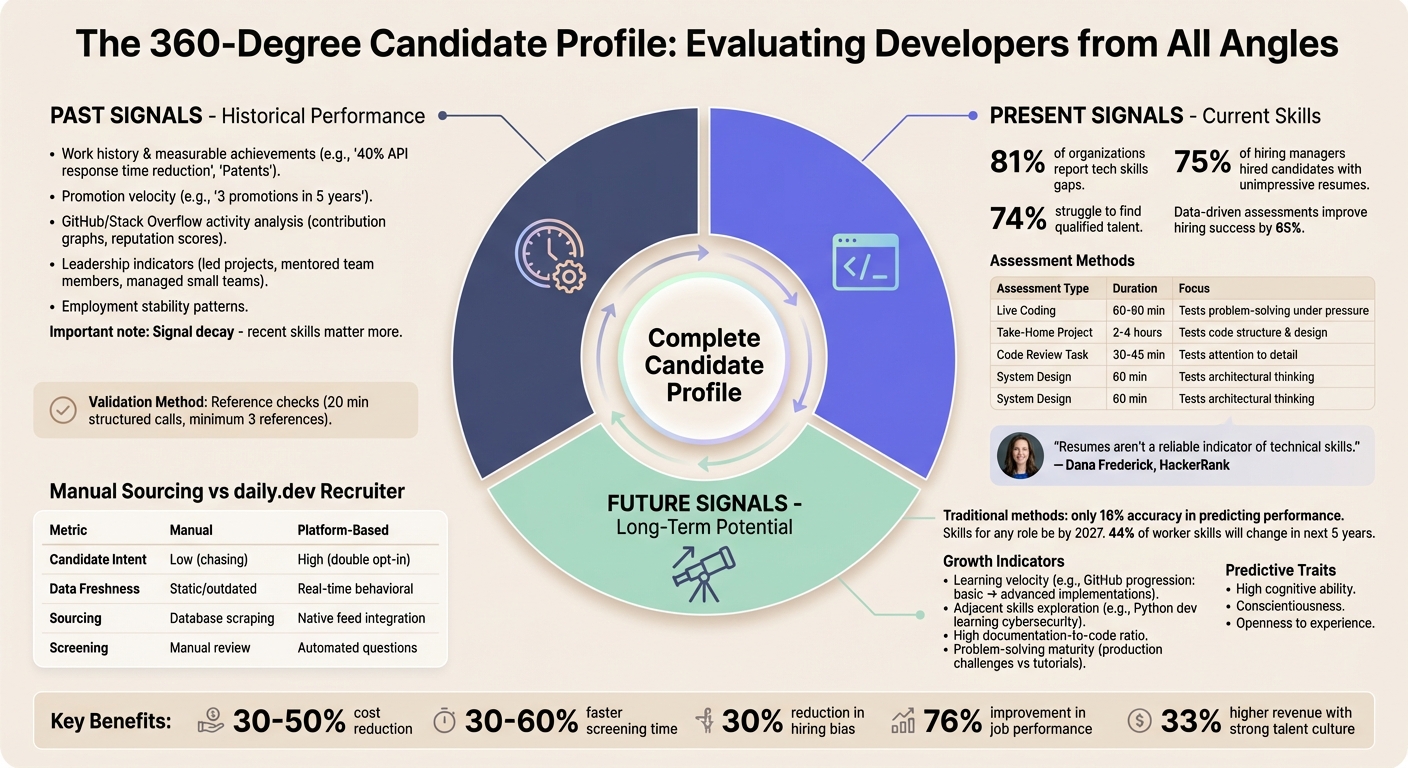 {The 360-Degree Candidate Profile Framework for Tech Recruiting}
Past Signals: Reviewing Historical Performance
Analyzing past signals is a cornerstone of building a well-rounded candidate profile. A developer's work history offers insights into their real-world capabilities, but it’s all about knowing how to dig deeper than the surface. The goal is to uncover patterns that highlight reliability, growth, and technical expertise.
What Resumes and Work History Reveal
Look for measurable accomplishments - things like patents filed, performance improvements (e.g., "cut API response time by 40%"), or academic honors . These details go beyond generic job descriptions and paint a clearer picture of a candidate’s contributions.
Frequent promotions are another strong indicator. For instance, a developer who’s climbed the ranks with three promotions in five years demonstrates consistent value and growth potential . Leadership qualities also stand out. Words like "led", "mentored", or "managed", paired with specifics like team size or budgets, highlight a candidate’s influence and seniority .
Employment duration is worth examining, too. A steady track record across roles often signals stability, while frequent moves could suggest either adaptability or a potential risk for turnover - it depends on the context . And while employment gaps might raise questions, they shouldn’t automatically disqualify a candidate .
For developers, platforms like GitHub or Stack Overflow can reveal work habits that resumes can’t. Take, for example, developer Carlos Becker. In August 2025, his env library earned 5,672 stars on GitHub, had no dependencies, and spanned 113 public repositories . This kind of work - focused on quality rather than sheer volume - demonstrates technical depth and maturity.
Also, keep in mind the concept of signal decay. Skills used daily two years ago are far more relevant than a certification earned a decade back . Always weigh skills with a time-sensitive lens to ensure you’re evaluating current proficiency.
Once these historical signals are identified, the next step is to validate them through references and employment checks.
Using References and Employment Verification
While historical performance offers valuable insights, it’s crucial to verify the details to ensure accuracy. Research shows that reference checks are better predictors of job performance than education or past job experience alone . That makes them a key step in confirming a candidate’s achievements.
Structured reference checks - lasting about 20 minutes - can uncover candid and detailed feedback . Aim to speak with at least three different references for a more complete evaluation .
Tailor your questions to the specific competencies needed for the role . Use these conversations to verify claims like patents, technical milestones, or sales growth mentioned on the resume. Also, confirm consistency in dates, job titles, and skills . This process helps spot any discrepancies early, reducing the chances of making a hiring misstep.
Present Signals: Measuring Current Skills and Abilities
Understanding a developer's current skills is critical to determining whether they can contribute effectively from day one. This aligns with the broader 360-degree candidate profile approach, which considers both past achievements and present capabilities. With 81% of organizations reporting tech skills gaps and 74% struggling to find qualified talent, accurate evaluation methods are essential .
Evaluating Technical Skills Through Portfolios and Code Repositories
A resume only tells part of the story. A developer's GitHub profile, for instance, can provide a clearer picture of their recent work. Focus on projects completed in the last 12–18 months to ensure their skills reflect current practices . Open-source contributions, Stack Overflow activity, and personal portfolios offer insight into coding style, documentation habits, and consistency. Interestingly, 75% of hiring managers have hired highly qualified candidates whose resumes were unimpressive .
When it comes to testing technical skills, practical tasks are far more effective than theoretical puzzles. Instead of asking candidates to reverse a linked list, consider assignments like debugging existing code, adding features to a codebase, or optimizing an algorithm. Studies show that data-driven skills assessments can improve hiring success rates by up to 65% and significantly cut screening time .
"Resumes aren't a reliable indicator of technical skills." – Dana Frederick, HackerRank
Keep take-home projects manageable - 2 to 4 hours max - to reduce candidate drop-off. Before implementing an assessment, test it with 20 current team members to ensure the difficulty is appropriate. Use a standardized rubric with criteria like correctness, readability, and testing, scored on a 1–5 scale [21, 23].
Live coding sessions and pair programming exercises (lasting 60–90 minutes) provide a real-time look at a candidate's problem-solving and communication skills. Similarly, simulated code reviews, where candidates assess a pull request, are excellent for evaluating technical and collaborative abilities .
| Assessment Method | Best For Evaluating | Recommended Duration |
|---|---|---|
| Live Coding | Problem-solving under pressure, communication | 60–90 Minutes |
| Take-Home Project | Code structure, testing, API design | 2–4 Hours |
| Code Review Task | Attention to detail, collaboration | 30–45 Minutes |
| System Design | Architectural thinking, scalability knowledge | 60 Minutes |
While these methods are great for measuring technical skills, assessing interpersonal abilities is just as important.
Behavioral Interviews and Team Fit Assessment
Technical skills alone don't guarantee success. How a developer collaborates under pressure or handles conflict is equally crucial. Structured behavioral interviews can reveal these qualities. Using the STAR method (Situation, Task, Action, Result) encourages candidates to share real-world examples of their problem-solving and teamwork experiences .
"A well-designed developer skills assessment is more than just a test; it's a preview of the collaborative and problem-solving environment a candidate can expect if they join your team." – Isabelle Fahey, Head of Growth, Cloud Devs
Standardized rubrics can make evaluations more consistent across interviewers. For example, grading systems that include clear examples of poor, mixed, good, and excellent responses save interviewers an average of 40 minutes per session and leave rejected candidates 35% more satisfied with the process [30, 31].
Instead of focusing solely on assessing cultural fit, aim to find candidates who bring new perspectives and strengths. Teams with diverse viewpoints tend to perform better - companies with strong talent-focused cultures report 33% higher revenue. On the flip side, employees who feel out of place are 24% more likely to leave within a year . Including current team members in the interview process can help gauge how well a candidate might integrate. And with 44% of worker skills expected to change over the next five years, adaptability is becoming just as critical as technical expertise [21, 28].
Future Signals: Estimating Long-Term Potential
To complete a comprehensive evaluation, future signals offer a way to gauge a candidate's potential to grow and thrive. While past and present signals focus on historical achievements and current skills, future signals help predict a developer's ability to evolve and excel in the long run. This forward-looking perspective is what separates good hires from exceptional ones. Traditional hiring methods, which often emphasize past experience, only achieve about 16% accuracy in predicting future job performance . Meanwhile, the tech world is evolving rapidly - since 2015, the skills required for a given role have shifted by around 25%, and this rate is expected to double by 2027 . As a result, many modern recruiters are shifting their focus from credentials to potential.
Spotting Growth Indicators and Learning Ability
The strongest indicator of future success isn’t just what a developer knows today - it’s how quickly they can learn what they’ll need tomorrow. For instance, earning three promotions in five years is a clear sign of rapid growth . Similarly, examining a developer’s GitHub activity can reveal how their work has evolved. Have they progressed from basic Java projects to advanced implementations like distributed systems or AI? Such growth reflects a strong learning ability .
It’s also helpful to look at related skills that hint at adaptability. For example, a Python developer exploring cybersecurity or a Java developer experimenting with Rust shows they’re ready to "refactor" their expertise as new challenges arise . Another useful signal is a high documentation-to-code ratio, which suggests a focus on long-term maintainability .
"The starting point is to shift from looking at credentials - what someone has done in the past - to their skills and capabilities - what they're capable of achieving in the future." – Eightfold AI
Problem-solving is another valuable indicator of potential. Developers who tackle real-world production challenges - like creating tools to monitor SSL expirations or automating deployment workflows - often demonstrate higher engineering maturity than those who stick to completing tutorials . A great example is Diego Pacheco, a developer who, in 2023, transformed his GitHub portfolio from basic Java projects to advanced AI/ML work using production-ready tools like Docker and Kubernetes .
These growth indicators lay the foundation for using data to predict future performance.
Forecasting Future Performance Using Data
Once you’ve identified growth signals, predictive analytics can quantify a candidate’s trajectory. This approach combines explicit signals (like listed skills such as Python or AWS) with implicit ones (such as promotion history and recent GitHub contributions) to forecast future performance . It’s also important to account for signal decay - recent skills and achievements carry more weight than outdated certifications .
Advanced tools now offer "skills intelligence", which benchmarks a candidate’s abilities against industry standards or team averages to predict their readiness for future roles . But technical skills alone don’t paint the full picture. Research highlights three key traits as strong predictors of long-term success: high cognitive ability (quick learning), conscientiousness (persistence in uncertain situations), and openness to experience (willingness to adapt and try new approaches) .
| Signal Type | Example | What It Predicts |
|---|---|---|
| Explicit | Certifications (AWS, PMP) | Baseline competency and formal training |
| Implicit | Promotion Velocity | High performance and professional growth |
| Implicit | GitHub Learning Path | Adaptability and continuous learning |
| Behavioral | Documentation Quality | Long-term thinking and maintainability |
To ensure your predictive model is effective, track metrics like "Precision@K" - the percentage of top-ranked candidates who make it to the offer stage - and "Time to Productivity" after hiring . Define clear goals for what an exceptional hire should accomplish within 6–12 months, and use those benchmarks to refine which future signals deserve the most weight in your evaluation .
Hiring engineers?
Connect with developers where they actually hang out. No cold outreach, just real conversations.
Building 360-Degree Profiles with daily.dev Recruiter
Once you grasp the importance of past, present, and future signals, the next step is figuring out how to bring all that data together efficiently. Traditional recruiting methods often involve piecing together fragmented information - resumes, LinkedIn profiles, GitHub repositories, and reference calls. This process can leave you with incomplete or outdated profiles. That’s where an integrated approach, like the one daily.dev Recruiter offers, comes into play.
How daily.dev Recruiter Supports 360-Degree Profiling
The platform goes beyond what traditional methods capture. Instead of relying on static resumes, it taps into dynamic talent pools, tracking what developers are actively learning and discussing. This provides real-time insights into their skills and potential growth paths.
With a double opt-in system, you connect with developers who have already reviewed a role brief tailored to technical challenges and growth opportunities. This ensures candidates are genuinely interested right from the start.
You can also use up to three custom screening questions and integrate directly with ATS platforms like Greenhouse and Lever. This setup automatically deduplicates candidates, keeping your data organized and consistent. Plus, job opportunities appear directly in the daily.dev feed - where developers are already spending time reading and learning. Reaching them in this context fosters trust and credibility, replacing social media cold outreach with meaningful, warm connections.
Manual Sourcing vs. Platform-Based Profiling
The benefits of daily.dev Recruiter become even more apparent when compared to traditional sourcing methods:
| Metric | Manual Sourcing (Cold Outreach) | daily.dev Recruiter (Platform-Based) |
|---|---|---|
| Candidate Intent | Low (Recruiter "chases" candidate) | High (Double opt-in/Mutual interest) |
| Data Freshness | Static/Outdated Resumes | Real-time behavioral & interest data |
| Sourcing Method | Database Scraping/InMails | Native integration in developer feed |
| Initial Screening | Manual Resume Review | Automated custom screening questions |
With manual sourcing, you're stuck relying on outdated resumes and hoping candidates respond to cold messages. On the other hand, platform-based profiling connects you with developers who are actively engaged and showcasing their current skills and interests. Automated screening and ATS integration reduce manual errors when you handle high-volume technical applicants effectively, letting you focus on the insights that truly matter for predicting success.
How to Build and Use a 360-Degree Profile
Step-by-Step Process for Building a 360-Degree Profile
Start by defining what success looks like before you even begin sourcing candidates. Think about what an exceptional hire should accomplish in their first 90 days on the job. From there, work backward to pinpoint the traits and qualities that your top performers share. This process helps you create an Ideal Candidate Profile (ICP) - essentially a roadmap to guide your hiring decisions.
Break the success profile into measurable signals across three main areas. First, focus on technical skills, like coding expertise and familiarity with specific frameworks. Next, evaluate soft skills, such as communication, teamwork, and conflict management. Finally, consider adjacent skills, which are transferable abilities - for instance, a Python developer who has started exploring cybersecurity.
Gather data from multiple sources. Look at portfolios and code repositories on platforms like GitHub or GitLab. Don’t just skim for commit volume; dive deeper into the quality of documentation and the thought process behind architectural decisions. For example, clear README files and a progression from basic to complex implementations can reveal a developer’s learning curve and their focus on maintainable systems . Add structured reference checks and use technical assessment tools like HackerRank or Codility to round out your evaluation.
Standardize your evaluations with a weighted scoring model to reduce bias. For instance, you might allocate 40% of the score to skills match, 30% to experience, 20% to assessment performance, and 10% to education. Research shows that structured, skills-based assessments can reduce hiring bias by 30% and improve job performance by 76% . To fine-tune your model, have 20 of your recent top performers take the same technical test to ensure it’s appropriately challenging.
Keep refining the process. Track how your highest-scored candidates perform after 90 days in their roles. If they don’t meet expectations, adjust your scoring model. Use metrics like "Precision@K" to measure how many of your top 10 candidates go on to secure interviews or job offers . This feedback loop ensures your 360-degree profiles stay relevant as market demands and job requirements shift.
Once your profile is ready, focus on detailed assessment strategies to capture the full potential of each candidate.
Assessment Strategies for Developer Candidates
With a well-rounded candidate profile in hand, the next step is to implement targeted assessments that validate the signals you’ve identified.
When reviewing developer portfolios, prioritize quality over quantity. A candidate with three polished, production-ready projects is often more impressive than someone with dozens of half-finished experiments. Look for details like terminal output screenshots, architecture diagrams, or design documents that shed light on back-end work. Watch for warning signs like a lack of project diversity, numerous abandoned repositories, or no recent activity - these might indicate outdated skills or poor follow-through.
Pay attention to technology learning patterns to gauge growth potential. Does the candidate’s GitHub history show a progression, such as moving from Java basics to integrating AI/ML solutions? Are they solving increasingly complex problems over time? This kind of trajectory says more about a developer’s potential than a static list of skills. Also, consider the documentation-to-code ratio - developers who document thoroughly tend to prioritize maintainability and collaboration .
Use multi-modal assessments to simulate real-world challenges instead of relying on abstract coding puzzles. For example, test debugging skills on large codebases, evaluate systems design for scaling user bases, or assess test-driven development practices. Pair these technical tests with Situational Judgment Tests (SJTs) to evaluate decision-making in realistic scenarios. For instance, how would they handle a difficult teammate or resolve a production outage? These tests reveal qualities that a resume alone can’t capture .
During behavioral interviews, stick to the STAR method to dig into past experiences. Ask candidates to describe the Situation, Task, Action, and Result of specific challenges they’ve faced. This approach provides concrete evidence of skills like conflict resolution and adaptability, rather than relying on hypothetical answers. Standardizing your interview questions across all candidates ensures a fair comparison and reduces unconscious bias.
It’s worth noting that 75% of hiring managers have successfully hired highly qualified candidates who didn’t have standout resumes . Your assessment strategy should go beyond technical tests to evaluate learning potential, collaboration, and problem-solving skills. The goal is to identify developers who will excel in the long run - not just those who can ace a coding challenge.
Conclusion
Relying solely on resumes to hire developers is like judging a book by its cover - you miss the essence of what truly matters. A more comprehensive approach, a 360-degree candidate profile, brings together their work history, current technical abilities, and potential for growth. This method offers a more accurate, evidence-based evaluation, moving beyond decisions based on instinct or incomplete information.
The advantages of this approach are clear. Streamlining your recruiting technology stack can slash costs by 30–50% . Additionally, using refined candidate scoring models cuts screening time by 30–60% per hire . Moreover, 81% of business leaders agree that skills-based hiring directly enhances growth potential .
daily.dev Recruiter takes this concept a step further by connecting you with developers based on their real-time activity and professional interests, rather than outdated resumes. Its double opt-in system ensures that every introduction is mutual and meaningful, eliminating the frustrations of cold outreach. Instead of reviewing static profiles, you’ll connect with developers who are actively learning, improving, and open to new opportunities.
This shift from traditional hiring methods to a 360-degree approach isn’t just about efficiency - it’s about hiring better. By evaluating candidates holistically, you can reduce bias, improve team compatibility, and build stronger, results-driven teams. Considering that 74% of companies struggle to find qualified talent using traditional methods , adopting this strategy is crucial for staying ahead. It’s a change that not only streamlines processes but also elevates the quality of your hires.
Start building 360-degree profiles today to save time and connect with developers ready to make an impact.
FAQs
What is a 360-degree candidate profile, and how does it enhance hiring decisions?
A 360-degree candidate profile offers a well-rounded perspective of a candidate by integrating details about their past experiences, current abilities, and potential for growth. This method allows recruiters to analyze resumes, portfolios, and professional networks to uncover key indicators of long-term success.
By bringing together all relevant information into a single profile, recruiters can assess not only concrete qualifications like skills and certifications but also harder-to-measure qualities such as leadership ability and behavioral patterns. This thorough, data-focused approach helps minimize guesswork, ensures better candidate alignment, and enables smarter hiring decisions.
What are the best tools to create a comprehensive 360-degree candidate profile?
Building a full-picture candidate profile becomes much simpler with tools designed to gather and analyze data seamlessly. Platforms that integrate applicant tracking systems (ATS), customer relationship management (CRM), sourcing capabilities, and analytics are especially helpful. They centralize all candidate interactions and touchpoints, eliminating the hassle of jumping between different systems and giving recruiters a clear, consolidated view of each individual.
AI-powered recruiting tools take this process a step further by automating tasks like sourcing, screening, and evaluating candidates. These tools not only save time but also boost accuracy. Advanced assessment features can dig deeper, analyzing resumes, technical skills, soft skills, and even how well a candidate might align with a company’s values. By combining these technologies, recruiters are equipped to make hiring decisions with greater confidence and insight.
How can recruiters use future signals to predict a candidate's potential for long-term success?
Future signals offer a way to gauge a candidate's potential by examining their past actions, current abilities, and career trajectory. These insights go beyond assessing what someone can do right now - they provide a glimpse into how they might evolve and contribute to an organization in the future. Factors like how quickly someone earns promotions, the pace of their skill development, and their ability to adapt to change play a big role in this evaluation.
Recruiters use structured scoring models to interpret these signals, turning raw data - such as work history, skill growth, and behavioral patterns - into meaningful insights. This approach helps reduce guesswork, enabling hiring decisions that are more aligned with a company’s long-term goals.
.png)