Startups often struggle with hiring technical talent due to limited time and resources. Choosing the best recruiting software for tech companies can save costs and streamline processes. Here are eight tools tailored for startups hiring 10 to 50 employees, focusing on affordability and efficiency:
- daily.dev Recruiter: Connects with active developers through warm introductions. Pricing is straightforward, with no hidden fees.
- Ashby: Combines ATS, CRM, and analytics. Starts at $400/month, ideal for Series A startups.
- Lever: ATS with CRM features for proactive sourcing. Costs around $4,000–$5,000/year.
- Greenhouse: Offers structured hiring for growing teams. Pricing starts at $6,000/year.
- Workable: AI-powered sourcing and simple setup. Plans start at $149/month.
- Manatal: Budget-friendly ATS starting at $15/user/month, with AI-driven features.
- Skima.AI: Automates resume screening and candidate matching.
- JuggleHire: Affordable and simple ATS starting at $19/month.
Quick Comparison
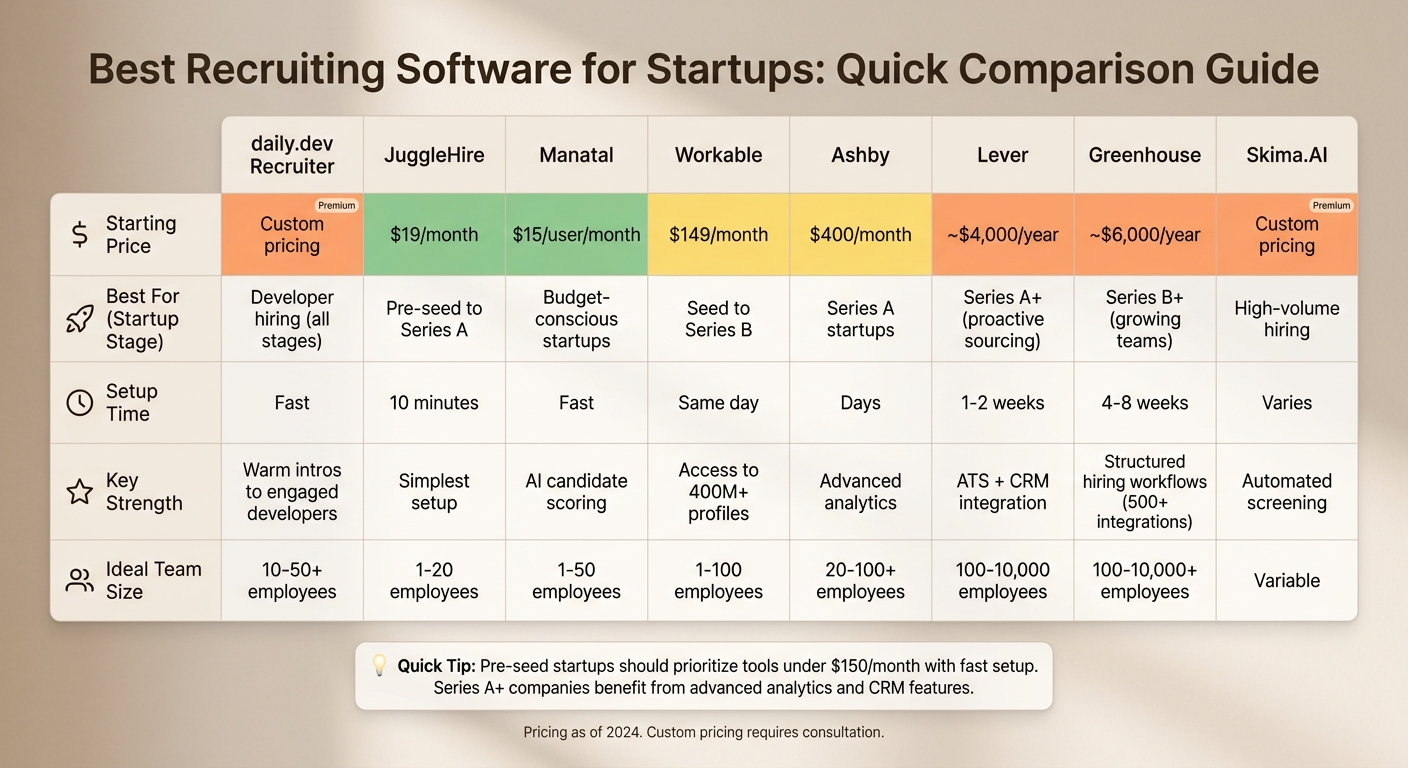
| Tool | Starting Price | Best For | Setup Time | Key Strength |
|---|---|---|---|---|
| daily.dev Recruiter | Custom | Developer hiring | Fast | Warm intros to engaged developers |
| Ashby | $400/month | Series A startups | Days | Advanced analytics |
| Lever | ~$4,000/year | Proactive sourcing | Weeks | ATS + CRM integration |
| Greenhouse | ~$6,000/year | Growing teams | Weeks | Structured hiring workflows |
| Workable | $149/month | AI-powered sourcing | Same day | Access to 400M+ profiles |
| Manatal | $15/user/month | Budget-conscious startups | Fast | AI candidate scoring |
| Skima.AI | Custom | High-volume hiring | Varies | Automated screening |
| JuggleHire | $19/month | Pre-seed startups | 10 minutes | Simplest setup |
Each tool offers unique advantages depending on your startup's stage and hiring needs. Whether you're looking for simplicity, AI-driven features, or structured hiring processes, there's a solution that fits your budget and goals.
1. daily.dev Recruiter
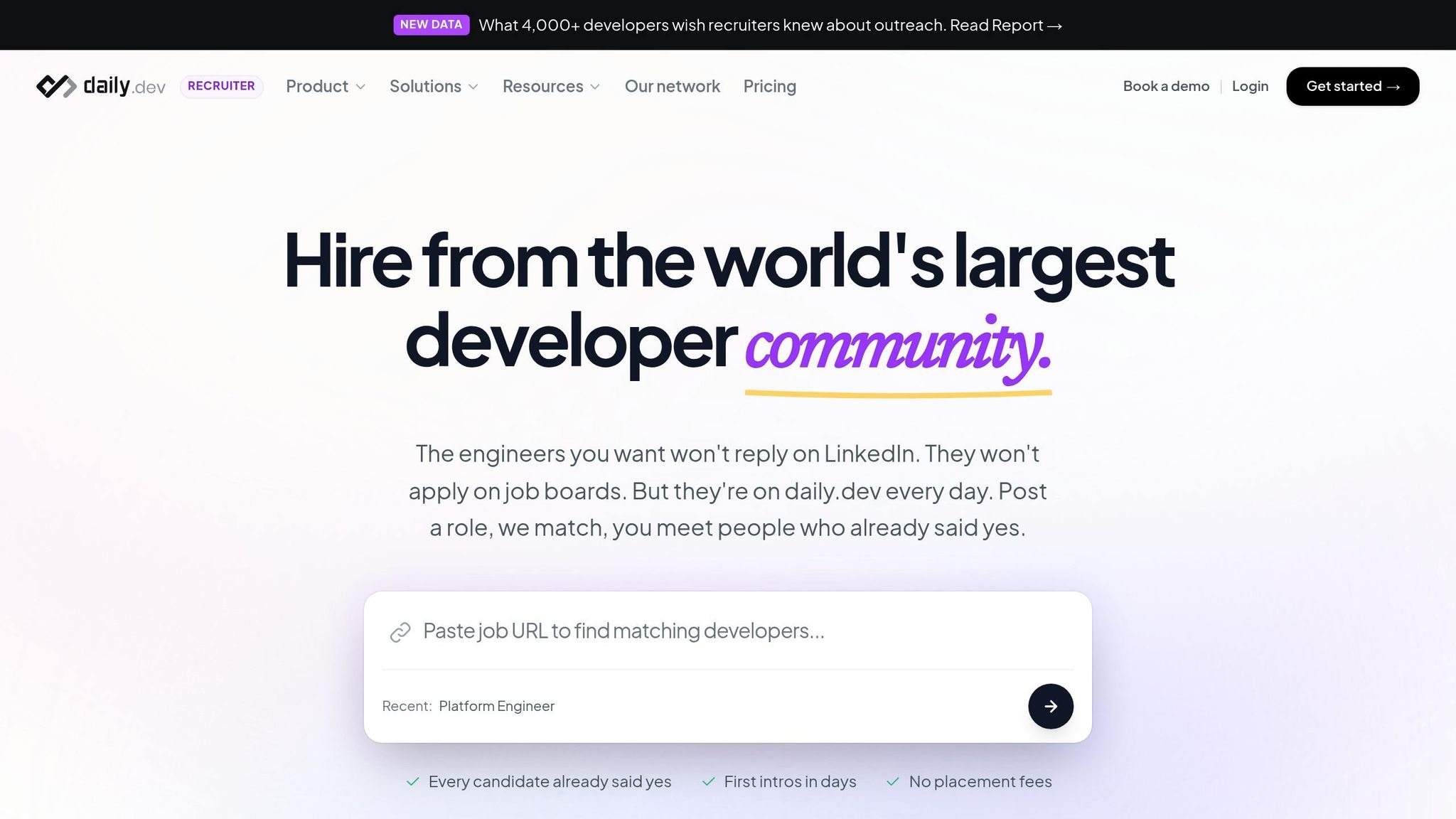
daily.dev Recruiter offers a fresh way to connect with developers. Instead of relying on outdated scraping techniques, it links you directly with active developers who are already engaged on daily.dev - a platform where over 1 million software engineers explore tech content, exchange ideas, and stay updated on industry trends.
The platform uses warm, double opt-in introductions. You post your job, and only developers who express interest while browsing relevant content will engage with you. This developer-focused approach is paired with pricing that's friendly to startup budgets.
Pricing
daily.dev Recruiter employs a straightforward pricing model tailored for startups. There are no percentage-based fees or long-term contracts, making it easier to predict recruitment costs as you grow from 10 to 50 employees - no surprise bills to worry about.
Key Features
- Pre-screened candidates: Developers are matched to your criteria before introductions, saving you time on unsuitable profiles.
- Global talent pool: Access a wide range of pre-qualified developers worldwide.
- ATS integration: Works seamlessly with your existing applicant tracking systems.
The platform designs job briefs to resonate with developers, focusing on how they evaluate opportunities. Because of this, you'll notice higher response rates from passive talent - the kind who might ignore a cold LinkedIn message. By connecting with engineers in their preferred environment, daily.dev Recruiter helps startups fill roles faster without unnecessary costs or complications.
2. Ashby
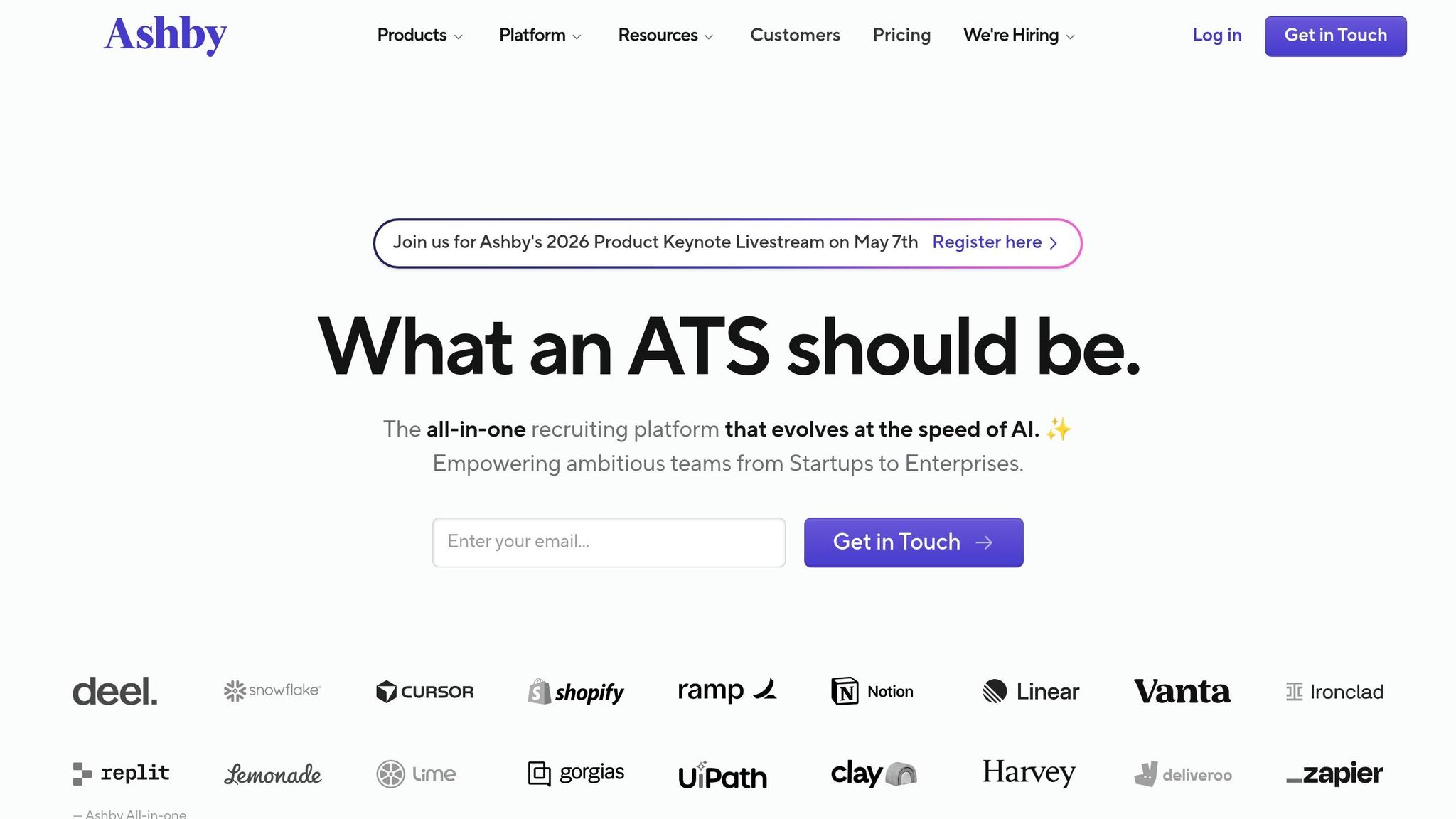
Ashby combines ATS, CRM, scheduling, and analytics into one platform. For startups prioritizing speed, cost-effectiveness, and straightforward functionality, Ashby delivers advanced automation and data-driven insights. It's particularly favored by startups that have raised a Series A or are nearing that milestone. While its pricing is on the higher side, its features and automation capabilities justify the expense.
Pricing
The Foundations Plan starts at $400 per month for companies with up to 100 employees. Opting for an annual contract comes with a 10% discount, and Ashby also provides special pricing for startups. While this cost may seem higher compared to more basic options, one customer shared that switching to Ashby led to a 64% cost saving over five years compared to their previous ATS . These savings highlight Ashby's ability to streamline and optimize hiring processes.
Key Features
Ashby stands out for its focus on analytics and automation. The platform claims to reduce interview scheduling time by 50%, while on-site scheduling becomes 5x more efficient . Features like AI-assisted application reviews, automated candidate sourcing sequences, and real-time Slack notifications help teams stay organized and responsive. Additionally, its two-way sync with Gmail and Google Calendar ensures that every candidate interaction is logged automatically - no more missed emails or forgotten follow-ups.
The sourcing tools and AI-driven outreach also deliver tangible results, with a 46% increase in candidate reply rates .
Scalability
For smaller teams, Ashby's comprehensive features might be more than necessary. Research shows that 20-person startups typically use only 40% of the platform's capabilities, making it a less practical choice for pre-seed teams . At $400 per month, it may feel like a steep investment if you're only hiring a few people each quarter. However, for startups with a dedicated recruiting lead and plans for rapid growth, Ashby scales smoothly to support teams of 1,000+ employees.
3. Lever
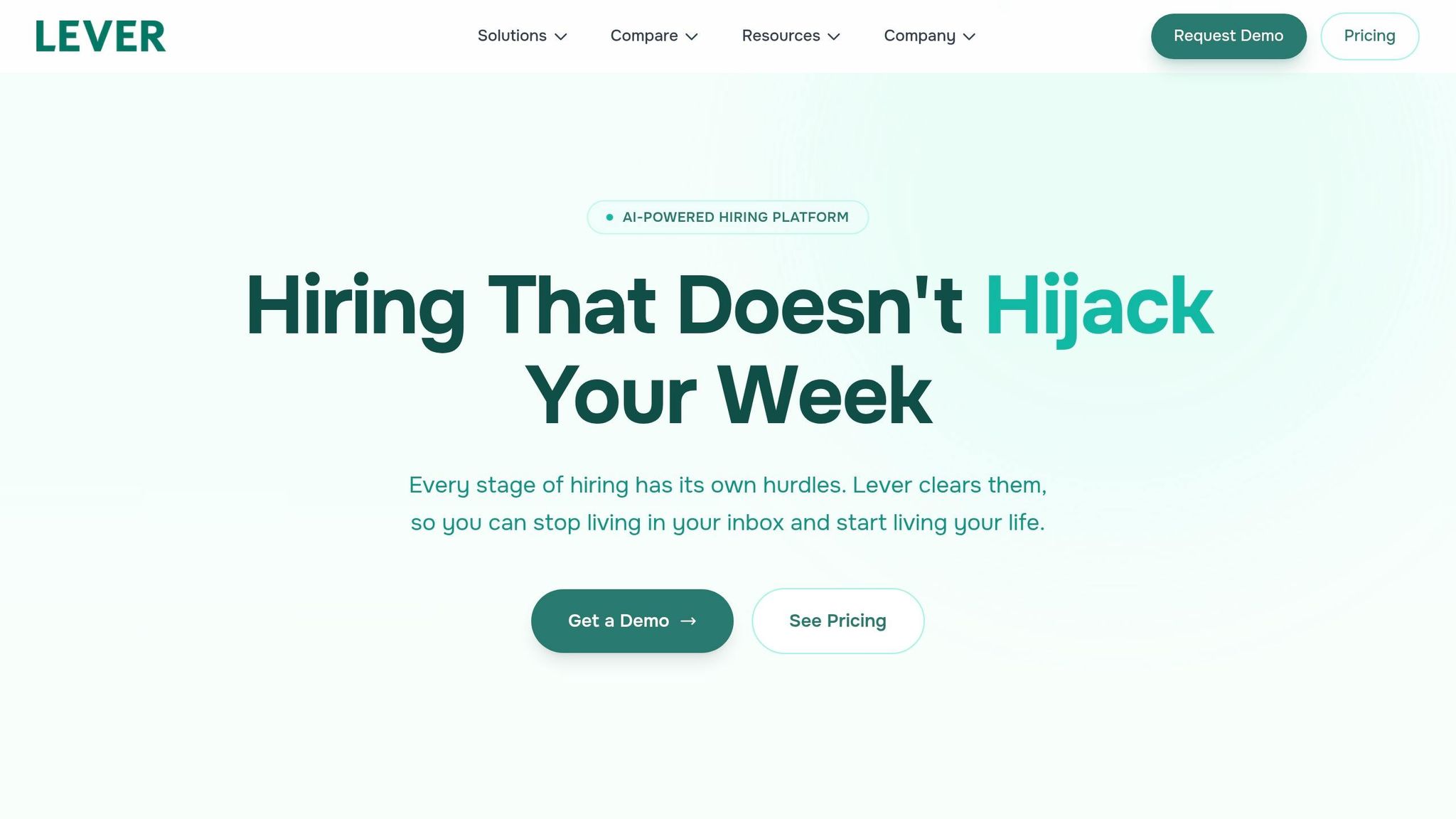
Lever combines an applicant tracking system (ATS) with a customer relationship management (CRM) tool, making it a strong choice for startups that prioritize proactive talent sourcing over waiting for inbound applications. It’s particularly suited for Series A+ startups looking to establish long-term talent pipelines.
Pricing
Lever’s pricing falls between $4,000 and $5,000 annually for startups (roughly $600 per month) . However, pricing is custom-quoted and requires an annual contract. While this commitment might be a hurdle for pre-seed teams operating on tight budgets, it can be a worthwhile investment for Series A startups with ambitious hiring plans.
Key Features
Lever’s standout features include a visual Kanban pipeline with a drag-and-drop interface, simplifying candidate tracking. It also offers an AI Companion that streamlines resume screening and interview scheduling. Elena Cacean, People and Operations Manager at Index.dev, praised Lever, stating:
"It really improved how our sourcing team nurtured passive applicants with its user-friendly interface and integrated CRM functionality" .
Another highlight is Lever’s automated nurture campaigns, designed to keep passive candidates engaged over time - perfect for maintaining relationships with high-caliber talent. Additionally, the platform’s Visual Insights dashboards provide valuable data on diversity metrics and pipeline health, offering actionable insights to support growth.
Scalability
Lever is designed to scale with businesses, accommodating teams from 100 to over 10,000 employees . That said, if your hiring needs are modest (fewer than 20 hires per year), its extensive features might feel excessive . Implementation is relatively quick, typically taking 1–2 days, though more complex setups may require additional time .
Candidate Experience
Lever optimizes the candidate experience with its "Easy Apply" feature, which minimizes application barriers and streamlines the process. Automated communication sequences also help reinforce your employer brand, even when juggling multiple open roles . In competitive hiring landscapes, this polished experience can make a lasting impression and bolster your company’s reputation.
4. Greenhouse
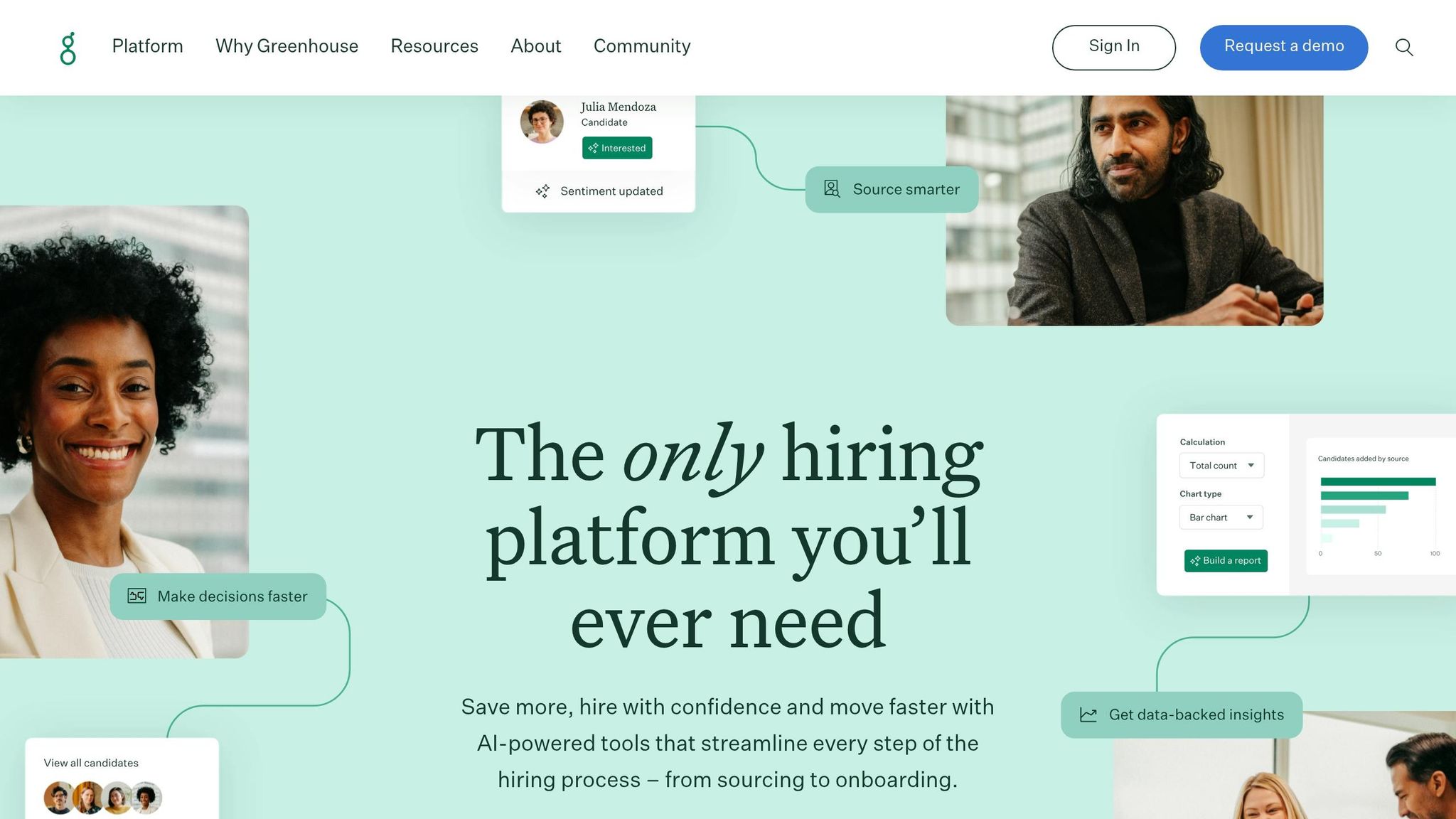
Greenhouse is a popular choice for startups experiencing rapid growth, often adopted after a Series B funding round or when the team surpasses 100 employees . While it leans toward the pricier side compared to budget-friendly options, its structured hiring frameworks help minimize bias and reduce costly hiring errors .
Pricing
For startups with 20–50 employees, the Core tier generally costs between $6,000 and $15,000 annually, with entry-level plans averaging around $500 per month. Pricing is tailored to your hiring volume and the complexity of your needs . Contracts are typically annual . For larger enterprises, costs can climb past $100,000 per year .
Despite the higher price point, Greenhouse offers a wide range of features that simplify hiring and improve candidate assessment.
Key Features
Greenhouse emphasizes structured interviews by providing tools like interview kits, scorecards, and rubrics. These ensure candidates are measured against consistent criteria, reducing bias and improving the quality of hires as your team grows . Its integration marketplace includes over 500 partners, seamlessly connecting with tools like Slack, Zoom, and LinkedIn . Leveraging AI, Greenhouse assists with talent matching, drafting job descriptions, and automating candidate report filtering . It also includes DE&I tools, such as candidate name pronunciation, personal pronouns, and diversity metrics, which become increasingly valuable as your hiring efforts expand .
Scalability
Greenhouse is designed to grow with your company, accommodating teams ranging from 20 to over 10,000 employees . The implementation process typically takes 4 to 8 weeks, allowing time to fine-tune workflows . For startups hiring fewer than 30 people annually, the setup might feel overly complex . However, for companies anticipating rapid expansion, Greenhouse provides a framework that can scale alongside your growth .
Candidate Experience
Greenhouse also focuses on creating a seamless candidate experience. Features like self-scheduling, automated reminders, and branded career pages ensure a smooth process for applicants . To promote fair evaluations, it offers tools like resume anonymization and anonymous take-home tests . These features contribute to an objective and consistent hiring process, benefiting both candidates and employers.
5. Workable
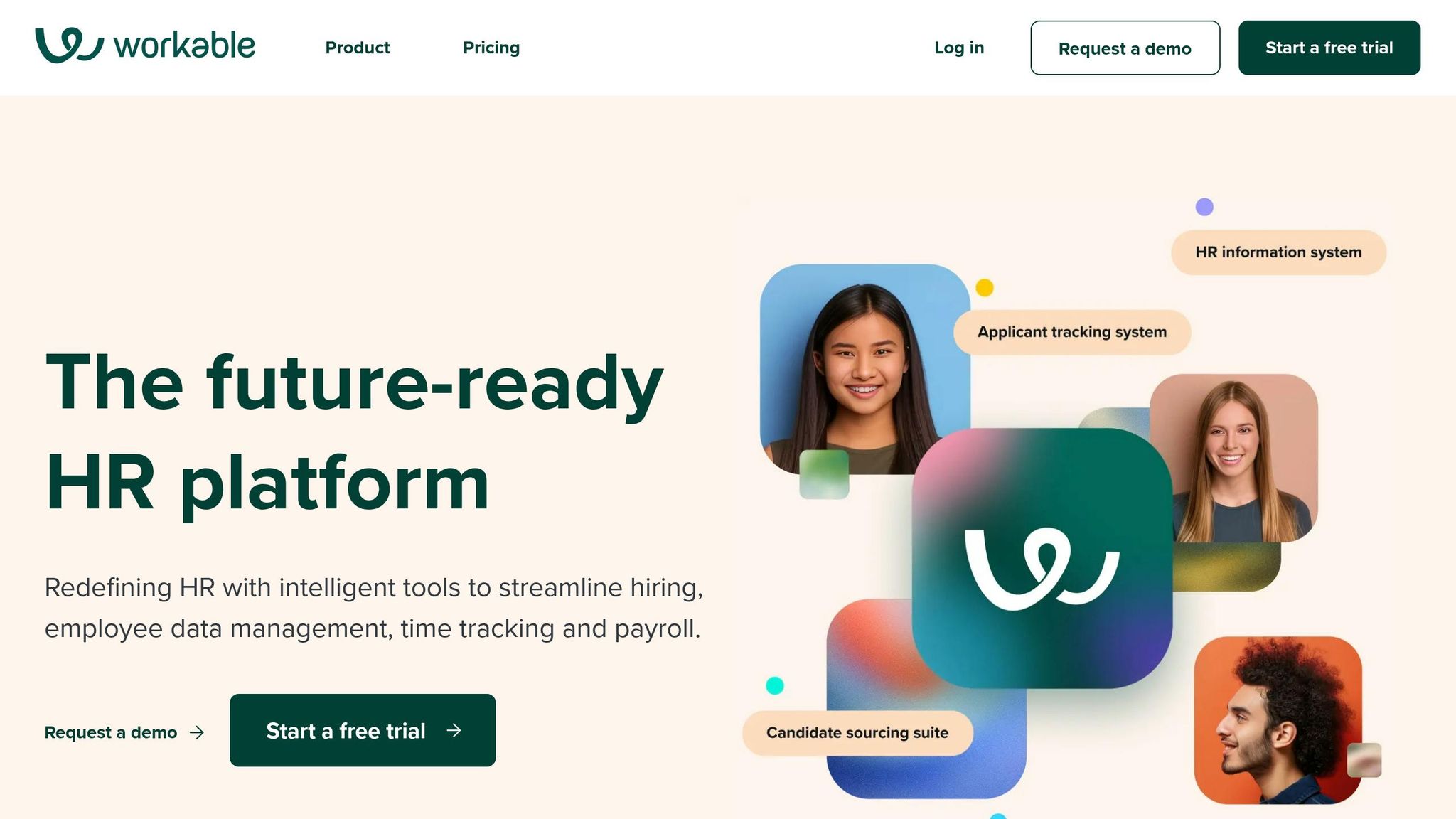
Workable provides a solid hiring solution that balances functionality with simplicity, making it a great choice for startups looking to hire efficiently without getting bogged down by unnecessary complexities . It’s designed with budget-conscious startups in mind, offering tools to streamline the hiring process.
Pricing
Workable’s pricing structure caters to varying needs:
- Starter Plan: $149/month with 2 active job slots.
- Standard Plan: $299/month for teams of 1–20 employees, including unlimited active jobs and AI sourcing. Add-ons like texting ($89/month), video interviews ($109/month), and assessments ($59/month) are available separately.
- Premier Plan: $599/month, bundling the add-ons for convenience.
- Enterprise Plan: $719/month, which includes single sign-on and priority support.
Workable also offers a 15-day free trial - no credit card required. Plus, bundling recruiting and HR tools can save up to 20% .
Key Features
Workable’s standout features make it a favorite for startups:
- AI-Powered Sourcing: Scans over 400 million profiles and posts to 200+ job boards, including LinkedIn and Indeed, with just one click.
- Self-Serve Setup: Allows teams to start posting jobs the same day - perfect for non-technical founders.
- Mobile App: Lets users review candidates and communicate on the go.
- HR Integration: Includes tools for onboarding and tracking time-off, simplifying your workflow (you can also use a technical onboarding checklist to further streamline the process) .
Scalability
Workable adapts seamlessly as your startup grows, whether you’re making your first hire or scaling up to Series B. Pricing tiers are based on employee count (e.g., 1–20, 21–50, 51–100), and the platform expands its features as hiring demands increase. Its self-serve setup ensures you can get started quickly, without requiring technical expertise .
Candidate Experience
Workable prioritizes a smooth experience for candidates:
- Mobile-friendly application forms and auto-fill resume options.
- Integrated "Easy Apply" features.
- Self-scheduling tools to simplify interview coordination.
- Automated confirmation emails to keep candidates informed.
For international hiring, the platform supports five native languages. It also offers anonymized screening options to help reduce bias during the initial review process, aligning with modern hiring practices .
6. Manatal
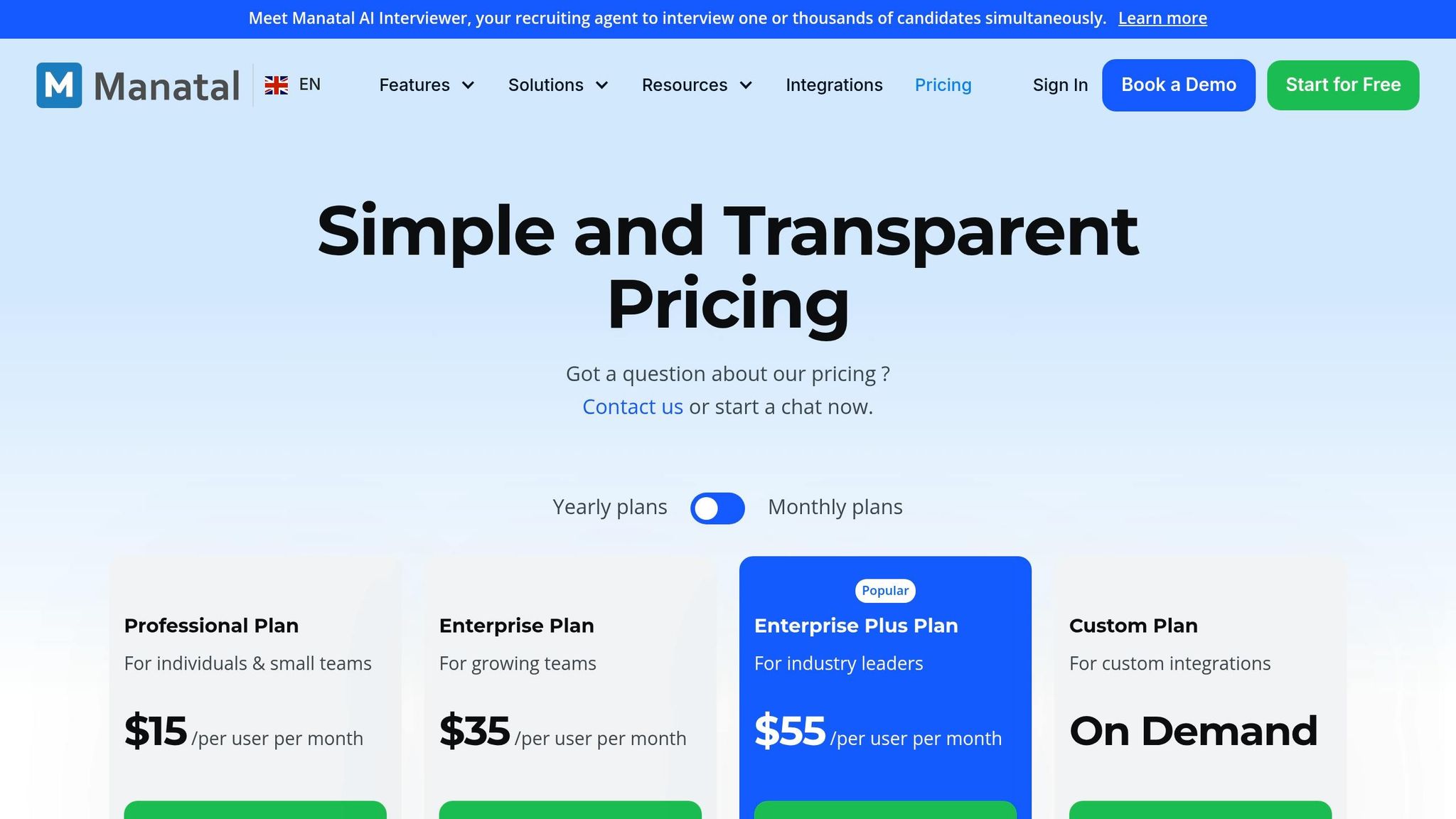
Manatal stands out as a budget-friendly recruitment platform tailored for startups, with pricing starting at just $15 per user per month when billed annually . Trusted by businesses worldwide, it has already facilitated over 900,000 recruitment processes across 135+ countries .
Pricing
Manatal keeps things simple with three pricing options:
| Plan | Annual Billing | Monthly Billing | Key Limits |
|---|---|---|---|
| Professional | $15/user/month | $19/user/month | Up to 15 jobs; 10,000 candidates |
| Enterprise | $35/user/month | $39/user/month | Unlimited jobs and candidates |
| Enterprise Plus | $55/user/month | $59/user/month | API access, SSO, priority support |
You can try Manatal for free with a 14-day trial, no credit card required . For startups managing fewer than 15 roles, the Professional plan is a great fit. As hiring needs grow, the Enterprise plan offers unlimited job postings and candidate management.
Key Features
Manatal is packed with features that simplify and enhance the recruitment process for startups. Here’s what it brings to the table:
- AI-powered candidate recommendations and social media enrichment across 20+ platforms, including LinkedIn and GitHub [24,25].
- A combined ATS and recruitment CRM, eliminating the need for separate tools to manage hiring manager relationships.
- A Chrome extension to source candidates directly from platforms like LinkedIn, GitHub, and Indeed, skipping manual data entry .
- Access to over 2,500 free and premium job boards, along with a customizable career page builder to showcase your company culture [24,25].
David Faustino, Co-founder and CEO of Advance Works, shared his experience:
"Manatal's integrated sourcing and automation boosted productivity by 20% and increased positive candidate responses by 25%."
Scalability
Manatal grows with your business. Start small with the Professional plan when managing fewer than 15 roles, and move to the Enterprise plan for unlimited job slots as your hiring expands . All plans come with unlimited access for hiring managers, and the Enterprise Plus plan offers Open API access for integrations with systems like SAP or Oracle .
Candidate Experience
Manatal also prioritizes the candidate experience, which is crucial for startups hiring at a fast pace. With a dedicated Candidate Portal, applicants can save their details and track their application status in real time . The platform supports mobile-optimized application forms, automated resume parsing, and communication through multiple channels like SMS and WhatsApp [24,25]. It also supports several languages, including English, Spanish, French, and German .
While some users feel the interface could be more polished compared to pricier tools , Manatal delivers strong functionality that meets the needs of startups, making it one of the top recruiting software platforms to consider.
7. Skima.AI
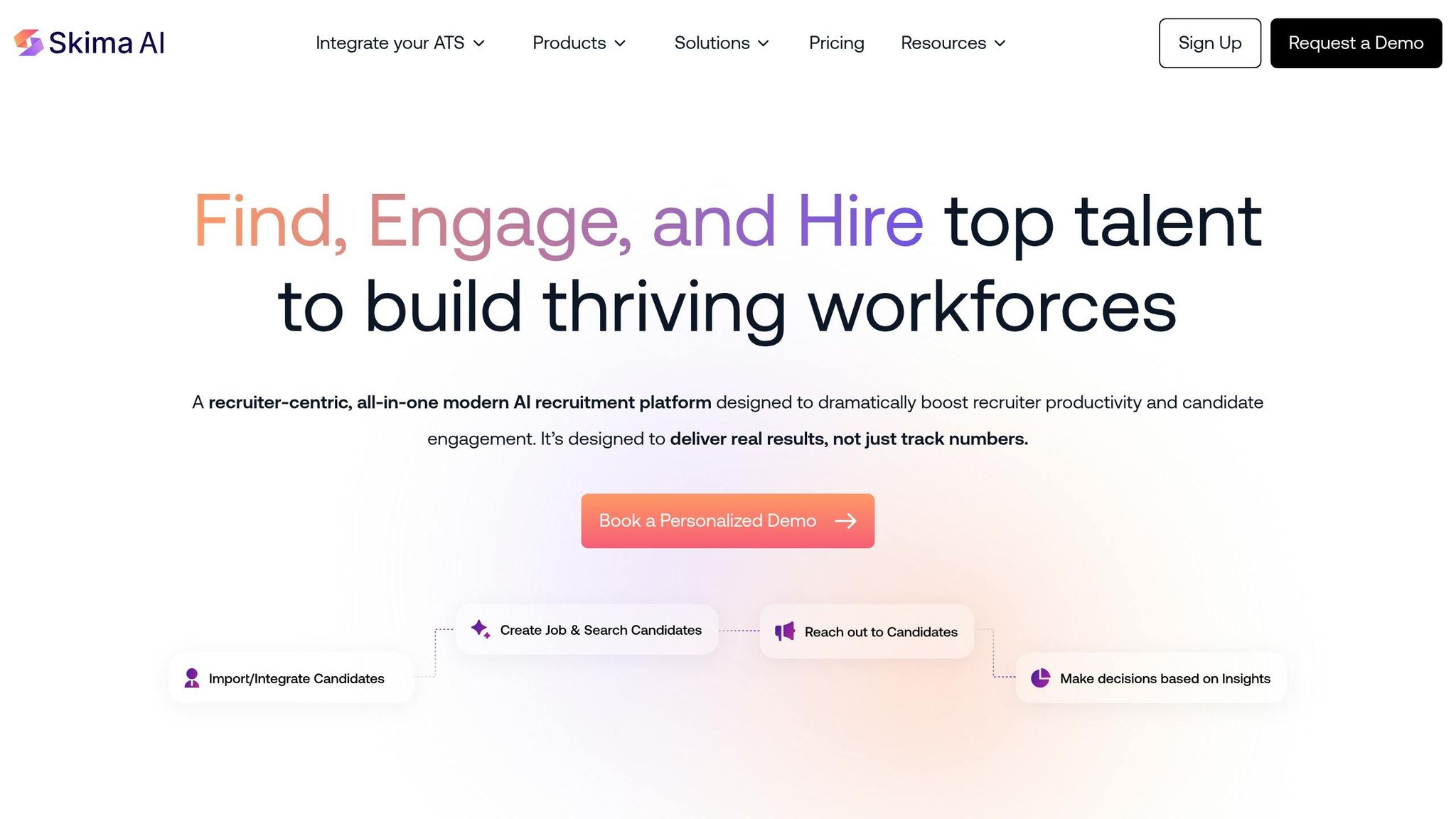
Skima.AI is built to help startups handle high-volume hiring without breaking the bank. Its AI-powered matching engine evaluates candidate skills and experience against job requirements, generating a "Matching Score" that cuts down on the time spent manually reviewing resumes.
Key Features
Skima.AI simplifies the hiring process by automating the initial screening phase, reducing the workload for your team. This automation ensures that qualified candidates move through the pipeline faster, allowing your team to focus their energy where it matters most.
Candidate Experience
With automated early-stage screenings, Skima.AI provides candidates with quick and meaningful feedback, keeping them engaged throughout the process. This efficiency frees up time for founders to build stronger connections with top-tier talent.
These features make Skima.AI a practical choice for startups seeking a recruiting platform that balances agility and affordability.
8. JuggleHire
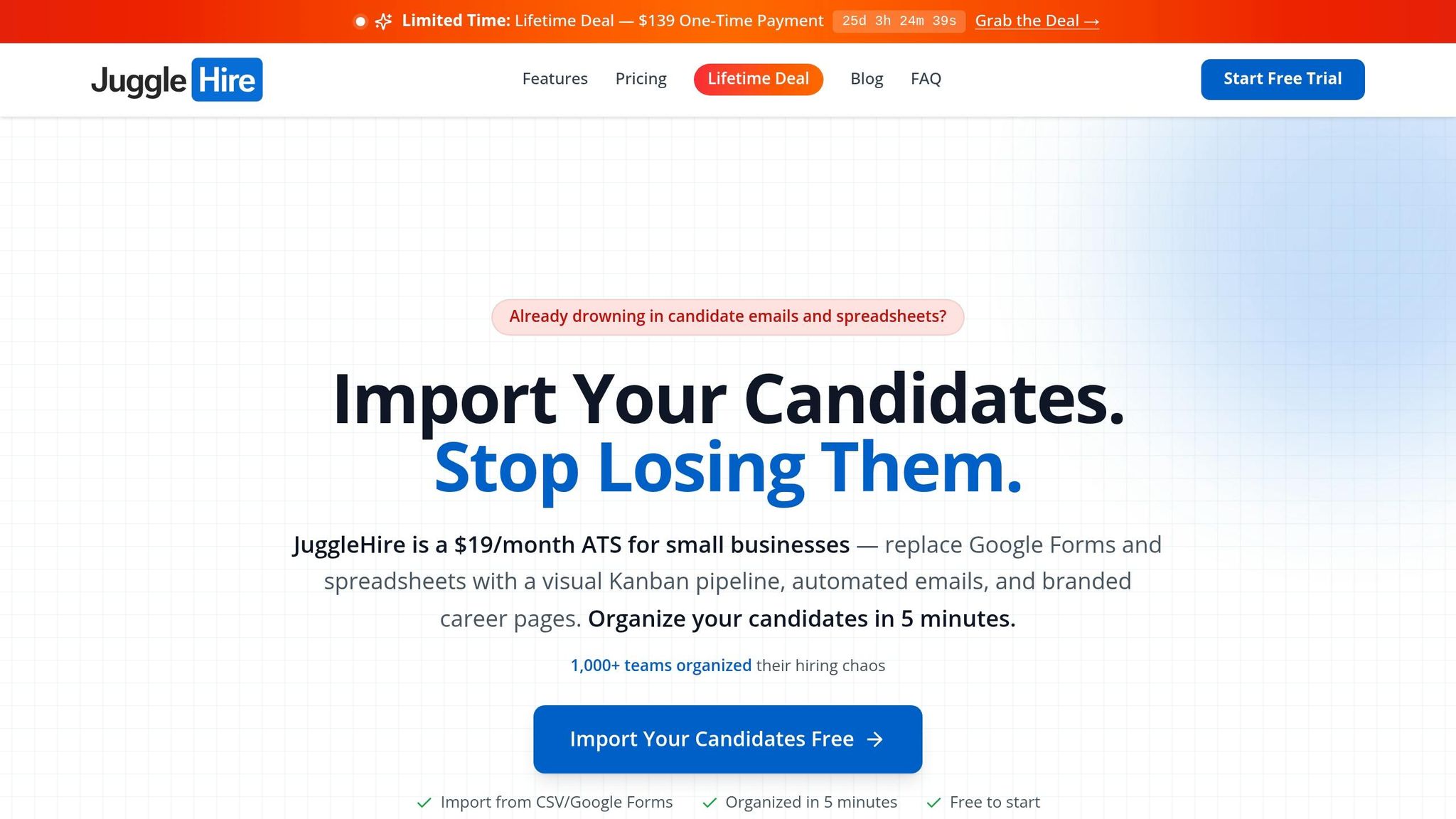
JuggleHire, also known as Hire.inc, is a recruitment platform tailored specifically for startups. It’s designed to help small teams fill crucial positions quickly and efficiently, without the complexity of larger, enterprise-focused tools. By incorporating AI into the hiring process, JuggleHire simplifies tasks like candidate sourcing and management tools, making it an ideal choice for companies looking for a straightforward solution.
Pricing
Details on pricing are provided upon request.
Key Features
JuggleHire comes packed with features to streamline the hiring process, including:
- AI Sourcing Agents: These tools match candidates to your hiring needs, saving you time on manual searches.
- AI Resume Screening: Instantly identifies top candidates based on your criteria.
- AI Notetaking: Automatically records important details during interviews.
All of these tools are integrated into a collaborative Applicant Tracking System (ATS), ensuring that your team stays updated on every candidate’s progress.
Comparison: Strengths and Weaknesses
Choosing the right recruiting software for your startup depends on factors like your growth stage, budget, and hiring strategy. As your needs change, the advantages of each solution may shift as well.
For pre-seed and seed-stage startups, tools like JuggleHire and Manatal provide affordable and easy-to-use options. JuggleHire stands out with its quick 10-minute setup for just $19/month. Meanwhile, Manatal offers AI-driven candidate scoring at $15/user/month. Zakir Hossen, Founder of JuggleHire, highlights the importance of affordability for startups:
"The best ATS for startups in 2026 combines professional features with startup‑friendly pricing - typically $19-99/month instead of $500+" .
For growth-stage companies, platforms like Workable and Ashby cater to more structured workflows and enhanced candidate management. Workable, starting at $149/month, focuses on AI-powered sourcing with access to over 400 million profiles and offers same-day setup. Ashby, priced at $300/month, emphasizes advanced analytics and detailed pipeline tracking. Workable is ideal for fast, AI-driven sourcing, while Ashby excels in providing deeper insights into hiring pipelines.
For Series B and beyond, Greenhouse and Lever are tailored to meet the demands of larger teams. Greenhouse, starting at around $6,000 annually, offers robust integrations and workflows designed to scale with growing organizations. Lever, costing between $3,000 and $10,000 per year, combines applicant tracking (ATS) and customer relationship management (CRM) capabilities for relationship-focused recruiting. Nilanjana Srivastava, Fractional People Lead, explains Greenhouse's appeal:
"Greenhouse is best for internal recruiting departments at mid‑sized organizations, large enterprises, and fast‑growing teams" .
However, for leaner startups, the complexity of these tools might outweigh their benefits.
For startups focused on technical hiring, daily.dev Recruiter provides a unique approach. It connects companies with pre-qualified engineers through warm, double opt-in introductions, avoiding the need for cold outreach or outdated candidate profiles. This developer-first model integrates seamlessly into existing hiring processes. This is particularly effective when implementing best practices for hiring remote technical talent to ensure team fit.
Here's a quick comparison of the top tools:
| Tool | Starting Price | Best For | Setup Time | Key Strength |
|---|---|---|---|---|
| daily.dev Recruiter | Custom | Developer hiring | Fast | Warm intros to engaged developers |
| JuggleHire | $19/mo | Pre‑seed to Series A | 10 minutes | Simplest UI; fastest setup |
| Manatal | $15/user/mo | Bootstrapped teams | Fast | AI candidate scoring |
| Workable | $149/mo | Seed to Series B | Same day | AI‑powered sourcing (400M+ profiles) |
| Ashby | $300/mo | Series A to C | Days | Advanced analytics |
| Lever | ~$3,000+/year | Series A+ | Weeks | Unified ATS + CRM |
| Greenhouse | ~$6,000+/year | Series B+ | Weeks | Structured hiring; 450+ integrations |
| Skima.AI | Custom | AI‑focused teams | Varies | Automation‑first workflows |
This breakdown helps match your startup's stage and priorities with the right recruiting solution.
Conclusion
The best recruiting solution depends on where your startup is in its journey and how quickly you're growing. As discussed earlier, daily.dev Recruiter is designed to adapt to your hiring needs - whether you're making your first engineering hire or scaling up to a team of 50+ employees.
For pre-seed or bootstrapped startups, daily.dev Recruiter offers an affordable and straightforward option without the hassle of complex enterprise tools. Instead of relying on cold outreach or outdated candidate lists, it connects you with pre-screened engineers through warm, double opt-in introductions. This developer-focused approach saves you from chasing unresponsive candidates and keeps your hiring costs predictable.
As your team grows, the platform scales effortlessly with you. Its transparent pricing - free of percentage-based fees or long-term contracts - ensures you can expand from 10 to 50 employees without unexpected expenses. Considering that founders spend an average of 23% of their time on hiring , having an automated system that prioritizes candidate engagement can be a game changer. daily.dev Recruiter helps you focus on qualified, interested developers, cutting down on wasted effort.
For startups at Series A and beyond, the platform continues to shine with its structured hiring process and developer-friendly design. It integrates seamlessly with your ATS, maintains high response rates from passive candidates, and strengthens your visibility in the developer community. Recruitment tools like this can reduce your time-to-hire by 50% - from 42 days to just 21 days - but only if you choose one that aligns with your current needs.
Start using daily.dev Recruiter today to simplify your hiring process and dedicate more time to what truly matters - scaling your startup.
FAQs
How do I choose recruiting software for my startup stage?
When picking recruiting software, it's all about matching the tool to your startup's current needs, budget, and growth phase. For early-stage startups, like those in the seed or Series A stages, look for affordable and straightforward options. Tools in the $0–$50/month range are often ideal, offering quick setup and essential features such as applicant tracking and basic automation.
As your company grows and hiring needs become more complex, it might be time to invest in more advanced platforms. These often start around $399/month and include features like detailed workflows and analytics - perfect for managing higher hiring volumes and intricate processes. The key is to choose software that can scale alongside your team.
What’s the cheapest hiring stack to reach 50 hires?
The most budget-friendly hiring stack for bringing on 50 new team members can cost as little as $19 per month. By pairing free or low-cost ATS (Applicant Tracking System) tools with affordable sourcing platforms like daily.dev Recruiter, small teams can manage their hiring process effectively. These tools are built to grow alongside your team, helping startups keep expenses in check without compromising on recruitment needs.
What automations improve hiring without harming candidate experience?
Automation tools can make hiring more efficient while keeping the candidate experience positive. For example, they can simplify engagement and screening processes, send personalized email or SMS follow-ups based on a candidate’s actions, and handle interview scheduling automatically. These features not only save time but also create a seamless and professional journey for candidates.
.png)