Losing a top engineer can cost your company hundreds of thousands of dollars and disrupt projects for months. 13–18% of tech talent leaves annually, and when senior engineers quit, team morale drops, productivity suffers, and others may follow. The good news? 77% of turnover is preventable if you address key issues early.
Why Developers Leave
- Unclear career paths: 57% quit feeling stuck or outdated.
- Poor management: Bad managers make engineers 5x more likely to leave.
- Scope creep and burnout: 62% cite unclear requirements; 38% feel burned out.
- Lack of autonomy: 48% leave due to micromanagement.
- Pay dissatisfaction: Only 15% leave purely over pay, but transparency matters.
What Keeps Developers Engaged
- Growth opportunities: Companies offering career development see 2.9x better retention.
- Autonomy and challenging work: 78% stay for interesting problems; 46% value decision-making freedom.
- Competitive pay: Fair pay is a baseline, not a motivator.
- Work-life balance: Hybrid/remote work reduces attrition by 33%.
Actionable Solutions
- Run effective 1:1s: Separate tactical updates from career discussions.
- Define career paths: Provide clear milestones for advancement.
- Offer autonomy: Trust engineers with decisions while maintaining light oversight.
- Invest in learning: Allocate budgets and time for skill development.
- Conduct stay interviews: Spot dissatisfaction before it leads to resignations.
Retention starts with addressing what developers care about most: career growth, autonomy, and meaningful work. Fix these areas, and you'll keep your best engineers while avoiding costly turnover.
The Real Cost of Losing Developers
What Turnover Costs in Dollars
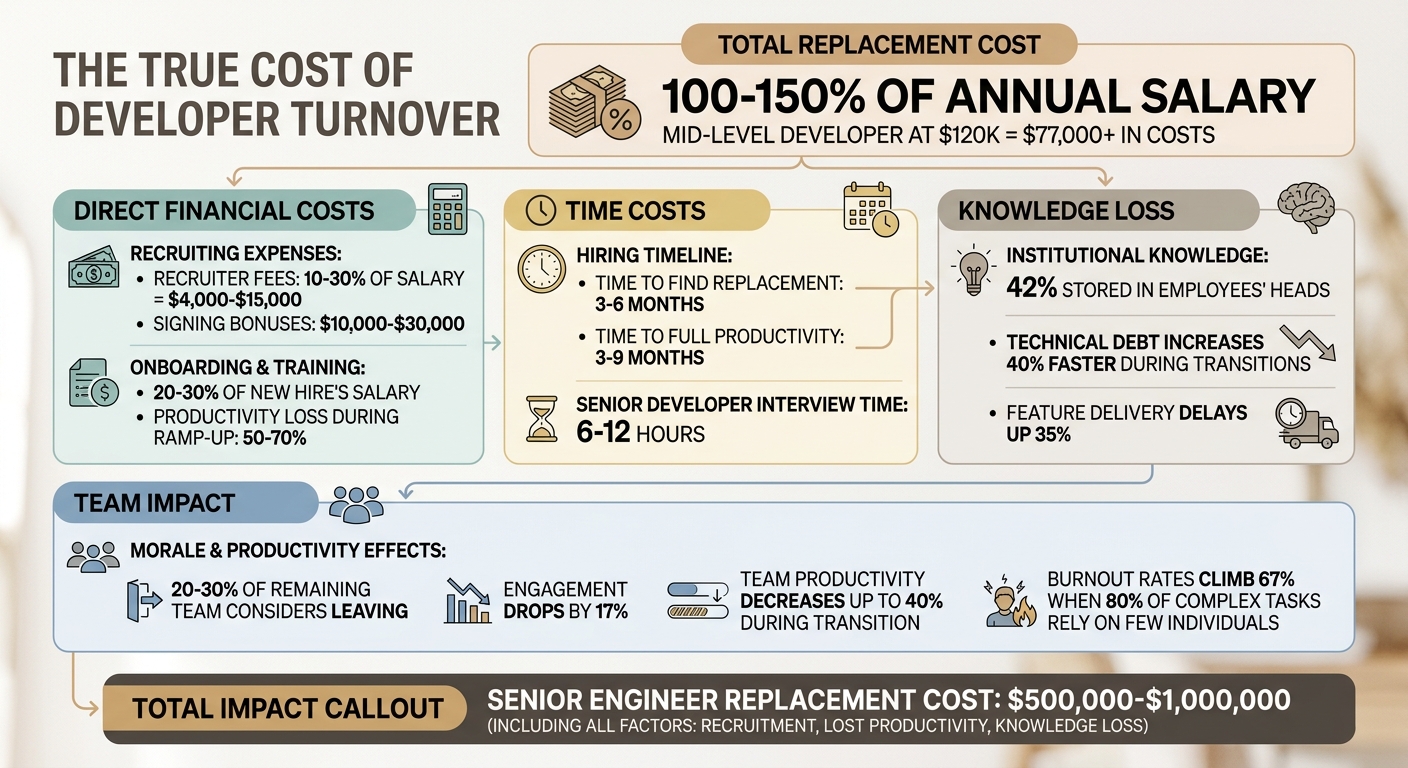
When a developer leaves, the financial impact is immediate and steep. Replacing a specialized technical role typically costs between 100% and 150% of the departing employee's annual salary. For a mid-level developer earning $120,000, this translates to at least $77,000 in expenses.
Let’s break it down. Professional recruiter fees alone can range from 10% to 30% of the new hire’s salary, which means $4,000 to $15,000 per hire in direct recruiting costs. Add to that the cost of technical assessment tools, premium job board listings, and 6–12 hours of senior developer time spent on interviews. Signing bonuses, often necessary to secure competitive talent, can tack on another $10,000 to $30,000. Once hired, onboarding and training can cost 20–30% of the new hire’s salary, while the ramp-up period results in productivity losses of 50–70%.
And it’s not just about money. Beyond these direct costs, losing a developer disrupts project timelines and drains institutional knowledge, creating ripple effects across the organization.
Lost Time and Knowledge
The financial strain of turnover is compounded by the time and expertise lost. New developers typically take 3–9 months to reach full productivity. Combine that with the 3–6 months it often takes to find and hire a replacement, and you’re looking at a significant delay in progress.
But the long-term impact can be even more damaging. Around 42% of institutional knowledge is stored in employees’ heads. When a senior engineer departs, they take with them critical insights about legacy systems, architectural decisions, and design choices - knowledge that’s rarely captured fully in documentation. During these transitions, technical debt can pile up 40% faster, and feature delivery delays may rise by 35%.
Impact on Team Morale
The effects of developer turnover don’t stop at finances or timelines - they ripple through the team, affecting morale and productivity. A single resignation can trigger a domino effect, with 20–30% of the remaining team members considering other job opportunities. Meanwhile, engagement among those who stay can drop by 17%, and team productivity can take a hit of up to 40% during transition periods.
The workload doesn’t simply disappear when someone leaves. Instead, it’s redistributed among the remaining team members, increasing stress and the risk of burnout. For teams where 80% of complex tasks rely on just a few individuals, burnout rates climb by 67%. This creates a vicious cycle: departures lead to overwork, overwork triggers more resignations, and the team's overall morale and stability suffer as a result.
Why Developers Leave: Survey Data and Patterns
Understanding why developers quit helps engineering managers take action before those dreaded resignation letters land on their desks. According to surveys, 62% of developers cite scope creep and unclear requirements as their top reasons for considering a job change. Other major factors include late or unreliable payment (51%), micromanagement and lack of autonomy (48%), and a lack of growth opportunities (43%). These aren't isolated complaints - they reflect deeper systemic problems.
As Mike Tempest points out, "The decision [to leave] was made months ago. Most engineering leaders don't realize they have a retention problem until resignation letters appear." But there are warning signs. For example, a developer who stops asking about promotions or suddenly starts documenting everything may be signaling their intent to leave. Spotting these shifts can give managers a 2–3 month head start to address issues.
No Clear Career Path
A lack of career progression is a dealbreaker for many. 57% of software engineers leave because they feel stuck or worry their skills are falling behind. Senior engineers often feel especially frustrated if they're stuck maintaining outdated systems without learning new technologies.
"The previously career-focused engineer stops asking about promotion timelines, skill development opportunities, or how to reach the next level... This shift from future-oriented to present-focused dialogue reveals they don't see a future worth investing in at your company." - Mike Tempest
Growth isn't just about climbing the ladder. It also means gaining technical expertise, tackling new challenges, and taking on leadership roles. Engineers who see a clear path forward are three times more likely to stay. Looking ahead to 2026, top engineers will gravitate toward roles that let them evolve into "orchestrators" of cutting-edge areas like Agentic AI and Cloud FinOps. If your team can't offer that, someone else's will.
Bad Management
Nothing drives developers away faster than bad management. Developers with poor managers are five times more likely to leave compared to those with excellent ones. The numbers speak volumes: 21.5% of employees with bad managers plan to leave, while only 4.3% of those with great managers feel the same way.
One recurring issue is when non-technical managers override technical decisions, eroding trust. Burnout is another major factor, with 38% of engineers in North America reporting they feel burned out "most of the time". As the CodePulse team puts it, "Burnout is a management failure, not a personal weakness. If your engineers are burning out, you have a system problem."
How can managers improve? Start by treating management as a skill that requires consistent effort. Hold quarterly career conversations separate from performance reviews, communicate priorities transparently, and respect your engineers' technical expertise.
Technical Debt and Limited Autonomy
Micromanagement and lack of autonomy are major red flags for developers, with 48% citing these issues as reasons to leave. Senior engineers, in particular, need the freedom to make architectural decisions without constant oversight. Forcing them to justify every choice to non-technical leaders sends a clear message: you don't trust them.
Technical debt only adds to the frustration. 27% of developers say an outdated or clunky tech stack is a big reason for quitting. Being stuck in a "feature factory" or handling only maintenance work can make the job feel meaningless. Teams where a few people handle most of the complex work are also more prone to burnout - by a staggering 67%.
"Autonomy matters enormously to senior engineers. They want freedom to make technical decisions, influence architecture, and solve problems their way without excessive oversight or micromanagement." - Mike Tempest, Engineering Leader
The solution? Strike a balance. Trust your engineers to own decisions within their expertise while maintaining light oversight. 78% of developers rank "interesting and challenging technical work" as a top reason to stay, and 46% prioritize autonomy over how they implement solutions. Give them both, and you'll see better retention.
Below-Market Pay
While pay isn't always the top reason developers leave, it still matters. Senior engineers who feel underpaid compared to market rates are twice as likely to leave within a year. That said, only 15% of senior engineers cite compensation as their primary reason for quitting. Once salaries hit market levels, pay becomes more of a baseline requirement than a motivator.
The bigger issue often lies in transparency. 73% of developers say clear and open communication about pay is crucial when evaluating a new role. If your compensation isn't competitive and you're not upfront about it, developers will find out - and they'll leave. By 2026, salary transparency will likely be the norm, making it even harder to hide pay gaps.
When developers feel stuck, undervalued, or disrespected, they leave. The good news? These are all areas managers can address - if they act before it's too late. The next sections will explore specific strategies to tackle these challenges head-on.
Retention Strategies Ranked by Impact
Understanding why developers leave is the key to creating strategies that address their concerns and encourage them to stay. However, not all retention efforts yield the same results. Engineering managers often focus on perks that barely make a difference while overlooking what truly matters. Data paints a clear picture: career growth and learning budgets are the most effective strategies, followed by autonomy and engaging work, competitive pay, and finally, perks, which have minimal impact.
Career Growth and Learning Budgets
Career development is the strongest tool for retaining developers. A staggering 85% of millennial employees value professional growth above other factors. Companies that offer solid learning opportunities experience 2.9 times better retention rates compared to those that don’t. On the flip side, 68% of developers cite limited growth opportunities as their main reason for leaving.
One case study highlights this vividly: a mid-size FinTech company slashed turnover from 35% to 14% - a 60% reduction - by introducing a seven-level career system and allocating 15% of engineering time to innovation over six months in 2024. Developers who see clear paths for advancement are three times more likely to stay with their current employer.
Professional development also curbs job-hopping by 53%. In 2026, engineers are drawn to companies that help them master cutting-edge fields like Agentic AI Orchestration and Cloud FinOps. If your organization doesn’t offer a way to grow, developers will seek one that does.
Autonomy and Interesting Problems
After career growth, autonomy and engaging work are the next big factors in keeping developers on board. 78% of developers rank "interesting and challenging technical work" among their top three reasons to stay, even more than the 73% who prioritize fair pay. Developers are willing to accept slightly lower salaries if the work is stimulating, but they won’t stick around for mundane tasks.
"Developers tolerate modest pay cuts if challenged, but reject monotonous work." - Yaseen Deen, Co-Founder, OctogleHire
Autonomy is another critical factor, especially for senior engineers. 46% of developers value the freedom to make decisions about how they implement solutions, and 48% have left jobs because their autonomy was restricted. When non-technical managers interfere with technical decisions or demand excessive justification for choices, trust erodes quickly. The fix? Let senior engineers take ownership of decisions while providing light oversight.
Competitive Compensation
While compensation is important, it’s often described as a "hygiene factor" - a basic requirement rather than a motivator. 73% of developers expect fair pay, but only 15% of senior engineers leave primarily due to compensation issues. However, 68% mention pay as a symptom of feeling undervalued when other problems exist.
Counter-offers rarely solve the problem. In over 70% of cases, employees leave within 12 months of accepting one because the core issues - like lack of growth or autonomy - remain unaddressed. Competitive pay prevents attrition, but paying above market rates won’t retain talent if other needs aren’t met.
"The decision to leave wasn't primarily about money - it was about the intangible factors that make work meaningful, challenging, and rewarding." - Mike Tempest, Engineering Leadership Consultant
Transparency is crucial. 73% of developers say pay transparency is a top factor when considering new roles. If your compensation isn’t competitive or you’re not upfront about it, employees will find out - and they’ll leave.
Perks and Office Culture
Perks, while nice, offer little in terms of retention compared to meaningful work and growth opportunities. By 2026, the focus has shifted from traditional perks to creating a frictionless work environment and providing impactful work experiences. Developers don’t care about ping-pong tables or free snacks - they want tools and systems that let them focus on innovation rather than troubleshooting.
"You cannot 'perk' your way into retention in 2026. Free snacks and Zoom happy hours have been replaced by the need for meaningful work in a frictionless environment." - Talentus Global
Flexibility is another key factor. Hybrid work arrangements cut attrition by one-third, and 89% of developers prefer fully remote work, with only 4% wanting to return to the office full-time. The takeaway? Remove obstacles and offer flexibility instead of relying on superficial perks.
Here’s a quick look at how these retention factors stack up:
| Retention Factor | % Ranking in Top 3 | Impact Level |
|---|---|---|
| Interesting/Challenging Work | 78% | Highest |
| Rate Transparency/Fair Comp | 73% | High (Table Stakes) |
| Timezone Respect | 61% | Medium |
| Career Growth/Learning | 58% | Highest |
| Autonomy over Decisions | 46% | High |
| Modern Tech Stack | 37% | Medium |
| Equity/Profit Sharing | 19% | Low |
Source: OctogleHire Developer Survey 2026
The message is clear: prioritize career growth and learning, give developers autonomy and challenging work, ensure competitive pay, and treat perks as optional extras. With 63% of employee departures being preventable, focusing on what truly matters can make all the difference.
Engineering Manager's Retention Toolkit
Understanding why developers leave and what keeps them engaged is only half the battle. The real challenge lies in applying this knowledge to everyday management. Below are actionable tools engineering managers can use to help retain top talent.
How to Run Effective 1:1s
Transform your 1:1s from routine status check-ins into meaningful retention opportunities. Start by separating tactical discussions from career-focused conversations. Weekly 1:1s can cover blockers and project updates, but set aside quarterly sessions to focus on growth and job satisfaction.
For career-focused 1:1s, try this four-step framework:
- Ask the developer to rate their job satisfaction on a scale of 1–10.
- Identify which aspects of their work energize them and which drain them.
- Explore what needs to happen for them to feel excited about staying for two more years.
- Discuss what might prompt them to start looking elsewhere.
This approach helps uncover potential issues early - before they escalate into resignations.
For tactical 1:1s, leverage Git-based signals to guide conversations. For example, if an engineer is handling 1.5× more complex work than their peers, use the meeting to discuss redistributing tasks or pairing strategies. Notice a pattern of late-night commits? That could signal burnout, and it's worth addressing immediately.
The stakes are high: 21.5% of employees with poor managers plan to leave, compared to just 4.3% with excellent managers. The quality of your 1:1s can make all the difference.
Building Career Ladders with Clear Milestones
A lack of clear career paths often drives developers to leave. To combat this, design a dual-track system that allows engineers to advance as either Individual Contributors (ICs) or Managers after reaching Senior or Tech Lead roles. This ensures engineers aren't forced into management roles they don't want.
Define each level with specific, observable milestones, not vague benchmarks like years of experience. Use a competency matrix that evaluates skills across areas like Communication, Leadership, Product, Implementation, Design, and Operations. Rate each skill on a four-tier scale: Learning, Proficient, Fluent, or None.
Promotion readiness should be based on meeting at least 80% of the criteria for the next level. Tie each level to transparent salary bands with clear minimum and maximum ranges. This clarity removes ambiguity and politics from promotions while giving engineers a clear financial picture of their career progression.
Project Ownership Models
Developers thrive when they feel ownership over their work. Instead of assigning isolated tickets, create dedicated pods or clusters that allow teams to focus on specific systems or products over time. This fosters a sense of connection to both the work and their teammates.
To avoid burnout and stagnation, rotate key projects periodically. When 80% or more of high-complexity tasks fall on just two or three people, burnout rates spike by 67%. Rotating responsibilities and pairing junior engineers with seniors on challenging projects can help distribute the workload more evenly.
Dedicate 10–20% of engineering time to innovation or addressing technical debt. Maintain a visible technical debt register where teams can create debt tickets and allocate sprint time for fixes. This gives developers a sense of autonomy and turns them into active contributors to the system's long-term health.
Skip-Level Meetings
Skip-level meetings - where leaders meet directly with engineers, bypassing their immediate managers - are a powerful way to build trust and gain unfiltered insights into team health. Schedule these monthly or quarterly to identify potential bottlenecks or issues in middle management.
These meetings are a chance to ask candid questions like, "What’s one thing your manager does well?" and "What’s one thing they could improve?" Engineers may feel more comfortable sharing concerns about workload, team dynamics, or technical debt in this setting without fear of immediate consequences.
Skip-levels can also reveal subtle signs that someone might be planning to leave. For instance, if an engineer shifts from saying "we" to "you" when discussing team outcomes, they may be mentally distancing themselves. Similarly, creating detailed documentation or runbooks could indicate they’re preparing for a handover.
The cost of losing a senior engineer is steep - $500,000 to $1,000,000 when you factor in recruitment, lost productivity, and knowledge loss. Investing just 30 minutes a month in skip-level meetings can help mitigate this risk. Combined with proactive career development and open communication, these tools form a solid framework for retaining your best talent.
The Stay Interview: Spotting Flight Risk Early
Too often, engineering managers don't realize there's a retention problem until a resignation letter appears on their desk. By then, the decision to leave was made long ago. Stay interviews, a key tool in any engineering manager's retention strategy, act as an early warning system, helping you catch dissatisfaction before it leads to turnover. These conversations focus on identifying potential issues and keeping top engineers engaged.
Unlike performance reviews or project updates, stay interviews zero in on career satisfaction and future goals. The objective? Understand what motivates your developers to stay and what might drive them to leave. When implemented effectively, stay interviews can reduce turnover by up to 20%.
When to Conduct Stay Interviews
Timing is everything. For most engineers, aim to hold stay interviews every six months. This schedule balances regular check-ins with enough space to avoid feeling intrusive. For senior engineers or high performers - those you absolutely can't afford to lose - quarterly discussions are more appropriate.
New hires require closer attention. Plan monthly check-ins during their first three months to address any onboarding challenges early. If you notice warning signs like disengagement or sudden spikes in documentation activity, don't wait. Initiate a 30-day retention audit immediately to address potential risks.
| Interview Type | Recommended Frequency | Primary Focus |
|---|---|---|
| New Hire Check-in | Monthly (First 3 months) | Integration and addressing early obstacles |
| Standard Stay Interview | Every 6 months | General satisfaction and retention |
| Senior/High‑Performer | Quarterly | Career growth, autonomy, and impact |
| Retention Audit | As needed (30‑day cycle) | Immediate intervention for flight risks |
Once your timing is set, the next step is crafting questions that uncover meaningful insights.
Questions That Actually Work
The right questions can make or break a stay interview. Start with: "On a scale of 1–10, how satisfied are you in your current role? What would move that number higher?" This question provides a clear starting point and invites specific feedback. Follow it up with: "What would make you excited to still be here in two years?" If they struggle to answer, take that as a warning sign about their long-term commitment.
Another key question is: "What would cause you to start seriously exploring opportunities elsewhere?" This helps identify deal-breakers before they escalate. Dive deeper with: "What parts of your work are most energizing right now? And what parts feel draining or frustrating?" Pay attention to what lights them up versus what might push them away. Lastly, ask: "How sustainable is your current workload?" to uncover hidden burnout risks that might not show up in performance metrics.
"I wanted to have a conversation that's just about you and your career satisfaction - nothing about current projects or performance. I'm checking in because I genuinely want to understand how you're feeling about your role and future here." – Mike Tempest, Engineering Leadership Consultant
These questions are just the beginning. What you do with the answers is what truly matters.
Acting on What You Learn
A stay interview is only effective if it leads to action. Document key takeaways immediately and create a plan to address concerns. For example, if a developer feels stuck in repetitive tasks, assign them to a more engaging project in the next sprint. If they’re frustrated by micromanagement, consider giving them greater decision-making authority in a specific area.
Remember, 52% of employees believe their managers could have done more to prevent them from leaving. Bridge that gap by following up on their feedback. If you can’t implement their suggestions, explain why and propose an alternative. The goal is to show that their input leads to real change - not empty promises.
Look for patterns across multiple interviews. If several team members mention similar frustrations, like excessive scope creep or too many meetings, you’re likely dealing with a broader issue that requires team-wide solutions. Addressing the root causes ensures you’re not just treating symptoms but creating a better environment for everyone.
When to Let Go: Healthy Attrition vs. Toxic Retention
Not every resignation signals failure. Sometimes, a departure is the best outcome for both the developer and the organization. The real challenge lies in identifying when trying to hold on does more harm than good - when you're clinging to someone who's already disengaged.
The Difference Between Healthy and Toxic Retention
Healthy attrition occurs when a developer leaves as part of their natural career progression. Maybe they're pursuing a principal role that doesn’t exist in your company or want to work with a tech stack that aligns better with their goals. In these cases, they often ensure a smooth transition by preparing detailed handover materials like runbooks or architecture diagrams.
Toxic retention, on the other hand, involves desperate attempts to keep someone who’s already checked out. High-pressure tactics or counter-offers might delay their departure, but they don’t address the real problems. For example, if you fail to align job offers with developer goals or if a developer is burned out from constant scope creep or frustrated by micromanagement, a 20% raise won’t fix those issues. It just postpones their exit and can breed resentment. To gauge whether retention efforts are worthwhile, consider the "Four Core Drivers" framework: Autonomy, Impact, Growth, and Respect. If a developer is missing more than two of these, attempts to retain them may be futile .
Understanding this difference helps you recognize when letting go is actually the healthiest choice.
Signs a Departure Is the Right Move
Certain behavioral changes can indicate that a developer has mentally checked out. One key signal is the shift from "we" to "you" language. When someone stops saying "we should refactor this" and starts saying "you could refactor that", it’s a sign they no longer see themselves as part of the team . Another red flag is disengagement in technical discussions. If a previously vocal engineer suddenly offers little more than polite agreement during architecture debates, they’ve likely lost emotional investment .
Sometimes, the issue is structural. For instance, if a developer is stuck working exclusively on outdated legacy systems with no chance to engage with modern technologies, they may start feeling "unemployable" down the line . Similarly, when a developer becomes a review bottleneck - spending over 40% of their time reviewing code instead of contributing their own deliverables - letting them move on can actually improve team efficiency . Misaligned values can also be a major factor. If a developer’s principles clash with a company’s growing bureaucracy or shifting priorities, forcing them to stay can create unnecessary tension.
Why Counter-Offers Usually Fail
Once it’s clear that retention efforts are no longer productive, another mistake often comes into play: counter-offers. These rarely address the real problems and fail in over 70% of cases . The reason is simple - developers rarely leave just for a higher paycheck. Typically, they’re seeking relief from creative stagnation, lack of autonomy, or poor leadership—factors that define what developers want in a role. As Hao Nguyen from The Nudge Group explains:
"A counter offer is rarely about a newfound appreciation for your talents. It is a calculated business decision."
"A sudden influx of cash does not fix a toxic internal culture. It does not magically align a broken leadership team, and it certainly does not turn a stagnant legacy product into an exciting innovation." – Hao Nguyen, The Nudge Group
Even when a developer accepts a counter-offer, the salary bump often loses its appeal after a few months, leaving them to face the same frustrations that prompted their job search in the first place . Worse, leadership may start viewing them as a "flight risk", which can harm their long-term prospects within the company. If counter-offers have become a recurring tool, it’s a clear sign that deeper issues in hiring or management need to be addressed.
How Better Hiring Reduces Turnover
Following technical hiring best practices lays the groundwork for employee retention. When recruitment is carefully designed, it minimizes the risk of turnover by ensuring new hires are not only skilled but also a good match for your work culture. If you're constantly struggling to keep developers on your team, chances are the issue started during recruitment.
Hiring for Mutual Fit
To retain developers long-term, focus on hiring for both technical expertise and alignment with your team’s culture. Relying solely on technical skills often leads to short-term hires who lack a deeper connection to the work or team dynamics. Developers who stick around for over a year aren’t just talented - they’re drawn to engaging, challenging projects and work environments that suit their style.
The numbers tell the story: 78% of developers cite "interesting and challenging technical work" as the top reason they stay, and 73% highlight rate transparency and fair pay as key factors. While fair compensation is a must, developers earning at or above their expectations are 2.3 times more likely to stay for 12+ months.
Behavioral alignment is equally important. For example, how does a candidate handle shifting project requirements mid-sprint? Do they thrive in structured environments or prefer autonomy? Matching candidates to your team’s communication and work preferences (e.g., async-first workflows, which 67% of developers now favor) helps avoid friction from the start. If a developer’s career goals involve mastering cutting-edge AI while your team focuses on maintaining legacy systems, that mismatch will likely cause frustration in a matter of months.
Once you’ve confirmed a good fit, warm introductions can further reinforce trust and alignment.
Warm Introductions Build Trust
Cold outreach often wastes time for both parties. Developers lose an average of 6.5 hours per misaligned interview process when compensation expectations aren’t clear upfront. That’s nearly an entire workday wasted.
Platforms like daily.dev Recruiter take a different approach. Instead of relying on scraped LinkedIn profiles or mass InMail campaigns, this tool connects you with developers who are already engaged - reading, learning, and signaling their interests through the content they consume. Every introduction is double opt-in, meaning both the developer and the company express mutual interest before any conversation begins. This respectful and intentional approach fosters trust early on, setting the stage for a lasting relationship.
Developer-Friendly Recruitment
To attract and retain the right candidates, your recruitment process should reflect the work environment you’re offering. Transparency is a key element: 73% of developers consider rate transparency the most important factor when evaluating a new role, yet 68% have gone through multiple interview rounds only to find the salary didn’t meet their expectations. Clearly stating compensation ranges upfront avoids mismatched expectations and builds credibility.
While developers may accept slightly lower pay for truly engaging technical challenges, they won’t compromise on the quality of work.
Your recruitment process should also mirror your team’s work style. For example, if your team values asynchronous communication, avoid scheduling numerous live interviews. If autonomy is a priority, don’t assign overly rigid tasks during the hiring process. Remember, developers are assessing you just as much as you’re assessing them. A chaotic or mismatched recruitment experience can signal deeper problems within your organization. By aligning the hiring process with the role itself, you’re not just hiring better - you’re creating a foundation for long-term retention from day one.
Conclusion
Retention isn’t about flashy perks like ping-pong tables or free snacks. It’s about creating an environment where developers can grow, make meaningful technical contributions, and feel their work has impact. The data speaks volumes: employees with poor managers are five times more likely to leave , and 40% of developers who quit cite a lack of career growth as the main driver . These are not issues you can patch up with a counter-offer or a trendy benefit.
The best retention strategies focus on what developers genuinely care about: autonomy in technical decision-making, challenging problems to solve, clear career paths, and managers who protect their teams from unnecessary chaos. When these fundamentals are addressed, turnover decreases - and your team’s reputation becomes a magnet for top talent.
"The best retention strategy is being a good place to work. No amount of data analysis can substitute for sustainable workloads, growth opportunities, and competent management." - CodePulse Team
Here’s a harsh truth: counter-offers fail to keep employees for more than a year in over 70% of cases . If you’re resorting to counter-offers regularly, it’s a sign that your hiring or management practices need serious attention. Instead, consider proactive solutions like stay interviews to uncover issues early, investing in manager training, and offering technical career paths that don’t force skilled engineers into management roles they don’t want.
Getting this wrong is expensive - replacing a senior engineer can cost anywhere from $500,000 to $1,000,000 , factoring in recruitment, onboarding, and the loss of institutional knowledge. On the flip side, nurturing a stable and engaged team leads to better products, an ability to attract top talent, and long-term success.
FAQs
What are the earliest signs an engineer is about to quit?
Engineers often show signs of planning to leave well before they actually resign. For example, reduced commit activity, delays in code reviews, or a noticeable drop in collaboration often appear 2-3 months before they hand in their resignation. Even earlier, around 3-6 months prior, you might notice changes like decreased engagement, struggles with workload, or frustration due to lack of recognition. Paying attention to these patterns can help spot potential issues early on.
How do I build a clear IC and manager career ladder?
To create a clear career ladder for both Individual Contributors (ICs) and managers, it's essential to outline structured levels, responsibilities, and expectations for each path. Define separate tracks for ICs and managers, ensuring the progression criteria are transparent and well-documented. Incorporate team feedback to make the framework realistic and engaging. Regularly revisit and refine the ladder to keep it aligned with your team’s evolving needs and to encourage ongoing professional development.
How often should I run stay interviews and 1:1s?
Stay interviews work well when done once a year and should take about 30–45 minutes. For one-on-one meetings, regular and ongoing conversations are key - quarterly check-ins are a popular choice. This approach combines structured annual feedback with consistent touchpoints to address issues early and take steps to support employee retention.
.png)