In 2026, hiring developers is more competitive than ever, with a global shortage of tech talent and lengthy hiring cycles. Recruiters face inefficiencies from juggling disconnected tools, costing over 11 hours weekly. The solution? Build an integrated recruiting stack that streamlines workflows, ensures compliance with emerging privacy laws, and respects candidate data.
Here’s what you need to know:
- Challenges: 85.2M unfilled tech jobs by 2030, 66 days to fill developer roles, and inefficiencies from using 6–8 platforms daily.
- Key Tools: A tech recruiting stack includes top recruiting software platforms for sourcing, screening, ATS/CRM, analytics, automation, and interview management.
- Compliance: New laws require bias audits and consent capture for AI-driven hiring tools.
- Efficiency: Integrated systems, such as developer hiring platforms vs ATS integrations, deliver nearly 2x the ROI compared to siloed tools.
This guide covers how to build a recruiting stack that integrates tools, automates repetitive tasks, and complies with regulations - all while improving hiring outcomes.
What Makes Up a Tech Recruiting Stack
A tech recruiting stack is essentially the collection of tools that powers every phase of your hiring process. Think of it as the backbone of recruitment operations. It ensures data stays organized, speeds up hiring, and keeps you aligned with changing employment laws.
Modern recruiting software platforms generally consist of six key layers: sourcing tools to find candidates, screening platforms to test technical skills, an ATS/CRM to manage candidate progress, analytics to track performance, automation to handle repetitive tasks, and interview operations to manage schedules and feedback. When these tools are linked through APIs, they create a unified system, eliminating scattered data and duplicate records. Below, we’ll explore each layer and its role in creating smooth and efficient workflows.
Here’s a reality check: 82% of organizations report that their current ATS lacks critical functionality, often pushing teams to adopt additional tools for tasks like sourcing, scheduling, and assessments . But the goal isn’t just to stack up tools - it’s to create a seamless workflow where data flows smoothly between stages. Disconnected systems can waste over 11 hours per week for recruiters as they chase down scattered information . Let’s dive into the components that make this process efficient and compliant.
Sourcing Tools: Finding Developer Candidates
Sourcing tools are where every successful hire begins. They help uncover passive candidates - those who aren’t actively job searching but might be open to the right opportunity. In the past, recruiters manually scoured platforms like LinkedIn or GitHub, copying profiles into spreadsheets. Now, AI-powered sourcing tools can scan over 850 million profiles, using machine learning to evaluate skills and career paths .
The best sourcing tools don’t just collect resumes; they prioritize trust by using consent-based systems where developers opt in to being contacted. This shifts outreach from cold emails to meaningful introductions. For example, between September and December 2025, Nick Poloni, President of Cascadia Search Group, used an AI sourcing tool to find overlooked candidates, resulting in over $1 million in billings during that period .
These tools also integrate seamlessly with your ATS, automatically syncing candidate profiles, contact details, and engagement history. They often connect with multi-channel outreach systems, enabling personalized messaging across email, LinkedIn, and SMS. Personalized, automated outreach can achieve response rates as high as 48%, compared to the industry average of 15–25% .
Screening and Assessment: Testing Technical Skills
Using the best assessment tools for evaluating software engineers is essential for filtering candidates early in the process, ensuring only qualified individuals move forward. These platforms assess technical skills through coding tests, take-home projects, or AI-led interviews, helping recruiters avoid wasting time on unqualified applicants. Unlike outdated trivia-based assessments, modern tools focus on practical, role-specific challenges, such as debugging code or building features. Many also include proctoring and identity verification to address concerns about AI-assisted cheating .
When integrated with your ATS, screening results - like scores and skill evaluations - are automatically updated in candidate profiles. This ensures all data stays centralized. Studies show that using AI for sourcing and screening can save recruiters about 20% of their workweek, equivalent to a full day .
ATS and CRM: Managing Your Candidate Pipeline
The Applicant Tracking System (ATS) or Customer Relationship Management (CRM) tool is the central hub for all candidate information. It tracks applications, communications, interview feedback, and hiring decisions. Every tool in your stack - whether for sourcing, screening, or scheduling - should feed data back into this system to maintain a single source of truth .
While the ATS manages active applicants through the hiring funnel, a CRM focuses on nurturing passive talent for future roles . An ATS also plays a critical role in compliance, logging decisions, storing consent records, and creating audit trails. For instance, new laws in California and Illinois require companies to conduct anti-bias testing and disclose when AI is used in candidate assessments . With all candidate data centralized, analytics can then measure and optimize the entire hiring process.
Analytics: Tracking Recruiting Performance
Analytics tools sit on top of your recruiting stack, offering insights into funnel efficiency, source quality, and recruiter performance. Key metrics include time-to-hire (66 days on average for software developers, which is 50% longer than for non-technical roles) and cost-per-hire (estimated at $5,475 for non-executive positions in 2026) . By pulling data from your ATS, sourcing, and screening tools, analytics provide real-time insights into what’s working and what needs improvement.
"A tool that doesn't communicate with your ATS creates more work than value." - Mangalprada Malay, Skillora.ai
Predictive analytics are also gaining traction, using historical data to forecast which candidates are most likely to accept offers or excel in specific roles . This shift is moving recruiting from a reactive process to a more proactive and strategic approach.
Automation: Reducing Manual Work
Automation tools tackle the repetitive tasks that often bog down recruiters - like posting job ads, parsing resumes, routing candidates to hiring managers, sending follow-up emails, and scheduling interviews. On average, recruiters spend about 38% of their time on scheduling and admin tasks that automation can handle .
Modern automation includes advanced AI systems that can autonomously search for candidates, send personalized outreach, and even schedule interviews. By mid-2026, 82% of HR leaders are expected to implement some form of these AI-driven tools . These systems can use data like GitHub contributions or shared alumni networks to craft highly personalized outreach, even at scale.
For instance, in 2025, JBGoodwin REALTORS integrated their tools using Zapier to create an automated recruiting pipeline. This improved their recruiting efficiency by 37% year-over-year while cutting manual workloads by 20–25% . Automation frees up recruiters to focus on more impactful tasks, like building relationships and guiding candidates through the process.
Developer Sourcing Tools Compared
In this section, we dive deeper into sourcing tools to help you identify the platform that best matches your needs. With workflows becoming increasingly integrated in 2026, selecting the right tool means evaluating features, pricing, and use cases to streamline your hiring process.
Picking a sourcing tool isn't about finding the "best" option overall - it's about finding the one that aligns with your hiring goals, budget, and operational flow. The trend toward consolidation is evident: platforms now combine sourcing, outreach, and scheduling into a single interface. With prices ranging from $15/month to over $8,999/year, it's important to weigh your options carefully. Below, we break down coding-focused candidate sourcing tools by their features, costs, and ideal applications.
Platform Comparison: Features, Pricing, and Use Cases
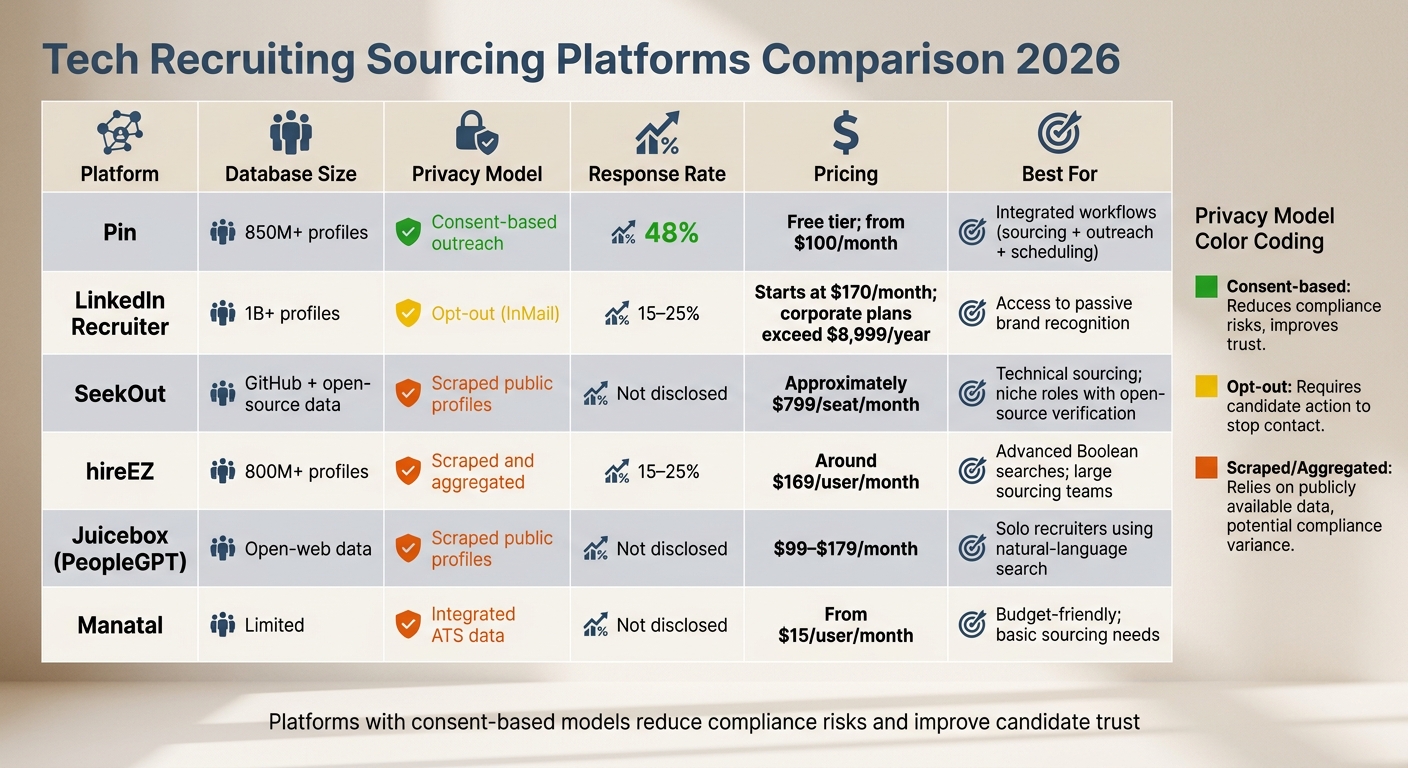
Here's a quick comparison of leading sourcing platforms, focusing on database reach, privacy policies, response rates, pricing, and their best applications:
| Platform | Database Size | Privacy Model | Response Rate | Pricing | Best For |
|---|---|---|---|---|---|
| Pin | 850M+ profiles | Consent-based outreach | 48% | Free tier; from $100/month | Integrated workflows (sourcing + outreach + scheduling) |
| LinkedIn Recruiter | 1B+ profiles | Opt-out (InMail) | 15–25% | Starts at $170/month; corporate plans exceed $8,999/year | Access to passive talent; brand recognition |
| SeekOut | GitHub + open-source data | Scraped public profiles | Not disclosed | Approximately $799/seat/month | Technical sourcing; niche roles with open-source verification |
| hireEZ | 800M+ profiles | Scraped and aggregated | 15–25% | Around $169/user/month | Advanced Boolean searches; large sourcing teams |
| Juicebox (PeopleGPT) | Open-web data | Scraped public profiles | Not disclosed | $99–$179/month | Solo recruiters using natural-language search |
| Manatal | Limited | Integrated ATS data | Not disclosed | From $15/user/month | Budget-friendly; basic sourcing needs |
It's worth noting that platforms relying on scraped profiles without consent can pose compliance risks and harm candidate trust. Consent-based tools, where developers opt in to be contacted, are quickly becoming the preferred standard.
How to Pick the Right Sourcing Tool
The comparison table provides a starting point, but your choice should depend on your team size, hiring volume, budget, and geographic focus.
For Startups (<50 employees):
If you're working with a smaller budget and need simplicity, look at tools like Manatal (starting at $15/user/month) or Juicebox (between $99 and $179/month). These platforms offer user-friendly interfaces and natural-language search. For startups testing the waters, begin with free tiers and avoid long-term contracts until you've confirmed the tool works well for your needs.
For SMBs (50–500 employees):
Efficiency and automation take priority here. Tools like hireEZ (around $169/user/month) or Pin (starting at $100/month) offer extensive candidate pools and multi-channel outreach capabilities. At this stage, integration with your ATS is crucial - ensure that your sourcing tool connects seamlessly to reduce manual data entry.
For Enterprises (500+ employees):
Larger organizations need tools that emphasize compliance, scalability, and analytics. SeekOut (approximately $799/seat/month) stands out for its technical sourcing features, such as GitHub data and diversity filters. Additionally, platforms like Gem (around $24,000/year) excel at surfacing dormant candidates within your ATS. Be sure to budget for tools that support compliance audits and candidate notice requirements.
Global vs. Local Hiring:
For international recruiting, data accuracy is key. High-performing platforms refresh contact information weekly to maintain 98% email accuracy. Outdated contact data not only wastes time and money but also damages email deliverability rates. As Prospeo explains:
"Your sourcing tools are useless if half the emails bounce."
The "1 Core + 2 Enablers" Rule
To optimize your recruiting stack, select one primary ATS/CRM and pair it with two specialized tools that directly address key metrics - like sourcing and scheduling. With technology now accounting for about 35% of recruiting budgets, avoid adding tools without first auditing for overlap. Redundant platforms can drain both time and resources.
Before committing, run a 30-day pilot using at least two active roles. Focus on the "screen-to-onsite" conversion rate to ensure your investment delivers quality candidates without requiring excessive manual effort.
Technical Screening and Assessment Platforms
Once candidates are sourced, the next step is to evaluate their technical skills. This phase often results in a high elimination rate, with 60–70% of candidates not passing the first-round coding assessments . Modern screening processes typically involve three key layers: structured screening, skills validation, and integrity governance.
By 2026, the focus has shifted from simple "black-box" scoring to explainability. Platforms are now expected to clarify why a candidate passed or failed, instead of just assigning a numerical score.
"The goal is not automation - the goal is consistent decisions" - Recruiting Tech Reviews Editorial Team
This multi-layered strategy helps tailor assessments to specific needs, from coding challenges to interactive interviews.
Coding Tests and Take-Home Assignments
Coding tests are a popular way to handle high application volumes early in the hiring process. Tools like HackerRank and Codility (both rated 4.5/5 on G2) offer features like plagiarism detection, session replays, and unit testing . HackerRank, for example, starts at $100/month .
However, the rise of AI tools like ChatGPT has created new challenges. Candidates can now use these tools to solve traditional algorithm problems, leading platforms like TestDome and Canditech to introduce "AI-resistant" questions . To ensure authenticity, features like tab-switching detection and identity verification are becoming essential .
Take-home assignments are better suited for mid-to-late stages, especially for senior roles. Platforms like CodeSubmit (starting at $159/month) and Woven (starting at $249/month) allow candidates the flexibility to work in their own IDE and on their own schedule. CodeSubmit boasts a 4.9/5 rating on G2 .
Time is a crucial factor here. Assignments that take longer than 2–3 hours can deter candidates, particularly those who are already employed. Keeping tasks between 30 and 45 minutes can help maintain engagement . For more complex skills, consider "watch-them-work" tasks, such as debugging a live server issue or optimizing a SQL query. These tasks provide clear evidence of a candidate's abilities without relying on abstract puzzles .
| Method | Best For | Signal Provided | Candidate Experience |
|---|---|---|---|
| Coding Tests | High-volume screening | Algorithmic/logic proficiency | Can feel stressful or academic |
| Take-Homes | Practical skills | Framework/real-world application | Flexible and low-pressure |
| Live Interviews | Late-stage evaluations | Communication & collaboration | High-pressure but interactive |
| Async Video | Soft skills screening | Technical reasoning/communication | Flexible but less personal |
Live and Async Technical Interviews
Interactive interviews go beyond automated tests by assessing real-time problem-solving and communication skills.
Live coding interviews are ideal for evaluating a candidate's ability to collaborate and solve problems on the spot. Tools like CoderPad (starting at $70/month) enable pair programming sessions where interviewers can observe the candidate's thought process in real time . These are particularly effective for late-stage evaluations, where teamwork and cultural alignment are just as important as technical expertise.
That said, live interviews can be a significant time investment for engineering teams. If scheduling becomes a bottleneck, Interview-as-a-Service platforms like Karat offer a solution. Karat, which acquired Triplebyte in March 2026, provides certified engineers to handle first-round technical screens. However, this convenience comes at a cost - filling a single role using this service can run into tens of thousands of dollars .
Asynchronous technical interviews provide a middle ground between automated tests and live sessions. Platforms like Tenzo AI and Skillora.ai use AI-powered voice or video interviews with structured scoring rubrics to replace traditional recruiter phone screens . These tools offer flexibility for candidates while providing reviewers with transcripts and decision logs for transparency.
"A tool that doesn't communicate with your ATS creates more work than value" - Mangalprada Malay, Skillora.ai
In 2026, compliance with new regulations in California (FEHA) and Illinois (HB-3773) is a critical factor. These laws require anti-bias testing and mandate that candidates be informed when AI is used in hiring decisions . Vendors must be able to provide audit-ready materials, such as transcripts, rubrics, and decision logs, to support compliance during reviews .
Before committing to a platform, it's wise to run a 21–30 day pilot focused on a specific role family. Use real requirements to measure outcomes like onsite pass-through rates and time-to-fill. This ensures the platform enhances decision-making without adding unnecessary complexity . Finally, ensure the platform integrates seamlessly with your ATS to maintain a unified candidate record. For more guidance, see our framework on how to choose a developer hiring platform.
ATS and CRM Platforms for Tech Hiring
An ATS (Applicant Tracking System) serves as the backbone for organizing candidate data, interview feedback, and your hiring pipeline. Over 90% of recruiters rely on an ATS to streamline their hiring processes . But here's the challenge: 82% of organizations report that their ATS has major functionality gaps . These gaps often force teams to adopt additional tools, creating the very complexity they aim to avoid.
For tech hiring, integration is just as crucial here as it is in using developer sourcing tools and screening platforms. A well-designed ATS/CRM ensures every stage of the hiring process stays connected. Specifically for engineering roles, a generic ATS won’t cut it. Technical recruiting involves unique steps - like coding challenges, system design reviews, and other in-depth evaluations - that require tailored solutions. An ATS built for tech hiring should integrate seamlessly with tools for technical assessments. Why does this matter? Because the right system helps you move faster, reducing the chance of losing top engineering talent to competitors.
Meanwhile, a CRM (Candidate Relationship Management system) complements your ATS by focusing on passive candidates. It helps you build talent pools, run nurture campaigns, and track "silver medalists" across various developer sourcing channels who weren’t hired for prior roles but could be a fit for future opportunities . In short, the ATS manages active applicants, while the CRM looks after your long-term pipeline.
Top ATS Platforms: Feature and Pricing Comparison
| Platform | Target Market | Core Strength | Pricing | Implementation Complexity |
|---|---|---|---|---|
| Greenhouse | Mid-market to Enterprise | Structured hiring with mandatory scorecards and reporting | $10,000–$50,000+ per year | High – requires setup of interview kits and evaluation frameworks |
| Lever | Mid-market | User-friendly design focused on candidate relationships | Custom pricing | Moderate – focuses on candidate nurturing |
| Ashby | High-growth Tech | All-in-one platform with a strong focus on analytics | Custom pricing | Moderate – tailored for fast-scaling engineering teams |
| Workable | SMBs | Easy to use with built-in sourcing for low-volume hiring | Starts at $299/month | Low – teams can be productive within a day |
Greenhouse stands out for its structured approach, requiring hiring managers to use scorecards and interview kits. This structure helps eliminate subjective "gut feel" decisions, which can be risky for engineering teams. However, implementing Greenhouse can take weeks, and ongoing maintenance may require dedicated recruiting operations support .
Ashby, on the other hand, has become a favorite among high-growth startups. It combines ATS functionality with advanced analytics, removing the need for separate reporting tools . For smaller teams, Workable is a practical option. It’s designed for companies hiring 5–20 roles annually and can be set up in just a few hours .
These platforms play a critical role in managing technical workflows and ensuring they align with the broader hiring needs discussed later.
ATS Features That Matter for Engineering Teams
When it comes to hiring engineers, certain features in an ATS make all the difference:
Support for technical workflows: Your ATS needs to accommodate multi-stage evaluations tailored to engineering roles. Forget generic labels like "phone screen" or "onsite" - you need stages like coding challenges or system design reviews that mirror the actual hiring process .
Coding platform integrations: Tools like HackerRank and Codility should integrate directly into your ATS. This allows you to launch coding assessments and automatically link results to candidate profiles .
Collaboration tools: Integrations with Slack or Microsoft Teams can speed up feedback loops and help finalize offers quickly.
"The ATS is the operational backbone of hiring. It centralizes candidate data, automates repetitive tasks... and ensures hiring workflows are consistent." - Tara Wickramasinghe, Ravenna
AI-powered matching: Advanced systems now go beyond simple keyword searches, using skills adjacency and career trajectory to identify candidates for niche technical roles. However, as of October 2025, 88% of HR leaders reported limited business impact from AI tools .
Predictive analytics: With clean historical data, predictive tools can estimate quality-of-hire and even flag potential flight risks among candidates. Connected HR ecosystems have been shown to deliver nearly twice the ROI compared to siloed systems .
Looking ahead, the trend is shifting toward modular systems. These setups use best-in-class microservices - like sourcing, testing, and scheduling tools - that connect via open APIs to a central ATS. Avoid platforms that rely on workarounds like Zapier for data integration. Native integrations ensure data stays clean and prevent teams from wasting over 11 hours per week tracking down information across disconnected systems .
Recruiting Analytics: What to Measure and How
Your recruiting tools generate a wealth of data at every step. Yet many teams focus on surface-level metrics, like total applications, instead of those that truly indicate success. For instance, the average cost-per-hire for non-executive roles is projected to reach $5,475 by 2026, and recruiting now accounts for 26% of total HR spending . Without proper analytics, decisions are often made blindly, putting a large portion of your recruiting budget at risk.
What sets high-performing teams apart is their ability to shift from simply tracking processes to making data-driven decisions. As Metaview aptly puts it:
"Recruitment technology is shifting from a process layer to a decision layer" .
This shift moves beyond basic dashboards, using data to uncover bottlenecks, predict hiring quality, and allocate budgets to the most effective channels. Focusing on these key metrics can transform your recruiting strategy.
Key Metrics for Technical Recruiting
Time-to-hire: This measures how quickly candidates progress through your pipeline after applying. The industry average is roughly 41 days . For technical roles, delays can mean losing top candidates to faster-moving competitors.
Quality of hire: Though challenging to quantify, this metric assesses new hire performance using indicators like ratings, productivity, and 90-day retention. Only 20% of companies currently track this metric , making it harder to evaluate the success of sourcing and screening methods.
Source of hire: This highlights which channels - referrals, LinkedIn, or niche communities - bring in the most hires. Ron White, a recruiter at Express Personnel, explains:
"We primarily use the metrics to get our processes as efficient as possible... one targeted shot with a scope versus a shotgun" .
By identifying the best-performing sources, you can cut spending on less effective channels and double down on those that deliver results.
Offer acceptance rate: This shows how well you "sell" the role to candidates. Rates below 80% may point to issues with compensation, candidate experience, or how the role is positioned . Monitoring diversity metrics at each stage - application, interview, and offer - can also reveal where underrepresented candidates may be dropping out. Companies in the top quartile for ethnic and cultural diversity on executive teams are 33% more likely to lead their industries in profitability .
Candidate Net Promoter Score (cNPS): This measures whether candidates, even those not hired, would recommend your company. A strong cNPS can boost employer branding and improve offer acceptance rates.
Cost-per-hire: This includes both internal costs (like recruiter salaries) and external expenses (such as job ads and agency fees), offering a detailed view of your recruiting ROI.
Tools for Tracking Recruiting Data
Modern ATS platforms like Greenhouse and iCIMS provide built-in dashboards to track metrics like time-to-fill, cost-per-hire, and conversion rates . For deeper insights, specialized tools can help. For example, Gem offers funnel analytics to analyze conversion rates by touchpoint , while Starred gathers feedback on candidate experience and interviews .
For advanced reporting, analysts can export ATS data to BI tools like Power BI, Tableau, or Looker . GoodTime, on the other hand, focuses on interview-specific analytics, identifying scheduling bottlenecks and optimizing interviewer utilization - especially valuable for scaling technical interview processes .
To maximize these tools, integration is key. Avoid data silos by standardizing taxonomies, such as consistent stages, sources, and location tags, before implementing analytics tools . Emma Clary, Senior Content Marketing Manager at Employ, emphasizes:
"By integrating your ATS + CRM solution with critical recruiting tools, you can streamline your processes, eliminate duplicated efforts, reduce human error, and - ultimately - allow your TA team to concentrate on what really matters: your candidates" .
Choose tools that share data natively rather than relying on manual exports. Integrated HR technology ecosystems have been shown to deliver nearly double the ROI compared to siloed systems .
Building Your Stack by Team Size
Your recruiting stack should align with both your team size and hiring needs. A solo recruiter juggling too many tools wastes time switching between platforms, while a large team relying on spreadsheets may struggle to keep up with demand. The right toolset evolves as your team grows, helping you avoid inefficiencies and redundancies. Below, you'll find tailored recommendations for solo recruiters, small teams, scaling teams, and enterprise operations.
Recommended Stacks by Team Size
Solo recruiters should keep things simple with three core tools: an ATS for record-keeping, a reliable sourcing tool, and automated candidate sourcing to connect the two. For a cost-effective setup, try Zoho Recruit's free tier, Prospeo's free plan (75 emails/month), and Zapier's free version. This lean stack can handle early-stage hiring without breaking the bank . If your workload increases, consider upgrading to Zoho's paid tier ($25–$30/user/month) and adding an AI sourcing tool like Juicebox ($99–$179/month) to save time on manual tasks . Stick to the "1 Core + 2 Enablers" rule: focus on your ATS and just two supporting tools.
Small teams (2–5 recruiters) should aim for integration rather than adding too many standalone tools. Connected systems can deliver twice the ROI of fragmented solutions . At this stage, you'll need an ATS with built-in CRM functionality (like Lever or Ashby), a sourcing tool for outreach (such as daily.dev Recruiter), and a scheduling tool like GoodTime to simplify calendar management . Costs will depend on hiring volume, so avoid adding extra tools for email tracking or analytics if your ATS already offers these features.
Scaling teams (5–15 recruiters) should incorporate tools for technical screening and analytics. Platforms like HackerRank or CodeSignal (custom pricing) can help evaluate coding skills before interviews . With multiple pipelines to manage, a unified CRM becomes essential. For example, between September and December 2025, Nick Poloni at Cascadia Search Group used Pin's AI sourcing platform to scan over 850 million profiles, generating over $1M in billings in just four months - showing how the right tools can handle high volumes effectively .
Enterprise teams (15+ recruiters) need a more comprehensive six-layer stack, including:
- Core ATS/CRM (e.g., Greenhouse or iCIMS)
- AI sourcing tools (e.g., SeekOut or hireEZ at ~$799/seat/month)
- Multi-channel outreach platforms (e.g., Gem)
- Automated scheduling (e.g., GoodTime)
- Voice AI screening (e.g., Tenzo AI)
- Dedicated analytics
At this scale, features like role-based permissions, SSO (SAML/OIDC), SOC 2 compliance, and audit trails are essential . With technology accounting for about 35% of recruiting budgets, calculate total cost of ownership carefully. For example, JBGoodwin REALTORS automated their pipeline using Zapier in 2025, increasing recruiting volume by 37% year-over-year while cutting manual workloads by 20–25% . Use a formula like this to measure ROI:
ROI = (hours saved × hourly rate × 12) ÷ annual software cost .
How to Avoid Tool Sprawl
Once your stack is in place, focus on eliminating redundancies that slow down hiring. Start by auditing your current process before adding new software. As Mangalprada Malay from Skillora.ai explains:
"Tools amplify processes - bad processes become faster bad processes" .
Identify bottlenecks and add tools strategically: begin with an ATS as your system of record, then add new candidate sourcing tactics to address top-of-funnel issues, followed by scheduling tools to reduce delays, and finally, analytics once you have enough data .
Choose tools that integrate natively with your ATS. Relying heavily on third-party connectors like Zapier can lead to sync problems and data silos - manageable for solo recruiters but risky for larger teams . As the Prospeo team advises:
"A tight three-tool stack will outperform a bloated seven-tool mess every time" .
Check software usage before renewing subscriptions. If active usage is below 60%, consider consolidating or canceling. Standardize taxonomies (like stages, sources, and location tags) across your tools to avoid reporting headaches later .
Finally, keep in mind that 82% of organizations report gaps in their ATS functionality, which is why additional tools are often layered in . The goal isn't to eliminate tools entirely but to ensure each one solves a specific problem and integrates seamlessly with the rest of your stack.
Conclusion
Creating an effective tech recruiting stack in 2026 isn't about having the most tools - it’s about connecting the right ones. Integrated systems can deliver nearly double the ROI compared to standalone platforms, while recruiters lose over 11 hours each week toggling between disconnected systems . The "1 Core + 2 Enablers" strategy remains central to efficiency: start with a reliable ATS as your foundation, then add tools that solve your most pressing challenges, whether that’s sourcing, screening, or scheduling .
The evolution of AI is also transforming recruiting workflows. By mid-2026, 82% of HR leaders aim to adopt autonomous AI capable of handling tasks like sourcing, outreach, and scheduling without manual intervention . However, technology alone isn’t enough to speed up hiring. A striking 88% of HR leaders report limited business value from AI tools due to poor system integration and orchestration . As Abhishek Sharma from Recruiterflow explains:
"In 2026, recruitment teams don't win with the biggest or most expensive stacks. They win with clean stacks that fit into their specific workflows and prioritize efficiency."
Meanwhile, compliance and ethics are taking center stage. With laws like California's FEHA and Illinois HB-3773 now in place, tools that secure consent, conduct bias audits, and offer transparent scoring are not just preferred - they’re legally required . Developers are increasingly drawn to employers who prioritize data ethics, and platforms that respect privacy build trust while minimizing legal risks. The right tools are about more than efficiency - they’re about maintaining fairness and dignity . These shifts underscore the importance of integrated, consent-driven technology in today’s recruiting landscape.
FAQs
What should I buy first when building a tech recruiting tools stack?
Start with a solid Applicant Tracking System (ATS) or Customer Relationship Management (CRM) platform. These tools act as the backbone for managing candidate information, monitoring hiring progress, and simplifying communication. Once you have this in place, integrate sourcing tools to help you efficiently build and assess talent pools. Combining these tools creates a scalable, data-focused hiring process that boosts both the speed of hiring and the quality of candidates.
How can I connect sourcing, screening, and scheduling tools to my ATS without creating data silos?
To break down data silos, connect your sourcing, screening, and scheduling tools directly with your ATS through APIs or built-in integrations. This approach allows data to flow both ways, avoids duplicate records, and keeps everything centralized in one system. Set up workflows so that sourcing tools automatically transfer candidate data into the ATS, screening updates candidate statuses, and scheduling tools sync details with profiles. Focus on tools that offer open APIs to create smooth, automated links throughout your hiring process.
What compliance steps are required when using AI tools in hiring?
To ensure compliance when using AI tools in hiring, it's crucial to focus on protecting candidate privacy and handling data responsibly. Start by securing explicit consent from candidates before processing their data. Avoid practices like unauthorized data scraping, which can lead to legal troubles. Always follow relevant regulations such as GDPR to stay on the right side of the law.
Implementing transparent practices is key. Regular audits and clearly communicated privacy policies can help establish trust with candidates and minimize risks. Whenever possible, rely on opt-in, consent-based methods - these are widely regarded as the ethical standard in recruiting.
.png)