Scaling an engineering team from 10 to 100 developers is challenging. Informal hiring practices that work for small teams often fail as growth accelerates, leading to delays, poor hires, and productivity losses. Key takeaways for scaling hiring effectively:
- Structured Processes: Define clear hiring workflows with rubrics, scorecards, and calibration sessions to maintain consistency and reduce bias.
- Automation: Use tools like developer assessment tools and recruiting dashboards to save time and improve efficiency.
- Recruiter Support: Hire a recruiter when leadership spends over 20% of their time on hiring or manages five or more open roles.
- Parallel Pipelines: Run multiple hiring workflows tailored to specific roles to avoid bottlenecks and speed up hiring.
- Metrics to Track: Monitor time-to-fill, quality of hire, and offer acceptance rates to optimize the process.
Designing Hiring Processes for Speed and Quality
When your engineering team is small - say, fewer than 30 people - an informal hiring process can work just fine. A quick Slack chat here, a founder-led interview there - it gets the job done. But as the team grows, this casual approach starts to create bottlenecks. The answer isn’t to rush through an inefficient system but to design one that scales.
"The teams that scale recruiting effectively treat it as a core engineering function, not an HR function that engineering occasionally participates in." – Mikael Danielian
The key to scaling is defining what "good" looks like long before you’re in the thick of hiring. By documenting engineering standards, code review expectations, and incident management processes, you make onboarding smoother and reduce the need for constant one-on-one training. Without this foundation, new hires can actually slow things down instead of speeding things up .
Creating a Structured Hiring Workflow
A well-oiled hiring process starts with a structured, three-tier screening system. This setup filters candidates early, so your senior engineers and leadership can focus on the final stages:
- Tier 1: A quick, 10-minute resume review using a rubric to identify must-have skills and spot any red flags.
- Tier 2: A 30–45 minute asynchronous technical assessment, auto-graded for basic functionality, with junior engineers reviewing the code for quality.
- Tier 3: A 30-minute structured phone interview to evaluate communication, motivation, and technical reasoning .
This system prevents the CTO or VP of Engineering from being the sole decision-maker for every candidate. Instead, the broader team handles the initial steps using standardized rubrics, leaving leadership to focus on final approvals.
Consistency is key, and that’s where calibration sessions come in. These regular meetings help hiring managers align on what separates a mid-level engineer from a senior one, ensuring everyone evaluates candidates the same way .
To further streamline decisions, replace informal "thumbs up" feedback with structured scorecards. These scorecards rate candidates on a 1–5 scale for areas like system design, code quality, and team compatibility. This not only reduces bias but also speeds up the hiring process .
Using Tools and Automation to Scale Hiring
Automation can take your hiring process to the next level, cutting down on manual tasks without compromising candidate quality. Auto-graded technical assessments, for example, help identify strong candidates early and save your engineers time. These assessments should reflect real-world tasks, not abstract puzzles, and take no more than 30–45 minutes to complete .
Platforms like daily.dev Recruiter simplify sourcing by connecting you with a community of pre-vetted developers who are already engaged with technical content. Instead of waiting for applications to trickle in, you can proactively reach out to engineers who’ve demonstrated their expertise.
Tracking your hiring funnel through a recruiting dashboard is another game-changer. By monitoring metrics like conversion rates, time spent in each stage, and sourcing effectiveness, you can pinpoint areas for improvement. For instance, if candidates drop off after the phone screen, your technical assessment might be too tough. If offer acceptance rates are low, you may need to revisit your closing strategy or compensation package . Using data to guide adjustments transforms hiring into a repeatable, efficient process.
When to Hire Your First Recruiter
Startups often hit a bottleneck when they grow to between 10 and 30 engineers. At this stage, founders can find themselves spending an overwhelming number of hours per hire, while engineering managers juggle interview coordination instead of focusing on product development. The strategies that worked early on - like leveraging personal networks or employee referrals - start to fall short. When the hiring workload becomes unsustainable, it’s time to bring in dedicated recruiting support.
Signs You Need a Dedicated Recruiter
A major red flag is how much time leadership is spending on hiring. If founders or engineering managers are devoting more than 20% of their time to recruiting or managing five or more open roles, it’s a clear indicator that a recruiter is needed. Other signs include a slowdown in referrals, candidates ghosting, interview feedback loops dragging on for over a week, or a disorganized process - all of which can hurt your company’s reputation and future hiring efforts. By bringing in a recruiter, you can ensure that hiring scales efficiently without sacrificing quality.
"Hiring the right recruiting help can also set founders up for success from the start... a recruiter should be among your first 10 hires." – Aurora Petracca, Startup Advisor
Take Coinbase, for example. Back in 2014, when they had just four employees, the founders brought on a contract recruiter. By the time they reached seven employees, they hired Aurora Petracca to take charge of their rapidly growing hiring needs. Airbnb made a similar move, hiring a contract recruiter at 18 employees to manage their recruiting process before they hit 50 people. Both companies understood that waiting too long to address hiring challenges can lead to rushed, error-prone decisions.
The cost of hiring a recruiter is about $60,000–$80,000 fully loaded, while external agencies typically charge 20–25% of a candidate’s first-year salary. For instance, hiring a senior engineer with a $180,000 salary through an agency could cost between $36,000 and $45,000. If you’re unsure about long-term needs, an embedded recruiter can be a flexible option, delivering results within two weeks without requiring a full-time commitment.
Balancing Founder Involvement with Recruitment Teams
Once you’ve hired a recruiter, it’s important to shift responsibilities to free up leadership for other priorities. This doesn’t mean founders and engineering managers step away completely. Instead, they can focus on high-impact tasks like assessing candidates for culture fit and participating in final-round interviews. Meanwhile, the recruiter can handle pipeline metrics, sourcing, and candidate experience. Technical leaders should continue to define the hiring bar and role-specific requirements.
Before the recruiter begins sourcing, engineering managers should create a one-page role profile for each position. This document should clearly outline the problem the hire will address, the expected impact within 90 days, and the technical skills required. Without this clarity, recruiters may craft overly ambitious job descriptions that attract the wrong candidates.
To ensure consistency in hiring, consider joint calibration sessions where recruiters and hiring managers align on evaluation criteria. For example, Stripe uses "Candidate Review" meetings where leaders review all interview feedback to ensure it follows predefined rubrics. This approach keeps evaluations consistent without requiring leadership to be involved in every interview.
Running Multiple Hiring Pipelines at Once
Scaling from 10 to 100 engineers isn't something you can achieve by hiring one person at a time. To hit those numbers, you need to run multiple hiring pipelines at the same time - whether it's for frontend, backend, infrastructure, or machine learning roles. The tricky part? Keeping things clear and moving quickly across all these pipelines. It’s not just about opening more roles; it’s about scaling your engineering team efficiently while maintaining the quality of your interview process.
How to Structure Parallel Pipelines
To make parallel hiring pipelines work, structure is everything. Each specialized role - like a machine learning engineer or a frontend developer - needs its own tailored process. Trying to use the same evaluation criteria for all roles is one of the common mistakes when hiring technical talent that leads to confusion and inefficiency.
One effective strategy is adopting a squad-based ownership model. In this setup, small, cross-functional teams (typically 6–8 engineers) are responsible for their product domain and its hiring pipeline. This way, each squad can make decisions quickly without waiting for approvals from a central team. For example, your payments squad can focus on hiring payment engineers, while the infrastructure squad handles its own hiring needs.
To keep everything aligned, integrate all these distinct pipelines into a single tracking system. Relying on separate spreadsheets for each team often leads to chaos - candidates slip through the cracks, interviews get double-booked, and feedback goes missing. A unified system ensures smooth coordination and prevents these issues.
Forget the old "post and wait" hiring method. Instead, source candidates proactively across multiple channels. Use tools like employee referrals, geo-targeted ads, community platforms (like daily.dev Recruiter), and direct outreach. By spreading your efforts across 6–7 channels, you can keep your pipeline active, even if one source slows down. To maintain a consistent hiring standard, set up a centralized hiring committee to review final decisions. This prevents teams from lowering the bar just to fill roles quickly.
Comparison: Solo Hiring vs Parallel Pipelines
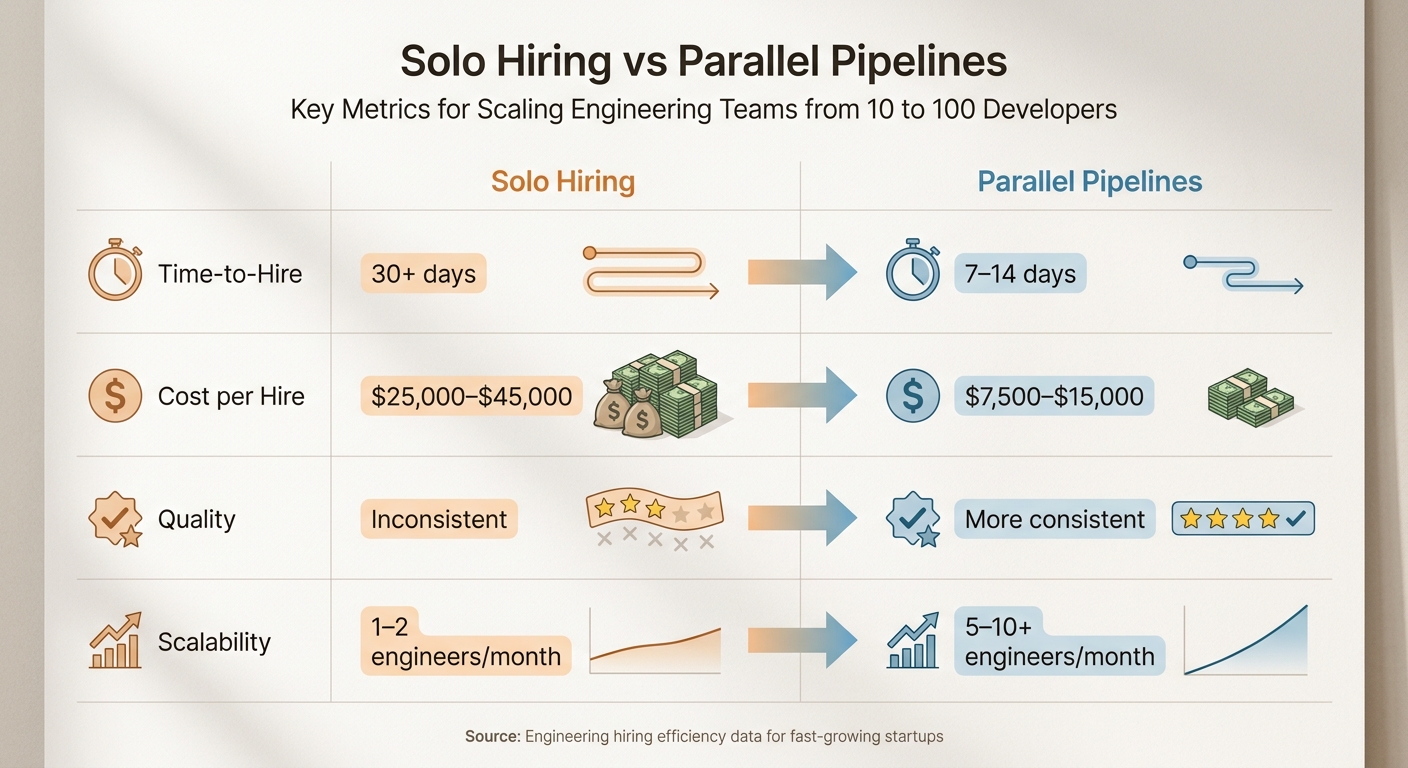
The shortcomings of traditional solo hiring become obvious when compared to a well-structured parallel pipeline approach. Here’s a side-by-side breakdown:
| Metric | Solo Hiring | Parallel Pipelines |
|---|---|---|
| Time-to-Hire | 30+ days | 7–14 days |
| Cost per Hire | $25,000–$45,000 | $7,500–$15,000 |
| Quality | Inconsistent | More consistent |
| Scalability | 1–2 engineers/month | 5–10+ engineers/month |
Solo hiring, often led by founders or a single recruiter, is slow and prone to bottlenecks. It also tends to produce inconsistent results due to the lack of standardized evaluations. On the other hand, parallel pipelines spread the workload, use scorecards to ensure fair evaluations, and leverage automation to speed up candidate screening.
The cost difference is also striking. Solo hiring often relies on expensive external agencies, which can charge 20–25% of a candidate's first-year salary. Parallel pipelines, by contrast, save money through employee referrals and internal tools.
But the real game-changer? Scalability. A founder-led hiring process might bring in 1–2 engineers a month, while a well-organized parallel system can onboard 5–10 or even more without compromising quality. That’s the level of efficiency you need when doubling your engineering team in just six months.
Maintaining Interview Quality at High Volume
When you're hiring 5–10 engineers each month, it's easy for evaluations to lose consistency. Interviewers might rely on personal judgment rather than sticking to data-based standards. That’s a problem because defined criteria can boost hire quality by 26%, but only if those criteria are consistently applied.
To keep quality high without slowing down the process, you need systems that work at scale. This means creating standardized evaluation tools, training interviewers to use them effectively, and setting clear decision-making guidelines. A structured approach ensures that as hiring volume grows, evaluation quality doesn’t take a hit.
Setting Up Calibrated Rubrics and Evaluation Criteria
A strong evaluation process starts with two tools: a scorecard and a rubric. A scorecard outlines what you’re assessing (e.g., technical skills or collaboration), while a rubric explains how to score each area with clear, observable behaviors. As Calvin D., Head of Enterprise Solutions at Rework, puts it: "A scorecard without rubrics is just a form people fill out based on gut instinct."
To keep things consistent, group similar roles into "role families" and define 7–10 core competencies for each group. For example, engineering roles might share criteria like technical depth, code quality, and communication skills.
Rubrics are powerful tools. They can cut scoring inconsistencies between interviewers by as much as 40%. Here’s an example of how a rubric might define prioritization skills:
| Rating | Label | Description (Prioritization) |
|---|---|---|
| 4 | Exceptional | Identified constraints before prioritizing; used a clear framework (impact/effort); made explicit trade-offs |
| 3 | Strong | Used a reasonable method with minimal prompting; made trade-offs with clear business rationale |
| 2 | Developing | Prioritized based on gut instinct; trade-off reasoning was unclear or post-hoc |
| 1 | Does not meet bar | Could not prioritize a backlog without significant guidance; no clear method applied |
Certain competencies - known as "knockout competencies" - should carry extra weight. For example, a backend engineer might need to score at least a 3 out of 4 in code quality to move forward, regardless of their overall score. This prevents teams from making quick but risky hires just to fill open roles.
Training Interviewers for Consistent Assessments
Even the best rubrics won’t help if interviewers don’t use them correctly. That’s why training is crucial. Provide concise sessions that cover the importance of competencies, how to apply rubrics, and how to handle debrief logistics.
Calibration exercises are especially effective. Have interviewers independently score a recorded 20-minute interview using your rubric. Then, compare scores and resolve differences by referring to the rubric’s behavioral anchors. This helps everyone align on what separates a "3" from a "4."
Stripe provides a great example of how this can work. Between 2016 and 2017, the company quadrupled its engineering team while maintaining quality. Raylene Yung, an engineering leader at the time, personally attended every "Candidate Review" session for six months to train reviewers. These sessions involved experienced reviewers examining all interview results to ensure decisions were based solely on documented evidence. The result? Feedback became more detailed and consistent. Rejected candidates even rated their interview experience an average of 4.1 out of 5, thanks to the transparent and structured process.
To further strengthen evaluations, make the "Evidence/Notes" column mandatory on scorecards. Rotate interview responsibilities across the team to prevent burnout among senior engineers and to help junior staff develop their evaluation skills. With well-trained interviewers, final hiring decisions become quicker and more reliable.
Decision-Making Frameworks for Fast Hiring
Speed is critical when competing for top talent. Set a firm rule: all scores must be submitted before the debrief call. This avoids "anchoring", where the first person to speak influences others’ opinions. As Calvin D. explains: "The debrief is where the scorecard either works or fails."[24]
During debriefs, focus on areas of disagreement. If one interviewer rates code quality as a 2 and another gives it a 4, dig into the specific evidence each person observed. Avoid letting discussions drift into vague judgments like "culture fit".
To stay competitive, aim for a 24-hour decision window after interviews. Before the process begins, define a minimum acceptable total score. For instance, you might decide that candidates scoring below 3.0 across all competencies are automatic "no’s", no matter how likable they seem.
Finally, conduct quarterly audits of scoring patterns. If an interviewer consistently rates everyone too high or too low, they likely need recalibration training. This feedback loop helps you catch and correct issues before they impact the broader hiring process.
Common Mistakes When Scaling Hiring
Scaling an engineering team from 10 to 100 members is no small feat. The pressure to fill roles quickly can lead to shortcuts that harm both team culture and productivity. The most common pitfalls include lowering hiring standards, prioritizing pedigree over proven skills, and outpacing onboarding capacity.
Lowering the Hiring Bar: Risks and Long-Term Costs
When companies rush to meet aggressive hiring goals, they sometimes compromise on quality. But hiring even one underperforming engineer can have a ripple effect. As Martin Bernard points out:
"One mediocre hire at this scale does not just fill a seat poorly. They influence the engineers hired after them and can poison team dynamics for everyone who follows."
These hires often participate in interviews, vote on future candidates, and inadvertently lower the bar for what qualifies as "good enough." High-performing team members notice this decline and may leave rather than work alongside those who aren't meeting expectations.
The damage doesn't stop there. Poor hiring practices - like disorganized interviews or ghosting candidates - can tarnish your company's reputation. Bernard refers to this as a "brand tax":
"The candidates you reject become your reputation in the market. Slow feedback, disorganized interviews, and ghosting candidates create a brand tax you will pay for years."
To avoid these issues, consider creating a hiring committee to oversee decisions across teams, ensuring that no manager lowers the bar under pressure. Track metrics like 90-day retention and time-to-productivity to identify early warning signs of quality issues. Regular calibration sessions can also help hiring managers align on what qualifications for roles like "Senior Engineer" actually mean.
Next, shift your focus to evaluating candidates based on their skills, not just their credentials.
Over-Indexing on Pedigree Instead of Skills and Fit
In a rush to hire, it’s tempting to rely on shortcuts like prestigious degrees or big-name employers. While these credentials might seem like a safe bet, they don’t guarantee a candidate's ability to excel in your specific environment.
This approach can lead to two major problems: overlooking talented candidates with non-traditional backgrounds and hiring individuals who look impressive on paper but struggle with your team’s challenges or culture.
A better strategy is to evaluate candidates based on their actual skills and how well they align with your team’s working style. Use structured interviews and calibrated rubrics to assess what candidates can do, rather than where they’ve worked. While this requires more effort upfront, it results in hires who are better equipped to contribute effectively and stay with the team longer.
Ignoring Onboarding Capacity While Scaling Teams
Even if you hire the right people, failing to onboard them effectively can lead to high turnover and wasted resources. Bringing on 50 engineers who leave within six months due to poor onboarding is far worse than hiring 30 who stay and thrive. As Bernard explains:
"Hiring fifty engineers who churn at six months because they never got properly ramped is worse than hiring thirty who stay and become productive."
As teams grow, informal onboarding methods - like shadowing - become less effective. New hires can’t rely on simply observing colleagues when there aren’t enough experienced team members to guide them. Mikael Danielian highlights the importance of documentation in these situations:
"You need enough documentation that a new hire can orient themselves without shadowing someone for two weeks."
Onboarding is especially challenging in remote environments. Jessica Popp, Operating Advisor at Bessemer Venture Partners, emphasizes this point:
"It's really hard for engineers out of college and even L2 engineers to get the support and learning opportunities they need within a remote company. So much of what we learn is through osmosis."
To address these challenges, track metrics like time-to-productivity - how long it takes a new hire to make their first production contribution. Document key processes, such as how work moves from idea to production or how code reviews are handled. Break down six-month retention rates by hiring source and interviewer to identify weak spots in your selection or onboarding process. If onboarding can’t keep up with hiring, slow down. It’s better to leave roles unfilled than to hire people who never become productive.
Filling Specialized Roles with Community-Sourced Platforms
Finding niche engineering talent - like AI specialists, machine learning engineers, or data scientists - through traditional job boards can feel like an exercise in futility. These professionals often aren't actively job hunting. Instead, they're deeply engaged in building products, improving their skills, and participating in technical communities. By the time a job posting reaches them, they've likely moved on to other opportunities or challenges.
Community-sourced platforms tackle this issue by connecting with developers where they already spend their time. Instead of relying on impersonal cold emails, these platforms allow you to engage with engineers who are already open to exploring the right opportunity. This shift from mass outreach to targeted connections saves time and effort, cutting down on dead-end interactions. For startups, targeting niche talent through these platforms ensures even the most specialized roles are filled efficiently, reinforcing growth without compromising on quality. It’s a smart addition to any scalable hiring strategy.
How daily.dev Recruiter Simplifies Specialized Hiring
daily.dev Recruiter is designed to address the challenges of hiring passive, specialized talent. Unlike methods that rely on outdated profiles or scattershot messaging, this platform connects you with developers who are actively using it to stay informed and grow in their fields. Importantly, every introduction is double opt-in - both the company and the candidate show interest before a conversation begins.
This approach is especially valuable for hiring roles like AI engineers or machine learning specialists. Beyond technical expertise, these hires must align with your startup’s culture and pace. As Jessica Popp, Operating Advisor at Bessemer Venture Partners, explains:
"If you're going to invest in AI talent, it should be because AI is core to your product... I would hire one senior scientist who I really trusted, and make that one my very expensive hire."
daily.dev Recruiter enhances this process by offering precise targeting options. You can filter candidates based on specific programming languages, frameworks, or experience levels before reaching out. This pre-screening ensures your engineering team focuses only on candidates who meet your needs. For startups scaling rapidly - from 10 to 100 engineers - this efficiency is essential. It’s not just about hiring quickly; it’s about hiring the right people who can contribute meaningfully.
Case Studies: Speeding Up Niche Developer Hires
Community platforms succeed in specialized hiring because they tap into a pool of engaged, passive candidates. With over 62% of developers citing the difficulty of finding qualified talent as a major challenge for companies, traditional methods like job boards or LinkedIn outreach often fall short for niche roles.
By using platforms rooted in developer communities, startups can avoid the inefficiencies of traditional hiring. Mayank Pratap Singh, Co-founder & CEO of Supersourcing, highlights this point:
"Scaling engineering teams from 10 to 100 developers isn't about hiring faster, it's about hiring smarter."
Engaging with candidates who are already consuming technical content reduces wasted interviews and accelerates the hiring process.
The key is to treat these platforms as a central part of your hiring strategy, not just a fallback option. Start by clearly defining your role requirements - what challenges will this AI engineer tackle in their first 90 days? What level of technical expertise is needed, and how much adaptability is required? Then, use the platform’s targeting tools to find candidates who fit those criteria. The result? Fewer irrelevant interviews, higher offer acceptance rates, and specialized roles filled in a matter of weeks rather than months. These outcomes underline why integrating community-sourced platforms is essential for scaling your team effectively.
Key Metrics to Track During Scaled Hiring
Scaling your hiring process - especially when growing from 10 to 100 engineers - requires more than intuition. To avoid wasting time and resources, you need clear, measurable metrics. These metrics will help you spot bottlenecks, identify the best candidate sources, and ensure your offers stay competitive. Without tracking the right numbers, you risk an inefficient process that drains both money and engineering hours.
Three key metrics stand out: time-to-fill, which measures how quickly candidates move through the hiring pipeline; quality of hire, which ensures you’re maintaining high standards; and offer acceptance rate, which reflects how effective you are at closing candidates. Monitoring these consistently helps you address problems early, keeping your growth plans on track.
Time-to-Fill: Measuring Hiring Efficiency
Time-to-fill measures the number of days from opening a job requisition to a candidate accepting your offer. This metric highlights delays in your pipeline, whether they stem from resume screening, scheduling interviews, or decision-making. For example, if your hiring process takes more than 14 days, you could face a 40% rejection rate, as top candidates often accept competing offers during prolonged delays.
To improve, break down time-to-fill into stages: from job posting to the first interview, between interview rounds, and from the final interview to the offer. If you notice candidates dropping off at specific stages, it might indicate a scheduling issue or a need for faster screening. Tools like AI-driven sourcing platforms or embedded recruiting partners can help. For instance, embedded recruiters often deliver results within two weeks.
Once you’ve optimized the pipeline, track how quickly new hires become productive to ensure efficiency doesn’t compromise onboarding.
Quality of Hire: Balancing Speed with Candidate Standards
Quality of hire measures whether new employees are meeting expectations and contributing effectively. Key indicators include 90-day retention rates (the percentage of hires still with your company after three months), six-month retention rates, and time-to-productivity (how long it takes a new hire to deliver meaningful work).
For example, at Stripe, 90% of new engineers understand the technical stack by the end of their onboarding program. This success stems from consistent evaluation rubrics and regular calibration sessions, which ensure the hiring bar stays steady as the team grows.
To assess quality, survey hiring managers 90 days after each hire. If satisfaction scores are low, it might point to gaps in your interview process or technical assessments.
Now, let’s look at how to improve your ability to close top candidates with a strong offer acceptance rate.
Offer Acceptance Rate: Improving Candidate Closing Rates
Offer acceptance rate (OAR) shows how effective you are at convincing candidates to join your team. A low OAR can indicate issues with compensation, the candidate experience, or how you present the role. For instance, employee referrals often lead to faster hires and better retention. In fact, referrals are five times more likely to result in accepted offers compared to job boards.
If your OAR falls below 70%, it’s time to audit your closing process. Are delays in extending offers causing candidates to lose interest? Are equity packages unclear? These factors can hurt your ability to land top talent. Additionally, a poor hiring experience can damage your reputation - 77% of candidates who have a negative experience share it with their networks.
To improve, streamline feedback loops, clearly communicate the role’s impact during interviews, and ensure your compensation aligns with market rates. These steps can help boost your acceptance rate and attract stronger candidates.
| Metric | How to Measure | Target |
|---|---|---|
| Time-to-Fill | Days from job post to offer acceptance | <14 days |
| Quality of Hire | 90-day retention; hiring manager satisfaction (1-5 scale) | >80% retention; >4.0 satisfaction |
| Offer Acceptance Rate | (Accepted Offers / Total Offers) × 100 | >70% |
Conclusion
Scaling an engineering team from 10 to 100 members requires laying the groundwork for growth well ahead of time. Mikael Danielian sums it up perfectly:
"The 10-person engineering team is a prototype of an engineering organization, not the real thing" .
To prepare for that growth, focus on documenting your culture, creating standardized evaluation rubrics, and implementing squad-based structures to reduce dependencies. These steps are crucial for ensuring stability as your team expands.
The challenges are clear: over 62% of developers cite hiring qualified talent as one of the biggest hurdles for companies . A single poor hire can lead to soaring costs . Compromising on standards during rapid growth doesn’t just hurt short-term productivity - it can disrupt team dynamics and affect future hiring decisions.
Keeping an eye on key metrics like time-to-fill, quality of hire, and offer acceptance rate is essential to spotting potential bottlenecks. For instance, if your hiring process stretches beyond 14 days, you could face a 40% offer rejection rate . Similarly, a drop in 90-day retention often signals a disconnect between your hiring process and the actual role.
As your hiring process matures, leveraging the right tools becomes essential. Platforms like daily.dev Recruiter simplify the process by connecting you with pre-qualified developers in a double opt-in system. This eliminates the need for cold outreach and lengthy screening calls, allowing you to engage with engineers actively seeking relevant opportunities. It’s a faster, more respectful approach that aligns with developers' expectations.
Successful companies treat hiring as a central function, not just a support task. By combining structured processes, adequate recruiting resources, and tools that connect with developers where they already are, you can scale your team while safeguarding your culture and maintaining quality. A disciplined hiring strategy not only meets immediate growth needs but also ensures your team’s core values and standards remain intact.
FAQs
How do I set a hiring bar that stays consistent as we scale?
To keep hiring standards consistent as your startup expands, it's crucial to set up structured processes from the start. Develop clear evaluation rubrics, train your interviewers thoroughly, and use decision-making frameworks to ensure every candidate is measured against the same criteria. Make it a habit to revisit and fine-tune your interview standards regularly. Also, track important metrics like the quality of hires and offer acceptance rates to maintain consistency, even when you're hiring at a faster pace.
What’s the fastest way to run parallel hiring pipelines without chaos?
To handle multiple hiring pipelines at once without creating chaos, prioritize clear organization and consistent quality. Implement calibrated rubrics to standardize evaluations, train interviewers thoroughly, and set up clear decision-making frameworks. These steps ensure that parallel searches can move forward smoothly, avoiding confusion while keeping evaluation standards high.
How can we speed up hiring without hurting onboarding and retention?
To speed up hiring without sacrificing onboarding quality or retention, consider transforming your engineers into recruiters by offering thoughtful referral incentives. This approach can lead to quicker hiring cycles while bringing in top-notch talent through trusted networks.
At the same time, ensure consistency and fairness by implementing scalable processes. Use well-defined interview frameworks and rely on trained interviewers to maintain high standards. To support retention and long-term success, plan ahead with structured onboarding programs that help new hires integrate seamlessly and contribute effectively as your team grows.
.png)