Building a developer talent community is about creating an interactive space where developers connect, share, and grow - not just a list of potential hires. Unlike traditional hiring methods, this approach focuses on long-term engagement, offering developers resources, mentorship, and opportunities to network. Here’s how it works:
- Developer Talent Community: A two-way engagement platform for networking and knowledge sharing.
- Talent Pool: A database of pre-screened candidates for future roles.
- CRM (Candidate Relationship Management): A tool to manage data, automate communication, and track engagement.
Key Steps to Build and Maintain a Community:
- Offer Value: Share technical insights, host events, and create content developers find useful.
- Engage Through Events: Organize hackathons, webinars, and mentorship programs.
- Stay Connected: Use newsletters for updates and personalized communication. This is essential for improving response rates when reaching out to potential members.
- Measure Success: Track metrics like active contributors, retention, and engagement depth.
- Leverage Tools: Use CRMs and developer sourcing tools for efficient management.
By focusing on meaningful interactions and genuine engagement, you’ll develop a reliable talent pipeline, reduce hiring time, and build trust with developers.
Developer Talent Community vs Talent Pool vs CRM
::: @figure 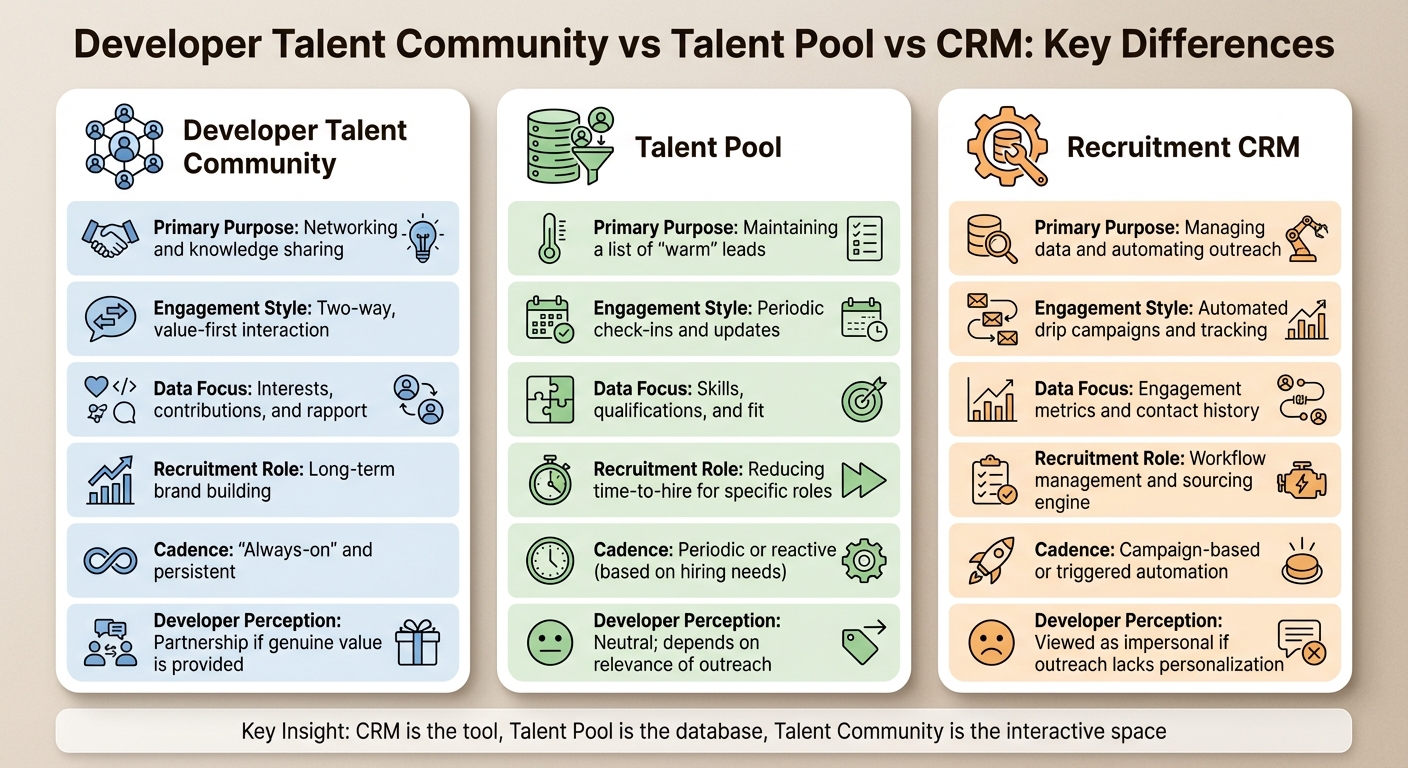 {Developer Talent Community vs Talent Pool vs CRM Comparison}
Definitions and Core Functions
Before diving into your recruitment strategy, it’s important to clarify the roles of three key elements: developer talent communities, talent pools, and CRMs.
A developer talent community is an active space centered around engagement, where professionals can connect and share insights. The focus here isn’t on recruitment but on creating a place for networking and knowledge exchange. As LogicMelon explains:
"To get the attention of candidates in a talent community, start by sending in your own best and brightest to build up a rapport. They should set out to strengthen your employer brand and convince other members that recruitment is secondary to knowledge sharing."
On the other hand, a talent pool is more passive. It’s essentially a database of pre-screened candidates who could be a good fit for future roles, often identified through proactive sourcing strategies. This group might include individuals who came close in previous hiring rounds, past applicants, or even developers who expressed interest but weren’t ready to make a career move.
A CRM (Candidate Relationship Management system) ties everything together. It’s the tool that manages your data, automates communication, and tracks engagement across both your talent pool and community. According to Gartner, by 2027, 80% of recruiting tech platforms will incorporate AI features. A good example of this in action comes from ClearCo. In May 2023, their talent acquisition team - led by Brian Abraham - used their CRM and ATS integration to achieve a time-to-hire of just 21 days. By texting 99% of their candidates, they were able to significantly outperform the market average of 45+ days.
To summarize the relationship: your CRM is the tool, your talent pool is the database within that tool, and your talent community is the interactive space where candidates actively engage.
Comparison Table: Community vs Talent Pool vs CRM
| Feature | Developer Talent Community | Talent Pool | Recruitment CRM |
|---|---|---|---|
| Primary Purpose | Networking and knowledge sharing | Maintaining a list of "warm" leads | Managing data and automating outreach |
| Engagement Style | Two-way, value-first interaction | Periodic check-ins and updates | Automated drip campaigns and tracking |
| Data Focus | Interests, contributions, and rapport | Skills, qualifications, and fit | Engagement metrics and contact history |
| Recruitment Role | Long-term brand building | Reducing time-to-hire for specific roles | Workflow management and sourcing engine |
| Cadence | "Always-on" and persistent | Periodic or reactive (based on hiring needs) | Campaign-based or triggered automation |
| Developer Perception | Partnership if genuine value is provided | Neutral; depends on relevance of outreach | Viewed as impersonal if outreach lacks personalization |
The main difference lies in how engagement is approached. CRMs and talent pools are company-focused and transactional, designed to move candidates through a hiring funnel. Developer communities, however, are collaborative and peer-focused, thriving on authentic, human connections. Success in these communities comes from offering value first, rather than jumping straight into recruitment.
As Darren Yuen from Iron Horse notes:
"A company should never join [a community] if they have no intention of engaging on a regular basis. Developer audiences can always spot imposters and will likely disengage with brands that seem to only participate out of self-interest."
Hiring engineers?
Connect with developers where they actually hang out. No cold outreach, just real conversations.
How to Build a Developer Talent Community
Start by focusing on providing genuine value rather than treating developers as mere entries in a recruitment database. Developers lose interest quickly if they feel like they're just another name on a list. Instead, create a space where they genuinely want to engage - a community that’s not constantly pushing job opportunities but offering something meaningful. This approach helps lay the groundwork for a strong talent pipeline.
The key is straightforward: offer resources developers truly need, host events that address real-world challenges, and maintain thoughtful, ongoing communication. These efforts build trust and position your company as a partner in their professional journey, not just another recruiter trying to meet hiring goals.
Create Content That Developers Actually Want
Developers are drawn to content that helps them solve technical problems or advance their careers. This means producing materials like technical deep-dives, architecture breakdowns, debugging guides, and discussions on engineering trade-offs. Skip the corporate fluff - developers value authentic, technical content over marketing spin.
Content written by developers for developers carries far more weight than pieces crafted by marketing teams. Share real code examples, explain why you chose one framework over another, or recount how you scaled a system to handle a growing user base. Hosting Q&A forums where developers can interact with your team also boosts credibility. The bottom line? Be authentic - developers can quickly spot content that’s just a thinly veiled sales pitch.
Don’t forget to address career growth. Highlight the technical challenges your team is tackling, showcase the new technologies you’re exploring, or explain the learning opportunities you provide. This positions your company as a place where developers can grow their skills and thrive, not just clock in for a paycheck.
Once you’ve established a foundation of great content, create opportunities for direct interaction to deepen these connections.
Host Events and Support Open Source Projects
Events offer a level of connection that blogs and emails simply can’t replicate. Hackathons, webinars, and tech talks let developers experience your team and engineering culture firsthand. Even small-scale virtual meetups held monthly can build momentum over time.
Supporting open source projects is another way to earn trust within the developer community. Contribute to the tools your team uses, sponsor maintainers, or open-source some of your internal projects. These actions show that your company is an active participant in the open source ecosystem, not just a passive consumer.
Importantly, don’t treat every event as a recruiting pitch. Let developers interact with your team, learn something valuable, and leave with a positive impression. When the time is right, recruitment conversations will happen naturally.
To keep the dialogue going, complement these events with regular, targeted communications.
Use Newsletters to Stay Connected
Newsletters are a great way to keep your community engaged between events and content releases - but only if done right. The biggest mistake? Using newsletters as glorified job boards and spamming your list with open roles. As Metaview points out:
"Nurturing your community isn't just spamming job ads. You need to stay relevant and human."
Instead, focus on value-driven content such as employee stories, behind-the-scenes updates on projects, and career advice. Segment your audience based on skills, experience, or interests so that each developer receives content tailored to their background. For instance, a front-end engineer might care more about updates to a design system than about DevOps hiring news.
A quarterly newsletter cadence works well - frequent enough to stay on their radar but not so often that it clutters their inbox. Use behavioral triggers to personalize follow-ups: if someone clicks on an article or downloads a resource, send them related content instead of generic updates. Monitoring metrics like open rates and click-through rates will help you identify what works and refine your approach. As Metaview emphasizes:
"Personalization shows attention to detail and reinforces that your company sees each candidate as an individual, not a number in a database."
How to Nurture Passive Candidates Without Being Spammy
One common mistake recruiters make is turning every interaction into a sales pitch. Instead of diving straight into job openings, focus on understanding a developer's long-term career goals and professional interests. As Samantha McLaren from LinkedIn's Talent Blog puts it:
"Contacting candidates too often can come across as a hard sell, while leaving them hanging for long periods with no contact might cause them to lose interest altogether" .
A good starting point? Ask candidates how often they’d like to be contacted and through which channel - email, LinkedIn, or something else. This approach respects their time and ensures your communication isn’t intrusive. It also ties back to the idea of tailoring interactions with meaningful, personalized updates. If you’re reaching out without an open role in mind, be upfront about it. Many developers appreciate this kind of transparency, finding it refreshing rather than off-putting .
Rather than pushing roles, focus on providing value. Share content like industry reports, career tips, or behind-the-scenes insights that could genuinely benefit them - even if they aren’t actively looking for a job. Use natural touchpoints, like LinkedIn notifications, to congratulate them on milestones such as work anniversaries or achievements. This type of thoughtful engagement beats generic "just checking in" messages every time . Companies with active talent pipelines also see measurable benefits, filling roles three times faster and cutting costs by 40% compared to starting from scratch .
Another great way to connect with passive candidates is by inviting them to low-pressure events. Coding challenges, tech talks, or hackathons let developers engage on their own terms. Vivek Ravisankar, Founder and CEO of HackerRank, explains:
"The key to all of this is that it's voluntary. The choice is with the developers - if they enjoy coding, if they want to prove their skills and knowledge to others in the community" .
The voluntary nature of these events is crucial. They provide developers with a chance to showcase their skills without the stress of a formal interview.
Finally, consider using a CRM to manage candidate interactions. A CRM helps centralize communication, set reminders based on their timelines, and avoid over-contacting. This ensures you don’t lose touch or let leads go cold . Plus, approximately 70% of candidates reached through cold outreach may not align with your needs anyway. Engaging them through community-driven initiatives helps pre-qualify candidates before active recruiting even starts .
Developer Community Engagement Strategies
Building a vibrant developer community requires more than just assembling a list of contacts - it’s about creating meaningful connections and offering real value. Developers thrive when they have opportunities to learn, collaborate, and grow. The best strategies focus on what developers want by delivering value first, with recruitment naturally following. Here’s how to bring that approach to life.
Run AMAs and Tech Talks
Live sessions like AMAs (Ask Me Anything) and tech talks are fantastic for building trust and fostering real interaction. AMAs give leaders a chance to answer developer questions in real time, creating a level of transparency that goes beyond polished marketing. Meanwhile, tech talks on topics like emerging technologies, best practices, or case studies provide developers with actionable insights.
For example, GitHub’s monthly AMAs with open-source maintainers have boosted engagement by 40% and increased contributions within their ecosystem . Similarly, Netflix’s tech talks - shared through their engineering blog and live streams - have attracted over 100,000 subscribers, many of whom later became passive candidates .
To make these sessions effective:
- Keep them consistent: schedule 30–60 minute sessions regularly.
- Promote them at least two weeks in advance.
- Follow up with recordings and key takeaways to ensure the value extends beyond the live event .
Organize Hackathons and Mentorship Programs
Hackathons and mentorship programs are excellent ways to build a sense of belonging and encourage active participation. Hackathons, especially when centered on real-world challenges like developing AI tools or optimizing data pipelines, not only spark innovation but also let developers showcase their skills. To make these events successful:
- Offer prizes ranging from $500 to $5,000.
- Use platforms like Devpost to manage submissions.
- Have your engineers serve as judges for added credibility .
Mentorship programs are equally impactful. Pairing junior developers with senior engineers for monthly one-hour sessions can focus on career advice, code reviews, or project guidance. According to the LinkedIn Workplace Learning Report, mentorship can increase engagement by 35% and cut time-to-hire for technical roles by 20% for tech companies . Hackathons, on the other hand, deliver even greater results - Major League Hacking reports that they generate four times more qualified referrals, with 70% of participants feeling a stronger connection to the brand .
Start small with 10–20 participants, track progress, and celebrate milestones to build momentum. These initiatives not only strengthen your community but also align perfectly with a value-first recruitment strategy, nurturing long-term relationships with talented developers.
How to Measure Community Health
A thriving developer community isn't just about numbers - it’s about meaningful engagement and real value. Measuring community health is critical because a strong community directly supports a robust developer talent pipeline. Interestingly, 87% of community teams focus on engagement volume rather than quality, which can lead to misleading conclusions about the community’s actual health . To ensure your community is truly contributing to your recruitment efforts, focus on metrics that matter.
Track These Key Metrics
The best approach to gauging community health is to monitor metrics across three levels: surface, value, and business impact. One key metric is Monthly Active Contributors (MACs) - those who add value by writing code, creating content, or offering peer support .
Retention is another critical indicator. Aim for 25–40% of first-time contributors to return within 90 days. Falling below this range could point to issues with onboarding or content relevance. Tracking return rates at 90 and 180 days provides insights into long-term engagement and stability.
The peer-to-peer support ratio is a strong indicator of a self-sustaining community. This measures how many questions are answered by community members versus your internal team. A low ratio suggests over-reliance on staff, which isn’t scalable. Empowering volunteer leaders can reduce your team’s workload by as much as 40% . This metric also ties directly to operational efficiency.
It's also important to measure engagement depth, not just attendance. For example, at events, track live participation through questions and polls rather than just RSVPs. Communities that focus on engagement depth often see up to 30% more post-event contributions and better retention rates .
| Engagement Level | Metrics to Track | Strategic Goal |
|---|---|---|
| Surface Level | Message count, member growth, event attendance | Awareness and reach |
| Value Level | Knowledge creation, peer support, technical problem-solving | Community health and utility |
| Business Level | Product adoption, churn reduction, organic advocacy | ROI and recruitment pipeline |
Data source: .
Once you’ve gathered data, the next step is turning those insights into actionable strategies.
Use Data to Improve Your Strategy
Start by developing a 60-day metrics roadmap. In the first two weeks, audit your current tracking methods and define what an "active contributor" means for your community. By day 60, focus on cohort analysis and business impact reporting .
To understand community value, weight contributions by their impact. For instance, assign higher scores to significant contributions like merged pull requests and lower scores to minor activities like typo fixes. If your data reveals lots of low-impact activity, consider shifting your strategy to encourage more impactful contributions, such as core feature development or technical documentation . A Business Impact Score can help quantify the value your community creates.
Regularly analyze returning contributors to identify common traits among those who remain active. Look for patterns like participation in specific events or mentorship programs, and replicate these success factors. Use tools like your CRM and ATS to calculate Quality of Hire by dividing the number of hires from a source by the total candidates from that channel, then multiplying by 100 .
"Developer communities aren't social networks. They're technical collaboration systems where quality trumps quantity every single time." - Mindy Faieta, Stateshift
Additionally, track organic advocacy signals such as unprompted mentions on platforms like Stack Overflow, Reddit, and GitHub. These signals can help you identify potential community champions who could take on leadership roles or join beta programs . Community-engaged users often show 15–30% higher lifetime value and adopt new features 25–40% faster , making them valuable not just as contributors but also as long-term assets to your talent pipeline.
Setting up a comprehensive measurement system can cost between $500 and $2,000 per month . However, many effective tools, like GitHub Insights and Google Alerts, are free. By refining your metrics, you’ll not only enhance community engagement but also create a smoother path for transitioning members into your recruitment pipeline.
Tools for Managing a Developer Talent Community
Managing a developer talent community effectively requires more than spreadsheets and manual tracking. As your community grows, scaling operations becomes critical, and the right tools can automate repetitive tasks while maintaining meaningful, personalized interactions. This balance of efficiency and engagement is key to building trust and keeping your community thriving.
CRM Platforms and Email Automation
A Customer Relationship Management (CRM) platform turns a simple database into a dynamic system for managing relationships. Tools like Phenom, BambooHR, and ClearCompany centralize candidate data, enabling segmentation based on technical skills, experience, and engagement history . This segmentation ensures that outreach is targeted and relevant - for example, avoiding the mistake of sending backend development content to a frontend developer.
CRMs equipped with AI can analyze profiles, identify skill gaps, and automate personalized follow-ups. For instance, if a developer downloads a technical resource or clicks on a job posting, the system can automatically send them related content, eliminating the need for manual tracking . This automation ensures that no candidate is overlooked.
A great example of CRM success comes from Romanian healthcare provider Regina Maria, which used Jobful's platform to build a talent community of over 100,000 members in just 18 months. By incorporating gamification, courses, and virtual career fairs, they streamlined their hiring process, reducing time-to-fill for roles from over 60 days to just 25–30 days. They also processed over 1,000 candidates monthly. A Regina Maria representative highlighted the transformation:
"We're no longer reactive - we have warm pipelines for every role type. When positions open, we're contacting engaged candidates within hours, not weeks" .
But CRMs are just part of the equation. For technical communities, specialized platforms are essential.
Community Platforms Built for Developers
While CRMs handle candidate management, developer-specific community platforms are designed to foster technical collaboration. Generic community tools often fall short for developers, who need features tailored to their work - like public repository integration, shareable code snippets, and technical challenge modules. These features provide real value beyond recruitment .
For example, HEINEKEN launched its "Academia de bere" program using Jobful's courses and challenge modules. This initiative not only educated and pre-qualified candidates but also led to higher retention rates and faster onboarding. The program even won a "Best New Launched Program" award . Gamification elements, such as points, badges, and leaderboards, can further boost engagement by up to three or four times when implemented thoughtfully .
The cost of these tools varies. Jobful offers modular pricing at $300 per month per module, with starter packages beginning at $600 per month . Other options include SC Training, which is free for up to 10 users, Zoho People starting at $14 per user per month, and Lattice at $11 per seat per month . While these investments may seem significant, they pay off by reducing time-to-hire by 40% and cutting cost-per-hire by 35%, shrinking traditional hiring timelines from 11–19 weeks to just 6–9 weeks .
Turn Community Members into Referral Sources
Tap into the full potential of your developer talent community by turning active participants into reliable referral sources. Referrals aren't just a small part of hiring - they're a game-changer. While referred candidates make up just 7% of applicants, they account for 40% of all hires. Plus, they’re hired 55% faster than job board applicants and are 45% more likely to stick around for at least two years .
Timing matters. The best time to ask for a referral? Right after a positive interaction. Whether it's following a strong interview, an engaging event, or a tech talk that sparks interest, this is when enthusiasm is at its peak. According to Harvard Business Review, asking for a referral immediately after such moments can lead to a response rate exceeding 50%. Compare that to a mere 5% when no direct ask is made . This strategy ensures you're asking at the right moment and in the right way.
Streamline the referral process to make it quick and hassle-free - ideally under two minutes with no login required. Instead of a vague "Do you know anyone?" question, provide 3-5 specific job openings and frame the request as an opportunity to help a peer land a great role. For developers, non-cash incentives often resonate more. Think mentoring sessions, tickets to tech events, professional books, or subscriptions to useful tools . These rewards align with their professional interests and reinforce their connection to your community.
Don’t overlook candidates who’ve had positive interactions with your company but weren’t hired. These individuals already understand your culture and technical standards, making them excellent advocates. When the timing isn’t right for their own placement, they can still become powerful referral sources. Notably, 88% of employers consider referrals the best source for candidates who align with both culture and technical skills .
Finally, always close the loop. Acknowledge referrals promptly and keep referrers updated on progress. When people see their efforts are valued and acted upon, they’re more likely to continue sending high-quality candidates your way. This creates a self-sustaining network where your community actively contributes to finding top talent .
How daily.dev Recruiter Leverages an Existing Developer Community
Creating a thriving developer community is no small feat - it requires years of effort, trust, and delivering real value. But with daily.dev Recruiter, you can skip the heavy lifting. The platform taps into an already active network of engaged, continuously learning software engineers, connecting employers directly to this vibrant talent pool.
What makes daily.dev Recruiter stand out is its ability to integrate seamlessly into a developer's daily routine. Instead of relying on static databases, the platform operates within a living, breathing community where developers are constantly reading technical content, staying updated on industry trends, and networking with peers. This means you're engaging with developers who are not just skilled but also actively invested in their professional growth.
Hiring through daily.dev Recruiter shifts from a reactive scramble to a steady, strategic process. Every introduction is warm and double opt-in, ensuring developers never feel bombarded with unsolicited messages. Recruiters, on the other hand, connect only with candidates who are genuinely interested. This eliminates the noise of cold outreach and endless screening calls, allowing recruiters to focus on meaningful conversations with pre-qualified candidates.
The result? Higher conversion rates. Developers who are part of this trusted community are far more likely to respond to outreach, apply for roles, and accept offers. By connecting with them in a space they value and trust, you avoid the pitfalls of interruptive tactics like cold emails.
This approach aligns with a proactive, relationship-driven recruiting strategy. With daily.dev Recruiter, you gain access to a dynamic pipeline of qualified, motivated candidates - all without the hassle of building a community from scratch. The trust and engagement are already there, giving you a faster, more efficient way to fill roles as they open up.
Conclusion
Building a developer talent community requires moving beyond reactive hiring and focusing on proactive relationship-building. The companies that thrive in this space recognize that developers respond best to authentic value rather than impersonal outreach. Cold emails rarely work, with response rates often falling short . Instead, trust grows when you consistently provide value through technical resources, career growth opportunities, and meaningful networking experiences.
This trust becomes the foundation of a thriving developer community. By segmenting your audience for personalized content, tracking key engagement metrics, and hosting interactive events like AMAs or mentorship programs, you can create a sense of belonging - long before candidates even consider applying.
Keep in mind the 70/30 rule: hire for 70% of the skills you need (using a tech candidate fit analyzer can help identify these gaps) and offer the remaining 30% as a chance for growth . The best developers are drawn to roles that challenge them and provide room for development. This approach turns your community into more than just a list of names - it becomes a vibrant network of skilled, motivated professionals who already trust your brand.
The payoff? Higher response rates, quicker hiring processes, and candidates who are genuinely engaged. Regardless of where you begin, the key remains the same: focus on providing value and building trust. Communicate with purpose, treat developers as individuals, and consistently offer value - that’s how you create a talent community that fuels your hiring pipeline and builds lasting connections. By prioritizing trust and value, your talent community evolves into a dynamic, reliable resource for finding the right talent.
FAQs
How do I start a developer talent community with a small team?
Creating a developer talent community doesn’t require a massive operation - small teams can make a big impact by focusing on key strategies. Start by fostering an inclusive space that welcomes developers of all experience levels. This means providing resources that cater to beginners, seasoned professionals, and everyone in between, while actively supporting diversity and representation.
Encouraging meaningful connections is another essential step. Organize meetups, establish mentorship programs, or collaborate on open-source projects. These activities not only strengthen the community but also create opportunities for developers to share knowledge and grow together.
To keep the community engaged, use content that resonates. Think newsletters packed with useful insights, or tech talks featuring industry experts. These types of content can also help attract passive candidates who may not be actively job-hunting but are interested in staying connected with the latest trends.
Finally, monitor the health of your community by tracking metrics like engagement rates and conversions. Simple tools can make managing these processes easier, allowing you to focus on building relationships and growing the community effectively.
What should I track to prove the community improves hiring?
To demonstrate that your community enhances hiring efforts, focus on tracking key metrics such as:
- Conversion rate: The percentage of community members who transition into applicants.
- Time-to-warm: How long it takes for members to become active candidates.
- Engagement rates: Participation levels in activities like AMAs, hackathons, or other events.
Additionally, keep an eye on referrals and the number of positive responses to outreach efforts. These data points can provide insight into how effectively your community nurtures passive candidates and strengthens your talent pipeline.
How do I nurture passive developers without sounding spammy?
To connect with passive developers in a meaningful way, start by establishing trust. Share consistent, relevant content that resonates with their interests and professional goals. Instead of aggressive outreach, focus on providing value - offer helpful resources, updates, and opportunities they’ll appreciate.
Engagement can also come from activities like open-source projects, tech talks, or even hackathons. These create opportunities for genuine interaction and collaboration, making developers feel like part of a community. By prioritizing support and shared growth, you can build relationships where developers feel valued, not pressured.
.png)