Hiring developers is hard when you’re in a rush. That’s why building a talent pipeline early is critical. A talent pipeline means you’ve already connected with pre-vetted candidates who know your company, making hiring faster, cheaper, and less stressful.
Here’s why it matters:
- 89% of organizations face technical skill gaps.
- 73% struggle to find local developers.
- A talent pipeline can cut time-to-hire by 37% and reduce costs by 31%.
The process involves:
- Forecasting future hiring needs: Plan 12–18 months ahead and identify skill gaps.
- Finding passive candidates: Use platforms like daily.dev Recruiter, attend events, and partner with universities.
- Building relationships: Stay in touch with developers through personalized outreach and community engagement.
- Keeping the pipeline active: Regularly nurture your network with value-driven communication.
- Measuring success: Track metrics like time-to-hire, conversion rates, and retention to refine your strategy.
The goal? Always have qualified developers ready when roles open up. By starting now, you can avoid last-minute hiring scrambles and fill positions with the right talent faster.
::: @figure 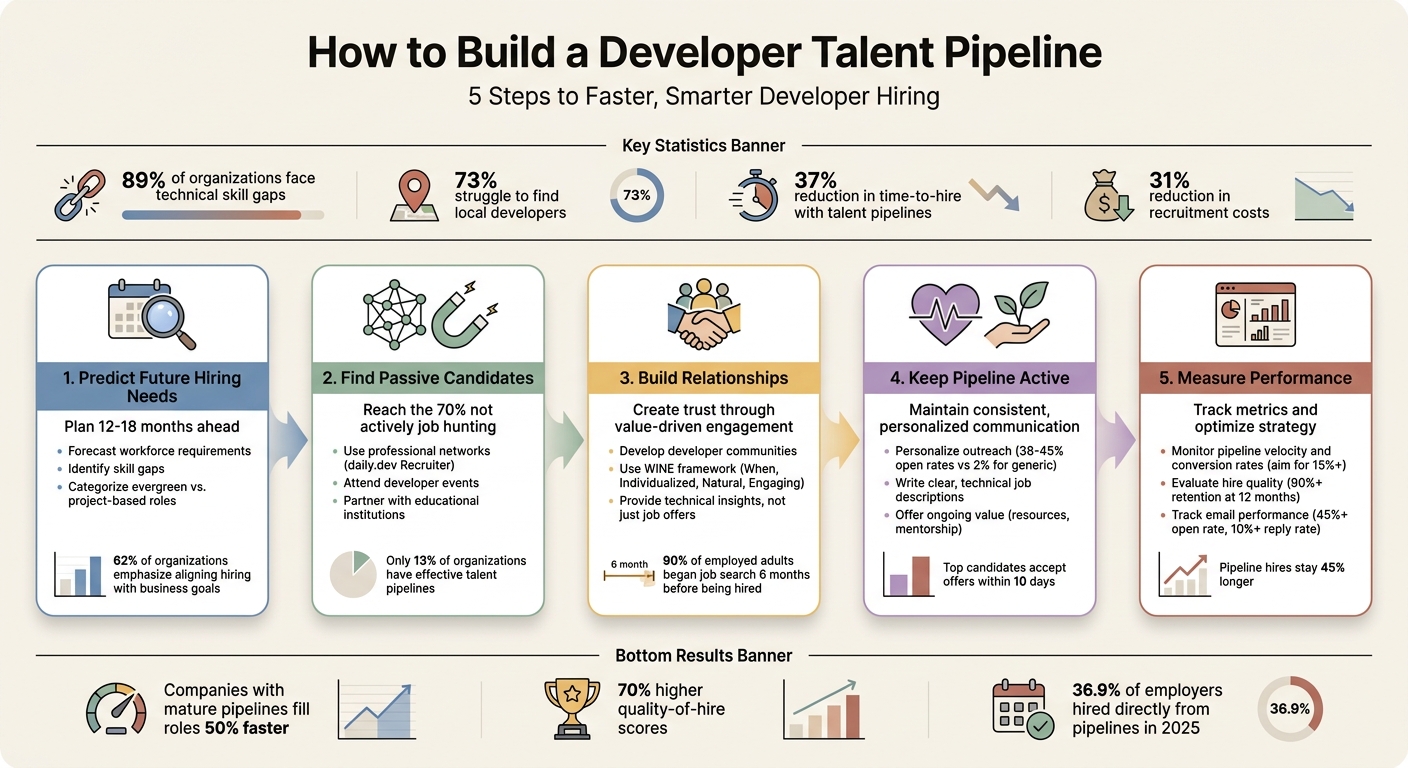 {5-Step Developer Talent Pipeline Building Process with Key Statistics}
Step 1: Predict Your Future Developer Hiring Needs
Plan Your Workforce Requirements
Take a forward-looking approach by planning your workforce needs 12–18 months in advance. This helps align your hiring strategy with your company’s long-term goals. Whether it’s launching a new product, expanding into new markets, or scaling infrastructure, turn these objectives into a clear talent forecast. Collaborate with department heads to understand upcoming priorities and the skills necessary to achieve them .
When planning, categorize developer roles into two groups: evergreen and project-based. Evergreen roles, like Senior Software Engineers, are critical and require a constant recruitment pipeline. On the other hand, project-based roles - such as developers for a mobile app launch - demand focused, time-sensitive hiring efforts. With 62% of organizations emphasizing the need to align hiring with business goals , this step is essential for companies aiming to hire efficiently rather than reactively.
After outlining your future needs, take a close look at your current team. This will help identify the skills required to bridge any gaps, laying the foundation for a proactive talent pipeline.
Find Skill Gaps in Your Team
A skills audit is the best way to uncover gaps between your team’s current capabilities and what’s needed for future projects . For instance, if you’re planning to add machine learning features but lack data engineers, or if you aim to expand into mobile development but only have web developers, these gaps should become your hiring priorities.
Start by focusing on roles that are harder to fill. Senior-level positions and niche specializations, like cybersecurity or DevOps, often take more time to recruit due to their complexity . Create detailed candidate profiles that outline the exact skills and experience you’re seeking . If your hiring strategy includes global recruitment, align your needs with regional expertise and remote hiring strategies. For example:
- Eastern Europe: Known for backend systems and cybersecurity talent.
- Latin America: Strong in full-stack development and DevOps.
- Southeast Asia: Excels in mobile development and QA testing .
This kind of strategic planning is critical, especially when 89% of organizations report that technical skill gaps are slowing their growth .
Step 2: Find Passive Developer Candidates
Once you’ve identified your future needs and skill gaps, the next step is to connect with passive developer candidates. These are the 70% of professionals who are employed and not browsing job boards but might be open to the right opportunity . The challenge? Most companies struggle in this area - only 13% of organizations have effective talent pipelines to reach these passive candidates .
That’s where daily.dev Recruiter comes in. This platform connects you with developers who are already engaged in tech content, learning, and community discussions. Unlike cold outreach on other platforms, every connection here is warm and double opt-in - developers have already expressed interest in hearing from recruiters.
With daily.dev Recruiter, you gain access to pre-qualified developers who are actively using the platform. These professionals see your job postings in context, and if they’re interested, they opt in to connect. This leads to high-quality conversations with candidates who are genuinely open to exploring new roles.
Use Professional Networks
Professional networks are essential for reaching passive talent. daily.dev Recruiter is built on a thriving developer community, where users stay up-to-date with tech news and trends. This makes it a perfect place to connect with developers when they’re engaged and receptive.
The difference lies in the approach. On daily.dev Recruiter, developers aren’t bombarded with generic pitches. Instead, they see tailored job opportunities that match their skills and interests. This targeted engagement leads to higher reply rates compared to traditional cold outreach. Companies using mature talent pipelines like this report filling roles 50% faster and achieving 70% higher quality-of-hire scores .
To maximize your outreach, focus on providing value first. Share insights like industry trends, career development tips, or compensation benchmarks before pitching a role . Research also highlights that 70% of people find jobs through acquaintances, not close contacts . Building these "weak ties" through professional communities can yield great results. Use the WINE framework to guide your outreach: time it right (When), personalize your messages (Individualized), maintain a conversational tone (Natural), and add value (Engaging) .
For an even deeper connection, combine online engagement with in-person interactions.
Attend Developer Events
Developer events - whether in-person or virtual - are another excellent way to meet talented professionals. Hackathons, conferences, and local meetups attract developers who are eager to learn, share, and network. By attending these events, you show your commitment to understanding and supporting the developer community.
Sending a diverse team to these events can help you connect with candidates from various backgrounds while promoting an inclusive work environment. Use these occasions for informational interviews, which are casual conversations to explore potential future roles .
"Meeting a candidate in person is a fast way to start building a relationship that can pay off down the line." – Samantha McLaren, LinkedIn
After meeting someone at an event, follow up quickly on professional networks to keep the conversation fresh . Reference specific skills or topics you discussed during the event - this level of personalization significantly boosts response rates . Ask how they prefer to stay in touch and set reminders to reconnect periodically to nurture the relationship .
Work with Educational Institutions
Another effective strategy is partnering with coding bootcamps, universities, and vocational schools. These institutions are excellent sources for emerging talent. By establishing pathways like internships, apprenticeships, or campus recruitment programs, you can connect with developers early in their careers .
Targeting specific schools can also align with your diversity goals. For example, Historically Black Colleges and Universities (HBCUs) and Hispanic-Serving Institutions (HSIs) can help you build a more diverse talent pipeline . In the U.S., 9% of Black college students attend HBCUs, while 53% attend predominantly white institutions, so casting a wide net is crucial.
Some companies have already seen success with this approach. In 2020, Blackstone launched the Career Pathways program, including the Data Center Academy, to address the growing demand for skilled professionals in data center and AI infrastructure. By 2026, the program is projected to have facilitated over 10,500 hires while also improving talent retention . Similarly, Deloitte combines active campus recruitment with industry partnerships to maintain a steady talent pipeline .
Stay in regular contact with college career centers to remain top-of-mind when graduates begin their job search . These early connections can feed into a long-term recruitment strategy, ensuring a consistent flow of talent for years to come.
Step 3: Build Relationships with Developers
Understanding passive developer needs is just the beginning. To truly succeed, you need to build trust and maintain consistent communication. Here's an eye-opening stat: 90% of employed adults hired in the past year began their job search six months before being hired . This tells us that developers are sizing up potential employers well before they’re officially on the hunt.
To stand out, shift your approach from transactional recruitment to genuine relationship-building. Instead of jumping straight into pitching roles, offer something valuable - technical insights, career resources, or connections with peers. By leading with value rather than a job offer, you create trust that will pay off when the right opportunity arises.
daily.dev Recruiter makes this process easier by connecting you with developers who are already engaged in learning and active discussions. These double opt-in interactions foster mutual interest, which is crucial. After all, candidates trust what employees say about work culture three times more than what companies say themselves .
Create Developer Communities
One of the best ways to stay connected with developers is by creating a community around your company. This allows for regular interactions without the pressure of immediate hiring. The key? Focus on value. Share technical insights, host webinars on relevant topics, and send newsletters packed with industry knowledge - not just job postings.
Think of community engagement in levels:
- Level 1: Basic updates like job alerts and company news.
- Level 2: Exclusive content and early access to roles.
- Level 3: Opportunities for mentorship and skill development.
- Level 4: Turn developers into ambassadors with co-creation programs and referral incentives .
To communicate effectively, use the WINE framework: make it When (timely), Individualized (personalized), Natural (conversational), and Engaging (value-driven) . For example, instead of sending a generic "just checking in" email (which typically gets a 2% open rate), send a technical case study. This approach can boost open rates to 38–45% and response rates to 15–20% .
Here’s an example of a quarterly nurture sequence you could implement:
- Week 1: Share a technical insight, like scaling Kafka to handle 5 billion messages daily.
- Week 3: Invite them to a private Slack group.
- Week 6: Highlight an open-source contribution.
- Week 9: Share an update on your CI/CD pipeline.
- Week 12: Check in on a personal project they’re working on .
"Branding messages need to be less about the organization and more about the interests and needs of the target audience." – Marvin Smith, HR practitioner at Lockheed Martin
It’s also important to segment your community. For example, a Rust developer shouldn’t receive the same updates as a Python enthusiast, and the interests of a senior architect will differ from those of someone just starting their career. Tailoring your content ensures it resonates with your audience.
Building these communities creates a foundation for ongoing, personalized outreach.
Maintain Regular Contact
Once your community is established, it’s essential to nurture those relationships consistently. Consistency matters more than frequency. The 3-3-3 rule can help:
- Use the first 3 months to provide value (welcome messages and technical resources).
- Over the next 3 quarters, maintain warmth with meaningful touchpoints.
- Every 3 years, reassess the candidate’s career trajectory and updated interests .
Trigger-based outreach feels more natural than sticking to rigid schedules. For instance, reach out when a developer earns a new AWS certification, contributes to an open-source project, or when their company announces a funding milestone . Mentioning specific GitHub activity or a recent conference talk shows you’re paying attention.
Automation can help with trigger-based sequences, but don’t let it replace human connection. For example, while automation can handle initial outreach, a recruiter should still perform a personalized check-in at least once per quarter . As one recruiting expert put it:
"You can't out-spend Big Tech, but you can out-nurture them." – Index.dev
The developers you connect with today might not be ready to switch jobs for another year - or even longer. But by the time they’re ready, you’ll already have a solid relationship built on trust and mutual respect, not just a cold pitch sitting in their inbox.
Step 4: Keep Your Talent Pipeline Active
Now that you've focused on building strong relationships in Step 3, it's time to ensure your talent pipeline stays active. Building connections is just the beginning - keeping them engaged is equally important. As Anastasia Dontova from Index.dev puts it, a CRM without a communication plan is just a fancy contact list . To truly succeed, you need consistent, meaningful engagement - not just outreach when a role opens up.
The way you communicate can make or break your efforts. For instance, generic "checking in" emails often result in a 2% open rate and a 0.1% response rate . On the other hand, personalized and thoughtful communication can boost open rates to 38–45% and response rates to 15–20% . The difference is striking, and it all comes down to treating developers as individuals, not just as entries in a database.
Personalize Your Outreach
Generic messages won't cut it. Instead, tailor your communication to the individual. Mention specific details, like a recent GitHub contribution, a conference talk they gave, or an AWS certification they earned. This kind of trigger-based outreach feels genuine and relevant .
Leverage the WINE framework for outreach that is timely, personalized, and engaging. For example, instead of sending a bland "Just checking in" email, try something like: "I saw your recent contribution to [specific open-source project]. We're tackling similar challenges with our CI/CD pipeline and would love to share our approach."
Even when automating outreach, make it feel personal. Use dynamic tokens to reference things like a candidate's latest blog post or GitHub handle. Then, make sure a recruiter follows up with a 1:1 personal check-in at least once per quarter to show candidates they're valued . Keep in mind, 70% of people find jobs through "weak ties" - connections like acquaintances - so maintaining a broad, warm network is key .
Tools like daily.dev Recruiter help eliminate cold outreach by connecting you directly with developers who are already engaged and open to conversations. With warm, double opt-in introductions, you're never starting from scratch.
Write Clear Job Descriptions
When it's time to share a job opportunity, clarity is everything. Developers appreciate technical depth over vague buzzwords. Include specifics like how your team scales infrastructure (e.g., "We process 5 billion Kafka messages daily") or details about your CI/CD redesign . This shows respect for their expertise and builds credibility.
Honesty also matters. Be upfront about your company's situation, values, and the role's responsibilities . Shift the focus from what your company needs to how the role aligns with the developer's career goals . For instance, instead of saying, "We need a senior backend engineer", you could say, "We're looking for someone passionate about architecting scalable systems and mentoring a growing team."
Top candidates often accept offers within 10 days . By building personalized relationships in advance, you'll already have a connection when the right role opens up, giving you a significant edge.
Offer Ongoing Value
Your pipeline shouldn't just be about filling immediate roles - it should provide consistent value to candidates. Share resources like salary benchmarks, industry trend reports, or technical insights tailored to their expertise. Invite them to private Slack groups, technical meetups, or roundtables where they can network with peers .
You can also offer career coaching, mentorship opportunities, or upskilling programs. Research shows that 70% of employees are influenced by training and development opportunities when deciding whether to stay with a company . This principle applies to passive candidates too - they'll remember those who invested in their growth.
A practical way to manage your pipeline is to segment candidates into three tiers:
- Tier 1 (Hot): Monthly check-ins
- Tier 2 (Warm): Contact every 6–8 weeks
- Tier 3 (Cool): Quarterly updates
This approach keeps candidates engaged without overwhelming them - or your team.
"You can't out-spend Big Tech, but you can out-nurture them" .
Step 5: Measure Your Talent Pipeline Performance
Once you’ve built and nurtured your talent pipeline, the next step is making sure it’s actually working. Measuring performance helps you see if your proactive approach is delivering results. Without tracking the right metrics, your pipeline risks becoming just a glorified contact list. The difference lies in data-driven decision-making. For instance, companies with established developer recruitment pipelines report a 37% faster time-to-hire for critical technical roles. Plus, proactive pipelines can cut recruitment costs by 31% compared to traditional methods .
The secret to success? Knowing what to measure and using those insights to refine your strategy. In 2025, 36.9% of employers hired directly from their existing talent pipelines , proving this method works - if you’re paying attention to the right data.
Monitor Pipeline Metrics
Start by measuring pipeline velocity - how quickly candidates move from first contact to being “ready” for a role. Compare the time-to-hire for pipeline candidates versus those sourced cold. Ideally, pipeline hires should be 30–50% faster .
Another key metric is your conversion rate: how many candidates progress from initial contact to hire. Aim for at least a 15% conversion rate for nurtured professionals . If your numbers fall short, it’s time to tweak your engagement strategy.
Consider using a warmth scoring system to gauge candidate readiness. Use a 0–100 scale, assigning points for actions like replying to outreach (+25), completing a phone screen (+30), finishing an interview (+35), or being referred (+20). Deduct points for inactivity - like -15 for no response after multiple attempts or -5 per month for score decay. This ensures your “hot” candidates reflect current interest, not outdated enthusiasm .
Don’t forget to track email campaign performance. Your nurture sequences should aim for an open rate of at least 45% and a reply rate of 10% or higher . For comparison, SMS open rates exceed 90%, while email averages between 20–30% . If your email metrics are underwhelming, consider diversifying your communication channels.
It’s also important to identify which sourcing channels bring in the best candidates. For example, a FinTech company struggling with local talent shortages implemented a global talent mapping strategy. This reduced their average hiring time from 97 days to just 31 - a 68% improvement. They also boosted development speed by 43% and achieved a 22% cost reduction compared to reactive hiring .
Lastly, keep an eye on pipeline depth, especially for roles you hire for frequently. If you’re regularly hiring Senior Backend Engineers, ensure you have a pool of pre-qualified, warm candidates ready to step in. As Anastasia Dontova from Index.dev explains:
"Every week a key role goes unfilled, vacancies stall key projects, goals slip, and business value is lost" .
But speed isn’t the only measure of success - quality matters just as much.
Evaluate Hire Quality
While speed can accelerate hiring, it’s the quality of hires that truly defines success. This isn’t just one metric - it’s a mix of factors like performance reviews, retention rates, cultural fit, employee engagement, and promotability .
Start by focusing on 12-month retention rates. For pipeline hires, aim for at least 90% retention . Developers hired through proactive pipelines tend to stay 45% longer , showing how early relationship-building pays off. The trust and familiarity built during the nurturing process often lead to higher retention and productivity.
Another critical metric is time-to-productivity - how quickly a new hire becomes fully effective and starts delivering results . Candidates from your pipeline often ramp up faster since they already understand your company’s mission and challenges.
Evaluate which sourcing channels consistently produce high-performing candidates, not just the highest volume . For instance, if developers recruited from open-source contributions consistently outperform others, you might want to invest more in engaging with GitHub.
Finally, use 360-degree feedback from colleagues and managers to assess how well new hires integrate into your team . Remember, every week a hiring process drags on past the fourth week, you risk losing 20% of your initial candidate pool to other offers . While your pipeline gives you a head start, acting quickly when the right candidate is ready is just as important.
Conclusion
By using the steps outlined earlier, you can shift from a reactive hiring model to a proactive engagement strategy, creating a strong developer talent pipeline. This approach focuses on anticipating hiring needs, connecting with passive candidates early, and fostering meaningful relationships. The result? A network of pre-qualified professionals who already align with your mission and tech stack. This can cut your time-to-hire by 30% , lower recruitment costs, and ensure critical roles are filled, keeping projects on schedule.
The most successful companies don’t wait until they have open positions to start building relationships. With only 13% of organizations currently leveraging effective talent pipelines , those who adopt this strategy early gain a clear edge: roles are filled 50% faster, and hires are 70% more qualified.
"You can't out-spend Big Tech, but you can out-nurture them." – Index.dev
Think of hiring like launching a new product. Research your target personas, segment talent by expertise and seniority, and engage candidates with personalized campaigns that focus on technical insights rather than generic job offers. Tools like daily.dev Recruiter help you connect with developers who are already engaged and open to authentic conversations. Building trust through developer communities can also make a big difference, offering warm introductions that establish credibility from the outset.
Track metrics like pipeline velocity, conversion rates, and retention to fine-tune your strategy. Remember, every day a specialized role remains unfilled could cost between $1,500 and $4,000 . A proactive approach, focused on early engagement and consistent relationship-building, ensures you stay competitive in the fast-paced tech hiring landscape.
Start building your talent pipeline today to secure top-tier candidates quickly and effectively. Taking action now can set you up for long-term recruiting success.
FAQs
How many developers should I keep in my pipeline per role?
When it comes to building a talent pipeline, there’s no magic number of developers you need per role. What matters most is having a consistent flow of qualified candidates and fostering strong relationships over time. To do this effectively, focus on a few key strategies:
- Segment prospects by role type: Group candidates based on their skills and specialties to streamline your outreach and engagement.
- Source proactively: Don’t wait for open roles - actively search for talent before the need arises.
- Nurture through multiple channels: Use a mix of communication methods, like email, social media, and networking events, to stay connected with potential candidates.
By staying proactive and organized, you’ll ensure you always have a pool of skilled developers ready to step in when opportunities arise.
What should I say to passive developers before I have an open job?
To connect with passive developers, focus on building genuine relationships and positioning yourself as a reliable point of contact. Show that you value their skills over the long term, rather than just reaching out for an immediate job opening. Keep the conversation going across different platforms, share useful insights or resources, and make them feel like part of an exclusive network. This strategy builds trust and keeps them interested in potential opportunities down the road.
How do I measure if my talent pipeline is actually working?
Keeping an eye on the right metrics is crucial for understanding how well your talent pipeline is performing. Start by focusing on these key areas:
- Source of Hire: Identify where your best candidates are coming from to prioritize effective channels.
- Time Spent in Each Stage: Measure how long candidates stay in each step of the hiring process to spot bottlenecks.
- Quality of Hire: Evaluate how well new hires meet performance expectations.
- Retention Rates: Track how long employees stay with your company to gauge long-term success.
- Candidate Experience: Assess feedback from candidates to ensure a positive hiring journey.
Efficiency metrics like the applicants-to-hire ratio and time to hire are also essential. Regularly reviewing these figures helps you maintain a strong, goal-oriented pipeline.
.png)