The developer hiring process has a major trust issue. Developers are overwhelmed by generic outreach, with 64% feeling messages are copy-pasted and 55% suspecting AI-generated personalization. Recruiters often fail to understand technical roles, with only 15% of developers believing they do. Key findings include:
- Transparency matters: 69% of developers want salary details upfront, while 19% ignore outreach without it.
- Respect developers' time: Include tech stack, salary, and work model in initial communication.
- Move beyond resumes: Platforms should use real-time signals like GitHub activity to match skills with roles.
- Opt-in systems work: Double opt-in boosts response rates to 85–90%, compared to 5–20% for cold outreach.
To regain trust, hiring platforms need to prioritize essential strategies for tech recruiting like clarity, respect, and skill-based matching over outdated methods like static resumes and mass messaging. Developers value transparency and targeted opportunities, making these strategies essential for creating a trusted marketplace.
::: @figure 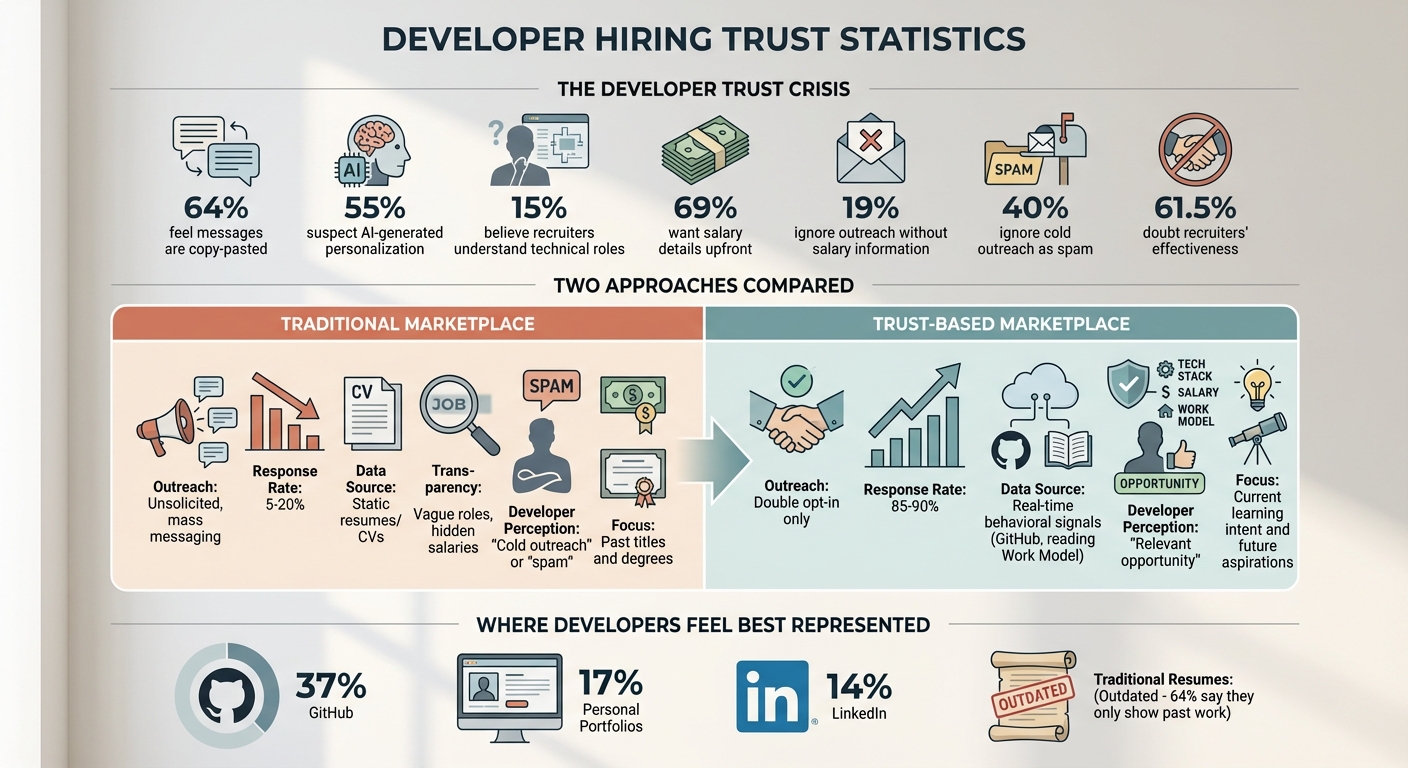 {Developer Trust in Hiring: Key Statistics and Comparison of Traditional vs Trust-Based Marketplaces}
Core Principles of a Developer Marketplace Built on Trust
In tackling the trust gap in developer outreach, hiring platforms need to rethink their approach. This means moving away from mass outreach, concealed salaries, and vague job descriptions, and instead focusing on principles that truly prioritize developers.
Clear Communication About Processes and Expectations
What developers want is clear: they expect upfront: tech stack, salary range, and work model (remote, hybrid, or onsite). These elements - known as the "Big Three" - are non-negotiable for transparent communication. For instance, 69% of developers want salary details included in the first message, while 19% will dismiss outreach entirely if this information is missing .
Here’s a quick comparison of traditional practices versus a trust-driven approach:
| Feature | Traditional Marketplace | Trust-Based Marketplace |
|---|---|---|
| Outreach | Unsolicited, mass messaging | Double opt-in only |
| Data Source | Static, self-reported resumes/CVs | Real-time behavioral signals (reading/building) |
| Transparency | Vague roles, hidden salaries | Upfront "Big Three" (Tech, Salary, Remote) |
By being upfront about compensation, work models, and required skills, platforms show respect for developers' time and attention.
Features That Put Developers First
A marketplace built for developers prioritizes features that eliminate common frustrations. These include double opt-in introductions, private role visibility, and custom technical prompts.
- Double opt-in ensures developers express interest before recruiters can contact them, putting an end to unsolicited cold outreach.
- Private visibility means developers only see roles tailored to their criteria, keeping irrelevant opportunities out of sight.
- Custom screening questions - short, technical prompts - allow developers to showcase their skills and align with roles before engaging further.
As Nimrod Kramer, CEO & Co-Founder of daily.dev, explains:
"Trust is the only hack. Engineers already come to daily.dev to grow. They already trust the platform, engage daily, and treat what they see here as signal" .
Recruiter accountability is another critical piece. A "Recruiter Compact" ensures detailed job briefs and timely responses, while strict measures are in place for those who spam or ghost candidates. A 48-hour screening SLA further reinforces this commitment, creating a smoother, more reliable experience for developers.
Matching Based on Skills, Not Credentials
Beyond transparency and respectful processes, trust hinges on aligning opportunities with real-time skills rather than outdated credentials.
Static resumes and profiles often fail to reflect a developer’s current abilities. In fact, 64% of developers feel platforms like LinkedIn only highlight their past work, not their present potential . The guiding principle here is simple: "Resumes lie. Behavior doesn't" . Platforms can utilize real-time signals - such as what developers are reading, building, or learning - to surface relevant opportunities.
Developers themselves report that platforms like GitHub (37%) and personal portfolios (17%) better represent their skills, compared to LinkedIn (14%) . This opens the door to pre-intent sourcing, where shifts in reading habits or exploration of new technologies signal interest weeks before a resume update .
Here’s how the shift compares:
| Feature | Credential-Based (Traditional) | Skill-Based (Trust-Driven) |
|---|---|---|
| Data Source | Static CVs, LinkedIn profiles, keywords | Real-time reading, GitHub activity, code |
| Developer Perception | "Cold outreach" or "spam" | "Relevant opportunity" or deliberate signal |
| Focus | Past titles and degrees | Current learning intent and future aspirations |
This transition isn't just about better matching. It's about recognizing developers for who they are today and aligning opportunities with their evolving skills and interests. By focusing on real-time abilities, platforms can create a hiring experience that feels intentional and meaningful.
Key Features That Build Trust in Developer Hiring Platforms
Trust is the cornerstone of effective developer hiring platforms. Features that reduce spam and foster meaningful connections between developers and recruiters play a significant role in building that trust.
Double Opt-In Introductions
Double opt-in systems dramatically improve response rates, boosting them from a mere 5–20% for cold emails to an impressive 85–90%. Here's how it works: developers review roles and opt in only if they're genuinely interested. Recruiters can then reach out, but only after the developer has expressed interest. This eliminates the generic cold outreach that 40% of developers tend to ignore as spam .
This approach benefits everyone involved. Developers avoid irrelevant messages, and recruiters save time by focusing only on candidates who are already engaged. It's a win-win that ensures time and effort are spent efficiently on both sides.
Targeted Job Visibility and Pre-Screening
Targeted visibility takes the matching process a step further by using real-time behavioral signals to show openings only to qualified candidates. This respects developers' time and attention, reinforcing trust by keeping irrelevant opportunities out of their inboxes.
Pre-screening adds another layer of precision. Platforms can include custom screening questions that help developers quickly demonstrate their alignment with a role before further engagement. This reduces unnecessary back-and-forth, creating a smoother experience for both developers and recruiters.
ATS Integration and Workflow Support
ATS integration ensures seamless connections between hiring platforms and applicant tracking systems like Greenhouse, Lever, and Ashby. Candidate profiles sync automatically, cutting down on manual data entry and allowing recruiters to manage interactions without switching between tools.
Other workflow features, like automated deduplication and real-time status updates, streamline the hiring process. Duplicate outreach is avoided, and transparency is maintained throughout the process. These tools not only improve efficiency for recruiters but also uphold a professional and respectful experience for developers, ensuring timely communication and clear updates.
How to Build and Maintain a Developer-Trusted Marketplace
Creating a marketplace that developers trust requires clear objectives, technical accuracy, and constant improvement.
Setting Goals and Defining Success Metrics
Start by identifying what success means for both developers and recruiters using a developer hiring checklist. One key metric is reply rates - aim for 85–90% with opt-in approaches, far exceeding the typical 5–20% seen with cold outreach. High open rates, ideally over 45%, indicate that your messaging and brand are connecting with your audience. Additionally, track 12-month retention rates (targeting 90% or above) to ensure placements meet expectations. These benchmarks help determine whether your platform fosters trust or falls into patterns that lead 61.5% of developers to doubt recruiters’ effectiveness .
Beyond these metrics, consider developer engagement. Use tools like reputation scores and community participation to measure involvement. For example, allowing developers to unlock premium features after earning 250+ reputation points can encourage valuable contributions to the platform.
Once your goals are defined, the next step is to build a technical foundation that supports these priorities.
Technical Setup and Testing
Develop your platform using a skills-based system that evaluates proof-of-work rather than relying on basic keyword matching . This could include verifying skills through GitHub contributions, open-source projects, and real-world experience.
Before launching, conduct pilot tests with a small group of developers and recruiters. Use brief surveys - at stages like initial outreach, screening, and interviews - to gather qualitative feedback. Messaging should clearly communicate critical details like the tech stack, salary, and work model, as failing to include these turns away 19% of developers .
Implement event-based synchronization to maintain smooth and reliable data flows. Model candidate progress using state machines (e.g., PENDING, IN_PROGRESS, COMPLETED) to ensure workflows are consistent and resilient.
A well-structured technical system ensures accurate metric tracking and allows for timely improvements.
Tracking Metrics and Making Improvements
Once the platform is live, use data and feedback to continuously refine it. Monitor external sentiment on platforms like Glassdoor and social media to gather unfiltered insights into the candidate experience. Regularly audit your messaging cadence and adjust check-in intervals (e.g., monthly or quarterly) to align with developer preferences.
Evaluate how well job opportunities match developer skills using fit scores and advanced matching algorithms. Analyze the number of screening calls needed per successful hire to identify inefficiencies. Integrate your ATS with community engagement data to understand which sourcing strategies yield the best results. To uphold trust, establish accountability measures - such as removing recruiters who spam or ghost candidates.
"Trust isn't the 'soft' side of recruiting. It's the moat. It's the currency. And it's the future." - Nimrod Kramer, CEO & Co-Founder, daily.dev
Conclusion
In today’s marketplace, trust isn’t just a nice-to-have - it’s the backbone of every meaningful interaction. And while advanced AI tools can enhance processes, they can’t single-handedly repair or establish trust. The platforms that thrive are the ones that treat trust as a core part of their structure, not as an afterthought.
The approach is clear: prioritize transparency, implement developer-focused features like warm, double opt-in introductions and skills-based matching, and stay committed to improving based on real-world data. Without these essentials, platforms risk alienating developers and losing their engagement. This focus on transparency and tailored engagement naturally leads to a recruitment strategy that leaves outdated methods in the dust.
The shift from cold emails vs. warm intros in recruiting marks a major evolution in talent acquisition. Unsolicited outreach often results in low engagement, while opt-in models foster higher response rates and more authentic connections.
Trust isn’t just a buzzword in recruiting - it’s the competitive edge that separates successful platforms from the rest. Companies that recognize this and design their hiring processes around developers’ needs will gain access to highly engaged, qualified talent. Those that ignore this reality may find themselves struggling to be heard in an increasingly disengaged marketplace.
The tools and strategies discussed here provide a clear path to building a platform that developers genuinely want to be part of. Start with clear objectives, develop systems that emphasize proof-of-work over traditional credentials, and refine your approach based on feedback. Align every improvement - technical or procedural - with what developers value most. Remember, trust isn’t built overnight, but it can be lost in an instant. Make every interaction count.
FAQs
What should a first outreach message include?
A first outreach message should feel personal, be straight to the point, and offer clarity. Mention something specific about the developer’s work - like their GitHub contributions - to show you’ve taken the time to understand their expertise. Upfront, share essential details such as the tech stack, salary range, and whether the role is remote. By aligning the message with their skills and past projects, you not only grab their attention but also establish a sense of trust and respect for their time.
How does double opt-in work in hiring?
Double opt-in in hiring means developers actively agree to be contacted about job opportunities. They review and provide explicit consent before any outreach takes place, ensuring communication happens exclusively with those who are genuinely interested. This approach helps establish trust and minimizes unwanted interactions.
How can platforms match by skills without resumes?
Platforms can connect developers with opportunities by assessing their abilities directly, bypassing traditional resumes. They use skills-based assessments and practical coding tests to evaluate a developer's expertise through tasks and scenarios that reflect actual work challenges. This method emphasizes proven skills over formal education or previous job titles. By removing barriers like degree requirements, it creates a more inclusive process, ensuring hiring decisions are based on real capabilities rather than credentials.
.png)