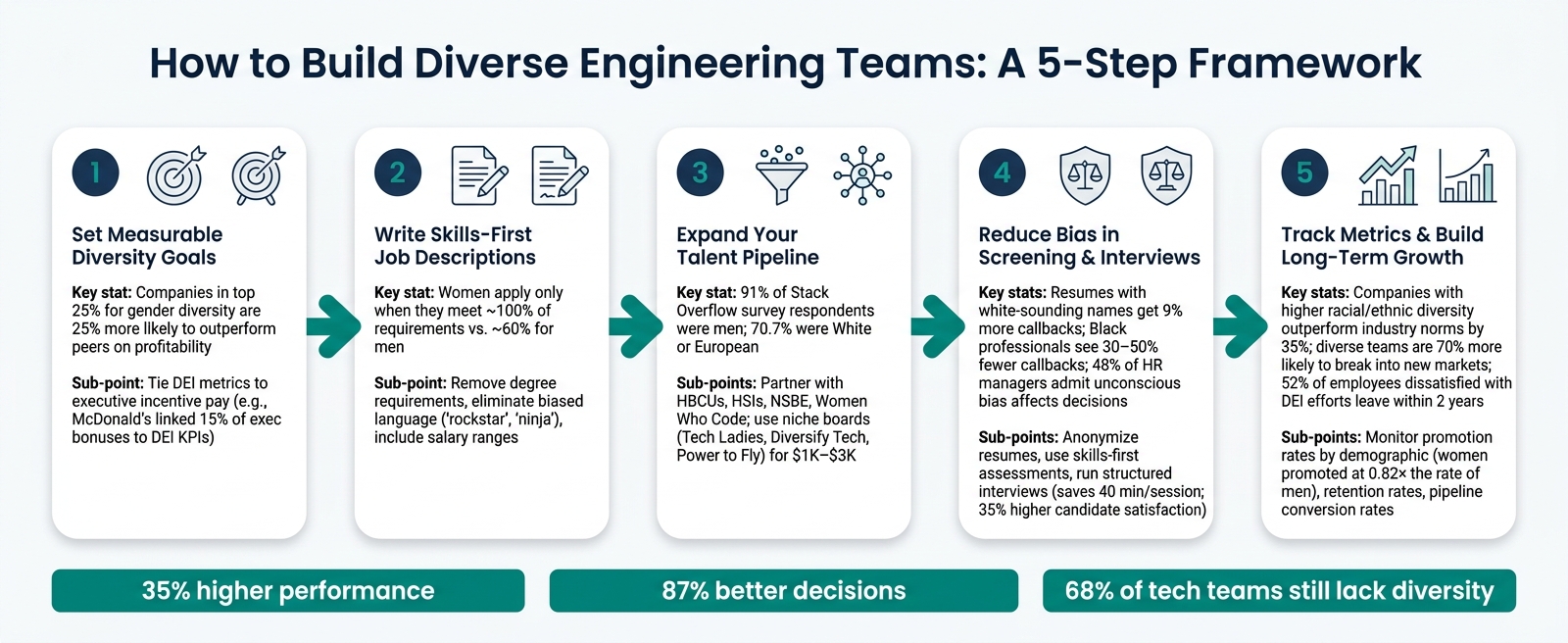
Want to create engineering teams that outperform industry norms by 35%? It starts with diversity. Yet, 68% of business leaders admit their tech workforce still lacks it. The problem? Outdated hiring practices that prioritize familiarity over skill.
This guide breaks down proven methods for improving diversity in technical recruitment, including:
- Setting measurable diversity goals tied to business outcomes.
- Writing job descriptions that focus on skills, not degrees or buzzwords.
- Expanding sourcing strategies to include HBCUs, bootcamps, and niche platforms.
- Reducing bias with evidence-based technical hiring approaches like anonymized resumes, structured interviews, and skills-based assessments.
- Tracking key metrics like retention and promotion rates by demographic to ensure long-term success.
Diversity isn’t just a moral imperative - it’s a competitive advantage. Here’s how to make it happen.
Setting Clear Diversity Goals and Defining Success
Without measurable diversity goals, hiring initiatives often lose momentum. To make real progress, think of diversity as an engineering problem: identify gaps, measure progress, and adjust strategies as needed.
Aligning Diversity Goals with Business Objectives
Diversity efforts resonate more when tied to outcomes the business already values. Here's why it matters: companies in the top 25% for gender diversity are 25% more likely to outperform peers on profitability , and diverse teams make 87% better decisions . These benefits directly impact product development speed and the quality of engineering work.
Take McDonald's as an example. In 2021, they linked 15% of executives' annual incentive pay to specific DEI (Diversity, Equity, and Inclusion) metrics, including hiring, retention, and employee engagement scores related to inclusion . This approach holds leaders accountable and ensures diversity goals are tied to tangible business outcomes. When metrics like representation, promotion rates, and retention are part of success measures, they become priorities, not afterthoughts.
"Prioritizing diverse engineering hiring doesn't need a business case, it is just 'the right thing to do.'" - Cat Miller, VP Engineering, Flatiron Health
These benchmarks lay the groundwork for refining hiring practices and tracking progress effectively.
Writing Skills-First Job Descriptions
Job descriptions often unintentionally exclude qualified candidates before they even apply. Research shows women apply for roles only when they meet nearly 100% of the listed requirements, while men apply when they meet about 60% . Overly detailed lists of tools, years of experience, or degree requirements often shrink the applicant pool unnecessarily.
The solution? Simplify. Separate must-haves from nice-to-haves, focus on the problems the role will solve, and eliminate degree requirements unless absolutely necessary. Be mindful of wording - terms like "rockstar", "ninja", or "dominant" often discourage female candidates . Tools like Textio can help identify and remove biased language . Also, include salary ranges upfront. Transparency fosters trust, especially with candidates who may be wary of unclear hiring practices.
Once job descriptions are streamlined, the next step is defining clear metrics to measure success.
Defining Success Metrics for Diversity Hiring
To truly understand the effectiveness of diversity hiring efforts, tracking headcount alone isn’t enough. The most revealing metrics dig into the hiring process itself . Use EEOC data to segment hiring KPIs and monitor key ratios - for example, resume screens to technical assessments, pass rates for technical assessments, and onsite interviews to offers - broken down by demographic groups . This helps pinpoint where candidates are dropping off in the process, not just that they are.
Post-hiring metrics are equally critical. For instance, women in tech are promoted from L3 to L4 at 0.82× the rate of men , a disparity that compounds over time. Tracking promotion rates and first-year retention by demographic group provides a deeper understanding of whether your hiring system supports long-term success.
| Metric Category | What to Track |
|---|---|
| Top of Funnel | Application rate by source, resume-to-assessment pass rate |
| Hiring Outcome | Offer rate, offer acceptance rate, pay band compression |
| Retention & Growth | First-year retention rate, promotion velocity, exit reasons |
| Engineering Culture | Assignment share (feature vs. glue work), code review acceptance rate |
To remain legally and ethically sound, always use voluntary self-identification, report data in aggregates of five or more, and separate demographic analysis from individual decisions . This approach ensures fairness while maintaining compliance.
Building a Diverse Talent Pipeline
After setting clear objectives and refining hiring practices, the next step for recruiters is expanding their sourcing strategies. Finding candidates from underrepresented backgrounds means moving beyond the usual channels, as those often yield the same limited candidate pools.
Partnering with Communities and Organizations
One of the most effective ways to connect with underrepresented engineers is to engage with the communities and organizations where they are already active. Groups like the National Society for Black Engineers (NSBE), Women Who Code, and events such as the Grace Hopper Conference provide direct access to talented and diverse technical professionals . Similarly, focusing on Historically Black Colleges and Universities (HBCUs) and Hispanic-Serving Institutions (HSIs) can help companies tap into a pool of capable engineering graduates who are often overlooked due to a narrow focus on traditional "target schools" .
A great example of success through community partnerships is the Financial Times. Between 2011 and 2021, under the leadership of Tech Director Sarah Wells, their engineering department grew to include approximately 35% women and non-binary individuals in their London-based permanent engineering staff. This achievement was supported by partnerships with organizations like Code Your Future, which trains refugees, and Makers Academy, alongside setting measurable goals, such as publicly committing to hire 50% women, trans, or non-binary individuals in a given quarter .
"Realise that when you are striving to make things more equal, a white man might feel his opportunities have shrunk. So you need to explain why this is a positive change, repeatedly. You are not lowering the bar, you are fixing the things that stopped you from being able to attract some great candidates." - Sarah Wells, Tech Director, Financial Times
Digital recruitment tools can complement these efforts to further expand your reach.
Using Developer-First Recruitment Platforms
Traditional recruitment methods, like cold emails or LinkedIn InMails, often fall flat with developers, achieving trust scores of less than 5% . Many developers simply ignore these approaches, which means underrepresented candidates - who may already be wary of generic outreach - are unlikely to engage.
Platforms like daily.dev Recruiter offer a more tailored approach. By using a developer-focused network, this tool connects recruiters with pre-qualified candidates through double opt-in introductions. Both the recruiter and the candidate must express mutual interest before any conversations begin, eliminating cold outreach and achieving 3x higher reply rates compared to traditional methods . This approach relies on real developer behavior - what they’re reading, building, and engaging with - rather than static resumes. For diversity hiring, this behavioral focus helps uncover candidates like self-taught engineers or bootcamp graduates who might otherwise be filtered out by traditional credential-based systems.
Broadening your sourcing channels can further strengthen your efforts to build a diverse talent pipeline.
Expanding Your Sourcing Funnel
To create a more inclusive pipeline, it’s important to rethink what defines a "qualified" candidate. A 2020 Stack Overflow survey of 38,000 developers revealed that 91% were men and 70.7% were White or of European descent . This highlights how standard sourcing methods often perpetuate existing disparities.
One way to address this is by exploring alternative channels. Instead of relying solely on LinkedIn, consider sourcing candidates from GitHub repositories, open-source contributions, and community Slack or Discord groups . These platforms often highlight self-taught engineers and bootcamp graduates who may not follow traditional career paths. Colin Howe, former Head of Engineering at Prolific, summed up this approach well:
"I'd happily absorb more risk and have more failures [at the screening stage], if it means we see more people with non-traditional profiles."
Niche job boards like Tech Ladies, Diversify Tech, Elpha, and Power to Fly are also excellent options. A budget of $1,000 to $3,000 is typically sufficient to secure several postings on these platforms . Finally, be explicit in your outreach. Clearly stating your interest in underrepresented candidates can encourage them to apply with confidence .
Reducing Bias in the Hiring Process
Once you've expanded your talent pool, the next critical step is ensuring that bias doesn't creep into how candidates are evaluated. Without this, any progress toward diversity may be lost. This is no small issue - 48% of HR managers admit that unconscious bias influences their hiring decisions . In technical hiring, the numbers are even starker: 65% of HR specialists and IT leaders acknowledge bias in the recruitment process . The good news? Bias can be addressed by refining your hiring practices.
Implementing Bias-Free Screening Practices
One of the most straightforward ways to combat bias is to remove the triggers that spark it. Resume anonymization - stripping away names, graduation years, and school names - forces reviewers to focus on what truly matters: skills. Research shows that resumes with white-sounding names receive 9% more callbacks, while Black professionals see 30%–50% fewer callbacks when identity-linked details are included .
An even better strategy is to prioritize technical assessments before resumes are even reviewed. By evaluating candidates with real-world coding tasks benchmarked against top performers, you can sidestep pedigree bias entirely.
Designing Inclusive Technical Assessments
The design of technical assessments plays a big role in reducing bias. Traditional methods like abstract algorithm puzzles or high-pressure whiteboard sessions can unfairly disadvantage those who haven't specifically trained for these formats. This often excludes the very candidates you're trying to attract, such as self-taught engineers or bootcamp graduates.
Instead, focus on assessments that reflect real job scenarios. Examples include debugging exercises, code reviews, or progressive coding challenges that grow in complexity. To level the playing field further, consider these two adjustments:
- Set time limits to ensure that candidates with busy schedules - like those juggling jobs or caregiving - aren't penalized.
- At the start of live coding sessions, give candidates a 5-minute window to privately review the problem. This can significantly reduce performance anxiety .
"Ambiguity is a breeding ground for bias and lack of accountability." - Erica Stanley, Engineering Leader
Once assessments are unbiased, the next step is ensuring interviews are just as fair.
Running Structured, Objective Interviews
Unstructured interviews often allow bias to slip in. When questions are improvised, interviewers may unconsciously favor candidates who remind them of themselves, steering evaluations away from true merit. The solution? Structure.
A structured interview follows a set list of questions in a consistent order, paired with a shared scoring rubric for every candidate. This approach doesn’t just ensure fairness - it also saves time. On average, structured interviews cut 40 minutes off each session for the hiring team , while candidates report being 35% more satisfied with the process .
Microsoft has taken this a step further by preventing interviewers from seeing their colleagues' ratings or feedback until they've submitted their own independent evaluations .
"The act of filling out a structured rubric will force your interviewers to objectively confront their biases because each evaluation is backed by a rigorous definition that you can audit and defend." - Shannon Hogue-Brown, Author, LeadDev
Here’s a quick comparison of how various interview and screening methods impact fairness:
| Approach | Evaluation Basis | Impact on Diversity |
|---|---|---|
| Unstructured interview | Gut feel, "culture fit", and rapport | High bias; favors candidates similar to the interviewer |
| Structured interview | Standardized rubrics, job-relevant questions | High fairness; focuses on objective competencies |
| Resume-first screening | Educational pedigree, past company names | High bias; excludes non-traditional or self-taught talent |
| Skills-first screening | Technical assessments, work samples | High inclusion; identifies talent regardless of background |
Improving Candidate Experience for Diverse Talent
A poor candidate experience can send a message of exclusion, particularly to engineers from underrepresented groups. A hiring process that is respectful and well-structured not only attracts diverse talent but also encourages them to stay and thrive. This is critical: nearly 80% of workers prioritize companies that demonstrate a commitment to diversity, equity, and inclusion .
Making the Hiring Process Transparent
Clarity is key. Start by laying out the hiring process in detail. Candidates should know how many stages to expect, the purpose of each stage, how long assessments will take, the tools they’ll need, and any resources available to them . This level of transparency can be especially helpful for self-taught engineers or career-switchers who might be less familiar with traditional hiring practices.
Flexibility is another must. Offering adaptable schedules acknowledges caregiving responsibilities, time zone differences, and other personal needs, showing respect for candidates from the very first interaction .
"Your goal as an interviewer is not to interrogate the candidate or try to push them until they fail." - Sheri Soliman, Senior Software Developer, Shopify
Once transparency is in place, the next step is to refine how you identify and reach out to candidates.
Writing Developer-Friendly Outreach
Transparency sets the foundation, but personalized outreach builds trust. Tailoring your messages to highlight a candidate’s specific contributions - like their GitHub projects, open-source work, or published articles - can lead to 3 to 4 times higher pipeline conversion rates compared to generic job postings .
GitLab’s experience in August 2020 is a great example. When recruiting for a "Software Engineer in Test" role, their initial outreach had low response rates. The team shared drafts of their messaging in internal Slack channels like #women and #diversity_inclusion_and_belonging. Feedback from women on the team pointed out that the messaging failed to emphasize asynchronous work and growth opportunities. After revising the approach to include these priorities, response rates jumped to 50% .
The takeaway? Involve Employee Resource Groups (ERGs) in reviewing outreach drafts. Replace outdated terms like "cultural fit" with "cultural contribution" to show that diverse perspectives are valued . Be upfront about compensation in USD, remote work options, and mentorship opportunities - these details resonate more with diverse candidates than a laundry list of technical skills.
With stronger outreach, you’re ready to measure and refine the overall candidate experience.
Measuring and Improving Candidate Experience
To improve, you need data. Use post-interview surveys to ask candidates about the clarity of instructions, the tools provided, and how they felt throughout the process .
In addition to surveys, track passthrough rates at every stage of the hiring funnel, broken down by demographic groups. This helps identify where underrepresented candidates are dropping off, which can reveal hidden biases in questions, scoring, or even scheduling . CERN’s "25 by '25" initiative is a great example. Launched in 2021, it used a "Conscious Hiring Dashboard" to monitor applicant flow from sourcing to final offer. By 2025, women’s representation in staff and graduate roles rose to 24.7%, while hires from underrepresented member states increased from 15.1% to 31.7% in just one year .
Here’s what to track at each stage:
| Funnel Stage | Metric to Track | What It Reveals |
|---|---|---|
| Sourcing | Sourcing mix by channel | Whether your outreach reaches diverse talent pools |
| Screening | Resume-to-assessment rate | If non-traditional candidates are being filtered out |
| Evaluation | Assessment pass rate by demographic | Whether technical tests contain unintended bias |
| Interviewing | Onsite-to-offer ratio | Fairness of final-stage panels and decisions |
| Experience | Candidate NPS / survey score | How candidates perceive inclusion and respect |
| Long-term | 12–24 month retention rate | Whether diverse hires are staying and advancing |
Tracking these metrics consistently transforms candidate experience from a vague goal into something tangible and actionable. Over time, these insights allow for meaningful improvements in how your organization attracts and supports diverse talent.
Building a Long-Term Diversity Hiring System
Establishing a system that supports lasting diversity in engineering teams requires more than just setting goals - it demands continuous tracking, collaboration, and fostering growth opportunities.
Tracking Metrics and Refining Your Process
Diversity hiring isn’t just about meeting quotas; it’s about understanding the entire journey, from sourcing to retention, to identify where gaps exist.
"Diversity recruiting metrics are quantitative measurements that let organizations track, analyze, and improve DEI hiring initiatives - turning vague commitments into concrete, actionable data." - Rod Danan, Founder, Prentus
Start by using your ATS to break down hiring KPIs by EEOC data. For instance, compare resume-to-assessment conversion rates across demographics to uncover potential biases early in the hiring process . But don’t stop there - retention and advancement metrics are equally important. Research shows that 52% of employees dissatisfied with their company’s DEI efforts are more likely to leave within two years . Without opportunities for advancement, diverse hires may not stay long enough to make a lasting impact.
Here’s a quick look at key metrics to track:
| Metric Category | Specific KPI | What It Reveals |
|---|---|---|
| Retention | Retention rates by demographic | Whether diverse hires remain with the company long-term |
| Advancement | Promotion rates by demographic | If diverse employees are moving into leadership roles |
Additionally, review sourcing channels regularly. Whether you’re working with HBCUs, coding bootcamps, or developer communities, focus your efforts on those that yield the most diverse talent .
These metrics provide a foundation, but they’re only effective when paired with leadership involvement.
Working with Engineering Leadership
Metrics alone won’t drive change - engineering leaders need to be actively involved in diversity hiring efforts.
"Recruiting diverse engineering talent is everyone's job." - Dr. Maisha Gray-Diggs, Vice President of Talent Acquisition, Twitter
Twitter offers a great example of leadership-driven diversity initiatives. In May 2021, the company restructured its technical recruiting by appointing Dr. Maisha Gray-Diggs, an engineer with talent acquisition expertise, to a VP-level role. They also promoted Joy Su and Jessie Link to VP positions, ensuring diverse leadership at the top. As Dr. Gray-Diggs explained, diverse leaders naturally attract diverse talent .
To align leadership with diversity goals, create formal recruiting plans that engineering managers and recruiters can share. These plans should outline specific sourcing strategies and engagement goals . Provide managers with practical recruiting tools tailored to their roles, and train interviewers to assess potential rather than just matching credentials. Studies show that women are often held to stricter standards, with hiring managers expecting them to meet 100% of job requirements, a bias not as commonly applied to men .
Creating Internal Growth Opportunities
Sustaining diversity isn’t just about hiring - it’s about creating pathways for career growth and retention. Without opportunities to advance, diverse talent may leave for companies that value their contributions more.
The Financial Times offers a compelling model. Between 2011 and 2021, Tech Director Sarah Wells and former CPIO Cait O’Riordan implemented "promotion boards" to eliminate bias in pay raises and promotions. By 2021, women and non-binary individuals made up about 35% of the FT’s engineering department across all levels, including leadership. In fact, the Tech Leadership Group (direct reports to the CTO) reached a point where men were in the minority .
"If you don't have any OKRs relating to culture, diversity and inclusion, you are sending a message to your teams that those things aren't important." - Sarah Wells, Tech Director, Financial Times
The FT’s success came from opening opportunities to everyone. Instead of handpicking candidates for new projects or management tracks, they encouraged broad participation. Structured processes like these help reduce bias, just as formal mentorship programs and transparent promotion systems ensure fairness. Pair these efforts with executive sponsorship of Employee Resource Groups (ERGs) to create an environment where underrepresented engineers can see a clear path forward.
"Why groom diverse talent for someone else to show them more appreciation via promotion and leveling?" - Dr. Maisha Gray-Diggs, VP of Talent Acquisition, Twitter
Retention is built on more than just inclusive language - it thrives when employees feel a true sense of belonging, supported by visible career growth and genuine opportunities to thrive.
Conclusion: Key Steps for Building Diverse Engineering Teams
Creating diverse engineering teams takes ongoing effort at every stage of the hiring process - from crafting inclusive job descriptions to supporting career development long after someone joins the team.
Starting with skills-first screening helps eliminate bias tied to educational backgrounds early in the process. Using structured interviews ensures every candidate is assessed consistently and fairly. Broadening your sourcing efforts - by partnering with HBCUs, HSIs, and organizations like the National Society of Black Engineers - opens doors to talent that often gets overlooked in traditional recruiting. Tools like daily.dev Recruiter can also help, offering warm, double opt-in introductions to engaged developers, replacing cold outreach with meaningful, trust-based connections. These methods, grounded in data, provide a strong framework for making real progress.
The numbers speak volumes: companies with higher racial and ethnic diversity outperform industry norms by 35% , and diverse teams are 70% more likely to break into new markets . Yet, 68% of business leaders admit their tech teams still lack sufficient diversity . The challenge lies in bridging the gap between understanding the importance of diversity and taking actionable steps.
"Diversity sourcing fails when it's treated as a compliance exercise." - Vamo
To close this gap, organizations need to treat diversity, equity, and inclusion (DE&I) metrics as seriously as any other business goal. Track key data points like recruitment funnel conversion rates by demographic, monitor promotion trends, and regularly review sourcing channels. If something isn't working, adjust it. If it’s effective, document and scale it. As CodeSignal aptly states: "What gets measured gets done."
Ultimately, building successful teams isn’t just about hiring diverse talent - it’s about creating an environment where individuals can thrive, grow, and step into leadership roles over time.
FAQs
What diversity goals should we set first?
To begin, focus on recruiting skilled individuals from underrepresented groups and educational institutions that are often overlooked. Alongside this, take a close look at your existing hiring methods to identify and reduce bias, ensuring the process encourages a more inclusive environment.
Which metrics prove our hiring process is fair?
Fair hiring metrics involve monitoring inclusive hiring KPIs to promote equity in the recruitment process. These KPIs might include measuring the representation of underrepresented groups and identifying efforts to minimize bias during candidate evaluations. Leveraging EEOC (Equal Employment Opportunity Commission) data to break down and analyze these metrics can add a layer of transparency and help ensure the process remains fair for all candidates.
How can we reduce bias without slowing hiring?
To keep hiring both fair and efficient, prioritize skills-based testing at the start of the process. This approach shifts the focus to a candidate's abilities rather than their resume. Pair this with structured interviews that use consistent, job-specific questions. These strategies highlight merit and competencies, ensuring evaluations are fair while maintaining a streamlined process.
.png)