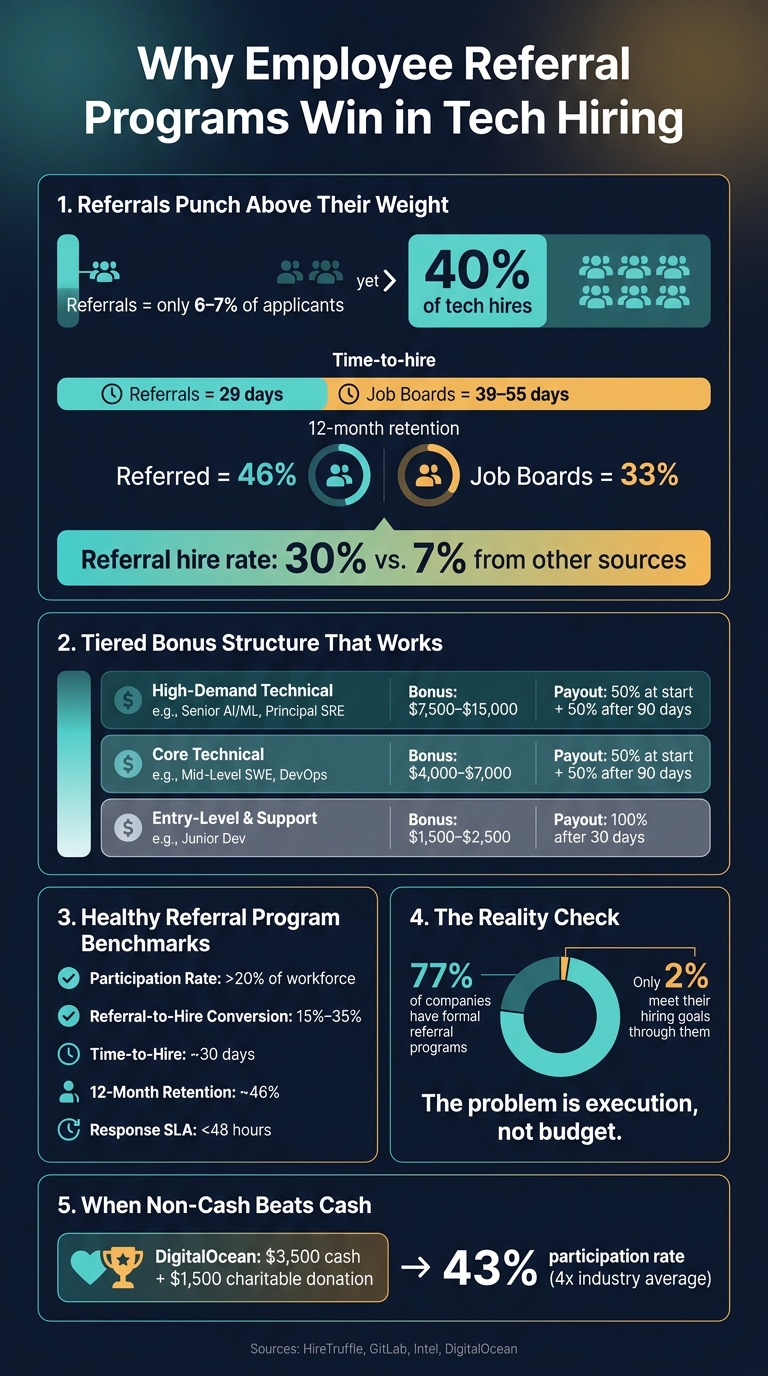
Referrals work because they’re personal. While only 6–7% of applicants come from referrals, they make up 40% of tech hires. Why? Referred candidates are hired faster (29 days vs. 39–55 days), stay longer (46% retention after one year vs. 33% from job boards), and deliver better results.
But most referral programs fail - not because engineers aren’t interested, but because the process is unclear, slow, or frustrating. To build a referral program engineers will actually use, focus on:
- Trust: Keep referrers informed with updates at every stage.
- Simplicity: Make referrals easy with mobile-friendly forms and specific role descriptions.
- Incentives: Use tiered cash bonuses (e.g., $7,500–$15,000 for high-demand roles) or non-cash rewards like PTO or charitable donations.
- Fairness: Ensure referred candidates go through the same hiring process as everyone else.
The best talent acquisition for engineering teams treats employees like trusted recruiters - clear communication, fast follow-ups, and meaningful rewards make all the difference.
Designing Referral Programs Engineers Actually Use
Referral programs often stumble not because engineers are unwilling, but because HR overlooks what matters most to them: professional reputation and trust.
Building Trust with Engineers
When engineers make a referral, they’re putting their own reputation on the line. If the person they recommend is treated poorly - whether through ghosting, unexplained rejections, or a frustrating process - it reflects badly on them. That’s why trust is a non-negotiable part of any referral program engineers will actually engage with.
The best programs tackle this head-on by focusing on three key aspects: clear role requirements, a straightforward submission process, and keeping referrers informed. GitLab offers a great example by distinguishing between a "Referral" (someone the employee has worked with directly) and an "Endorsement" (a recommendation for an acquaintance). Only direct referrals are eligible for bonuses . This approach prioritizes quality over quantity, signaling to engineers that the company values meaningful recommendations.
Transparency is equally important. Providing engineers with real-time updates - such as whether their referral is "Interviewing" or has an "Offer Extended" - eliminates the uncertainty of not knowing what’s happening . And if a candidate doesn’t move forward, a brief, specific explanation, like "We needed more distributed systems experience at this stage", shows respect for both the referrer’s effort and their relationship with the candidate . This mix of clarity and transparency aligns with technical hiring best practices and builds the trust needed for engineers to participate actively.
"A referral bonus without structure behind it is just a number on a Slack message." - HireTruffle
Getting Developers to Participate
Generic calls for referrals - like "Know any good engineers? We’re hiring!" - tend to fall flat. What makes a difference is specificity. For instance, a message like "We’re looking for a senior backend engineer with experience in high-throughput data pipelines. Here’s a two-sentence description and the current bonus" helps engineers immediately think of someone who fits the bill .
Ease of use is another critical factor. If submitting a referral takes more than two minutes, most engineers won’t bother. A mobile-friendly form that requires only a name and LinkedIn URL - and takes under a minute to complete - can remove this hurdle entirely . Some teams even suggest candidates prepare a "pre-packaged" blurb, including their resume, the job ID, and a short "why me" paragraph. This allows engineers to simply copy and paste the details into the referral portal .
Participation is often highest among mid-level engineers with 3–6 years of experience. These individuals are invested in building a strong team, have active professional networks, and aren’t as stretched thin as senior engineers managing architecture or mentorship responsibilities. Targeting this group with weekly digests of priority roles - rather than occasional, broad reminders - keeps the program visible without feeling overwhelming .
Referral Bonus Structures That Work
Cash Bonuses: Timing and Amounts
When designing referral bonuses, it's crucial to align the payout with the complexity of the role. Tiered structures not only highlight the urgency of filling specific positions but also set clear expectations. Here's a practical framework:
| Role Category | Example Roles | Bonus Range (USD) | Payment Structure |
|---|---|---|---|
| High-Demand Technical | Senior AI/ML Engineer, Principal SRE | $7,500 – $15,000 | 50% at start, 50% after 90 days |
| Core Technical | Mid-Level Software Engineer, DevOps | $4,000 – $7,000 | 50% at start, 50% after 90 days |
| Entry-Level & Support | Junior Developer, Customer Support | $1,500 – $2,500 | 100% paid after 30 days |
The 50/50 payout model - half upon the new hire's start date and the other half after 90 days - is used by over half of companies (54%). This approach balances risk and reward: it minimizes losses if a hire leaves early while motivating employees to refer candidates they believe will succeed. For instance, HubSpot offers a $10,000 referral bonus for developers, but only pays it after the hire has been with the company for at least four months .
"A $3,000 bonus that pays out 50% at the hire date and 50% after 90 days is specific enough to build trust." - HireTruffle
Transparency and structure are key to building trust in referral programs. A clear, time-stamped "first-in" rule for duplicate referrals avoids confusion and resentment. Splitting bonuses between employees in such cases often creates unnecessary friction, so having an objective tie-breaker simplifies the process .
While cash is effective, adding rewards with emotional or experiential value can further elevate participation.
Non-Cash Incentives
Cash incentives aren't always enough to engage employees, especially in engineering roles. Alternatives like high-quality equipment, conference tickets, or charitable donations can make referral programs more appealing . For example, DigitalOcean combined a $3,500 cash bonus with a $1,500 charitable donation on the employee's behalf in January 2026. This approach led to a 43% participation rate - four times the industry average . Adding a philanthropic element often resonates with mission-driven teams, making the program feel less transactional.
"The bonus amount matters far less than how you structure and communicate the program." - Maciej Kamieniak, Founder & CEO, Rewordin
It's also worth rewarding the act of referring, not just the successful hire. Offering extra PTO, professional development stipends, or conference tickets acknowledges employees' efforts and aligns with their priorities - like personal growth and work-life balance. This approach ensures the program feels like a genuine recognition of their contributions rather than just another HR initiative.
Common Mistakes That Kill Referral Programs
Even with ample funding, referral programs can fail quietly. You send out a Slack announcement, but participation dwindles, and engineers lose interest. Often, the problem isn’t the incentive - it’s the referral process itself. These missteps can erode the trust that’s essential for a successful developer referral program.
Referral Fatigue from Over-Asking
Bombarding your engineering team with referral requests for every open role is a quick way to overwhelm them. When engineers are asked to refer for too many positions, it dilutes the sense of urgency. They don’t know where to focus, which often leads to inaction.
"The problem starts with ambiguity. Most programs give employees no guidance on which positions are open to referrals, how to submit them, or what information to include." - HireTruffle
The solution is simple: create a concise "Priority Referral" list with no more than 5–10 roles at a time. Pair this with clear, specific guidance. Instead of asking, "Know anyone good?" try something like, "We’re looking for a backend engineer with Kubernetes experience who has managed enterprise-scale deployments." This level of detail helps engineers connect the request to people in their network.
Bias and Clique Hiring
Referral programs often reflect the makeup of your current workforce. Engineers tend to refer people from their own circles, which frequently share similar backgrounds, schools, and demographics. If left unchecked, this can lead to insular teams - and even potential legal risks. The EEOC warns that word-of-mouth recruiting can violate Title VII if it results in a homogenous workforce .
The numbers tell the story: women of color are 35% less likely than white men to receive an employee referral . And since referred candidates are hired at a 30% rate compared to just 7% from other sources, any bias in referrals can snowball quickly .
Intel tackled this issue head-on in 2025 by doubling referral bonuses for candidates from underrepresented groups. This led to an increase in underrepresented hires from 32% to 41% during the tracking period . Another key safeguard is ensuring referred candidates go through the same technical assessments and interview processes as other applicants. No fast-tracking or skipping steps just because someone vouched for them.
Ghosting Referred Candidates
This is the number one killer of referral programs - and it’s entirely avoidable. When an engineer refers someone and hears nothing back - no confirmation, no updates, no outcome - they feel like their effort and reputation were wasted.
"Silence kills future participation faster than anything else." - Pin.com
The fallout doesn’t stop with the individual referrer. That engineer will share their negative experience with teammates, causing overall participation to plummet. GitLab combats this by committing to review and act on referrals within 5 business days . Even a basic 48-hour acknowledgment SLA - just confirming the referral was received - can preserve trust. Automating status updates through your ATS, with stages like "Screening", "Hiring Manager Review", or "Rejected", keeps referrers informed without overloading recruiters. Providing brief feedback on why a candidate wasn’t moved forward also helps engineers refine future referrals and feel valued for their efforts.
How to Measure Referral Program Health
Once you've established a referral program built on trust, the next step is to measure its performance. This is crucial for ensuring the program remains effective and impactful. Many teams suspect their referral programs aren't delivering results, but the real challenge lies in pinpointing where things are going wrong. By tracking the right metrics, you can turn vague concerns into clear, actionable insights.
"A referral program without defined goals and measurement is just a bonus policy with no accountability." - HireTruffle
Key Metrics to Track
To understand the health of your referral program, focus on these essential metrics:
| Metric | Healthy Target | What It Tells You |
|---|---|---|
| Participation Rate | >20% of workforce | If fewer than 20% of employees are participating, it could indicate a lack of awareness or that the process is too cumbersome . |
| Referral-to-Hire Conversion | 15%–35% | A rate below 10% may point to unclear role expectations, while a rate above 40% might suggest favoritism . |
| Time-to-Hire | ~30 days | Referrals should close faster than other channels (typically ~55 days); delays may highlight inefficiencies in screening (using a hiring timeline planner can help identify these bottlenecks) . |
| 12-Month Retention | ~46% | Retention rates lower than the ~33% average for job board hires could signal issues with candidate quality . |
| Response SLA | <48 hours | Timely follow-ups are critical for maintaining trust in the system . |
In addition to these metrics, it's important to evaluate the program's impact on diversity. If your referral pipeline leans too heavily toward a single demographic, it may be time to explore alternative sourcing strategies instead of simply tweaking bonus structures . For engineering teams, tracking a Referral Quality Score - which measures the average interview feedback for referred candidates - can help ensure referrals meet the team's technical standards.
Finding Where the Program Breaks Down
One of the most telling indicators is the referral-to-interview rate. If a large number of referrals result in few interviews, it may mean the criteria for a "qualified" candidate are unclear. On the flip side, a conversion rate above 40% could suggest that referred candidates are being fast-tracked without proper evaluation .
Participation is another common sticking point. Despite 77% of employers having formal referral programs, only 2% report actually meeting their hiring goals through them . A lack of participation often doesn't reflect unwillingness from employees - it usually stems from a process that feels unresponsive. By closely monitoring your response SLA and ensuring feedback loops are in place, you can identify and address inefficiencies in how referrals are handled. Keeping tabs on these metrics allows for ongoing adjustments, helping your referral program deliver stronger hiring outcomes for engineering teams.
Combining Referrals with Passive Sourcing
Integrating passive sourcing with a referral program creates a more comprehensive hiring strategy, ensuring broader coverage of your talent pipeline. While referral programs are incredibly effective, they can't fill every open position. Referrals typically account for about 30–40% of engineering hires, leaving the remaining 60–70% to be filled through other methods . Rather than competing, these two channels work together to strengthen your hiring efforts.
Filling Pipeline Gaps with Referrals
Passive sourcing and referrals target different segments of the talent pool. Passive sourcing reaches the approximately 70% of developers who aren’t actively job hunting , while referrals tap into strong-tie networks - the trusted connections of your current employees. The real opportunity lies in combining these approaches: using passive sourcing to build volume and then leveraging employee networks to identify warm leads.
For example, passive sourcing might get a recruiter’s InMail ignored, but a direct message from a colleague is far more likely to get a response. Companies like Stripe have capitalized on this dynamic, sourcing 55% of their engineering hires through referrals and reducing their time-to-hire by 35% . Similarly, Ramp streamlined its referral program during its Series B-to-C growth phase, achieving over 60% of hires through referrals and adding more than 100 employees in just 18 months .
For particularly challenging senior roles, tiered referral bonuses can help focus efforts where they’re needed most. Offering higher incentives for filling critical positions, like Staff Engineer roles, signals to employees where their networks can make the biggest impact .
This dual strategy not only broadens your talent pool but also lays the groundwork for a fair and consistent hiring process.
Keeping Candidate Experience Consistent
One common pitfall of referral programs is treating referred candidates differently during the hiring process. While it might seem like a favor to fast-track referrals with fewer interview steps, this approach can lead to unintended consequences - such as lower-quality hires, frustration among other candidates, and a loss of credibility within your engineering team.
"Referral interviews should not be more or less demanding than any other interview. To prevent wrongful hires, Referrers need to keep their bar high." - GitLab
To maintain fairness, both referred and passively sourced candidates should receive the same level of attention and rigor. This includes a 48-hour acknowledgment SLA, standardized interview rubrics, and timely updates on their application status . A process that prioritizes referrals while neglecting passively sourced candidates can quickly gain a reputation for favoritism, which spreads fast in engineering circles.
Tools like daily.dev Recruiter can help ensure consistency, especially on the passive sourcing side. By facilitating warm, double opt-in introductions, these tools allow recruiters to connect with developers who are genuinely interested, rather than cold contacts. When both referrals and passive candidates are funneled through the same structured screening process, the result is a stronger talent pipeline and a reputation for fairness that enhances your employer brand.
Templates for Launching and Running a Referral Program
When it comes to setting up a referral program, trust and clear communication are the foundation. Even the best-designed programs can falter if their launch is messy or follow-up efforts are inconsistent. Below are practical templates and strategies to ensure your referral program runs smoothly and keeps engineers engaged.
Referral Program Launch Email
The launch email is your first impression, so it needs to address what developers want and answer key questions right away: What’s in it for me? How does it work? Who qualifies? Keep it short, clear, and to the point.
Subject line ideas:
- "Help us hire your next teammate"
- "Know a great backend engineer? Earn $3,000!"
- "We’re hiring - and your referral could make all the difference"
Here’s a simple and adaptable email template:
Subject: Know someone we should hire?
Hey [First Name],
We’re hiring for [Role 1], [Role 2], and [Role 3], and your network is one of our best resources.
Here’s how it works:
- Refer someone you’ve worked with directly and would love to work with again.
- If they’re hired and stay for 90 days, you’ll earn $[X] as a cash bonus.
- Submitting a referral is quick and easy: [one-click form link].
Key details:
- You’ll get confirmation of your referral within 48 hours.
- Track your referral’s progress in real-time: [dashboard/ATS link].
- Check eligible roles here: [link to open positions].
Please note: former candidates, lateral moves, and ex-team members aren’t eligible. If you’re unsure about eligibility, feel free to ask.
Thanks for helping us build an incredible team!
[Recruiter Name]
Did you know that only 2% of referral programs hit their hiring goals? The biggest culprit? Poor follow-up communication .
Reminder Schedule and Follow-Up
After launching the program, silence can kill momentum. Most referral programs see a spike in the first week, followed by a steep drop-off. Avoid this by creating intentional, well-timed touchpoints instead of bombarding people with emails.
“A referral bonus without structure behind it is just a number on a Slack message.” - HireTruffle
Here’s a suggested cadence to keep your referral program alive and thriving:
| Touchpoint | Frequency | Purpose |
|---|---|---|
| Referrer status update | Every 2 weeks (or at stage changes) | Keeps referrers informed and avoids the “what happened to my friend?” gap . |
| Priority role list | Monthly | Draws focus to the most critical and hard-to-fill positions . |
| Referral sprint | Ad-hoc, 2-week windows | Temporarily doubles the bonus for high-priority roles, creating urgency . |
| Success story shoutout | Monthly (Slack or all-hands) | Reinforces that the bonus is real and encourages participation . |
| Recruiter pipeline review | Weekly | Ensures no candidate stalls for more than 5 business days . |
"The companies with the highest referral participation rates are the ones that close the loop. Every referral gets a status update within two weeks." - HireTruffle
Referral Tracking Spreadsheet
Keeping track of referrals is essential for maintaining transparency and accountability. If you don’t have an ATS with built-in tracking, a shared spreadsheet can work just fine - provided it’s well-organized to ensure no one falls through the cracks.
Here are the most important columns to include:
| Column | Purpose |
|---|---|
| Candidate Name + LinkedIn URL | Makes it easy for hiring managers to reference candidates. |
| Referrer Name | Helps recruiters get technical context from the right person. |
| Technical Fit Note | Adds valuable insight about the candidate’s skills and strengths. |
| Current Status | Tracks progress: Applied → Screening → Interviewing → Offer → Hired/Rejected. |
| Days in Stage | Flags candidates stuck in one stage for more than 5 business days. |
| Referrer Last Updated | Ensures referrers receive timely updates on their submissions. |
| Bonus Payout Date | Tracks when bonuses are paid (e.g., 50% at hire, 50% after 90 days). |
To get better context for referrals, ask engineers to describe how they’ve worked with the candidate and highlight one technical strength they observed. This approach provides much more value than a simple name drop.
Finally, consider sharing a filtered version of the tracker with your team. When engineers see their referrals are being acted on, it builds trust and encourages continued participation.
Conclusion: How to Build a Referral Program Engineers Will Actually Support
The difference between a referral program that simply exists and one that actually delivers results comes down to trust, structure, and execution. While 77% of companies claim to have formal referral programs, only 2% say those programs meet their hiring goals . The issue isn’t about budgets - it’s about how the program is implemented.
Engineers only refer people they respect to companies they trust. That trust quickly erodes when bonus rules are unclear or when the referral process is overly complicated. The key takeaway? Every unnecessary obstacle is just another reason for engineers to stop participating.
Successful programs share a few common practices: they respond to every referral within 48 hours, split bonuses into two payouts (half at hire and the other half after 90 days), provide clear guidance on which roles need filling, and ensure referrers are kept in the loop with consistent updates. These steps create a system that engineers can genuinely get behind.
"The best referral programs treat employees as recruiters - with the same urgency, communication, and incentives you'd give an external agency." - Maciej Kamieniak, Founder & CEO, Rewordin
Referral hires consistently outperform other hires by staying longer and delivering 20% better performance . This success is even more pronounced when the program focuses on strong-tie referrals - people engineers have actually worked with - rather than casual acquaintances. Nail this, and referrals won’t feel like just another HR initiative. Instead, they’ll become something your engineering team takes pride in and truly owns.
FAQs
How do I prevent referral bias from hurting diversity?
To keep referral programs fair and promote diversity, ask employees to recommend candidates beyond their close social circles. Pair this with structured evaluation methods that focus on a candidate's skills and potential rather than personal ties. This approach helps create a more impartial hiring process and expands the range of potential talent.
What’s the best referral bonus payout schedule for engineers?
The best time to pay out a referral bonus for engineers is either on the day of hire or after a probationary period (like 90 days) to ensure the new hire is a good fit and stays with the company. Referral bonuses usually fall between $2,000 and $10,000, but some companies also include non-cash perks. These might include extra PTO, conference tickets, or even equipment upgrades. This strategy keeps employees motivated while ensuring the success of the referral.
How can I combine referrals with passive sourcing in one pipeline?
Blend the power of employee referrals with passive sourcing to create a more dynamic hiring strategy. Employee referral programs give you access to trusted networks, while passive sourcing helps you engage candidates who aren't actively searching for new roles.
To make this work, use tools that allow you to manage both referred and passive candidates in a single pipeline. This ensures recruiters have full visibility and can track progress seamlessly. Encourage your team to refer qualified contacts, and at the same time, build relationships with passive candidates through personalized outreach and regular updates about your company.
By integrating trusted recommendations with proactive engagement, you can significantly expand your talent pool and find top-tier candidates.
.png)