Hiring cybersecurity engineers is challenging due to a growing talent shortage and increasing demand. By 2024, there were 4.8 million unfilled cybersecurity roles globally, with the workforce growing at just 0.1% annually. This imbalance has made finding the right candidates, especially for senior roles, a lengthy and costly process.
To succeed, focus on:
- Clear Role Definitions: Understand the specific skills and responsibilities for roles like Security Engineer, SOC Analyst, or Penetration Tester.
- Effective Job Descriptions: Avoid unrealistic qualifications and focus on outcomes instead of certifications.
- Targeted Sourcing: Look beyond LinkedIn to platforms like HackTheBox, Bugcrowd, and niche security communities.
- Skills-Based Assessments: Test practical abilities, such as threat modeling or incident response, instead of trivia or memorization.
- Competitive Offers: Offer salaries aligned with market rates (e.g., $110K–$220K for engineers), plus perks like remote work and learning budgets.
Streamline your hiring process, respect candidates' privacy, and prioritize clear communication to attract top talent.
Cybersecurity Roles and What They Require
Before crafting a job description, it’s crucial to understand the specific responsibilities of each cybersecurity role. Confusing the duties of a SOC Analyst and a Security Engineer, for example, can waste time and harm your reputation with potential candidates.
Key Cybersecurity Roles
Every cybersecurity role has a distinct purpose. Here's a breakdown of some of the most common positions:
| Role | Primary Focus | Core Skills to Screen For |
|---|---|---|
| Security Engineer | Designs and maintains technical defenses like firewalls and breach detection systems | Network protocols, Linux internals, Python/Bash scripting, SIEM tools |
| AppSec Engineer | Integrates security into the software development lifecycle (SDLC) through code reviews and threat modeling | OWASP Top 10, secure code review, CI/CD integration |
| Penetration Tester | Conducts simulated attacks to identify vulnerabilities before they’re exploited | Attacker mindset, Burp Suite, network exploitation, remediation reporting |
| SOC Analyst | Monitors and triages alerts around the clock, providing root cause analysis | Alert triage, incident documentation, threat intelligence feeds |
| DevSecOps Engineer | Automates security checks within CI/CD pipelines | Pipeline tooling (GitHub Actions, Jenkins), IaC security, container scanning |
It’s worth noting that SOC Analysts focus on monitoring systems, while Security Engineers are responsible for building defenses .
Tailoring job descriptions to these specific roles ensures candidates understand what’s expected and prevents confusion.
How to Write Effective Job Descriptions
One of the biggest pitfalls in cybersecurity hiring is creating "unicorn" job postings. These are listings that demand unrealistic qualifications, like 10 years of experience with a tool that’s only been around for five years, or requiring a CISSP certification for an entry-level position (a certification that itself requires five years of experience) .
Instead, focus on writing job descriptions that are outcome-based rather than overly credential-focused. For example, instead of saying, "Must have CISSP", try something like, "Reduce mean time to respond (MTTR) within 90 days of onboarding." Similarly, avoid overwhelming candidates with an exhaustive list of tools. Instead, clarify the role’s primary mission - whether it’s offensive (Red Team), defensive (Blue Team/SOC), or architectural. This approach helps candidates quickly determine if they’re a good fit and prevents skilled professionals from being excluded simply because they lack a specific certification.
Be clear about which qualifications are non-negotiable and which are nice-to-haves. Core skills like OWASP Top 10 knowledge, TCP/IP fundamentals, Linux internals, and Python or Bash scripting should be prioritized. Additional skills can be categorized separately.
Finally, if the role requires security clearances, make that explicit to avoid wasting time for both your team and the candidates.
When Security Clearances Are Required
Some cybersecurity roles require legal authorization to handle sensitive information. Security clearances are typically necessary for positions involving government work, defense contracts, or access to classified national security data. These aren’t certifications - they’re legal permissions that create a separate hiring market with unique challenges .
If a clearance is required, it’s important to approach the search differently. The talent pool is smaller, the hiring process takes longer, and salaries tend to be higher. Cleared professionals often earn $20,000–$40,000 more annually compared to their non-cleared counterparts with similar technical skills . Currently, defense contracting is one of the most competitive sectors for this talent.
In the job description, specify the required clearance level (e.g., Secret, Top Secret, or TS/SCI). Also, clarify whether your organization will sponsor a candidate through the clearance process or if an active clearance is needed from day one. Leaving this information vague only leads to unnecessary delays and confusion.
Why Sourcing Cybersecurity Talent Is Hard
Filling security roles is a tough challenge - not just because demand far outweighs supply, but also because the professionals you're trying to hire often prefer to stay out of the spotlight. In fact, cybersecurity positions take 21% longer to fill compared to typical IT roles . This creates a need for more targeted and thoughtful recruiting strategies, which we'll dive into later.
How Cybersecurity Professionals Think About Privacy
For security professionals, protecting data isn't just part of the job - it’s a mindset that extends to their personal lives, even when job hunting. Many of the best security engineers avoid high-profile platforms like LinkedIn. Instead, they operate under pseudonyms on platforms like HackTheBox, Bugcrowd leaderboards, or GitHub, where they showcase their work on security tools.
This means traditional recruiting approaches can backfire. For example, starting with a message like, "I found your profile and noticed you work at X", can immediately raise red flags. Why? It suggests a lack of respect for privacy - something security experts value deeply. To connect with these professionals, transparency is non-negotiable. Be clear about how you found them, the role you're hiring for, and why you think they’re a good fit. Vague, overly data-heavy outreach is a surefire way to lose their interest.
"Transparency has become the currency of modern recruiting." - Mitratech
Beyond privacy concerns, recruiters often make other missteps when hiring for security roles.
Common Mistakes in Security Hiring
One major mistake is equating certifications with skills. For instance, requiring a CISSP for a mid-level role - or disqualifying candidates without it - can exclude many talented professionals. Surprisingly, 38% of hiring managers demand a CISSP for entry-level roles , even though the certification typically requires five years of experience.
Another issue is underestimating the scope of the role. Expecting a single security engineer to juggle application security, cloud security, SOC operations, and compliance is unrealistic and often leads to burnout. Combining such diverse responsibilities into one role shows a lack of understanding about the complexities of cybersecurity .
Finally, slow hiring processes can be a dealbreaker. While IT hiring timelines often stretch from three to six months, top-tier security candidates are typically off the market within three to four weeks . Lengthy interview rounds, delayed feedback, and unclear compensation packages make it easy for competitors to swoop in.
Avoiding these pitfalls is key to successfully hiring cybersecurity talent. In the next sections, we’ll explore strategies to improve candidate outreach and streamline the hiring process.
Where to Find Cybersecurity Talent
Finding skilled cybersecurity professionals requires knowing where they actively engage and contribute. Given the challenges of security hiring, targeting the right platforms and communities is key. Many top candidates participate in Capture The Flag (CTF) competitions, bug bounty programs, and niche online groups.
Security Communities Worth Exploring
Platforms like HackTheBox and TryHackMe offer public rankings that showcase hands-on skills - these are far more reliable indicators than a line on a resume. Similarly, hall-of-fame entries on HackerOne and Bugcrowd highlight researchers who have identified real vulnerabilities in production environments, providing clear proof of their expertise.
Conferences such as DEF CON and Black Hat are excellent for networking. Reviewing attendee and speaker lists can help identify active contributors in the field. Meanwhile, OWASP chapters host regular meetups across the U.S., offering a relaxed environment to connect with professionals focused on application security. These communities prioritize genuine technical passion over polished presentations, making them ideal for sourcing talent.
Reaching Out Without Alienating Candidates
Cybersecurity professionals highly value their privacy, so outreach needs to be thoughtful. Start by referencing specific achievements, like a published CVE, a standout GitHub project, or impressive CTF results. For example, opening with, "I saw your write-up on the recent Apache vulnerability", demonstrates genuine interest and research. On the other hand, generic messages like, "I came across your profile", can feel impersonal and intrusive.
Transparency is also critical. From the first message, include details about the role, such as salary range, work setup (remote or hybrid), and professional development opportunities. This approach signals seriousness. It's worth noting that 53% of U.S. employers are now willing to offer higher starting salaries for candidates with sought-after security skills . Vague or overly general outreach can make candidates question a company’s competitiveness or commitment.
"It's no longer about finding enough bodies, it's about finding the right skills - and every cybersecurity recruiter needs a fundamentally different approach than standard IT hiring." - Pin
Using daily.dev Recruiter to Find Security Talent

daily.dev Recruiter takes a unique approach to finding talent by focusing on engagement signals rather than job titles. This is especially important in cybersecurity, where the same skill set - such as network segmentation or threat modeling - can be listed under various role names . Depending solely on job titles can lead to missing out on qualified individuals.
Instead, daily.dev Recruiter identifies professionals based on the content they engage with. For instance, if someone frequently reads about SIEM tools, cloud security, or Kubernetes hardening, it’s a strong indicator of their expertise - even if their current title is "Software Engineer." This method is particularly effective for connecting with passive candidates who aren’t actively job hunting. Additionally, the platform’s double opt-in process ensures that security professionals are approached respectfully, avoiding unsolicited or unwelcome messages.
How to Assess Cybersecurity Candidates
When it comes to evaluating cybersecurity candidates, your assessment process should reflect the challenges they'll face on the job. A well-thought-out assessment builds confidence in your organization, while a poorly designed one can drive away top talent.
Skills Worth Testing in Security Interviews
Focus on what candidates can actually do, rather than what they can memorize. Certifications may confirm knowledge, but they don’t always prove hands-on ability. That’s why 84% of cybersecurity hiring managers now incorporate skills-based assessments into their hiring processes .
The best assessments replicate real-world tasks. For example:
- Application Security (AppSec): Share a Python Flask or Node.js code snippet with vulnerabilities like IDOR, SSRF, or command injection. Ask candidates to identify the issues and suggest fixes .
- Security Architecture: Present a system diagram, such as a CI/CD pipeline or e-commerce flow, and have candidates analyze potential threats using the STRIDE framework. This exercise helps you see if they can prioritize risks and identify trust boundaries, not just name threat categories .
- Incident Response and Cloud Security: Describe a scenario - like unusual outbound traffic or ransomware indicators - and ask how they’d respond. Alternatively, have them assess an AWS IAM policy for over-permissioned roles or find misconfigurations in an S3 bucket .
Here’s a quick overview of recommended assessments by role:
| Role Focus | Recommended Assessment |
|---|---|
| AppSec / Secure Code Review | Identify vulnerabilities in a Python or Node.js snippet (e.g., IDOR, SSRF, SQLi) |
| Security Architecture | Conduct a STRIDE-based threat model of a microservices API or CI/CD pipeline |
| Incident Response | Walk through the first 5 steps in responding to a credential compromise or ransomware |
| Cloud Security | Review an AWS IAM policy or identify misconfigurations in an S3 bucket |
| Offensive Security / Pen Test | Complete a time-boxed CTF challenge or a live Burp Suite request interception exercise |
The key is to design exercises that reflect actual job tasks while avoiding assessments that rely on memorization.
Assessments to Drop From Your Process
Certain types of assessments can hurt your hiring process more than help. For instance:
- Trivia Questions: Asking “What port does DNS use?” or “What are the OSI model layers?” only tests rote memorization. These questions don’t reflect the practical skills needed for the job and may frustrate candidates.
- Unpaid Exploit Development: Assignments like unpaid exploit development can come across as exploitative. Security professionals talk, and a negative reputation can spread quickly .
- Outdated Compliance Checklists: Testing someone on PCI-DSS control numbers won’t reveal their ability to protect a system.
You should also be cautious about over-relying on certifications. While credentials like CISA and CISSP are often required (38% and 34% of hiring managers, respectively), they typically demand 5+ years of experience, making them unsuitable for entry-level roles . The OSCP is a notable exception, as it involves a rigorous 24-hour hands-on exam that’s widely respected in the industry .
"The best technical assessments feel less like an interrogation and more like a collaborative problem-solving session. You want to see how a candidate thinks, not just what they know." - TekRecruiter
Finally, always provide feedback after technical assessments. The cybersecurity community is tight-knit, and candidates who invest time in your process only to receive silence will likely share their negative experience. That kind of reputation can impact your future hiring efforts.
How to Structure Compensation for Security Roles
Salary Ranges and Market Data
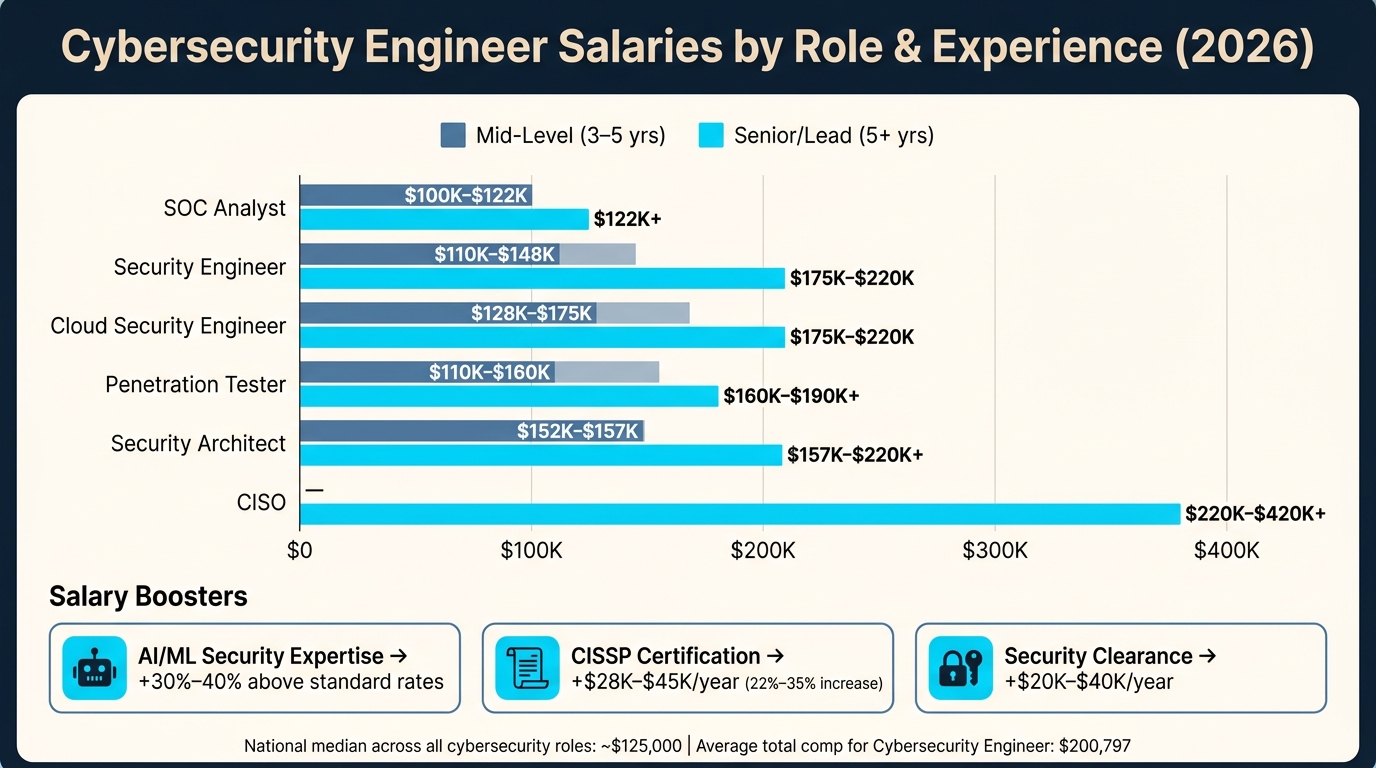
Security roles often come with higher pay compared to general software positions. For instance, the average total compensation for a Cybersecurity Engineer in the U.S. is $200,797, which includes a $166,851 base salary and $33,946 in additional cash . Across all cybersecurity roles, the national median salary hovers around $125,000, though this varies widely depending on factors like specialization, location, and experience .
Here’s a breakdown of projected salaries by role for 2026:
| Role | Mid-Level (3–5 yrs) | Senior/Lead (5+ yrs) |
|---|---|---|
| SOC Analyst | $100,000 – $122,000 | $122,000+ |
| Security Engineer | $110,000 – $148,000 | $175,000 – $220,000 |
| Cloud Security Engineer | $128,000 – $175,000 | $175,000 – $220,000 |
| Penetration Tester | $110,000 – $160,000 | $160,000 – $190,000+ |
| Security Architect | $152,000 – $157,000 | $157,000 – $220,000+ |
| CISO | - | $220,000 – $420,000+ |
Certain skills and credentials can significantly boost these figures. AI/ML security experts, for example, earn 30%–40% more than traditional security professionals . Similarly, holding a CISSP certification can mean 22%–35% higher pay - translating to an additional $28,000–$45,000 annually on a $130,000 base salary . For roles tied to defense or government work, a security clearance typically adds $20,000–$40,000 to the base pay .
Location also plays a big role in salary differences. For example, Orange County averages $250,000 compared to $150,117 for remote positions. It’s worth noting that benchmarks from 2023 or early 2024 may be outdated, as salaries are expected to rise by 15%–25% by 2026 .
A well-rounded compensation package includes more than just base pay, offering benefits and opportunities for professional growth.
What Else Belongs in the Offer
In today’s competitive cybersecurity job market, a strong offer isn’t just about salary. Comprehensive packages are essential for attracting and keeping top-tier talent. In fact, 53% of U.S. employers have increased starting pay for in-demand skills .
One standout perk is a $5,000–$10,000 annual professional development budget, which can cover expenses like certification exams (CISSP costs $749; CEH is $575), conference fees for events like DEF CON or Black Hat, and ongoing training . As one recruiter aptly put it:
"A cybersecurity professional's greatest asset is their knowledge. An offer that invests in their continuous education is an offer that invests in the company's long-term security." - TekRecruiter
Flexibility in work arrangements is another critical factor. Remote or hybrid options are now expected rather than optional. Requiring full-time on-site attendance could deter senior candidates . Additionally, with 62% of cybersecurity leaders reporting burnout , offers that include clear on-call policies and well-defined incident response boundaries can stand out.
For senior individual contributor (IC) roles, consider creating a Staff Security Engineer track with compensation on par with management-level roles. This approach helps retain top technical talent by providing growth opportunities without requiring a title change .
Building and Keeping a Strong Security Team
What a Security-First Culture Looks Like
Hiring cybersecurity engineers is just the beginning; keeping them around is where the real challenge lies. By May 2026, only 34% of cybersecurity professionals plan to stay with their current employer . That means the culture you create is just as important as the offer you make.
A security-first culture integrates security into the development process from the start - through DevSecOps - rather than tacking it on at the end. When security engineers are involved early, during the architecture phase, they not only produce better results but also feel more valued. Companies with mature DevSecOps programs saved an average of $1.68 million per breach in 2023 . These savings make a strong case for giving your security team real influence.
"Treating security as a gate at the end of development... creates bottlenecks and misses architectural issues that are expensive to fix post-implementation." - StepTo
Another key to fostering a security-first culture is empowering engineers to communicate technical risks in terms of financial and legal consequences. When engineers are encouraged to voice their insights and are included in strategic decisions, it sends a clear message: security is a priority, not an afterthought.
How to Retain Cybersecurity Engineers Long-Term
A strong security culture doesn’t stop at processes - it extends into how teams are managed. Research shows that team quality (78%) and direct manager quality (73%) are the top drivers of job satisfaction for security professionals, ranking higher than compensation or company reputation . This highlights the importance of developing leaders who provide clear guidance, regular one-on-one check-ins, and collaborative problem-solving.
Career growth is another critical factor. Retention rates drop from 75% in the first year to 66% in the second year , often because engineers don’t see a clear path forward. Offering a dual-track career model - one path leading to management and the other to advanced technical roles like Staff Security Engineer - gives employees a reason to envision their future with the company.
Tooling autonomy also plays a big role in retention. Security engineers who are stuck with outdated or purely reactive tools tend to disengage . Allowing teams to choose their own tools - whether it’s Burp Suite, Semgrep, Snyk, or AWS GuardDuty - demonstrates trust and keeps their work engaging. Additionally, dedicating 10–15% of work time for research helps foster ongoing learning and innovation.
"The organizations that get those fundamentals right [progression, realistic workloads, leadership support] tend to attract and retain people far more effectively than those relying on compensation alone." - David Berwick, Director, Adria Solutions
Finally, addressing burnout is non-negotiable. Nearly half of security professionals (48%) feel drained by the constant flow of new threats, and 47% feel overwhelmed by their workload . Implementing structured on-call rotations, setting clear incident response expectations, and maintaining realistic workloads aren’t just “nice-to-haves” - they’re essential for keeping your team productive and motivated over the long haul.
Conclusion
Hiring cybersecurity engineers in 2026 requires careful planning and a deep understanding of the field. With 4.8 million cybersecurity positions unfilled globally , the challenge isn't just finding candidates - it’s finding the right ones. In fact, 52% of cybersecurity leaders report that lacking the right talent is a bigger issue than the number of applicants . A cookie-cutter job listing won’t solve this problem.
The solution? Treat cybersecurity professionals as specialists from the start. Before drafting a job description, understand the nuances between roles like AppSec, Cloud Security, penetration testing, and SOC analysts. Go beyond traditional job boards - tap into CTF platforms, bug bounty programs, and security conferences to discover skilled talent. Evaluate candidates with real-world, task-based scenarios to ensure they have the expertise you need.
When it comes to offers, align with what these professionals value most. U.S. cybersecurity engineers enjoy annual salary increases of 7–10% , so competitive compensation is a must. Beyond pay, focus on benefits that resonate: remote work flexibility, a $5,000–$10,000 annual learning stipend, and clear opportunities for career advancement.
"A cybersecurity professional's greatest asset is their knowledge. An offer that invests in their continuous education is an offer that invests in the company's long-term security." - TekRecruiter
Speed is also critical. While the industry average to fill a cybersecurity role is 3–6 months, top candidates are often hired in 3–4 weeks . A streamlined process that prioritizes privacy, builds trust, and demonstrates your organization’s commitment to security can make all the difference. By combining specificity, efficiency, and respect, recruiters can stand out and secure top talent.
FAQs
How do I choose the right cybersecurity role title?
Choosing the right title for a cybersecurity role means being clear about the responsibilities and areas of focus your organization requires. Titles such as security engineer, penetration tester, SOC analyst, or AppSec engineer each represent specific roles with distinct skills. To attract candidates with the right expertise and avoid confusion, align the title with the role’s scope, technical focus (like threat modeling or code review), and established industry norms.
Where can I source security engineers beyond LinkedIn?
You can discover security engineers in specialized cybersecurity hubs and platforms. Check out Capture The Flag (CTF) groups, bug bounty platforms such as HackerOne and Bugcrowd, or attend major security conferences like DEF CON and Black Hat. You can also engage with OWASP chapters and communities like daily.dev to connect with talented, security-minded individuals.
What’s the best practical interview test for this role?
When evaluating a cybersecurity engineer, the focus should be on hands-on skills rather than certifications or trivia. The most effective interview exercises test a candidate's ability to handle real-world scenarios and demonstrate practical expertise.
Here are some recommended exercises:
- Code Reviews: Ask candidates to identify vulnerabilities in sample code. This highlights their ability to spot potential risks in software development.
- Threat Modeling: Present a system or application and have them outline potential threats and mitigation strategies.
- Incident Response Scenarios: Simulate a security breach and assess how they respond, prioritize actions, and communicate during the incident.
- Practical Hacking Challenges: Provide controlled environments where they can demonstrate penetration testing skills or exploit detection.
Avoid relying on outdated or superficial questions. Instead, focus on tasks that reveal their ability to identify vulnerabilities, configure security controls, and respond effectively to simulated attacks. This approach ensures you’re assessing the skills that matter most in real-world cybersecurity roles.
.png)