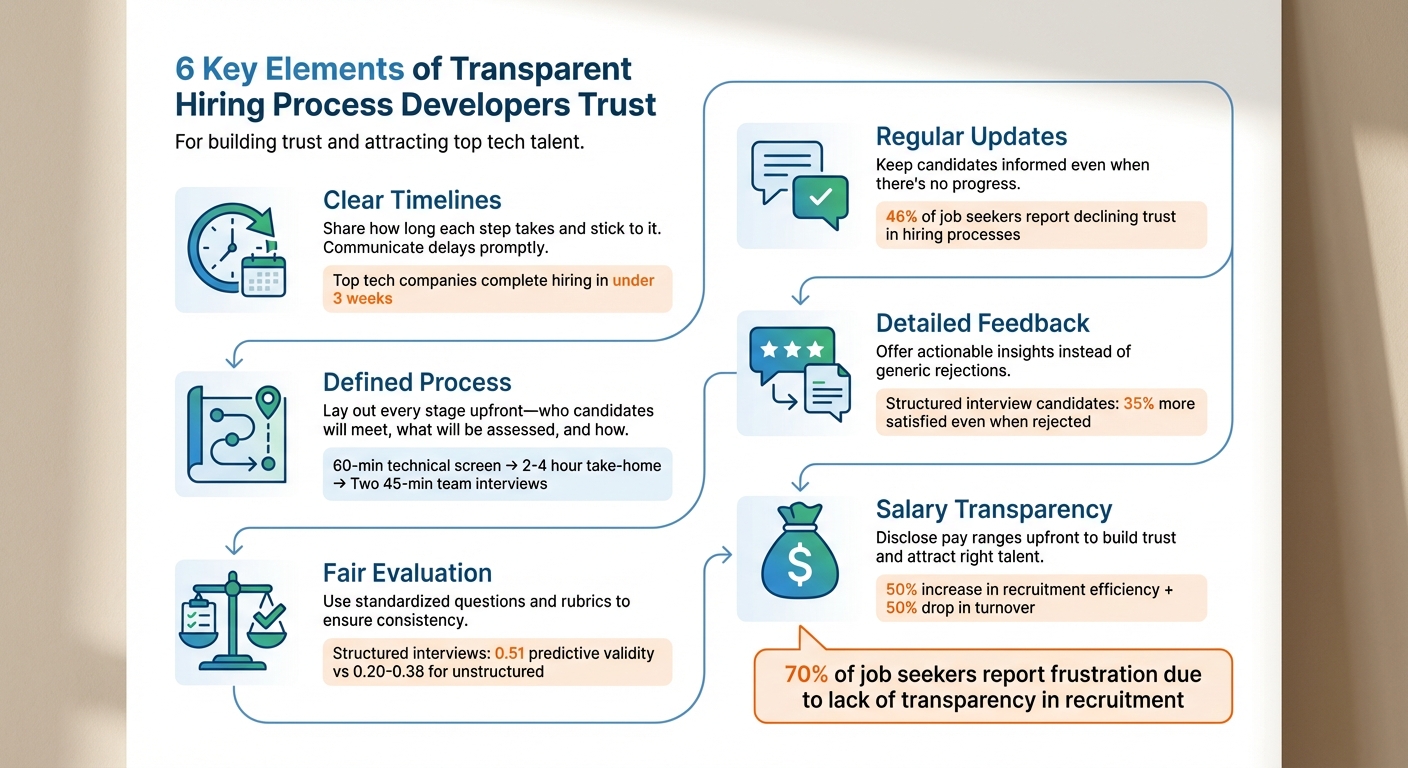
Developers often drop out of hiring processes due to poor communication and lack of clarity. Transparency can fix this by replacing uncertainty with trust. Here’s what you need to focus on:
- Clear Timelines: Share how long each step will take and stick to it. Communicate delays promptly.
- Defined Process: Lay out every stage of the hiring process upfront - who candidates will meet, what will be assessed, and how.
- Fair Evaluation: Use standardized questions and rubrics to ensure consistency. Share evaluation criteria to help candidates prepare.
- Regular Updates: Even when there’s no progress, keep candidates informed to avoid feelings of being ignored.
- Detailed Feedback: Offer actionable insights instead of generic rejections to improve candidate experience.
- Salary Transparency: Disclose pay ranges upfront to build trust and attract the right talent.
Transparent hiring isn’t just about being open; it’s about creating a process that candidates trust. This approach reduces dropouts, improves offer acceptance rates, and reflects positively on your company’s culture.
Core Principles of Transparent Hiring
Transparent hiring rests on two straightforward principles aimed at reducing the anxiety and uncertainty candidates often feel when navigating the hiring process.
Clear Process and Communication
Clarity is the foundation of trust, especially in tech recruiting. Transparency starts the moment a candidate encounters your job posting. Clearly outline the hiring steps, timelines, and evaluation criteria upfront. For example, specify: "The process includes a 60-minute technical screen, a 3-hour take-home project, and two rounds of team interviews over three weeks." Avoid vague statements like "we'll be in touch soon", as they can create unnecessary doubt.
A simple yet effective tactic is the "no-update update." Generi Wilson, Talent Acquisition Program Manager at Greenhouse, highlights its importance:
"Even if the hiring team isn't ready to make a decision yet, sending a simple 'no update, update' is better than not communicating at all."
Regular updates, even when there's no progress, reassure candidates and prevent them from feeling overlooked. This is especially crucial when 46% of job seekers report a decline in trust in the hiring process over the past year.
Melissa Shannon, Senior Talent Acquisition Manager at Greenhouse, emphasizes the risks of inconsistent communication:
"Trust erodes when candidates receive mixed signals late in the process. Acting as a single, consistent voice helps candidates feel grounded instead of confused."
To maintain trust, ensure recruiters and hiring managers are aligned before engaging with candidates. Mixed messages about role expectations, compensation, or the next steps can quickly undermine the trust you've built.
Equally important is evaluating every candidate on the same criteria.
Consistent and Fair Evaluations
Standardized evaluations help reduce bias while still allowing room for human judgment. Use structured interviews and ask every candidate the same core questions for a given role, ensuring fair comparisons. The same principle applies to technical assessments. Whether it’s a 60-90 minute technical screen or a 2-4 hour take-home task, keep the scope and evaluation criteria consistent for all candidates.
Providing candidates with interview topics or specific questions ahead of time levels the playing field. This doesn’t make the process easier but allows candidates to focus on demonstrating their skills rather than improvising under pressure. Additionally, train your hiring team on unconscious bias, psychological safety, and inclusion best practices. For behavioral questions, the STAR method (Situation, Task, Action, Result) ensures evaluations are based on concrete actions and measurable outcomes rather than subjective impressions.
If AI tools are part of your screening process, be upfront about their use. Establish "human-in-the-loop" systems where a person reviews and validates AI-generated recommendations. Candidates need reassurance that human judgment - not an unexplainable algorithm - has the final say. These steps transform what might feel like a murky process into one that builds trust and confidence.
What to Share with Candidates
Being open with candidates means sharing the details that matter most. Developers care about three key aspects: how long the process will take, what the stages involve, and how they’ll be evaluated. Addressing these concerns effectively can ease the anxiety that often causes candidates to withdraw or accept competing offers.
Timelines and Deadlines
Give candidates a straightforward timeline that covers each step from start to finish. For example, outline the expected duration of each phase: "Application to recruiter screen: 2–3 days. Recruiter screen to technical screen: 3–5 days. Technical screen to practical exercise: 3–5 days." Leading tech companies often complete their hiring processes in under three weeks.
If delays occur, communicate promptly. For instance, let candidates know: "You’ll hear from us by Friday, even if it’s just an update". Delays beyond six weeks can give the impression of disorganization and may reflect poorly on your engineering culture.
Internally, set Service Level Agreements (SLAs) for your hiring team, such as requiring feedback from interviewers within 24 hours. This ensures you can stick to the timelines you promise externally. Some top companies even publish their entire interview process on their careers pages, detailing evaluation criteria and offering preparation guides to build trust before candidates apply.
Hiring Process Steps
Break down each stage of the hiring process and explain its purpose. Provide candidates with an interview roadmap that specifies who they’ll meet, what skills will be assessed, and how long each session will last. For instance:
- Round 1: 60-minute technical screen focusing on API implementation and debugging.
- Round 2: 2–4 hour take-home project assessing system design and code quality.
- Round 3: Two 45-minute team interviews evaluating collaboration and communication.
This clarity helps candidates understand what lies ahead and how to prepare.
Evaluation Criteria
Be transparent about how candidates will be assessed. Instead of sharing exact questions, explain the dimensions you’ll evaluate: "We assess technical depth, system design thinking, collaboration skills, and communication clarity." As the daily.dev Recruiter Guide puts it:
"Sharing your evaluation dimensions upfront isn't 'giving away the test' - it's enabling candidates to show their best selves".
Let candidates know what success looks like at each stage. If you use a scoring rubric, explain the criteria. Structured evaluation methods, like scoring rubrics, have a predictive validity of 0.51 or higher, compared to just 0.20–0.38 for unstructured interviews. Require interviewers to submit independent feedback within 24 hours to minimize bias and maintain consistency.
Communication Tactics for Transparency
Transparency in Job Descriptions and Initial Outreach
Trust begins before candidates even hit "apply." Your job descriptions should clearly outline specific technical requirements - list the programming languages (e.g., Python, JavaScript), frameworks (e.g., React, Node.js), and tools your team actually uses. Avoid vague phrases like "fast-paced environment." Instead, describe the project scope, team dynamics, and what the first 90 days on the job will entail.
Salary transparency is crucial. Companies that disclose salary ranges, bonus structures, and benefits in job postings experience a 50% increase in recruitment efficiency and a 50% drop in employee turnover. Leading employers take it a step further by sharing salary ranges and outlining interview processes directly on their careers pages. This kind of upfront clarity helps candidates gauge fit and builds trust even before the first interaction.
When reaching out to potential hires, tailor your message. Highlight specific role responsibilities and provide clear next steps. Setting expectations early creates a foundation for transparent communication throughout the hiring process.
Regular Updates and Feedback
Silence erodes trust. Keep candidates informed at every stage - send updates within 24–48 hours of receiving an application, after each interview round, and even when delivering rejections. If you promised feedback by a certain day but need more time, get in touch before the deadline with a revised timeline.
When offering feedback, be detailed. Swap generic phrases like "not a fit" for actionable insights: "Your frontend skills are strong, but we were looking for deeper backend experience with distributed systems." This kind of feedback not only helps candidates improve but also strengthens your reputation as an employer. Companies like VTS prioritize timely and thoughtful responses, fostering trust and positive word-of-mouth among candidates.
To make this process smoother and more consistent, consider using tools designed to enhance communication and transparency.
Using Tools to Improve Clarity
Tools like daily.dev Recruiter can simplify transparency by giving candidates a clear view of matching criteria and providing automated updates at every stage of the hiring process. Candidates can track their progress in real time, knowing exactly where they stand and what’s next.
Additionally, integrating your ATS (Applicant Tracking System) can automate updates as candidates move through different stages. Replace vague messages like "we’ll be in touch" with precise timelines and proactive notifications about delays. Remote-first companies such as GitLab and Zapier set a high standard by publicly sharing their entire hiring processes and employee handbooks, ensuring complete visibility.
Examples of Transparent Hiring in Practice
Transparent hiring practices help build trust by removing uncertainty, as shown in these standout examples.
daily.dev Recruiter's Transparent Matching Process
daily.dev Recruiter tackles the "black-box" issue in hiring by using a double opt-in introduction system. This means developers must first express interest in a job before recruiters can reach out. All job details - like tech stack, salary range, and work model (remote, hybrid, or onsite) - are shared upfront, so candidates know exactly what to expect before engaging.
Transparency is further reinforced through the Recruiter Compact, a code of ethics that holds recruiters accountable. Recruiters who spam or fail to follow through with candidates are removed from the platform. Opportunities are private by default, shown only to developers whose skills, learning preferences, and career goals align with the role. To keep the process clear, recruiters can add up to three custom screening questions to the job brief, giving candidates a full understanding of how they'll be evaluated. This straightforward approach earns trust and boosts candidate engagement.
Google's Structured Interview Framework
Google has also set the bar high with its structured interview system. Every candidate applying for the same role is evaluated using standardized questions and rubrics, ensuring fairness. Interviewers use a 7-point scale (ranging from Strong No-Hire to Strong Hire) and take detailed notes to support an objective, evidence-based review. The process assesses four key areas: General Cognitive Ability, Emergent Leadership, alignment with company values, and Role-Related Knowledge.
"Structured interviews are one of the best tools we have to identify the strongest job candidates (i.e., predictive validity). Not only that, they avoid the pitfalls of some of the other common methods." - Dr. Melissa Harrell, Hiring Effectiveness Expert, Google People Analytics
To help candidates feel prepared, Google shares materials that outline the kinds of questions they’ll encounter and how decisions are made. The results speak for themselves: rejected candidates who went through structured interviews reported being 35% more satisfied than those who didn’t. Google’s research also shows that structured interviews are the most reliable way to predict job performance. This transparent process builds trust and encourages candidates to stay engaged.
Amazon's Automated Hiring Flowchart
Amazon uses automation to keep its hiring process clear and consistent. Automated systems efficiently screen large numbers of resumes, ranking candidates on a 1-to-5 scale by identifying key terms from profiles of top performers. To demystify the process, Amazon outlines each stage of its hiring flow on its careers page, explaining what is assessed at every step so candidates can prepare.
Algorithmic transparency plays a key role here. After an early AI recruiting tool (used from 2014 to 2017) developed a bias against resumes containing the word "women's", Amazon shifted to more transparent automated systems that require human oversight. This move ensures the process feels fair and gives candidates a better chance to showcase their skills. With 38% of HR leaders piloting or using generative AI in hiring as of January 2024 (up from 19% in June 2023), maintaining clarity in these systems is more important than ever. This openness strengthens trust and keeps candidates engaged throughout the process.
Measuring the Impact of Transparency
Tracking the right metrics can reveal whether your transparent hiring process is truly building trust. One key indicator is application-to-offer completion rates, which show how many candidates stick with your process from start to finish. A high drop-off rate often signals issues like confusion or frustration - problems transparency is meant to address. Considering that 70% of job seekers report frustration due to a lack of transparency in recruitment, monitoring these rates helps identify where candidates lose confidence and disengage.
Application-to-Offer Completion Rates
Breaking your hiring funnel into stages can help pinpoint where candidates drop out due to transparency gaps. Measure timelines for each step, such as application to initial screen, technical assessments and practical exercises. Developers often interpret a streamlined process as a sign of organizational competence. When you clearly communicate the number of steps involved and their expected duration, and then stick to those timelines, you build trust and keep candidates engaged.
"In competitive markets, speed is a feature. Candidates with options choose the company that moves with confidence and conviction." - daily.dev
Additionally, collecting direct feedback from candidates can provide deeper insights into how they perceive the process.
Candidate Feedback Scores
Post-interview surveys are a valuable tool for understanding candidates' experiences. Focus on specific aspects like process clarity and fairness, which are critical for building trust. Use a straightforward 1-to-5 scale to ask questions such as, "How clear were the evaluation criteria?" or "Did you feel the process was fair?" Tracking these scores over time can highlight areas for improvement. Even candidates who don’t receive offers should feel that the process was positive if transparency is effectively implemented.
The final step is to evaluate outcome metrics to get a comprehensive view.
Offer Acceptance and Time-to-Hire
Offer acceptance rates are a clear sign of whether candidates trust your organization enough to join. A low acceptance rate might indicate a gap between the transparency you promise and what candidates actually experience. Similarly, time-to-hire is not just a measure of efficiency but also a trust signal. Developers often associate a quick, streamlined process with a well-run organization. High acceptance rates and shorter hiring timelines demonstrate that a transparent process is working effectively.
Conclusion
In tech recruiting, transparency isn’t just a nice-to-have - it’s the bedrock of trust. When developers are informed about your process, timelines, and evaluation criteria upfront, it eliminates the uncertainty that often comes with vague hiring methods. Consider this: nearly one-third of job applicants report feeling "ghosted" after just a week without an update.
Moving away from traditional "black box" recruiting to open and clear practices has a direct impact on attracting top-tier talent. As Steve Bartel, Founder & CEO of Gem, explains:
"Leading with transparency is your BEST opportunity to build trust with candidates".
This openness not only eases candidate concerns but also creates pathways for meaningful recruitment improvements. Industry leaders have shown that sharing specifics - like compensation details, evaluation criteria, and honest feedback (even for those not selected) - sets a new standard for hiring.
Transparent practices also improve recruitment efficiency and increase offer acceptance rates by fostering mutual respect. Even candidates who don’t get hired can become advocates for your brand, spreading positive impressions that enhance your reputation.
To put these principles into action, start with clear communication: define response timelines, share an evaluation rubric, and provide detailed briefings for finalists. The real secret lies in consistency - follow through on feedback and meet deadlines. These small but powerful steps build the credibility that sets trusted employers apart.
As Kenneth Royal, Senior Talent Acquisition Leader, says:
"Hiring isn't just about skill alignment anymore - it's about expectation alignment".
When your promises align with the candidate experience, you foster trust and create a process that not only attracts top talent but strengthens your organization for the long run. Transparency is the key to making that happen.
FAQs
How do we publish timelines without locking ourselves in?
To give candidates a sense of timing without locking into strict deadlines, share approximate milestones along with expected timeframes (like "tech hiring may take 25–35 days"). Be clear that these timelines are subject to change and make it a priority to keep candidates informed throughout the process, regardless of the outcome. This method strikes a balance by being transparent, easing candidate concerns, and allowing for necessary adjustments while ensuring consistent communication.
What should a developer interview rubric include?
A developer interview rubric should include clear, measurable criteria such as technical expertise, problem-solving skills, communication abilities, and how well the candidate aligns with the team’s values and work environment. Using a standardized scoring system ensures evaluations are fair and consistent for every applicant. This approach promotes transparency and builds confidence in the hiring process.
How do we explain AI screening to candidates?
AI has become a powerful tool in the hiring process, helping recruiters sift through resumes quickly and efficiently. By analyzing resumes against specific criteria - like skills, experience, and qualifications - AI can identify candidates who are a strong match for the role. This saves time and ensures that hiring teams can focus their energy on the most promising applicants.
That said, AI doesn’t replace human judgment. While it can handle the initial screening, final decisions still rely on human insight to evaluate factors like cultural fit, personality, and potential. The combination of AI and human expertise creates a more balanced and effective hiring process.
One of AI's strengths lies in its focus on fairness. Designed to prioritize skills and experience, it removes subjective biases that might creep into manual screening. However, transparency about how AI is used in hiring is crucial. When companies are open about AI’s role, it helps build trust with candidates.
For job seekers, it’s worth noting that tailoring your resume to match the job description can make a big difference. Highlight the specific skills and experiences that align with the role to ensure your application resonates with both AI systems and human recruiters. This approach increases your chances of standing out in a competitive hiring environment.
.png)