Developers expect hiring processes to be as efficient and transparent as the technologies they work with. A slow, unclear, or overly complex process not only risks losing top talent but also harms your reputation as an employer. The good news? Small, actionable changes can make a big difference.
Here’s a quick summary of 15 practical strategies to improve your hiring process for technical roles:
- Leverage Platforms Built for Developers: Tools like daily.dev Recruiter connect you with developers where they already engage, offering targeted outreach and reducing unnecessary friction.
- Simplify Applications: Use one-click apply and resume parsing to save candidates time and effort.
- Mobile-Friendly Processes: Ensure applications and assessments work seamlessly on mobile devices.
- Automate Updates: Keep candidates informed at every stage with automated status updates.
- Use AI Chatbots: Provide instant answers to common questions and streamline communication.
- Write Clear Job Descriptions: Be specific about technologies, responsibilities, and compensation.
- Streamline Scheduling: Integrate calendar tools for easy interview booking.
- Offer Flexible Interviews: Use both live and asynchronous video options to accommodate schedules.
- Showcase Your Team: Share employee testimonials and culture videos to give candidates a sense of your workplace.
- Provide Timely Feedback: Whether after tests or interviews, quick and specific feedback keeps candidates engaged.
- Personalize Outreach: Tailor messages using data from GitHub, LinkedIn, or past interactions.
- Pre-Application Engagement: Build trust with developers by sharing technical content and hosting events.
- Adopt Blockchain Verification: Speed up credential checks with secure, instant verification.
- Track and Improve: Use surveys and analytics to monitor and enhance the candidate experience.
These strategies prioritize efficiency, clarity, and respect for candidates’ time, helping you attract and retain top technical talent while strengthening your employer brand.
1. daily.dev Recruiter
Developer-Focused Features
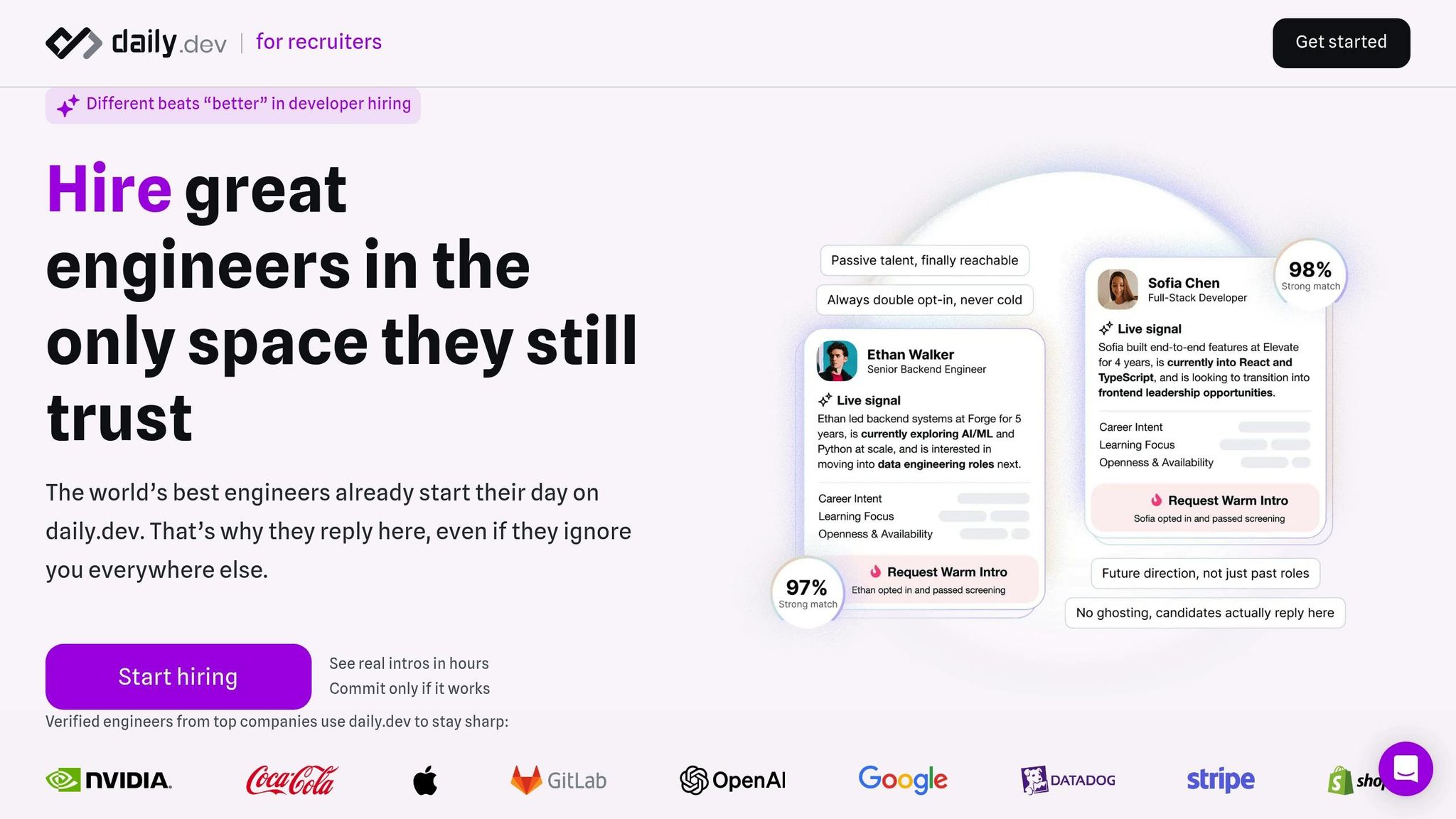
daily.dev Recruiter is built with developers in mind, rather than being a repurposed tool from general hiring platforms. It connects you directly with software engineers in a space they already frequent - daily.dev. This is where they read technical articles, pick up new skills, and engage with their professional community. Instead of forcing developers into traditional job-hunting routines, daily.dev Recruiter fits seamlessly into their existing habits.
The platform uses a double opt-in system to ensure technical compatibility before any interaction begins. This approach reduces spam and saves time for both parties. Developers encounter your job opportunity alongside the content they're already consuming, and they engage only if they're genuinely interested. No cold outreach. No interruptions. Just meaningful connections with developers who are open to hearing about the right opportunity.
Job briefs are crafted with developers in mind - clear, technical, and upfront about the role to ensure developers don't misunderstand job descriptions. This developer-first approach leads to a smoother process that respects their time and expectations.
Reducing Candidate Friction
Traditional recruiting often feels like a chore for developers. Updating resumes, filling out endless forms, responding to generic messages, and waiting weeks for feedback - these steps can be exhausting. daily.dev Recruiter eliminates these hurdles by meeting developers where they already are. They don’t need to create yet another profile or actively search for jobs to be discovered.
Because daily.dev connects you with developers already engaged on the platform, you’re reaching candidates who aren’t actively job hunting but are open to the right opportunity. These individuals are more likely to reply because they’ve chosen to engage, rather than being bombarded with unsolicited messages.
The platform also automates initial qualification, so every conversation starts with purpose. This efficiency fosters better communication and a more productive hiring experience.
Transparency and Better Communication
Transparency is a top priority for developers during the hiring process, and daily.dev Recruiter builds this into its core. Candidates know exactly what they’re getting into before any introductions occur. Job briefs are shared openly within the developer community, encouraging honesty about the role, tech stack, and company culture.
This mutual opt-in process creates a sense of respect often missing in traditional recruiting. Developers can see that you’ve targeted them for their specific skills and interests, not just because they have "Python" on their profile.
The platform also keeps pricing straightforward and predictable, making it easier to plan your recruiting budget. There are no hidden fees or confusing pricing tiers. This same clarity extends to the candidate experience - they know why they’re seeing your job and what the next steps are if they choose to engage. It’s a win-win for everyone involved.
Streamlining with Technology
daily.dev Recruiter integrates seamlessly with your existing ATS and sourcing tools, so you’re not juggling multiple systems or manually transferring data. Candidate details flow directly into your current workflow, keeping things simple and efficient.
Advanced targeting features allow you to connect with developers based on their actual skills, interests, and engagement patterns, rather than relying on static keywords in a profile. This targeting happens within the daily.dev network, where developers actively showcase their expertise through the content they read and interact with.
The platform’s infrastructure supports a global talent pool, making it easy to find top developers whether you’re hiring locally or building a distributed team. The technology takes care of the complex matching and targeting, ensuring a smooth experience for both recruiters and candidates. It’s all about using technology to create meaningful connections without adding unnecessary complexity to the process.
2. Add One-Click Apply and Resume Parsing
Efficiency in Reducing Candidate Friction
Nobody enjoys re-entering their resume details, especially developers. Research shows candidates can spend up to 45 minutes manually filling out application forms, and 70% abandon applications that take longer than 15 minutes . For developers, who are often casually exploring opportunities rather than actively job hunting, that patience threshold is even lower. If the process feels tedious, they’ll simply close the tab and move on.
One-click apply, paired with intelligent resume parsing, eliminates this hassle. Candidates upload their resume once, and the system automatically extracts and fills in the required fields. For example, in September 2025, a healthcare company struggling with a 60% application abandonment rate adopted this technology. The result? A 40% boost in application completion rates . While this example comes from healthcare, the same principle applies even more strongly in technical recruiting, where competition for candidates’ attention is fierce. Reducing friction here not only improves the candidate experience but also sets the stage for more advanced, AI-driven recruitment tools. However, it is crucial to use tech recruiting in the age of AI to handle administrative tasks rather than replacing human connection.
Use of Technology to Streamline Processes
Modern resume parsing technology leverages AI to analyze and understand resumes, no matter the format. It can extract key details like job titles, company names, dates, technical skills, programming languages, and educational history - all without requiring candidates to repeatedly fill out forms.
This technology integrates seamlessly with your existing ATS, ensuring that parsed data flows directly into your recruitment system. There’s no need to overhaul your current setup; the parsing layer works alongside what you already use . Some platforms even offer solutions that bypass traditional ATS limitations, further simplifying the process for candidates.
Keep application forms short and to the point. Limit required fields to just the essentials: name, email, phone number, and resume . Everything else can be addressed later in the hiring process. Adding unnecessary fields only creates friction, driving candidates away. By streamlining these steps, you respect candidates’ time while maintaining a smooth recruitment workflow.
Developer-Focused Features
Developers often apply for jobs using their phones. In fact, more than half of all job applications now come from mobile devices . That means your one-click apply system must perform flawlessly on smartphones and tablets - not just desktops.
Offer alternatives to the traditional resume upload. Many developers maintain their professional profiles on platforms like LinkedIn or GitHub instead of keeping a Word document up to date. Allowing candidates to link directly to these profiles demonstrates an understanding of how technical professionals operate .
To enhance the mobile experience further, ensure buttons are large enough to tap easily, text is readable without zooming, and file uploads are smooth on all mobile operating systems. Test your application process across various devices and screen sizes to identify and fix any issues before candidates encounter them.
Finally, track your application completion rates. If you notice high drop-off rates at specific steps, that’s your cue to simplify or remove those barriers. By relying on this data, you can create a more seamless experience that respects developers’ time and increases the number of qualified applicants in your pipeline .
3. Make Applications Mobile-Friendly
Reducing Barriers for Candidates
When forms are designed with mobile users in mind, they eliminate unnecessary hurdles that might turn technical candidates away, as outlined in this developer hiring checklist. Features like a save-and-resume option make a big difference. Candidates can start an application on their phone and pick up where they left off on any device, ensuring flexibility and convenience.
Tailored Features for Tech Professionals
Developers and other tech professionals often highlight their expertise through platforms like GitHub, personal websites, or technical portfolios. Allowing candidates to link these directly - or even apply via platforms like LinkedIn - not only respects their workflow but also simplifies the process for them.
Additionally, offering mobile-compatible, role-specific skills assessments with instant feedback is a game-changer. These tests let candidates gauge their fit for a role without committing to lengthy, desktop-only evaluations. This mobile-first approach ensures the application process aligns with technical hiring best practices and the fast-paced, tech-savvy habits of these professionals.
Leveraging Technology for a Smoother Experience
Mobile-friendly design is just the starting point. Advanced tools like AI chatbots can take the candidate experience to the next level. These bots can answer questions about tech stacks, team setups, or role specifics, making it easier for candidates to navigate the process while on the go . For more complex inquiries, chatbots can seamlessly escalate issues to human recruiters, ensuring no question goes unanswered. This blend of mobile optimization and smart technology creates a smoother, more engaging journey for candidates.
4. Send Automated Status Updates
Keeping Candidates in the Loop
One of the biggest frustrations for job applicants is feeling like their application has disappeared into a "black hole." This lack of communication creates unnecessary anxiety. Automated status updates solve this by keeping candidates informed at every step of the hiring process. For example, candidates can receive updates as their application moves from "received" to "under review" or when a "technical assessment is scheduled" . These timely updates create a steady flow of communication, reducing uncertainty and fostering a better overall experience. This is critical because closing the loop is one of the most significant ways to rebuild trust in developer hiring.
Simplifying the Candidate Experience
Much like features such as mobile-friendly designs or one-click applications, automated updates make the hiring process smoother. Regular updates keep candidates engaged, making them more likely to remain interested in the role and accept an offer if one is extended . By reducing friction and maintaining consistent communication, these updates help build trust and improve the chances of securing top talent.
5. Use AI Chatbots for Instant Support
Making the Hiring Process Smoother
Technical candidates often have questions about things like the tech stack, remote work policies, or the status of their applications. These questions usually need quick answers, and that's where AI chatbots shine. Available 24/7, they provide instant responses to common inquiries such as, "What programming languages does your team use?" or "When will I hear back about my application?" This quick access to information helps eliminate delays and keeps candidates moving through the process without unnecessary frustration.
Tailored for Developers
Developers value clear, accurate, and technical communication. AI chatbots can be tailored to meet these expectations, offering precise answers to questions about the role. For example, they can share details about the development environment, version control systems, or deployment workflows. They can even explain the format of technical assessments and evaluation tools, including the tools or programming languages that will be evaluated and how long the process might take.
But chatbots don’t stop at answering questions - they can also guide candidates through the application process step by step. Whether it’s helping troubleshoot issues with uploading a portfolio or clarifying next steps, these chatbots provide immediate support. This frees up recruiters to focus on tasks like interviewing and building relationships with top-tier candidates.
Building Trust Through Clear Communication
AI chatbots also play a key role in creating a transparent hiring experience. By providing consistent and accurate answers, they ensure every candidate gets the same level of information, reducing any perception of bias. This consistency builds trust and reassures candidates that the process is fair.
Chatbots can also take the initiative when it comes to communication. For example, if a candidate starts an application but doesn’t complete it, the chatbot can send a friendly nudge with tips to help them finish. Before a technical assessment, the chatbot can offer preparation resources or address last-minute concerns. This kind of proactive engagement keeps candidates informed and reassures them that your organization is committed to their success throughout the hiring journey.
6. Write Clear Job Descriptions for Developers
Developer-Focused Features
Developers want specifics, not vague language. Avoid generic phrases like "experience with modern web technologies." Instead, list the exact tools and technologies they'll work with, such as React 18, TypeScript, Node.js, PostgreSQL, AWS, and Docker. This kind of detail helps candidates quickly determine if their expertise aligns with the role.
Be equally precise about responsibilities. For instance, say, "architect microservices for high-volume APIs" or "optimize search algorithms to achieve sub-200ms query times." Developers appreciate clear, actionable details that outline the scope of work and the impact they'll have. This clarity ensures everyone has realistic expectations from the start.
Transparency and Communication Enhancements
Honesty is key when writing job descriptions for technical roles. If the position involves maintaining legacy systems, state it upfront. If there's an on-call rotation, be clear about its frequency and whether compensation is included. Developers value transparency and honesty far more than sugarcoated descriptions that hide potential challenges.
Include practical details like a salary range (e.g., "$120,000–$150,000") to set expectations early. Mention work arrangements - whether fully remote, hybrid (with specific in-office days), or on-site. Highlight team size, collaboration tools, and other logistical details. When candidates have a full picture of the role, it builds trust and helps them make informed decisions.
Efficiency in Reducing Candidate Friction
A well-written job description eliminates unnecessary back-and-forth. For example, outline the interview process upfront: "one 30-minute phone screen, a 90-minute technical assessment, and two 45-minute team interviews." Knowing the steps allows candidates to prepare without added stress.
Avoid including unnecessary qualifications. For instance, requiring a computer science degree when practical skills are more relevant - or asking for five years of experience with a tool that's only existed for three - can alienate strong candidates. Focus on the skills and experience that truly matter for success in the role.
If you're requesting code samples, be specific: "Provide a link to your GitHub profile or share an API design example." Vague requests like "examples of your best work" leave candidates unsure of what you're looking for. The easier you make it for qualified developers to apply, the better your chances of attracting top talent. Clear, detailed descriptions remove guesswork, build trust, and encourage more meaningful engagement from candidates.
7. Connect Calendar Tools for Easy Scheduling
Making Scheduling Easier for Candidates
Scheduling interviews shouldn’t feel like a marathon. Yet, in traditional setups, it can take up to 47 emails to finalize an interview slot . That’s a lot of back-and-forth for something that should be straightforward. By integrating calendar tools, candidates can skip the hassle and directly view available time slots to book their interviews. This self-service option eliminates waiting for responses and cuts out unnecessary communication loops.
Offering flexible options, like evening or weekend slots, makes it even easier for candidates to follow through. This approach not only respects their time but also creates a smoother, more transparent process that sets a positive tone for the entire hiring experience. It’s a win-win: candidates get convenience, and recruiters save time.
Leveraging Technology to Simplify Scheduling
Calendar integration isn’t just about convenience; it’s about efficiency. These tools handle scheduling automatically, freeing up recruiters from the tedious task of coordinating calendars. The result? reducing time to hire . This extra time can be redirected toward more impactful tasks, like digging into candidates’ technical skills and assessing soft skills or crafting thoughtful interview questions.
Modern calendar tools also come with handy features like automated reminders and easy rescheduling. Plus, they sync seamlessly with popular platforms like Google Calendar, Outlook, and Apple Calendar, ensuring real-time availability checks. This means no more double bookings or scheduling conflicts - just smooth, hassle-free coordination.
Building Trust Through Transparency
Transparency is key in creating a positive interview experience, and calendar integration plays a big role here. When candidates can see all available time slots at a glance, there’s no guessing or confusion about when the interview will happen. Instant confirmations provide clear details, including the interview’s format, duration, and participants, helping candidates feel prepared and confident.
This streamlined communication shows candidates that your organization values their time and prioritizes efficiency. It’s a simple yet powerful way to build trust and reinforce your commitment to a modern, respectful hiring process.
8. Allow Asynchronous and Live Video Interviews
Developer-Focused Features
Technical candidates often juggle multiple responsibilities, which makes traditional interview scheduling a hassle. Video interviews - whether live or asynchronous - offer the flexibility developers need, sparing them from taking time off or dealing with scheduling conflicts. For fully remote technical roles, video interviews remove location constraints, opening access to a broader talent pool regardless of geography .
Asynchronous video interviews are especially useful for developers in different time zones or those who prefer to highlight their skills outside standard business hours. Instead of struggling to coordinate schedules, candidates can record their responses to technical questions at a time that suits them best. This approach acknowledges that many developers produce their best work outside the usual 9-to-5 schedule.
Live video interviews, combined with self-scheduling tools, give candidates the ability to choose time slots that fit their availability. This setup allows for real-time discussions on complex technical topics while still respecting the candidate's schedule. It’s a win-win for both parties, enabling a balance between flexibility and meaningful interaction .
Efficiency in Reducing Candidate Friction
The flexibility of video interviews also translates into a more streamlined hiring process. By cutting out travel and reducing delays, video interviews can improve hiring efficiency by 25-40% . That’s a major time-saver for everyone involved. For candidates, this means no travel expenses, no wasted commute time, and no stress about navigating unfamiliar office locations. For employers, it means quicker hiring cycles and the ability to evaluate more candidates without logistical headaches.
Self-scheduling tools take this efficiency a step further. Candidates can easily book interview times that suit them, freeing hiring managers from endless back-and-forth emails. This smoother process saves time and keeps the focus on what matters most - evaluating talent .
Transparency and Communication Enhancements
Video interviews also create opportunities for more transparent and personalized interactions. Before virtual interviews, hiring managers should take the time to research candidates' backgrounds and interests. This extra effort helps foster a welcoming environment and shows genuine interest in the individual, not just their technical skills . Such preparation not only demonstrates respect for the candidate's time but also helps build a stronger connection - even through a screen.
For asynchronous interviews, keep introductory videos short and to the point. Anything longer than 15 minutes risks losing candidates due to overly lengthy application processes . Developers value efficiency, so stick to the essentials when conveying information.
Use of Technology to Streamline Processes
To make the most of video interviews, it’s crucial to implement the right tools and provide proper training. Interviewers should be comfortable with the platform to ensure a smooth, professional experience for candidates. Technical issues or a lack of familiarity with the tools can derail the process and leave a poor impression .
The technology should also integrate seamlessly into your recruitment workflow. Look for platforms that sync with calendars, send automated reminders, and provide clear instructions to candidates ahead of time. When the tools operate smoothly in the background, candidates can focus on showcasing their skills instead of troubleshooting technical problems.
Video interviews are a powerful way to enhance the candidate experience in tech recruitment . They represent a shift toward flexibility and a candidate-first approach, meeting developers on their terms - both in terms of location and schedule. This modern approach not only simplifies the hiring process but also helps attract top talent in an increasingly competitive market.
9. Show Employee Testimonials and Culture Videos
Including employee testimonials and "day-in-the-life" videos on your career site can give technical candidates a genuine feel for what it’s like to work at your company. These videos highlight a typical workday and provide a window into your company’s culture, helping candidates envision themselves as part of the team .
Looking ahead, technology is taking this concept to the next level. Virtual reality (VR) is emerging as a powerful tool for creating immersive candidate experiences. Imagine offering virtual office tours or programs that let candidates get a sense of your workplace atmosphere before they even step through the door. Some companies are already working on VR partnerships, aiming to launch these immersive workplace previews as soon as late 2025 .
10. Give Immediate Feedback After Technical Tests
The Importance of Timely Feedback
When candidates invest their time and effort into completing technical assessments, leaving them in limbo afterward can create unnecessary stress and leave a negative impression. Silence after these assessments often signals a lack of respect for their time and contributions.
The data speaks volumes: 94% of candidates want feedback after an interview, regardless of the outcome . Yet, many companies fail to meet this expectation, leaving developers feeling undervalued. This disconnect can directly affect how candidates view your company and its hiring practices.
Providing timely updates helps keep candidates engaged throughout the hiring process. Even a brief message like, "We're still reviewing your submission", can go a long way in reducing uncertainty and showing that you value their effort . Clear communication about when to expect feedback can also prevent candidates from pursuing other offers while they wait to hear from you.
Tailoring Feedback for Developers
Developers are used to receiving instant feedback in their daily work, whether through code editors or CI pipelines. Bringing that same immediacy to technical assessments creates a more seamless and relatable experience for them .
Quick feedback also allows candidates to assess their own performance. If someone struggles with a specific technology during the test, they might choose to withdraw their application, saving both their time and yours. On the flip side, a strong performance can boost a candidate's confidence and enthusiasm for the role.
Personalized feedback adds even more value. Highlighting a candidate's strengths and areas for improvement not only prepares them for future opportunities but also leaves a lasting positive impression.
"Sharing personalized, constructive feedback helps candidates prepare for future opportunities. Applicants who receive timely feedback are more likely to consider the company again for future roles." - Dice Staff
This thoughtful approach benefits your company beyond the immediate hiring cycle. Candidates who receive constructive feedback, even after rejection, are more likely to reapply for future roles. Over time, this builds a pool of developers who are familiar with your technical requirements and have a favorable view of your company .
Leveraging Technology for Speed and Accuracy
Providing immediate feedback when you handle high volume technical applicants effectively requires the right tools. Technical assessment platforms can evaluate coding challenges and system design exercises automatically, generating initial feedback that integrates seamlessly with your recruitment workflow. This ensures candidates receive timely updates without adding to your team's workload.
Automated systems, such as RPA bots, can handle routine feedback delivery, allowing recruiters to focus on candidates with high potential. However, it’s important to review automated messages to ensure they strike the right balance between honesty and encouragement. The tone of your feedback matters just as much as its speed. Even constructive criticism, when delivered respectfully, can enhance the candidate's overall experience .
Reducing Friction in the Hiring Process
Timely feedback doesn’t just keep candidates engaged - it reduces drop-off rates. Developers often juggle multiple job opportunities, and long periods of silence after assessments can push them toward companies that communicate more effectively.
Setting clear expectations upfront is key. Let candidates know when they can expect feedback, and make sure your systems are equipped to meet those deadlines . For example, if you promise feedback within 48 hours, ensure your processes are reliable enough to deliver on that commitment. Consistency in communication builds trust and sets you apart from competitors who leave candidates guessing.
When combined with a streamlined application process and open communication, immediate feedback demonstrates a genuine commitment to putting candidates first. This approach not only keeps candidates engaged but also reinforces a culture of transparency and respect throughout your hiring process.
11. Provide Clear Interview Feedback Quickly
Why Feedback Matters in the Hiring Process
Let’s face it - interview feedback often gets lost in the shuffle. Candidates pour hours into preparing for multiple interviews, only to be left waiting for weeks or receiving vague rejection emails. This lack of communication doesn’t just frustrate applicants; it can damage your company’s reputation and drive talented developers to competitors who prioritize open communication.
Developers value clarity and openness in their work environments, and they expect the same during hiring. By providing clear, specific feedback after interviews, you show that your organization aligns with the transparency they value. Timing also plays a big role here. Delaying feedback by two weeks or more leaves candidates feeling frustrated and uncertain, especially when they’re likely interviewing with other companies. A simple commitment - like delivering feedback within three business days - can go a long way in showing respect for their time and helping them navigate their job search.
And no, feedback doesn’t have to be an essay. It just needs to be honest and specific. For example, instead of saying, “We’ve decided to move forward with other candidates,” you could say, “Your system design skills were strong, but we’re looking for someone with more hands-on experience scaling distributed systems.” This level of detail not only helps candidates understand the decision but also gives them a roadmap for improvement. Clear, timely feedback is just as important as other aspects of the hiring process, like automated status updates or user-friendly application systems.
Borrowing From Developers’ Daily Work
Developers are no strangers to detailed code reviews, so why not apply a similar approach to interview feedback? Offering constructive, technical feedback mirrors the kind of input they’re used to receiving in their day-to-day work, making the process more meaningful.
When providing feedback, focus on their technical performance. If a candidate struggled with an algorithm or made a questionable architectural choice, explain what you were looking for and why their approach didn’t quite hit the mark. On the flip side, don’t forget to highlight their strengths - whether it’s their problem-solving skills or their ability to communicate complex ideas clearly. Developers appreciate this level of detail because it resonates with the feedback culture they’re accustomed to.
To make your feedback even clearer, structure it around the criteria you used to evaluate them. For example, if you assess candidates on technical skills, problem-solving ability, communication, and team fit, organize your feedback into those categories. This approach not only helps candidates understand how they performed in different areas but also shows them your evaluation process is thoughtful and consistent.
For those who make it to later interview stages, feedback becomes even more critical. Candidates want to know what impressed the team and where they could improve. Offering this kind of input not only helps them prepare for potential next steps but also reinforces your company’s commitment to continuous learning, a principle many developers hold dear.
Speeding Things Up Without Cutting Corners
Clear communication is only half the battle. To truly reduce friction for candidates, you need to streamline your internal processes as well.
One common bottleneck is the manual coordination between interviewers. By the time everyone submits their notes and the hiring manager compiles the feedback, days - or even weeks - can pass. To avoid this, set clear expectations with your interview team. Ask interviewers to submit structured feedback, complete with ratings and comments, within 24 hours of the interview. When everyone knows their role in the process, things move much faster.
Another way to save time? Provide feedback after each interview stage instead of waiting until the end of the process. This keeps candidates informed and gives them a chance to adjust their approach for future rounds. Plus, it lightens the workload at the end when final decisions need to be made quickly.
Even when a candidate isn’t selected, the feedback process doesn’t have to end there. Thoughtful, constructive feedback can leave a lasting impression, encouraging candidates to stay in touch or reapply in the future. They might even recommend your company to other talented developers, turning a rejection into a long-term opportunity.
Leveraging Technology for Faster, Smarter Feedback
Technology can be a game changer when it comes to delivering feedback quickly and efficiently. Modern applicant tracking systems (ATS) allow interviewers to submit feedback directly through mobile apps, often right after the interview. This real-time input reduces the risk of forgetting key details and cuts down on the time spent hunting for feedback later.
Automated workflows can also help. For instance, once all interviewers submit their evaluations, the system can compile a summary report highlighting areas of agreement and discrepancies for the hiring manager to review. This automation frees up time for crafting personalized feedback for candidates.
Templates are another useful tool. Create templates for common scenarios, like candidates with strong technical skills but limited team experience or those who excel in communication but lack specific technical expertise. These templates ensure consistency while still leaving room for customization with specific examples from the interview.
Some video interview platforms even let you record sessions and timestamp key moments. Reviewing these recordings allows you to reference specific answers or problem-solving approaches in your feedback, showing candidates that you paid close attention and took their evaluation seriously.
Finally, analytics tools can track metrics like average feedback time, completion rates, and candidate satisfaction. These insights help identify bottlenecks in your process and hold your team accountable for delivering timely, quality feedback.
12. Personalize Messages Using Candidate Data
Personalizing your outreach efforts is a powerful way to improve the candidate experience, especially when combined with strategies to simplify and streamline tech-driven hiring processes.
Developer-Focused Features
Generic outreach emails often fall flat with developers. These professionals are inundated with messages that all sound the same: "We're looking for a rockstar developer..." or "Exciting opportunity at a fast-growing startup..." These cookie-cutter approaches fail because they lack any real understanding of who the candidate is or what they value.
Developers appreciate when you take the time to understand their work. By referencing specific contributions on GitHub, Stack Overflow, or open-source projects, you can craft messages that resonate. For example, instead of saying, "We're hiring a Python developer", try something like, "I came across your contributions to the Django REST framework, especially your work on serializer optimization. We're building a high-performance API platform and could really use your expertise in reducing response times."
This kind of message stands out because it acknowledges the candidate's skills and accomplishments. It speaks to what developers care about: solving technical challenges, doing meaningful work, and being recognized for their expertise.
When personalizing your messages, highlight specific technologies, projects, or even technical blog posts that the candidate has worked on. If they've spoken at a conference or contributed to a well-known open-source library, mention it. This level of detail shows that you value their unique contributions and sets the tone for a more engaging conversation.
Efficiency in Reducing Candidate Friction
While personalization is key, it doesn't have to be time-consuming. The trick is to focus on relevant data points that allow you to create tailored messages without spending excessive time on each candidate.
For developers, prioritize information like their tech stack, years of experience with specific tools, and preferences for company size or remote work. Modern applicant tracking systems (ATS) can pull this data from LinkedIn profiles, GitHub activity, personal websites, or even past applications to your company. Use this information to group candidates into segments based on their experience level or technical expertise. For instance, a junior developer seeking mentorship will need a different approach than a senior engineer exploring leadership roles.
Once segmented, you can use message templates with dynamic fields to save time while maintaining a personal touch. For example, a message might read: "Hi [First Name], I noticed your experience with [Primary Technology] at [Current Company]. We're tackling similar challenges with [Specific Technical Problem] and think your expertise in [Relevant Skill] would be a great asset." This approach balances efficiency with authenticity, making candidates feel valued without requiring hours of manual effort.
By focusing on quality over quantity, you can send fewer messages but see better results. Instead of blasting 100 generic emails and getting a handful of replies, you might send 50 personalized messages and receive 20 genuine responses from candidates who feel the role aligns with their skills and goals.
Transparency and Communication Enhancements
Personalization shouldn't stop at the first message - it should extend across every stage of the hiring process. Thoughtful, data-driven communication creates a sense of continuity that candidates notice and appreciate.
For example, when following up after an application, reference specific details from the candidate's resume or portfolio. If they've worked on migrating monolithic applications to microservices, highlight how your team is tackling similar challenges: "We saw your experience with microservices architecture at [Previous Company]. That aligns closely with the work we're doing to modernize our systems."
Even small touches can make a big difference. Include details in scheduling invites, like the name of the interviewer and their background: "You'll be speaking with Sarah, our lead backend engineer, who has extensive experience with Kubernetes. She's excited to hear more about your work with container orchestration."
As candidates progress through the hiring process, use notes from earlier conversations to tailor future interactions. If someone mentioned remote work flexibility as a priority, address it before the final interview: "We know work-life balance is important to you. During your next conversation, our team lead will explain how we support flexible schedules."
Clear communication also means keeping candidates informed during delays. If your hiring timeline shifts, acknowledge their situation and provide an update: "We know you're considering other opportunities with December deadlines. We're still finalizing decisions and wanted to share our updated timeline so you can plan accordingly."
Use of Technology to Streamline Processes
Technology plays a key role in making personalization scalable - but it works best when used strategically. The goal isn't to automate every interaction but to streamline repetitive tasks so you can focus on building genuine connections.
Start with tools that gather publicly available candidate data from platforms like LinkedIn, GitHub, and technical forums. These tools can provide a comprehensive view of a candidate's skills and interests without requiring hours of manual research. Ensure this data integrates seamlessly into your messaging system, allowing you to reference it easily.
AI-powered writing assistants can also help speed up the personalization process. These tools analyze candidate data to suggest relevant talking points, like specific technologies or projects to mention. This ensures you don't overlook key details while saving valuable time.
Dynamic content blocks are another efficient way to personalize outreach. These blocks automatically populate with candidate-specific details, creating tailored messages for each recipient. For example, a message might reference their experience level, technical specialties, or recent open-source contributions, all without manual input.
Track engagement metrics to refine your approach over time. Pay attention to which personalized messages get the best response rates, which subject lines resonate with different candidate segments, and which data points seem most impactful. If referencing open-source contributions consistently drives higher engagement, adjust your strategy to emphasize that more.
Finally, ensure your ATS and communication tools are fully integrated so everyone on your hiring team has access to the same candidate data. This allows interviewers to tailor their conversations based on prior interactions, reinforcing the idea that your company values candidates as individuals, not just resumes.
13. Set Up Pre-Application Engagement Campaigns
Connecting with developers before they even think about applying can transform your hiring process. Pre-application engagement campaigns help create awareness, build trust, and prepare potential candidates for future opportunities. This strategy works particularly well for technical talent, who often take their time evaluating opportunities and prefer engaging with companies they already respect. By starting early, you set the stage for a smoother and more positive recruitment experience.
Developer-Focused Features
Developers thrive on solving problems, learning new skills, and building great projects. To truly connect with them, meet them where they already spend their time - whether that's in their professional routines or online communities.
Start by offering meaningful technical content. Share blog posts about your engineering challenges, open-source contributions, or GitHub repositories that highlight your team’s work. Host technical talks or webinars that showcase your expertise. When developers see your company sharing knowledge instead of just posting job ads, it creates a positive impression of your engineering culture.
Beyond content, events are a great way to engage. Host hackathons, coding workshops, or meetups focused on specific technologies. These events give developers a chance to interact with your team in a natural, low-pressure environment. Over time, these interactions create familiarity and trust, making recruitment conversations feel more organic.
Developer newsletters and email campaigns are another effective tool. Focus on sharing knowledge - like insights into your tech stack, architectural decisions, or lessons learned from real-world challenges. When you do mention job openings, frame them as opportunities to tackle exciting technical projects rather than generic announcements.
Platforms like daily.dev Recruiter can also help you connect with developers. Since developers already use daily.dev to stay updated on industry trends, your company can gain visibility and credibility within this community. When you eventually reach out about a role, candidates are more likely to recognize your brand and understand what your team is all about.
Reducing Candidate Friction
Engaging developers early doesn’t have to be complicated or time-consuming. The key is to create systems that nurture relationships over time.
Automate nurture sequences based on candidate behavior. For example, if a developer visits your careers page but doesn’t apply, follow up with a series of emails introducing your engineering team, explaining your development process, and highlighting interesting projects. Space these emails out weekly or bi-weekly to stay top of mind without overwhelming them.
If someone engages deeply - like reading multiple blog posts about your infrastructure - consider inviting them to a technical webinar or sharing related case studies. Similarly, if they download a technical whitepaper, follow up with resources that align with their interests or connect them with engineers who’ve tackled similar challenges.
Creating a dedicated talent community or newsletter for developers can also be a game-changer. This gives passive candidates a low-commitment way to stay connected. They can learn more about your team, your projects, and your culture, so when they’re ready to explore opportunities, they already feel like part of the fold.
Use engagement metrics to identify warm leads. Developers who consistently open your emails, attend webinars, or interact with your content are already showing interest. When relevant roles open up, these candidates should be prioritized - they’re already halfway through the decision process.
Transparency and Communication
Transparency is a cornerstone of effective pre-application engagement. Developers value honesty and clarity, so use this phase to set clear expectations about your hiring process, team structure, and engineering practices.
Share behind-the-scenes content that gives developers a glimpse into your engineering culture. This could include “day in the life” videos, detailed explanations of your code review process, or candid discussions about how your team handles technical debt. Authenticity is key - developers can easily spot overly polished, corporate messaging.
Be upfront about your hiring process. If you’re building a pipeline for future roles, say so. If you’re actively hiring, provide clear details about the interview process, timelines, and what candidates should prepare for. This kind of transparency reduces uncertainty and helps developers decide if they want to move forward.
Address common concerns directly. For instance, if you frequently get questions about remote work or professional development, create content that answers these upfront. Showcase how team members have grown their skills and careers within your organization.
Encourage two-way communication by offering multiple ways for developers to ask questions. Host Q&A sessions with engineering leaders, schedule open office hours, or provide direct messaging options. When candidates feel they can get honest answers before applying, they’re more likely to approach the process with confidence.
Streamlining Processes with Technology
The right technology stack can make pre-application engagement scalable and efficient. Start with tools that integrate content, communication, and tracking systems to manage campaigns seamlessly.
Marketing automation platforms can help you segment your audience by interests, engagement levels, and technical backgrounds. For instance, a frontend developer might receive updates about your React architecture, while a backend engineer gets content about your microservices journey. This personalized approach ensures relevance without requiring constant manual effort.
Use analytics to refine your strategy. Track which blog posts drive the most traffic to your careers page, which webinar topics attract the largest audiences, and which email subject lines get the best open rates. This data helps you focus on what resonates most with developers.
Integrate these tools with your applicant tracking system. If someone from your talent community applies for a role, their engagement history - like attending technical talks or downloading resources - should be visible to recruiters and hiring managers. This context can make conversations more meaningful and targeted.
Chatbots and AI assistants can also play a role. They can handle routine questions, like inquiries about your tech stack or remote work policies, even outside of business hours. For example, a developer browsing your careers page late at night can get immediate answers, keeping their interest alive until your team is available for deeper discussions.
Platforms like daily.dev Recruiter are designed to naturally support pre-application engagement. By connecting with developers in a space they already trust, your company can build relationships long before discussing specific roles. This early connection strengthens every step of the hiring process, making it easier to bring the right talent on board.
14. Use Blockchain for Fast Credential Verification
Credential verification has always been a bottleneck in technical hiring. Traditional methods often take weeks, delaying the process unnecessarily. Blockchain technology offers a game-changing alternative by enabling instant and tamper-proof verification, cutting out these time-consuming delays entirely .
Developer-Centric Benefits
Blockchain technology aligns with the demand for faster and more transparent hiring processes. It allows technical candidates to create portable profiles that consolidate all their verified credentials in one place. No more resubmitting the same documents over and over - credentials can be securely shared using cryptographic proof. Plus, blockchain provides a detailed audit trail for every credential, ensuring full visibility into the verification process.
Smoother Hiring with Faster Turnarounds
Background checks that once dragged on for weeks can now be completed instantly with blockchain. This means faster onboarding, saving both candidates and recruiters significant time. When candidates earn new certifications or qualifications, they can quickly update their profiles without additional administrative hassle, keeping their information accurate and up-to-date.
Building Trust Through Transparency
Blockchain doesn’t just speed things up - it also enhances trust. Both candidates and recruiters gain access to an auditable record of credential verifications, so there’s no ambiguity about the authenticity of qualifications. This transparency eases concerns and strengthens confidence in the hiring process. On top of that, blockchain can help ensure compliance with data privacy regulations like GDPR and CCPA, simplifying legal complexities.
The Future of Hiring with Blockchain
The adoption of blockchain in hiring workflows is expected to grow significantly between 2025 and 2027 . Companies are increasingly integrating this technology, particularly for technical roles that require frequent verification of multiple certifications.
Platforms like daily.dev Recruiter are already leveraging blockchain to provide developers with continuously updated, verified professional profiles. This approach not only boosts credibility but also speeds up the hiring process, allowing technical professionals to focus on finding the right job instead of dealing with repetitive paperwork.
15. Track Candidate Experience with Surveys and Analytics
Measurement is the key to refining and improving your hiring process. By using surveys and analytics to track candidate experience, you can uncover weak points and make meaningful changes.
The data speaks volumes: 60% of job seekers report having a poor experience, and 72% of them share those experiences publicly . For technical roles, where word-of-mouth spreads rapidly within tight-knit developer communities, a single negative experience can have long-lasting repercussions. Even more striking, 83% of candidates say a bad interview experience can make them reconsider a role they initially liked . These numbers highlight the importance of refining every step of the candidate journey.
Developer-Focused Features
Technical candidates often have distinct priorities compared to other job seekers. They value transparency, efficiency, and respect for their time. To meet these expectations, your surveys should focus on the metrics that matter most to developers at every stage of the hiring process.
Pay close attention to candidate engagement. For instance, measure how much time candidates spend reviewing job postings or technical content before applying. During the application phase, monitor completion and drop-off rates to spot potential issues.
The interview stage is particularly critical. According to surveys, 52% of candidates find a "lack of response from employers" to be the most frustrating part of job hunting . Use analytics to track response times between interview rounds, compare the actual duration of technical assessments to your initial estimates, and gather feedback on the relevance of coding challenges to the role.
Post-interview feedback is just as important. Ask candidates if they received timely updates, understood the next steps, and felt the technical evaluation was fair. Following a tech recruiting cheatsheet can help ensure these touchpoints are handled consistently. For those who decline offers, understanding their reasons can reveal where your process might be falling short. This data helps you refine your approach and improve the overall experience.
Reducing Bottlenecks in the Hiring Process
Analytics can help you identify and address delays in your hiring process. Timing matters - a slow process can drive candidates away. In fact, 50% of professionals decline offers due to lengthy hiring timelines, and 72% expect the process to wrap up within three weeks .
Track your time-to-hire metrics at each stage. If certain steps, like scheduling interviews or reviewing technical assessments, consistently take too long, you’ve found a bottleneck. Even minor delays can turn a three-week process into a drawn-out ordeal.
Application completion rates are another critical metric. If many candidates start but don’t finish their applications, it could indicate issues like redundant form fields, clunky data entry requirements, or a poor mobile experience. Analytics can pinpoint these problems, allowing you to address them quickly.
Improving Transparency and Communication
Surveys give candidates a platform to share their thoughts about your hiring process. Short, focused post-interview questionnaires can provide actionable insights. Keep surveys concise - limit them to five specific questions that focus on measurable aspects rather than vague satisfaction ratings.
For example, you could ask, "Did you receive clear information about our technical stack before the interview?" or "How would you rate the relevance of the coding challenge to the role?" These targeted questions provide insights you can act on immediately.
Another useful metric is the Net Promoter Score (NPS) for your candidate experience. Knowing whether candidates would recommend your hiring process to others can directly impact your ability to attract referrals and maintain a strong reputation in the developer community.
Leveraging Technology for Better Insights
Applicant tracking systems (ATS) and AI tools can automate the collection of candidate experience data . These platforms track behavioral metrics like time spent on application pages, drop-off rates, and response times, reducing the need for manual effort.
Advanced analytics tools can also break down data by role type, experience level, or referral source. This allows you to see if your process works differently for senior engineers compared to junior developers or if candidates from certain sources have consistently better experiences.
Tools like daily.dev Recruiter integrate analytics directly into your hiring workflow, enabling real-time monitoring of candidate engagement. By pinpointing where candidates face friction, you can make immediate adjustments instead of waiting for periodic reviews.
Automated surveys triggered after key milestones - such as application submission, phone screens, technical interviews, and final decisions - can provide real-time feedback. This allows you to refine critical aspects like interview response times, application forms, and feedback methods without delay. For example, if surveys reveal that take-home coding assignments take longer than expected, you might shorten the assignment or adjust your time estimates. Collecting data is essential, but acting on it is what truly makes a difference.
Comparison: Old vs. Modern Candidate Experience Methods
The way companies approach hiring has undergone a major transformation, especially when it comes to technical roles. Modern hiring practices have addressed the pain points of traditional methods, creating a smoother and more engaging experience for candidates.
In the past, hiring often involved tedious manual processes. Candidates had to repeatedly fill out the same information across multiple forms, and resume reviews were slow and labor-intensive. Communication was another weak spot - candidates were often left in the dark for days or even weeks about their application status. These inefficiencies and frustrations highlighted the need for better solutions, often leading to common mistakes when hiring technical talent.
Today, automation has revolutionized recruitment. Tools like resume parsers instantly pull relevant details from applications, while AI-powered screening ensures every candidate is evaluated consistently. Features like one-click applications save candidates from repetitive tasks, and automated status updates keep them informed at every stage.
Scheduling interviews has also become much simpler. Instead of endless email exchanges, candidates can now use integrated calendar tools to view open time slots and book interviews in seconds.
Technical assessments have seen significant upgrades, too. Traditional assessments lacked context and often left candidates waiting for feedback. Modern platforms offer structured coding environments with clear instructions and immediate, automated feedback. This not only reduces stress but also sets clear expectations for candidates.
Another key improvement is the focus on timely and constructive feedback. Candidates now receive detailed insights into their performance within days, helping them understand their strengths and areas for growth. This aligns with the broader improvements in communication and engagement throughout the hiring process.
Modern systems also emphasize mobile-friendly experiences and showcase company culture through videos and testimonials. This transparency helps candidates make informed decisions early in the process, building trust and interest.
Data analytics have become a game-changer in recruitment. Unlike the intuition-driven decisions of the past, modern tools track every step of the hiring journey, identifying bottlenecks and areas for improvement. This data-driven approach ensures that companies can refine their processes continuously.
Personalization is another hallmark of modern hiring. Instead of generic emails, candidates now receive tailored communication that reflects their unique skills, experiences, and projects. Even before applying, companies engage with potential candidates by sharing technical content, participating in developer communities, and conducting targeted outreach. This proactive approach turns passive talent into an active, engaged pipeline.
The shift toward efficiency, transparency, and personalization has redefined the candidate experience. Technical professionals now expect streamlined processes, clear communication, and thoughtful engagement. Companies that embrace these modern methods not only speed up their hiring timelines but also build a strong reputation that attracts top-tier talent. From AI-driven tools to pre-application engagement, these innovations are shaping the future of recruitment.
Conclusion
Improving the technical candidate experience doesn’t mean you need to completely revamp your hiring process overnight. The 15 strategies discussed in this article tackle the specific challenges and expectations developers face during recruitment. From simplifying applications and speeding up communication to offering meaningful feedback and authentically presenting your company culture, these methods address what matters most to candidates.
Start small with a phased approach. Focus on quick, impactful changes. For example, if candidates are frustrated by lengthy application forms, implement features like one-click apply or resume parsing. If communication gaps are an issue, introduce automated status updates to keep candidates in the loop. These simple changes can make a noticeable difference right away.
At the core of these strategies is respect for candidates' time and expertise. Streamlining scheduling, crafting clear job descriptions, providing timely feedback, and maintaining transparent communication all show candidates that their skills are genuinely valued.
Technology plays a key role in enhancing these interactions. Automated candidate sourcing and AI chatbots can handle routine questions, freeing your team to focus on meaningful conversations. Calendar integrations remove scheduling headaches, allowing interview time to be spent on productive discussions. Automated updates ensure candidates stay informed while recruiters build stronger connections with top talent.
To measure progress, use candidate surveys and analytics to identify areas for improvement, such as drop-off points or key touchpoints that make the biggest impact. This data not only helps refine your approach but also demonstrates the return on investment for your efforts.
Ultimately, the candidate experience shapes your employer brand. Every interaction influences how developers view your company. In tight-knit technical communities, a positive reputation can set you apart and attract top talent. By investing in these strategies, you’ll not only speed up hiring but also strengthen your position in the competitive job market.
FAQs
How can blockchain technology improve the hiring process for technical roles?
Blockchain technology has the potential to simplify and secure the hiring process for technical positions in several impactful ways. One standout feature is its ability to create a tamper-resistant record of candidate credentials - including degrees, certifications, and work history. This ensures that qualifications are authentic and drastically reduces the risk of fraud, enabling recruiters to verify information quickly and with confidence.
Another advantage lies in blockchain’s role in improving data privacy and security. Candidates can maintain control over their personal information, deciding exactly what details to share with employers. This approach not only builds trust but also aligns with data protection regulations. Together, these features make blockchain a powerful tool for boosting efficiency, transparency, and trust in technical hiring.
How can recruiters effectively connect with developers before they apply for a job?
Engaging with developers early is a smart way to build trust and spark interest in your opportunities. Start by connecting with them in the spaces they frequent - think coding forums, GitHub, or online tech communities. Share content that resonates with their world, like open-source projects, technical blogs, or industry updates, to show you genuinely understand their interests.
Personalized outreach makes a big difference too. Craft messages that highlight how your role aligns with their unique skills and career aspirations. Skip the generic stuff - developers value authenticity and relevance. You might also want to host or sponsor events like hackathons or webinars. These not only create meaningful connections but also demonstrate your dedication to supporting the tech community.
How can automating status updates enhance the candidate experience in technical hiring?
Automating status updates makes the recruitment process more seamless and open by keeping candidates regularly informed about their application status. This approach removes guesswork and eases the stress that often comes with prolonged waiting periods.
When candidates receive timely updates, it strengthens their trust and connection with the hiring process, demonstrating that their time and effort are appreciated. Plus, it frees up recruiters to spend more time on meaningful, personalized interactions, enhancing the overall experience for everyone involved.
.png)