Deciding between a contractor and a full-time developer depends on your business needs, timelines, and budget. Contractors are best for short-term, specialized work, while full-time developers are ideal for roles requiring continuity and long-term ownership. Here’s a quick breakdown:
Hire Contractors for:
- Defined, time-bound projects.
- Specialized skills (e.g., AI, Web3).
- Variable workloads or seasonal demands.
- Testing new functions or ideas.
Hire Full-Time Developers for:
- Core product development and maintenance.
- Roles requiring deep integration with your team.
- Long-term responsibilities and institutional knowledge.
- High control over work methods and processes.
Quick Comparison
| Factor | Contractor | Full-Time Developer |
|---|---|---|
| Best For | Short-term, specific projects | Long-term, core functions |
| Cost Type | Variable (hourly/project-based) | Fixed (salary + benefits) |
| Onboarding | Minimal, project-focused | In-depth, team integration |
| Control | Low (self-directed methods) | High (employer-directed) |
| Value Over Time | Immediate, short-term impact | Compounds with experience |
This decision impacts costs, compliance, and team dynamics. Misclassification (treating a contractor like an employee) can lead to legal penalties, so clearly define roles and expectations. For part-time or specialized roles under 1,000 hours annually, contractors save money. For roles exceeding 1,500 hours, full-time hires are more cost-effective. Choose based on your project needs and long-term goals.
::: @figure 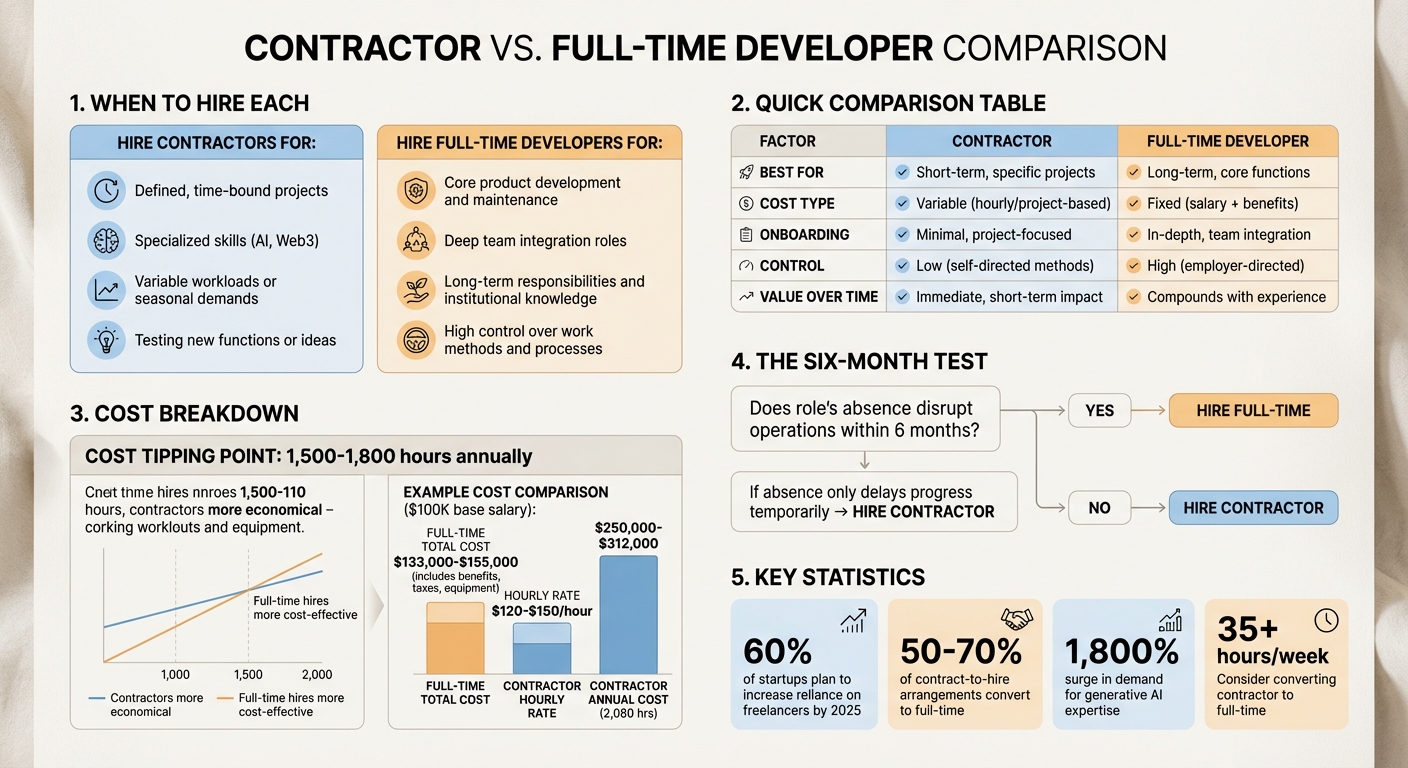 {Contractor vs Full-Time Developer: Complete Comparison Guide}
When to Hire Contractors vs. Full-Time Developers
Deciding between contractors and full-time developers comes down to your immediate and long-term needs. A simple rule of thumb is the six-month test: if a role’s absence would disrupt operations within six months, hire full-time. If it would only delay progress temporarily, a contractor is likely the better choice . This approach helps align your hiring strategy with your business goals.
When to Hire Contractors
Contractors are ideal for situations where you need speed, flexibility, or specialized skills. They’re perfect for short-term, well-defined projects like redesigning a website, running a research pilot, or conducting a cybersecurity review. Contractors can jump in quickly with minimal onboarding, making them a go-to option when time is critical .
Financially, contractors make sense for variable workloads. Instead of committing to a fixed salary, you pay for their services as needed. This flexibility is particularly valuable for startups. In fact, by 2025, 60% of startups planned to increase their reliance on freelancers to maintain adaptability , and 61% described themselves as either "very reliant" or "reliant" on contract talent .
For niche expertise, contractors offer a practical solution. For instance, demand for generative AI expertise has surged by 1,800% . Hiring a full-time AI engineer at a median salary of around $145,000 might not make sense for a short-term project. A contractor can provide the necessary skills without a long-term financial commitment.
Consider contractors for:
- Defined projects with specific timelines, such as feature development or security audits.
- Specialized skills that are expensive or hard to find for full-time roles (e.g., Web3, AI, or niche frameworks).
- Testing new functions - like experimenting with a new tech stack or exploring a potential product line .
- Scaling up quickly for seasonal demands or product launches, with the ability to scale back down afterward.
When to Hire Full-Time Developers
For long-term needs, full-time developers are the better choice. These roles require continuity, ownership, and deep integration into your team. Full-time employees build institutional knowledge over time, gaining a deep understanding of your systems and processes that adds value year after year.
Full-time hires are crucial for core product work that evolves over time. Roles that involve ongoing maintenance, cross-department collaboration, or high-stakes responsibilities - like managing banking infrastructure or healthcare platforms - require someone fully embedded in your team. In these cases, security, stability, and retention are critical.
While the cost of a full-time developer in the U.S. is about $160,000–$170,000 annually when factoring in benefits , this investment pays off when the role demands extensive onboarding and delivers long-term contributions. A contractor charging $60–$100 per hour may seem cheaper initially, but the costs can escalate over time without the loyalty or deep product knowledge that comes with a full-time employee.
Consider full-time hires for:
- Roles involving ongoing work that evolves, such as core product development or platform maintenance.
- Positions requiring deep integration with internal systems, customers, and company culture, where onboarding takes months.
- Situations needing high behavioral control, like setting work hours, methods, and processes, which is legally required for W-2 employees and ensures team cohesion .
- Jobs that handle sensitive proprietary work or demand frequent real-time collaboration across departments.
| Factor | Contractor | Full-Time Employee |
|---|---|---|
| Best For | Time-bound projects, specialized skills | Ongoing work, core functions |
| Cost Type | Variable (pay-as-you-go) | Fixed (salary + ~25–30% benefits) |
| Onboarding | Fast; expected to be experts | Slower; requires cultural training |
| Control | Low (sets own methods) | High (employer sets hours/methods) |
| Value Over Time | Immediate impact, short-term | Compounds with institutional knowledge |
Cost Comparison: Contractors vs. Full-Time Developers
Hourly Rates vs. Total Employment Costs
When comparing costs, it's important not to directly equate a contractor's hourly rate with a full-time developer's salary. A full-time developer's base salary usually covers only 65% to 75% of their actual cost . The difference becomes clearer when you factor in all the expenses tied to full-time employment versus contractor rates.
For example, hiring a full-time developer with a $100,000 salary ends up costing between $133,000 and $155,000 . This includes payroll taxes (FICA at 7.65%, federal and state unemployment taxes, workers' compensation), health insurance, retirement contributions like 401(k) matching, paid leave, recruiting fees, and equipment. These extra costs add 33% to 55% on top of the base salary .
On the other hand, contractors charge higher hourly rates - often 25% to 100% more than a comparable employee's base hourly rate - to account for their own taxes, benefits, and operational expenses . For instance, a developer earning $100,000 annually as an employee might charge between $120 and $150 per hour as a contractor . However, contractors only charge for hours they work, while full-time employees are paid for 2,080 hours annually, even though actual productive time is closer to 1,840 hours after factoring in PTO, holidays, and sick days .
The financial tipping point lies between 1,500 and 1,800 hours annually . For part-time roles (under 30 hours per week) or short-term projects requiring fewer than 1,000 hours, contractors are usually more economical. Beyond that, the higher hourly rate of contractors can surpass the fully loaded cost of a full-time hire .
| Base Salary | Total Employee Cost (Loaded) | Equivalent Contractor Rate | Annual Contractor Cost (2,080 hrs) |
|---|---|---|---|
| $50,000 | $67,000–$78,000 | $60–$75/hour | $125,000–$156,000 |
| $100,000 | $133,000–$155,000 | $120–$150/hour | $250,000–$312,000 |
| $150,000 | $200,000–$233,000 | $180–$225/hour | $374,000–$468,000 |
Source:
To estimate a fair contractor rate, a good rule of thumb is to multiply a developer's base hourly salary by 1.5 to 2 . This accounts for the extra costs contractors handle themselves. For a more accurate cost comparison, divide a full-time developer's total loaded cost by 1,840 productive hours instead of the full 2,080 scheduled hours .
Legal Considerations: Avoiding Misclassification
1099 Contractors vs. W-2 Employees
When determining whether a worker is a 1099 contractor or a W-2 employee, the IRS and Department of Labor (DOL) emphasize the actual working relationship over any contractual labels .
"A contract that calls someone a 'contractor' does not override the facts. If the reality of the relationship looks like employment, the IRS and DOL will treat it as employment."
- Employee vs Contractor Guide
Three primary factors guide this classification:
- Behavioral Control: Who decides how the work is performed?
- Financial Control: Who provides tools and assumes financial risk?
- Relationship Type: What do benefits, permanency, and other factors indicate?
W-2 employees typically follow employer directives regarding when, where, and how tasks are done. In contrast, contractors decide their own methods, with the employer focusing only on the final deliverable.
Some states, such as California, Illinois, and Massachusetts, apply the stricter ABC Test. This test presumes workers are employees unless the business can prove:
- The worker operates free from control.
- The work is outside the company’s usual business activities.
- The worker is engaged in an independent trade.
For example, hiring a developer to create a core product often fails the second prong of the ABC Test, making the worker an employee by default .
The consequences of misclassification are steep. Penalties can reach up to 41.5% of the worker's earnings, with state fines exceeding $100,000 for intentional violations . On the federal level, back wages and penalties range between $7,000 and $15,000 per worker . Illinois imposes civil fines of $1,000 for first offenses and $2,000 for repeat violations within five years, and some states even pursue criminal charges for willful violations .
| Factor | W-2 Employee | 1099 Independent Contractor |
|---|---|---|
| Tax Withholding | Employer withholds federal/state income tax and FICA | No withholding; contractor pays quarterly taxes |
| FICA Responsibility | Shared: Employer and employee each pay 7.65% | Contractor pays the full 15.3% self-employment tax |
| Control | Business dictates how, when, and where work is done | Contractor determines methods; business sets outcomes |
| Tools/Equipment | Provided by the employer | Provided by the contractor |
| Benefits | Eligible for health insurance, PTO, and 401(k) | Not eligible for employer-sponsored benefits |
| Legal Coverage | Protected by FLSA (minimum wage, overtime) | Not covered by FLSA protections |
Source: IRS and DOL guidelines
How to Stay Compliant
Follow these steps to reduce the risk of misclassification:
- Draft Clear Scopes of Work: Focus on deliverables or milestones instead of dictating how tasks should be done . Avoid mandatory training or procedural instructions, as these suggest behavioral control.
- Require Independent Tools: Contractors should use their own hardware and software licenses rather than relying on company-provided resources .
- Document Independence: Collect evidence like a business tax ID, proof of insurance, and records of the contractor serving multiple clients. Keep in mind, paying through an LLC doesn’t automatically establish independent status; the IRS evaluates the actual working relationship .
- Conduct Regular Audits: Periodically review job descriptions and classifications to ensure they align with contractor criteria . Document the behavioral, financial, and relational factors supporting each classification .
- Consider Conversion: If a contractor becomes integral to your operations or must follow specific schedules and methods, it may be safer to reclassify them as a W-2 employee .
Additionally, businesses must file Form 1099-NEC for any contractor paid $600 or more in a year. Failure to file can result in penalties of up to $310 per form . With a renewed focus on worker misclassification, particularly in startups and remote work sectors, compliance is more important than ever .
Managing Teams with Contractors and Full-Time Developers
Leading a team that blends contractors and full-time developers requires a thoughtful approach. Full-time employees thrive on consistent integration and a deep understanding of company goals, while contractors need clear guidelines and well-defined deliverables from the outset . For many engineering managers, this balance has become a daily reality. The challenge isn’t just finding the right talent - it’s making sure they work together effectively once they’re on board.
"Employees create continuity, whereas contractors create optionality." - Rosalind Toews, Mercury
This insight highlights a key difference: full-time developers contribute to long-term strategy and institutional knowledge, while contractors focus on specific, short-term objectives. Treating these groups the same can lead to operational hiccups or even legal complications. To avoid this, your management approach should align with your broader business goals.
Let’s dive into tailored strategies for onboarding and performance management to ensure both contractors and full-time developers succeed.
Onboarding Contractors vs. Full-Time Developers
Onboarding processes should reflect the different roles these team members play. Full-time developers need a deep dive into your company’s culture, tools, long-term plans, and collaborative networks . This onboarding can take weeks as they prepare for sustained contributions and ownership of key projects.
By contrast, contractors require a streamlined approach. Focus their onboarding on the essentials: project scope, deliverables, deadlines, and access to necessary tools or systems . Since contractors are brought in for their expertise, they don’t need to learn every detail about your company - just what’s relevant to their task.
For mixed teams, a one-page brief can be a game-changer. This document should outline the expected outcomes for the first 90 days, clearly separating priorities into "must-haves" and "nice-to-haves", along with specific deadlines . To prevent delays, establish communication norms early, such as response times for requests, code reviews, and escalation of blockers . Without these agreements, you risk wasting time and resources.
Once onboarding is complete, the next step is adapting your management and evaluation practices to suit the strengths of each group.
Performance Management for Mixed Teams
Evaluating contractors and full-time employees with the same metrics doesn’t work. For full-time developers, focus on behavioral control - how, when, and where their work is done. For contractors, your focus should be on outcomes: the quality of their deliverables and whether they meet deadlines . Overstepping into controlling contractor methods can lead to legal risks, so it’s crucial to keep those boundaries clear.
| Factor | Full-Time Employee (FTE) | Independent Contractor |
|---|---|---|
| Management Focus | Behavioral control (when, where, how) | Result/outcome control (deadlines, deliverables) |
| Accountability | Sustained ownership of core functions | Execution of time-bound, scoped tasks |
| Performance Evaluation | Regular reviews, ongoing feedback, and professional development | Output-based evaluation tied to project milestones |
| Engagement Level | High involvement in strategic decisions | Independent execution within a defined scope |
For full-time developers, regular check-ins and quarterly reviews are essential. These conversations should cover their contributions to team velocity, code quality, mentorship efforts, and cross-functional projects. Contractors, on the other hand, should be evaluated based on specific project milestones and the quality of their deliverables . Keep their performance metrics tightly tied to the scope of their contract and how their work impacts overall team progress .
Weekly alignment meetings can ensure everyone stays on track. For contractors, keep these meetings focused on outputs - what they’ve delivered and what’s next. For full-time employees, these discussions should include broader context, such as strategic decisions and upcoming changes.
Before assigning any task, ask yourself: Does this role require ownership of decisions (FTE) or simply the delivery of output (contractor)?
Effective management of mixed teams doesn’t just improve day-to-day operations - it also impacts hiring budget planning, compliance, and even the success of transitioning contractors to full-time roles.
Contract-to-Hire: Converting Contractors to Full-Time
Contract-to-hire models strike a balance between flexibility and commitment, offering a practical way to assess a contractor's fit before making a permanent hire. This approach isn't just theoretical - 50% to 70% of contract-to-hire arrangements successfully transition to full-time roles . It’s a proven way to reduce hiring risks while building a strong team.
The challenge is determining the right time to convert and ensuring the process is smooth for both the developer and your organization.
When to Convert a Contractor to Full-Time
Deciding to convert a contractor often depends on workload, risk, and the evolving nature of the role. For instance, if a contractor is regularly clocking 35+ hours per week, it might be more cost-effective to offer a salary with benefits rather than paying higher hourly rates .
One way to assess the need for conversion is the "replacement test": Ask yourself, what would be lost if this contractor left? If the answer includes critical contributions like months of institutional knowledge, access to important systems (e.g., repositories, customer databases), or ownership of key projects, it’s time to consider a full-time offer. Developers in such roles often carry what’s known as "key-person risk", and securing their long-term availability can safeguard your business from unexpected disruptions .
"Full-time employment is buying availability. Contracting is buying output. If you are already getting the output you need, paying for extra availability is just burning money." - James Heaney, CTO & Co-founder, Grade
Another sign that conversion is necessary is when the role shifts from task-based work to strategic influence. While contractors are typically hired for specific deliverables - like building a feature or fixing a bug - if they’re now making architectural decisions, mentoring team members, or steering product strategies, they’ve outgrown the contractor role. At this stage, you’re not just paying for their time; you’re investing in their long-term accountability .
Additionally, controlling a contractor’s schedule or tools might inadvertently classify them as an employee under labor laws. To avoid potential penalties - such as 1.5% to 3% of wages for federal tax withholding and 20% to 40% of social security and Medicare taxes - converting them to W-2 status can mitigate those risks .
Once you’ve identified the need for conversion, the next step is executing the transition effectively.
How to Execute a Contract-to-Hire Conversion
A successful conversion starts with early alignment. Don’t wait until the last minute to discuss salary, benefits, or equity. Set clear expectations at the start of the contract to avoid surprises when it’s time to formalize the offer . If you’re working through an agency, clarify any buyout fees upfront to prevent unexpected costs.
During the contract phase, establish clear success criteria. Both you and the contractor should know what milestones, skills, or cultural indicators will lead to a full-time offer. This clarity eliminates uncertainty and gives the contractor a clear path forward .
From the beginning, treat contract-to-hire developers as part of the team. Include them in standups, planning sessions, and team communication channels. This isn’t just about making them feel included - it’s about accurately gauging their cultural fit and collaboration style before extending a permanent offer . Isolating contractors during the trial period can leave you without the insights you need to make a confident decision.
When you’re confident in the fit, act quickly. Waiting until the contract’s final days to extend an offer can signal hesitation and may prompt the contractor to explore other opportunities. If you’re certain after a couple of months, initiate the conversion early to secure their commitment .
Finally, handle the administrative details carefully. Ensure tax forms are filed to close out their 1099 status, coordinate benefits to avoid gaps in coverage, and clarify whether their time as a contractor will count toward tenure for perks like PTO or vesting schedules . These steps help streamline the transition and show the developer you’re invested in making the process seamless.
Where to Find Quality Contractors
Finding skilled contractors is a key part of balancing your hiring strategy. It helps you address immediate project demands while keeping your team adaptable. The best approach combines thorough vetting with reliable sources, ensuring you connect with professionals who deliver both expertise and effective communication.
Professional Networks and Referrals
Your own network is often the most dependable place to find contractor talent. Referrals from colleagues, former teammates, or industry contacts come with the added benefit of being pre-vetted. When considering a referred contractor, ask for three specific types of references:
- A recent client: This confirms their current skills and communication abilities.
- A legacy client: This helps verify their reliability over time.
- A repeat client: This demonstrates consistent quality and the ability to build lasting relationships.
This method can uncover valuable insights that a single reference might not, such as how well they meet deadlines, handle feedback, or maintain professional connections over time .
Hiring through referrals also cuts out the middleman, saving you from paying hefty agency fees. However, you’ll need to handle administrative tasks like issuing 1099-NEC forms and ensuring proper worker classification on your own. Tools like Gusto or Plane can simplify these responsibilities .
If you’re looking for a quicker solution, consider developer networks and specialized platforms designed specifically for developers.
Developer-Focused Platforms
Specialized platforms are another effective way to find contractors. Options like Toptal, Match.dev, and Arc.dev pre-screen candidates using technical assessments and even paid trials . For example:
- Match.dev: Developers undergo a 10-hour paid vetting process, and many are available within 48 hours. Hourly rates typically range from $50 to $80 .
- Toptal: This platform claims access to the top 3% of freelance talent through rigorous screening, with rates between $90 and $200 per hour .
While these platforms tend to charge higher rates, they save you time on vetting and reduce the risk of hiring someone who isn’t a good fit. Many also offer replacement guarantees, allowing you to quickly swap out a contractor if needed. Additionally, they often handle compliance tasks like intellectual property agreements, NDAs, and worker classification, helping you avoid potential legal issues .
For permanent, full-time roles, check out tools tailored for long-term recruitment. Matching your hiring methods to your specific needs ensures you can build a team that’s ready for both immediate challenges and future growth.
Conclusion
When deciding between contractors and full-time developers, your choice should align with the specific needs of your business. This decision boils down to three main factors: whether the work is ongoing or project-based, whether the role demands in-depth knowledge of your organization or specialized skills, and how much flexibility your team requires.
Here’s a practical rule of thumb: if your business would come to a standstill within six months without a specific role, hiring a full-time developer is likely the better option. On the other hand, if the role’s absence would only delay progress, a contractor provides flexibility and allows you to test the waters before committing. Roles requiring over 1,500 hours annually are generally more cost-efficient with full-time employees, while contractors are ideal for specialized tasks needing fewer than 1,000 hours of work .
"Employees create continuity, whereas contractors create optionality."
- Rosalind Toews, Mercury
Full-time developers bring long-term value as they gain a deeper understanding of your systems, customers, and workflows. Meanwhile, contractors excel at delivering focused expertise for clearly defined projects. Both approaches serve unique purposes and can coexist in a well-rounded hiring strategy.
It’s also essential to establish clear role boundaries. This not only ensures compliance with labor laws but also helps attract and retain top developer talent. Contractors should retain control over their methods and schedules, while employees should be fully integrated into your team’s daily operations and decision-making processes. By balancing hiring costs, compliance, and team dynamics, your hiring strategy can remain flexible and responsive to your company’s evolving needs.
Looking to build a permanent team? daily.dev Recruiter connects you with pre-qualified developers through warm, double opt-in introductions. Say goodbye to cold outreach and outdated profiles - connect with real developers who are actively seeking the right opportunity.
FAQs
What’s the fastest way to choose contractor vs. full-time?
To make a quick decision, start by evaluating your current needs and future objectives. If you need short-term, flexible help with quicker onboarding and potentially lower upfront costs, contractors might be the way to go. On the other hand, full-time employees are better suited for long-term projects that require consistency and employee retention. Take a close look at your project's scope, timeline, and budget to determine which option fits best with your priorities and overall strategy.
How do I calculate the true cost of a contractor vs. an employee?
To get a clear picture of the true cost, you need to account for all expenses. For employees, this goes beyond their base salary. You’ll need to factor in payroll taxes, benefits like health insurance and 401(k) matching, paid time off, and equipment costs. Altogether, these additional expenses usually add up to about 33-55% more than the base salary.
For contractors, the calculation is a bit different. Take their hourly rate and multiply it by the number of hours they work. Keep in mind, contractors handle their own taxes and benefits, but they often charge higher rates to make up for these responsibilities. Plus, you're only paying for their productive hours.
What are the biggest red flags for contractor misclassification?
Misclassifying workers as contractors can lead to serious problems, including legal trouble, audits, and penalties for not following worker classification laws. The biggest warning signs of contractor misclassification are:
- Excessive control over how the work gets done.
- Providing tools or equipment for the job.
- Establishing a long-term or permanent working relationship instead of a temporary or project-based one.
These factors blur the lines between independent contractors and employees, putting businesses at risk.
.png)