When hiring developers, the choice between contractors and full-time employees depends on your project needs, budget, and long-term goals. Contractors are ideal for short-term projects requiring speed or specialized skills, while full-time developers are better for roles that demand ongoing involvement and team integration.
Key Points:
- Contractors: Flexible, specialized, and cost-efficient for short-term tasks. They charge higher hourly rates but only bill for actual work completed.
- Full-Time Developers: Provide stability, deep product knowledge, and long-term value. They come with higher upfront costs due to benefits and onboarding but are more cost-effective for ongoing work.
Quick Comparison:
| Factor | Full-Time Developer | Contractor |
|---|---|---|
| Primary Value | Long-term ownership | Speed and niche expertise |
| Best For | Strategic or ongoing work | Short-term or specialized tasks |
| Onboarding | 2–4 weeks, with training | Rapid start if scope is clear |
| Knowledge | Deep internal context | Broad external experience |
| Cost Efficiency | Better for >1,800 hours/year | Better for <1,500 hours/year |
Cost Insights:
- Contractors charge 25–100% more per hour but save on benefits and downtime.
- Full-time employees cost 33–55% above base salary due to taxes, benefits, and equipment.
Avoid costly mistakes by aligning your hiring model with the role's demands, duration, and required expertise. Misclassification can lead to legal penalties, so ensure proper worker classification (1099 vs W-2). If unsure, consider contract-to-hire as a middle ground to test compatibility before committing.
::: @figure 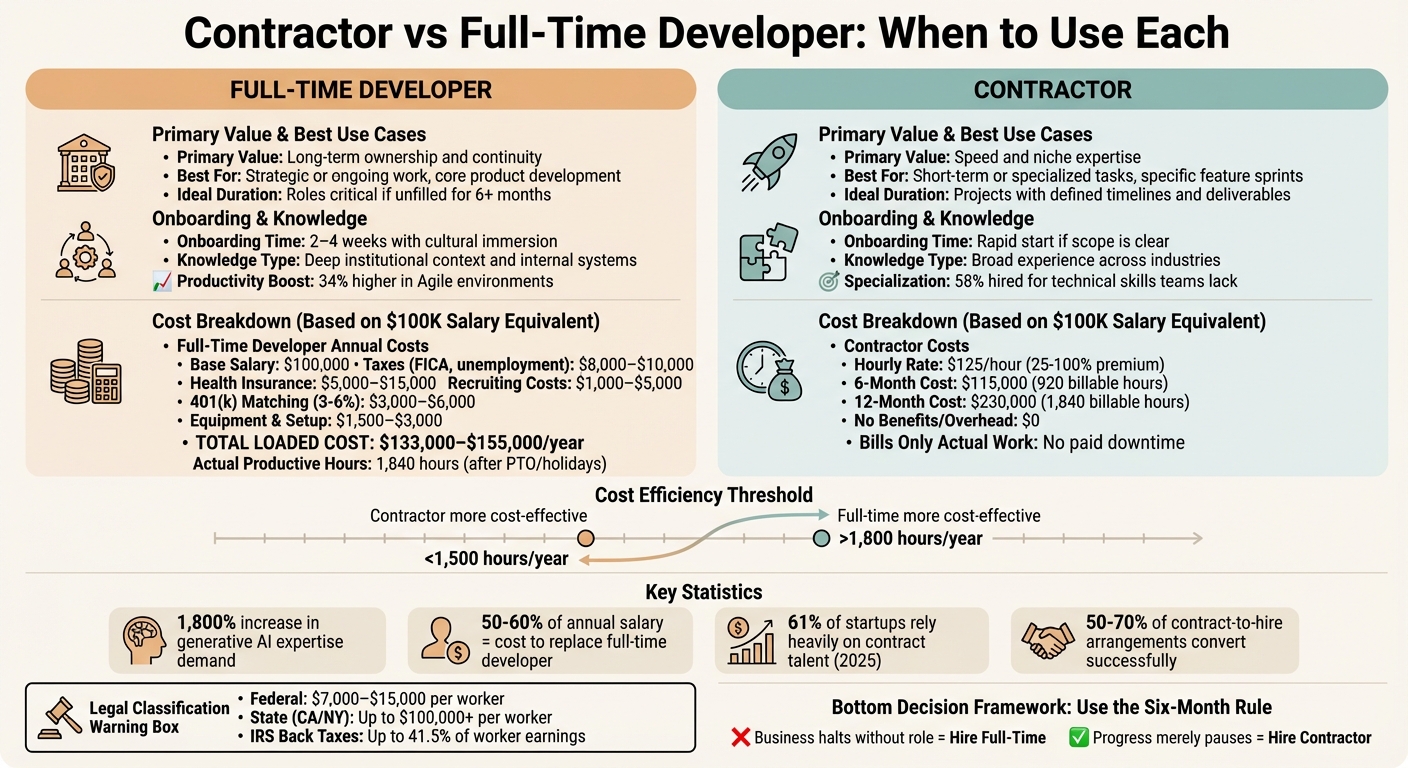 {Full-Time Developer vs Contractor: Complete Cost and Feature Comparison}
When to Hire Contractors vs Full-Time Developers
Choosing between contractors and full-time developers depends on your business goals, priorities, and the type of work you need done. Full-time employees provide stability, building knowledge of your company that grows over time. On the other hand, contractors offer flexibility, bringing speed and specialized skills without the long-term commitment .
"Employees create continuity, whereas contractors create optionality." - Rosalind Toews, Mercury
A good rule of thumb is the "Six-Month Rule": If your business would face setbacks or lose momentum if a role went unfilled for six months, hire full-time. If progress would merely pause, a contractor may be the better choice .
Short-Term Projects vs Long-Term Roles
Contractors are ideal for short-term projects with well-defined timelines, such as redesigning a website, completing a feature sprint, or conducting a compliance audit. They can hit the ground running with minimal onboarding and deliver results quickly .
Full-time developers, however, are critical for long-term work that involves strategic decisions and ongoing development. For tasks like building core product functionality, developing proprietary technology, or designing system architecture, you need someone who can take ownership and contribute over time. Full-time roles often lead to 34% higher productivity in Agile environments because developers gain a deep understanding of internal systems, which helps them solve problems faster .
Keep in mind that onboarding differs significantly between the two. Full-time employees typically require 2–4 weeks to onboard, but their value grows as they accumulate institutional knowledge. Contractors, on the other hand, can start quickly if the project scope is clear, but they need an upfront transfer of knowledge to be effective. If success depends on deep familiarity with your systems, a full-time hire is the better option.
Beyond the project's duration, think about whether the role requires niche expertise or extensive collaboration within your team.
Niche Skills vs Team Integration
Contractors are perfect for specialized expertise that isn't practical to maintain in-house. For example, 58% of businesses hire freelancers to access technical skills their teams lack . This includes advanced areas like AI/ML, cybersecurity, blockchain, Web3, VR/AR, or specific front-end technologies . The demand for generative AI expertise alone has skyrocketed by 1,800% in job postings .
Full-time developers, by contrast, shine in roles that demand close collaboration and deep involvement in your product roadmap. If the position requires prioritizing tasks, shaping product strategy, or coordinating across departments, you need someone embedded in your company's culture and processes . Replacing a full-time developer can cost 50–60% of their annual salary due to recruitment expenses and lost productivity, making stability a key factor .
Contractors can also be a smart choice for testing out new functions, such as a growth initiative or compliance project. Once the need is validated and responsibilities are clearly defined, you can decide whether to transition to a full-time hire .
| Factor | Full-Time Developer | Independent Contractor |
|---|---|---|
| Primary Value | Continuity and deep ownership | Speed and specialized expertise |
| Best For | Long-term product development | Short-term sprints or niche features |
| Onboarding | 2–4 weeks; cultural immersion | Rapid start; clear project scope |
| Knowledge | Deep institutional context | Broad experience across industries |
| Management | High organizational control | Milestone-based deliverables |
Hiring engineers?
Connect with developers where they actually hang out. No cold outreach, just real conversations.
The Real Cost Breakdown: Hourly Rates vs Loaded Costs
When deciding between hiring a full-time employee or a contractor, it’s essential to look beyond surface-level numbers. A $100,000 salary and a $125/hour contractor rate may seem easy to compare, but the reality is more complex. To make an informed decision, you need to consider additional factors like taxes, benefits, and how many hours of work you’re actually paying for. Let’s dive into the real costs behind both options to help clarify where your money is going.
What Contractors Actually Cost
Contractors typically charge 25–100% more per hour than what a full-time employee with a comparable salary earns on an hourly basis . For example, a developer earning a $100,000 salary (equivalent to $48/hour) might charge $120–$150/hour as a contractor. The higher rate accounts for expenses contractors must cover themselves, such as self-employment taxes, health insurance, retirement savings, and unpaid time off - costs that employers usually bear for full-time staff.
However, contractors only bill for actual work completed. No paid holidays, no sick leave, and no downtime during slow periods. If your project requires 920 hours of work over six months, you pay for exactly 920 hours - nothing more. Additionally, hiring a contractor means skipping costs like recruiting fees, equipment purchases, and ongoing HR management. For short-term projects needing fewer than 1,200 hours annually, contractors are often the more economical choice because they don’t add fixed overhead .
The Full Cost of Full-Time Employees
On the other hand, the cost of a full-time employee goes far beyond their base salary. In fact, base salary typically represents only 65–75% of an employee’s total cost . The remaining 33–55% comes from taxes, benefits, equipment, and other operational expenses that can be easy to overlook.
Here’s a breakdown of additional costs for a developer earning $100,000 annually:
- Mandatory taxes: Social Security (6.2%), Medicare (1.45%), Federal Unemployment (0.6%), and State Unemployment (0.5–10%) add up to $8,000–$10,000 annually .
- Health insurance: Costs range from $5,000 to $15,000 per year, depending on the level of coverage .
- 401(k) matching: Most employers contribute 3–6% of salary, which equals $3,000–$6,000 annually .
- Paid time off (PTO): Employees typically receive 28–47 days off for vacation, sick leave, and holidays, reducing their productive hours while still being paid .
- Equipment and setup: Expect to spend $1,500–$3,000 on items like laptops, software licenses, and desk setups .
- Recruiting costs: Hiring expenses, including job postings and background checks, run between $1,000 and $5,000 .
"A $50,000 employee costs $67,000–$78,000 when you add payroll taxes, benefits, and PTO - that's 33–55% above base salary."
While full-time employees are scheduled for 2,080 hours per year, their actual productive time is closer to 1,840 hours once PTO and holidays are accounted for . When comparing costs to a contractor, it’s important to base calculations on these productive hours instead of the total scheduled hours.
6-Month and 12-Month Cost Comparison
To illustrate the difference, here’s a side-by-side look at the costs for a mid-level developer, comparing a $100,000 salary to a $125/hour contractor rate. For full-time employees, the six-month figure includes approximately $5,000 for recruiting and equipment costs:
| Duration | Full-Time Employee (Loaded) | Contractor (Billable Hours) |
|---|---|---|
| 6 Months | $71,500–$82,500 | $115,000 (920 hours) |
| 12 Months | $133,000–$155,000 | $230,000 (1,840 hours) |
This comparison shows that contractors are more cost-effective for projects requiring fewer than 1,500–1,800 hours annually (roughly 30–35 hours per week). For shorter projects, contractors save money by eliminating fixed costs. However, once work exceeds that threshold, full-time employees become the better financial choice, even with their higher overall cost .
For short-term specialized tasks, contractors are the clear choice. But for ongoing work that benefits from collaboration and institutional knowledge, full-time employees deliver better value over time. The decision ultimately depends on aligning your cost structure with the type of work you need.
Legal Rules: 1099 vs W-2 Classification
Misclassifying workers can be a costly mistake, with serious financial and legal consequences for your business. The IRS and the Department of Labor don’t just look at what’s written in a contract - they dig into the actual working relationship and how much control you have over the worker’s tasks and schedule . This makes it crucial to align your hiring practices with the nature of the work being done, using a tech hiring budget calculator to account for these variables.
Federal penalties for misclassification range from $7,000 to $15,000 per worker, but in states like California and New York, where enforcement is stricter, penalties can exceed $100,000 per worker. On top of that, the IRS may demand up to 41.5% of the worker’s earnings in back taxes and fines .
"Misclassifying workers can result in massive penalties: back taxes, interest, fines, and even criminal charges in extreme cases."
- Slava Akulov, CEO, Jupid
If a worker should have been classified as a W-2 employee, you might also owe unpaid benefits like health insurance, retirement contributions, and paid time off. In 2024, these benefits averaged $14.68 per hour .
Misclassification Penalties and Risks
The consequences of misclassification vary depending on whether it’s deemed intentional or unintentional. For unintentional cases, the IRS imposes:
- 1.5% of wages for federal tax
- 40% of the unpaid employee FICA
- 100% of the employer FICA
Intentional misclassification comes with harsher penalties: 20% of wages plus 100% of both employer and employee FICA contributions . State penalties can add even more to the cost. For example, Illinois fines $1,000 per worker for a first offense, doubling to $2,000 for repeat violations. Intentional misclassification in Illinois can even lead to criminal charges, classified as a Class 4 felony .
Workers who’ve been misclassified can also sue for back pay, unpaid overtime under the Fair Labor Standards Act, and any benefits they were denied, such as health insurance and retirement contributions. Depending on state laws, these claims can cover several years of employment .
If you’re unsure about a worker’s classification, you can file Form SS-8 with the IRS for an official determination. If misclassification has already occurred, the Voluntary Classification Settlement Program (VCSP) offers a way to reclassify workers as employees while paying only about 10% of the back tax liability for the most recent year .
How the IRS Determines Worker Status
The IRS uses a three-factor test to assess whether a worker is an employee or an independent contractor. These factors are:
- Behavioral Control: If you dictate the worker’s hours, methods, or require attendance at meetings, they’re likely an employee. Independent contractors, on the other hand, set their own schedules and work independently.
- Financial Control: This focuses on who bears the business risks and provides tools. Employees typically receive steady wages, expense reimbursements, and company equipment. Contractors are paid per project, cover their own costs, and bring their own tools.
- Relationship Type: The presence of benefits, the permanency of the relationship, and whether the work is central to your business all suggest an employment relationship.
The Department of Labor applies an Economic Reality Test to determine if a worker is financially dependent on your business . Companies looking to navigate these complexities often hire developers through platforms that vet for specific engagement types. Additionally, states like California, Illinois, and Massachusetts use the ABC Test. This test assumes workers are employees unless the employer can prove that the worker is free from control, performs work outside the usual operations of the business, and has an independent trade .
1099 Contractor vs W-2 Employee Comparison
Here’s a quick side-by-side look at the key differences between 1099 contractors and W-2 employees:
| Feature | 1099 Contractor | W-2 Employee |
|---|---|---|
| Tax Withholding | None; contractor pays 15.3% self-employment tax | Employer withholds income, Social Security, and Medicare taxes |
| Employer Tax Burden | $0 in payroll taxes | 7.65% FICA on wages up to $176,100 (2026 limit) |
| Work Control | Sets own hours, methods, and tools | Employer directs how, when, and where work is performed |
| Equipment | Provides own laptop, software, and workspace | Company provides all necessary tools and systems |
| Benefits | Not eligible for company benefits | Eligible for health insurance, PTO, and retirement benefits |
| Payment Structure | Invoices per project or milestone | Regular salary or hourly wage via payroll |
| Legal Protections | Limited to contract terms | Covered by minimum wage, overtime, and anti-discrimination laws |
| Relationship Duration | Specific project or finite period | Ongoing and indefinite |
To ensure compliance, focus on the deliverables when working with contractors instead of micromanaging how they complete their tasks. Avoid dictating tools, processes, or schedules, and document that contractors have other clients, use their own equipment, and operate as independent businesses .
As your company grows, it’s a good idea to review contractor relationships annually. A legitimate contractor relationship can shift into employment if you start exerting more control over their work .
How to Manage Contractors and Full-Time Developers Together
Managing a team made up of both contractors and full-time developers requires a shift in focus - from micromanaging tasks to achieving meaningful outcomes. By 2025, 61% of startups reported relying heavily on contract talent, highlighting the importance of mastering this skill for engineering leaders .
"Contractor management in 2025 is less about task delegation and more about strategic orchestration."
- Aday, Content Campaign Manager, Talent Hackers
It's important to avoid treating contractors like remote employees, as this can lead to misclassification issues and disrupt their independence. Instead, create systems that empower both contractors and full-time staff to work efficiently without constant oversight.
Setting Clear Deliverables and System Access
Ambiguity in project instructions can derail contractor productivity and complicate security for your team. Swap vague Slack messages for detailed Statements of Work (SOWs) that clearly outline deadlines, dependencies, and what "done" looks like. For instance, a backend API project might be considered complete when it passes all unit tests, includes documented endpoints, and provides a Postman collection for testing .
Access control is key. Following the principle of least privilege, grant contractors access to staging environments first and only provide production access when absolutely necessary. Use tools like multi-factor authentication (MFA) and ensure each contractor has their own account - never share credentials. To minimize risks, set up dedicated Slack channels for specific projects or contractors, preventing sensitive information from reaching general team discussions .
For managing code, adopt a pull request (PR) workflow. This ensures full-time developers review contractor submissions before merging, keeping your team informed and catching potential issues early . Limit access to repositories on a project-by-project basis instead of opening up your entire codebase. Share only the specific documents or pages needed for the task .
Set clear communication expectations. Establish a 24-hour response window for asynchronous communication, allowing contractors to avoid rigid 9-to-5 schedules while maintaining progress. For global teams, plan for 2–3 hours of overlapping work time for real-time discussions and approvals. Rely on async tools like Slack, Notion, and Loom for everything else .
When a project concludes, immediately revoke tool access and permissions. This standard security practice protects both your company and the contractor from unnecessary risks . These measures not only streamline workflows but also help maintain clear boundaries, reducing the chance of misclassification.
Once deliverables and access protocols are in place, the next step is to onboard contractors efficiently so they can hit the ground running.
Onboarding Contractors and Transferring Knowledge
A well-structured onboarding process ensures contractors can contribute value right away. To make this happen, create a centralized "Contractor Wiki" using tools like Notion. Include Standard Operating Procedures (SOPs), brand guidelines, coding standards, and contact details for key team members . This eliminates repetitive onboarding questions and ensures everyone is aligned.
Make documentation part of the job. Contractors should deliver READMEs, runbooks, setup instructions, and architecture notes as part of their project completion criteria . For instance, if a contractor develops a new microservice, the final deliverable should include both the code and the documentation needed to deploy, monitor, and troubleshoot it. This ensures your full-time team can seamlessly maintain the work after the contractor's departure.
Use tools like Loom for video walkthroughs to explain complex tasks or provide feedback. A short video can often clarify processes better than a lengthy document, while also creating a searchable record for future reference .
Set 30/60/90-day milestones to track progress and address potential issues early, even for shorter contracts. For example, a 30-day check-in might focus on whether the contractor has adapted to your tech stack and coding standards, while the 60-day mark could evaluate feature delivery .
Replace daily standups with weekly check-ins that address four key questions: What’s done? What’s in progress? What’s blocked? What’s next? This approach respects contractor independence while keeping the entire team informed .
When the project wraps up, conduct a formal offboarding process. Collect all final files, revoke permissions, and document lessons learned to improve future engagements. Avoid ghosting contractors - ending on a professional note helps preserve your reputation and makes re-engagement smoother down the line .
Contract-to-Hire: Converting Contractors to Full-Time
Contract-to-hire arrangements offer a practical way to evaluate potential long-term employees. Think of it as an extended working interview - one that lets you observe a candidate’s performance on real tasks, something traditional interviews can’t fully capture . In fact, 50% to 70% of these arrangements transition successfully into permanent roles, with evaluation periods typically lasting between 3 and 6 months .
This approach balances the need for immediate project output with the possibility of long-term team integration. As James Heaney, CTO & Co-founder at Grade, explains:
"Full-time employment is buying availability. Contracting is buying output. If you are already getting the output you need, paying for extra availability is just burning money" .
How to Identify Contractors Worth Converting
Before deciding to transition a contractor to full-time, it’s important to evaluate their contributions and role within your organization. Start with the "Loss" test: Ask yourself, “What would happen if this contractor left tomorrow?” If their departure would cause significant disruption or if they hold critical knowledge, converting them may be a strategic move to mitigate risk .
Another key factor is workload consistency. If a contractor consistently works 35+ hours per week, their hourly rate may already exceed the cost of hiring a salaried employee . High-volume work or roles that require deep access to sensitive systems - like repositories, customer databases, or strategic documents - are strong indicators that a full-time position might make more financial sense . Similarly, if your business needs the contractor to focus exclusively on your projects, that’s another clear signal for conversion .
Pay attention to how they handle ambiguity and collaboration. Do they effectively manage competing priorities? Are they good at working with stakeholders? The contract period often reveals these qualities better than any interview could .
The Conversion Process Step-by-Step
When you’re ready to make the transition, start by discussing compensation early. Talk about salary and benefits at the beginning of the contract to prevent surprises later on . Keep in mind that employee benefits, taxes, and overhead can add 20% to 35% to a base salary .
To estimate the cost of converting a contractor, multiply their hourly rate by 2,080 hours (the standard full-time annual hours), and then factor in overhead. For example, a contractor charging $50/hour ($104,000/year base) would cost approximately $135,200 per year after including a 30% overhead for benefits and taxes .
Gauge their interest before proceeding. Some contractors prefer the independence of freelancing. As Heaney puts it:
"Some people are contractors by choice... Offering them a full-time role feels like a promotion to you. To them, it might feel like a cage" .
If both parties agree to move forward, follow this checklist to ensure a smooth transition:
- End the existing 1099 agreement.
- Collect necessary forms like W-4 and I-9.
- Set up payroll to issue W-2s.
- Enroll them in company benefits such as health insurance and retirement plans.
- Provide company equipment if needed.
- Verify any conversion fees or buy-out clauses if they were hired through a staffing agency .
Starting the conversion conversation early signals your commitment and reduces the risk of the contractor accepting other opportunities . It also helps you avoid legal complications, as certain conditions - like requiring exclusive focus - might already classify them as an employee under labor laws .
Where to Find Quality Contractors
Developer Networks and Pre-Vetted Communities
If you're relying on generic job boards or LinkedIn to find top-tier contractor talent, you're likely missing the mark. Why? Because platforms like daily.dev report that 90% of developers ignore cold outreach, only engaging when the opportunity genuinely aligns with their interests .
Developer-focused communities like daily.dev take a smarter approach. They use a double opt-in system, meaning developers express interest in a role before any introductions happen. This not only boosts response rates but also eliminates the spam-like feel of traditional recruiting.
What sets these platforms apart is how they match candidates. Instead of relying on resume keywords, they focus on developers' actual technical interests - what they read, build, and follow. The result? Access to a pool where 85–90% of users are employed passive talent, with 40% holding senior roles or leadership positions . Plus, you can set up to three short technical screening questions during the initial phase to ensure candidates are a good fit before scheduling interviews. Nimrod Kramer, CEO & Co-Founder of daily.dev, sums it up perfectly:
"Trust is the only hack" .
Once you’ve tapped into these targeted networks to find quality candidates, the next step is nailing your developer hiring checklist and payment terms to secure their commitment.
Clear Payment Terms That Attract Top Talent
Finding the right talent is only half the battle. To keep them engaged, you need to establish transparent and milestone-based payment terms. Ambiguous agreements or delayed payments can frustrate contractors and lead to unnecessary change orders .
The key is to reduce any friction. Your contract should clearly outline terms from the start, using milestone-based payments tied to specific, measurable deliverables instead of large upfront payments. Include details on what’s covered, what’s not, and how change orders will be handled - including their pricing and triggers. This level of clarity builds trust and sets the tone for a professional partnership .
Top contractors value their independence. They thrive in roles where you define the project outcomes and deadlines but give them the freedom to decide how the work gets done . Clearly outlining the project scope and required technologies also helps position you as an organized and reliable client.
To streamline your workflow, integrate your sourcing platform with your ATS. For example, daily.dev Recruiter offers a simple pricing model - $350 per role, per month, with no placement fees, hidden costs, or long-term contracts . This predictable structure keeps budgeting straightforward and avoids surprises.
Conclusion: Choosing the Right Hiring Model
Deciding between hiring a full-time employee or a contractor depends on your specific business needs and circumstances. A good starting point is the six-month test: If your business would grind to a halt without this role within six months, go for a full-time hire. If things would simply slow down, a contractor might be the better choice .
Next, consider the financial side of things. A full-time developer earning a median salary of $127,000 could cost you around $160,000–$170,000 per year when you add taxes, benefits, and overhead costs . On the other hand, while a contractor charging $75 per hour may seem pricey, they help you avoid expenses tied to onboarding, benefits, and long-term commitments. To get a clearer picture, try using the cost calculator to compare the costs over six and twelve months.
Legal considerations also play a significant role. The IRS looks at behavioral control, financial control, and the nature of the relationship when determining worker classification . Misclassifying a worker can lead to penalties starting at 25% of unpaid taxes, with the potential for even steeper consequences . Proper classification isn’t just a legal requirement - it’s a critical part of your overall hiring strategy.
If you’re unsure about a role, a contract-to-hire arrangement could be the middle ground. This setup allows you to evaluate both technical skills and compatibility before committing to a permanent hire. It can also help you avoid the steep costs of replacing a bad hire, which can reach 50–60% of an annual salary .
The key is to choose a hiring model that aligns with your business goals while maintaining the right mix of stability and flexibility .
FAQs
How do I estimate the break-even point between a contractor and a full-time hire for my role?
To figure out the break-even point, you need to compare the total costs of hiring a contractor versus a full-time employee over a specific timeframe. For full-time employees, you should account for all related expenses, including salary, taxes, benefits, and equipment. These additional costs typically add about 33-55% to the base salary.
On the other hand, while contractors generally charge higher hourly rates, they don’t come with the same overhead costs. By calculating the expected hours worked, you can pinpoint when the contractor’s total costs surpass those of a full-time employee.
What are the biggest 1099 vs W-2 misclassification red flags for developers?
When determining whether someone is classified correctly as a 1099 contractor or a W-2 employee, there are a few key red flags to watch out for. These include unclear or inconsistent scopes of work, which can indicate a lack of proper boundaries in the working relationship. Another warning sign is if the worker has little to no autonomy in how they complete their tasks - this often points to an employee relationship rather than independent contracting. Additionally, payment practices that resemble traditional employment, like net-60 terms or ongoing, indefinite engagements, can further blur the lines and suggest misclassification.
How can I protect my codebase when contractors need access to internal systems?
To keep your codebase secure, put a mix of technical and contractual safeguards in place. Start with confidentiality agreements and non-disclosure agreements (NDAs) to protect intellectual property when working with contractors. Clearly outline the scope of access in contracts to avoid any misunderstandings.
On the technical side, implement role-based access controls (RBAC) to limit access based on job responsibilities. Add multi-factor authentication (MFA) for an extra layer of security. Use secure credentials, enforce the use of VPNs, and make it a habit to audit access logs regularly to monitor activity.
By combining these measures, you can ensure that contractors have the access they need while keeping your systems and codebase safe.
.png)