Choosing between a contractor and a full-time developer depends on the work's duration, importance to your company, and budget. Contractors are best for short-term, specialized tasks with clear end dates. Full-time developers are ideal for core, long-term projects requiring ongoing maintenance and team integration.
Key factors to consider:
- Duration: Contractors suit projects under 6 months; full-time hires are better for work exceeding 9 months.
- Work Type: Use contractors for defined, niche tasks; hire full-time for core product development or strategic roles.
- Cost: Contractors often cost more hourly but may save money for short projects. Full-time hires are more economical for long-term needs.
- Speed: Contractors can start within 1–2 weeks, while hiring full-time takes 45–75 days, though you can use strategies for reducing time to hire to speed up the process.
- Legal Risks: Misclassification can lead to penalties. Ensure roles align with IRS and state guidelines.
Quick Comparison:
| Factor | Contractor | Full-Time Developer |
|---|---|---|
| Project Duration | Short-term (< 6 months) | Long-term (9+ months) |
| Work Type | Defined, niche tasks | Core product work |
| Speed to Start | 1–2 weeks | 45–75 days |
| Cost | Higher hourly, short-term savings | Lower hourly, long-term savings |
| Team Integration | Limited | Deep integration |
| Legal Risks | Medium, requires careful contracts | Lower, built-in protections |
The right choice balances your project's scope, timeline, and financial goals using a tech hiring budget calculator. Short-term needs? Go contractor. Long-term goals? Go full-time.
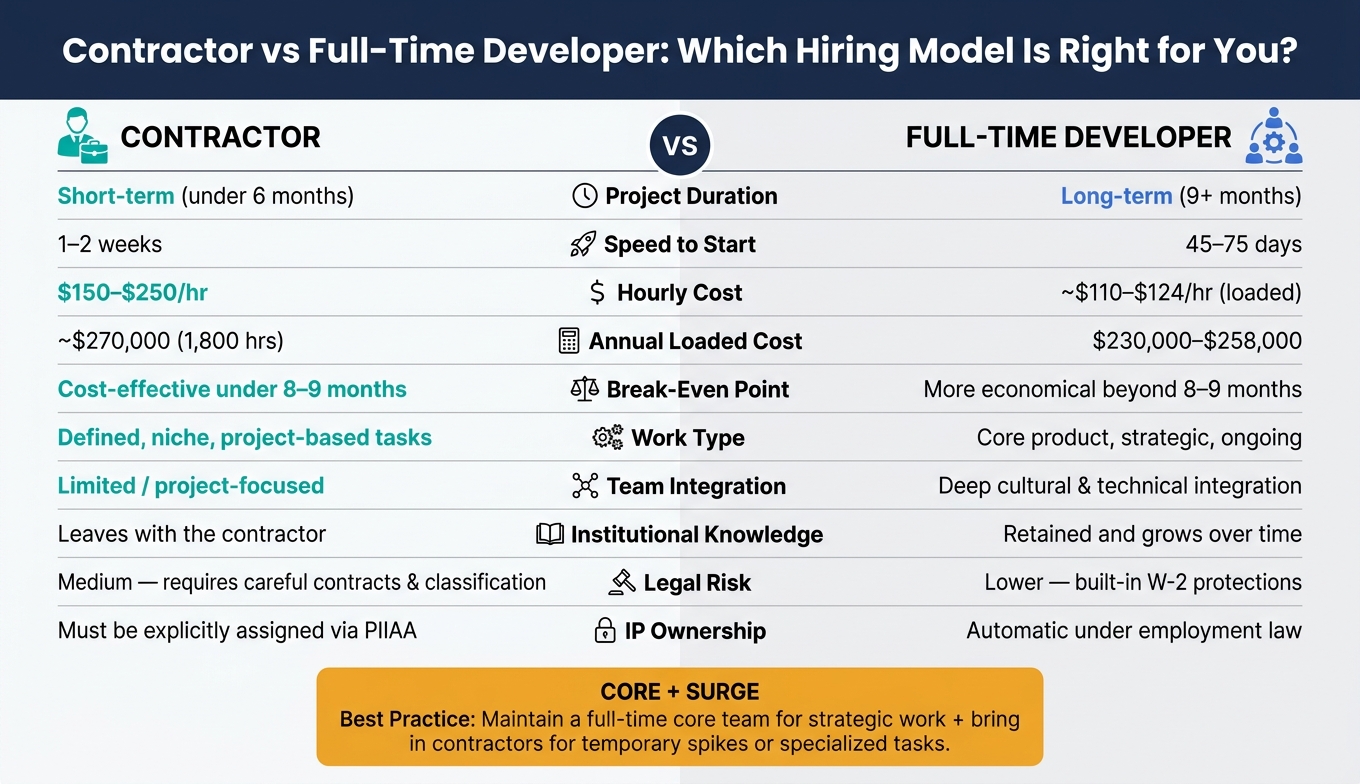
Decision Framework: Contractors vs Full-Time Developers
The real question isn’t about which hiring model is better, but which one aligns with your current needs. This framework builds on earlier discussions about legal classifications and compliance, helping engineering leaders and hiring managers choose the right option for their specific situation.
When Contractors Are the Right Fit
Contractors shine when the work has a clear start and end date. Think projects like database migrations, SOC 2 compliance audits, specific API integrations, or launch sprints. For tasks that are time-sensitive or highly specialized, contractors are often the way to go. They’re perfect for one-off projects - like a niche API integration - where committing to a permanent hire doesn’t make sense.
"Contractors optimize for delivery within their engagement window. Full-time engineers optimize for systems that will still be maintainable in two years." - riem.ai
Contractors are ideal when you need expertise that’s only required temporarily. Many contractors are highly skilled, including former staff engineers from top companies like Stripe and Figma, who prefer short-term, project-based work. However, keep in mind that contractors are less likely to challenge architectural decisions they won’t be around to maintain . This focus on immediate delivery is a fundamental aspect of the contractor role.
When Full-Time Developers Are the Right Fit
Full-time hires are essential when the work directly ties to your company’s core offering. Whether it’s building key product features, designing platform architecture, or maintaining systems that require a deep understanding of why decisions were made, full-time employees (FTEs) are the better choice.
Institutional knowledge is a huge advantage of full-time developers. Someone who’s been with your team for a year knows the reasoning behind every major system decision. On the other hand, contractors take that context with them when their engagement ends . For early-stage startups, in particular, those first hires set the tone for architectural decisions and team culture that will influence everything going forward.
"A full-time team will be critical for shaping your product's strategy, adapting to changes in the market... and establishing a scalable, long-term vision." - Greg Vilines, SVP of Product, Terminal
Financially, full-time hires often make more sense in the long run. For example, a senior contractor charging $150 per hour becomes more expensive than a senior FTE with a $180,000 annual salary after just 8–9 months . Beyond that point, the FTE not only costs less but continues to build valuable context, while a contractor would need to start from scratch.
These factors feed into a structured decision-making process.
Decision Flowchart: How to Structure the Hiring Discussion
Before you source software developers or contact a contractor, consider these key questions. The flowchart below can guide your decision-making process:
- How long is the work? If it’s under 6 months, lean toward a contractor. If it’s over 12 months, an FTE is likely the better choice. For work lasting 6–12 months, move to the next question.
- Is this work core to your product? If yes (it’s central to what you sell and needs long-term maintenance), go with an FTE. If no (it’s a well-defined project with a clear end), hire a contractor.
- How quickly do you need someone? If you’re blocked and need help within two weeks, a contractor is your best bet. If you can handle a 45–75 day hiring cycle, an FTE is an option.
- Do you have management bandwidth? Contractors require guidance and code reviews from your team. If your senior engineers are already stretched thin, bringing on a contractor could add to their workload.
| Scenario | Recommended Model |
|---|---|
| Building core platform architecture | Full-Time |
| Niche tech migration (e.g., Rust, GraphQL) | Contractor |
| Scaling capacity for a sprint or launch | Contractor |
| Early-stage founding team | Full-Time |
| Long-term roadmap ownership | Full-Time |
The "Core vs. Project" rule simplifies the decision: if the work will need ongoing maintenance and evolution, hire full-time. If it has a clear finish line, a contractor is usually the faster and more cost-effective option.
Next, we’ll dive into a detailed comparison of the costs associated with contractors and full-time developers.
Cost Comparison: Contractors vs Full-Time Developers
Hiring mistakes often arise from flawed cost comparisons. A common error is comparing hourly contractor rates directly to an employee's base salary - this approach can be misleading.
What Contractors Actually Cost
A contractor's hourly rate includes expenses that employers typically cover for full-time staff, such as self-employment taxes, health insurance, and business-related costs. Because of this, contractors generally charge 20% to 40% more per hour than the equivalent employee's base rate. When hiring through an agency, you’ll also face an additional 15% to 20% markup for agency overhead . However, contractor costs are limited to the duration of the engagement - there’s no severance, ongoing benefits, or retention expenses once the project is complete.
This highlights the importance of evaluating total costs, not just headline rates, when comparing hiring models.
What Full-Time Developers Actually Cost
A full-time developer’s $180,000 salary doesn’t reflect their true cost. Once you account for payroll taxes, health insurance, 401(k) contributions, paid time off, and equipment, the total cost rises to $230,000–$258,000 per year . This translates to an approximate hourly cost of $110–$124.
"A W-2 employee costs 29 to 50 percent more than the equivalent wage rate when all employer costs are included." - FirstHR
Now compare this to a contractor charging $150 per hour. When you look at the full-time employee’s loaded cost (not just their salary), the gap between the two narrows significantly - to around 15% to 24% .
This underscores the need to factor in all costs, not just base rates, when deciding between contractors and full-time hires.
Cost Comparison Table: Contractors vs Full-Time Developers
To illustrate, the following table compares a full-time developer earning $180,000 annually with a contractor charging $150 per hour. The contractor’s hours are capped at 1,800 annually to reflect realistic project engagement rather than a theoretical full-year workload.
| Cost Component | Full-Time Developer ($180k Salary) | Contractor ($150/hr for 1,800 hours) |
|---|---|---|
| Base Pay | $180,000 | $270,000 |
| Payroll Taxes (FICA/FUTA/SUTA) | ~$15,000–$18,000 | $0 (paid by contractor) |
| Benefits (Health/401k/PTO) | ~$25,000–$40,000 | $0 (paid by contractor) |
| Overhead (Equipment/Software) | ~$10,000–$20,000 | $0 (typically contractor-provided) |
| Equity/Stock Options | Variable | $0 |
| Total Annual Loaded Cost | $230,000–$258,000+ | $270,000 |
| Effective Hourly Cost | ~$110–$124/hr | $150/hr |
The cost-effectiveness of contractors depends heavily on project duration. For short-term projects (3–6 months), a contractor charging $150 per hour can be a competitive choice. However, extending that contractor to 12 months at full capacity results in higher costs than a full-time hire - without the added benefit of long-term institutional knowledge.
"Full-time employment is buying availability. Contracting is buying output. If you are already getting the output you need, paying for extra availability is just burning money." - James Heaney, CTO & Co-founder, Grade
The takeaway is clear: compare loaded costs, consider how long you’ll need the resource, and weigh what you’re paying for - short-term output or long-term availability and context.
Legal and Compliance Considerations
Misclassifying workers can lead to serious financial and legal consequences. Even if the mistake is unintentional, it can result in penalties, back taxes, and lawsuits.
1099 vs. W-2: The Basic Classification Rules
The primary question boils down to this: how much control do you have over the worker?
W-2 employees operate under your direction. You determine their hours, tools, and work methods. On the other hand, 1099 contractors decide how and when to complete the work. You're paying for the result, not the process . This distinction impacts tax responsibilities, benefits, and legal protections.
For W-2 employees, you’re responsible for withholding taxes and contributing to Social Security and Medicare. Meanwhile, 1099 contractors handle their own 15.3% self-employment tax . Additionally, you must issue a Form 1099-NEC if you pay a contractor $600 or more in a year .
"The biggest distinction between a W-2 employee and 1099 worker is the amount of control you have over them." - Karyn H. Rhodes, SHRM-SCP, SPHR, Complete Payroll Solutions
If you’re uncertain about a worker’s classification, the IRS provides Form SS-8. Submitting this form allows you to get an official determination and avoid costly errors .
Federal and State Regulations That Apply
State laws can be stricter than federal ones. For example, California’s AB5 uses the ABC Test, which assumes a worker is an employee unless all three of these conditions are met: (A) the worker is free from your control, (B) the work is outside your company’s usual business activities, and (C) the worker is independently established in their trade or profession . States like Massachusetts, New Jersey, and Illinois have similar rules .
The penalties for misclassification are steep. The IRS may impose 1.5% to 3% of wages for income tax withholding mistakes and 20% to 40% of FICA taxes not withheld . For example, misclassifying a worker earning $60,000 annually for three years could result in liabilities exceeding $30,000 to $50,000, not including legal fees .
"Misclassifying workers can be expensive. California's AB-5 law, similar regulations in other states, and new rules across Europe mean you can't just call someone a contractor and hope for the best." - Index.dev
To minimize risks, structure contracts carefully. Use Statements of Work (SOWs) that outline deliverables and milestones, not day-to-day tasks. Let contractors use their own tools and avoid setting specific office hours or requiring them to participate in internal team meetings .
For global engagements, additional rules and risks come into play.
Hiring International Contractors: Compliance Risks
When hiring internationally, proper classification is just as important to avoid unexpected tax and legal issues. For example, engaging a developer in Poland, Argentina, or Ukraine introduces unique challenges. Each country has its own classification standards, and the actual nature of the working relationship - not the contract’s wording - determines compliance .
One major concern is Permanent Establishment (PE) risk. If a contractor works extensively for your company in their home country, local tax authorities may claim your business has a taxable presence there, leading to corporate tax obligations . This risk increases significantly when contractors work more than 20 hours per week on an ongoing basis.
Another issue is intellectual property (IP) ownership. Unlike W-2 employees, where employers typically own the work by default, contractors must explicitly assign IP rights to your company in their contract. This clause must also comply with the contractor’s local laws, not just U.S. regulations .
For companies hiring in complex jurisdictions, using an Employer of Record (EOR) can simplify compliance. An EOR handles local payroll, tax withholdings, and labor law requirements, eliminating PE risks and ensuring the engagement is legally sound from the start .
Managing Mixed Teams: Contractors and Full-Time Developers Together
After addressing cost, legal, and compliance considerations, the next challenge is integrating contractors with full-time developers. Without a structured approach, you risk creating two separate groups that operate independently, slowing down progress for everyone.
Setting Clear Team Norms for Contractors
onboarding contractors should be as thorough as hiring and onboarding remote developers. Even for short-term engagements, contractors need immediate access to tools, communication channels, documentation, and an introductory call with key stakeholders.
"The best teams we've worked with treat contractor onboarding like employee onboarding." - Elena Bejan, People Culture and Development Director, Index.dev
A simple yet effective strategy is assigning contractors a "buddy" - a full-time team member who can provide context about the company’s processes and explain architectural decisions. This ensures contractors avoid technically correct but contextually misplaced choices . Since contractors often juggle multiple clients, setting clear expectations around response times and asynchronous communication from the start can prevent misunderstandings on both sides .
Additionally, it’s crucial to address intellectual property (IP) rights and confidentiality to safeguard your work.
IP Agreements and Confidentiality for Contractors
Unlike W-2 employees, where IP ownership is automatic, contractors are not covered under the same default rules.
Under the U.S. Copyright Act, the "work made for hire" doctrine applies to employees automatically but covers contractors only in specific cases - and only with a signed written agreement . Without this, the contractor retains ownership of the code they create for you.
To avoid disputes, every contractor should sign a Proprietary Information and Invention Assignment Agreement (PIIAA) before beginning work . This agreement should include a moral rights waiver, which ensures that, even if economic rights are transferred, the creator cannot claim authorship or object to modifications later. This waiver must be explicit, as legal protections vary by jurisdiction .
One caveat: avoid using "work made for hire" language for contractors in California. Doing so could unintentionally classify them as statutory employees under state law .
Performance Management and Knowledge Transfer
Once contracts are in place, the focus shifts to managing performance and ensuring smooth knowledge transfer. Contractors often deprioritize documentation unless it’s explicitly required. To prevent knowledge gaps, include documentation as a deliverable in the Statement of Work (SOW). Properly documented handoffs can reduce transition time to just 1–2 days, saving both time and money.
"Contractors are less likely to push back on bad architectural decisions because they will not be around to live with the consequences." - riem.ai
Code reviews are invaluable for performance management. They not only catch bugs but also ensure contractors adhere to your team’s coding standards and architectural guidelines . Additionally, a 1–2 week paid trial on a real project (not a simulated test) is one of the best ways to evaluate the quality of their pull requests and their communication style before committing to a longer engagement .
Contract-to-Hire: How It Works and When to Use It
What Contract-to-Hire Actually Means
Contract-to-hire (C2H) is a flexible hiring approach where a developer starts as a contractor for a set trial period, usually 3–6 months. During this time, the company evaluates their performance with the intention of transitioning them to a full-time role if they meet expectations. Instead of relying solely on interviews or coding tests, this model allows companies to assess a candidate’s real-world contributions before committing long-term. This trial period can carry financial weight, as a poor full-time hire may cost 1.5–2 times their annual salary .
"A three-month contractor engagement could unblock a critical project faster than a two-month recruiting cycle for a permanent hire." - Robert Half's 2026 Hiring Outlook
This idea of balancing trial periods with long-term costs leads naturally to weighing the benefits and drawbacks of the C2H approach.
Pros and Cons of Contract-to-Hire
One of the biggest benefits of C2H is reducing risk. It gives you the chance to evaluate a developer’s work quality, communication skills, and ability to fit into the team before making a permanent decision. Another advantage is speed - contractors can often start within 1–2 weeks, which is much quicker than the hiring timeline for full-time roles.
However, there are challenges. Senior developers may be wary of C2H roles, especially if the terms seem unclear or one-sided. If the conversion timeline or compensation details aren’t defined upfront, experienced candidates might opt for a direct full-time offer elsewhere. The contractor talent pool has shifted in recent years, with many senior engineers from major companies now choosing project-based work , meaning they often have plenty of options.
C2H isn’t suitable for every position either. For example, it’s not ideal for foundational hires (like engineers 2 through 5) who need to focus on building systems for the long term. Similarly, roles that require immediate access to sensitive proprietary information are better suited for direct full-time hires .
| Scenario | C2H a Good Fit? |
|---|---|
| Validating a new tech stack or proof of concept | ✅ Yes |
| MVP build before Series A funding | ✅ Yes |
| Core product engineering (engineers 2–5) | ❌ No |
| Roles requiring immediate access to sensitive IP | ❌ No |
| Ongoing operations with no defined project end | ⚠️ Convert proactively instead |
How to Structure the Conversion Process
To make the most of C2H, it’s crucial to lay out a clear path for conversion. A common mistake is waiting until the contract ends to discuss full-time terms. By then, the contractor might have already lined up their next project. Instead, negotiate conversion terms before the contract begins. This should include the timeline, performance goals, and a range for full-time compensation.
From a financial perspective, understanding the costs can help guide your decision. For example, a senior contractor earning $150 per hour costs about $312,000 annually. In comparison, a senior full-time employee (FTE) with a $180,000 base salary costs between $273,000 and $326,000 when benefits and other expenses are factored in . The break-even point for converting a contractor typically falls around 8–9 months .
Before the trial period ends, finalize the conversion terms and document everything. Terminate the contractor agreement and issue a formal full-time offer to maintain a clean legal record. It’s also wise to create an internal memo explaining why the role transitioned, such as “scope expanded beyond the original project” or “hours consistently exceeded 35 per week.” This documentation helps demonstrate that the contractor role was legitimate from the start, reducing the risk of misclassification audits .
"The cheapest insurance against misclassification claims is to convert proactively when the operational reality has shifted, rather than wait for the worker to complain or for an audit to find the problem." - Chaindoc Guide, 2026
Finally, avoid rushing into conversions out of fear of losing a contractor. A hasty decision can lead to disengagement.
"Do not convert out of fear of losing someone. Fix the relationship instead. Pay them well, pay them on time, give them interesting work, and respect their autonomy." - James Heaney, CTO & Co-founder, Grade
Where and How to Source Quality Developers
How to Find Skilled Contract Developers
The key to finding skilled contract developers lies in choosing the right sourcing channels for your project needs. For short-term, high-priority projects, platforms like Toptal, Gun.io, and Scalable Path are excellent options. These networks rigorously screen candidates, so you're only presented with top-tier developers. However, this level of pre-vetting typically comes with higher costs. On the other hand, general marketplaces like Upwork offer a larger talent pool but require you to handle the screening process yourself.
Clarity in your project scope is crucial. Developers often evaluate potential opportunities based on how well-defined the project is. Ambiguous statements of work (SOWs) or delayed payment terms (like net-60) can drive away the best talent. Damien Filiatrault, Founder of Scalable Path, emphasizes:
"I've found that good communication skills directly correlate with good development skills."
To attract skilled developers, outline the deliverables, timeline, and payment schedule upfront. A clear and professional approach not only helps in contractor sourcing but also lays the groundwork for successful full-time recruitment.
How daily.dev Recruiter Helps You Hire Full-Time Developers
When building a core engineering team, you need a different strategy. Full-time hiring often revolves around attracting active vs passive developer candidates—those who aren't actively job hunting. In fact, 70% of software engineers fall into this category . Traditional job boards alone often fail to reach this audience.
This is where daily.dev Recruiter stands out. The tool connects hiring teams with pre-qualified developers who are already part of the daily.dev network. Since daily.dev is a platform where engineers stay updated on industry trends, you're engaging with professionals actively invested in their craft. Each introduction is double opt-in, meaning only interested and pre-qualified developers are presented to you. This eliminates cold outreach, unresponsive candidates, and guesswork about a developer's activity or availability. The result? A more focused and efficient hiring process that respects everyone's time.
This approach is particularly valuable for core engineering roles, where the goal isn't just to secure short-term output. It's about finding someone who can provide continuity, context, and ownership over the long term .
Matching Your Sourcing Approach to Your Hiring Need
Your recruitment strategy should align with the specific goals of your hiring effort. For example, a short-term project with a clear outcome - like a website redesign or an MVP build - is best suited to a contractor platform. But if you're hiring for a critical, long-term engineering role, you'll need a more targeted approach.
| Hiring Need | Recommended Channel |
|---|---|
| Short-term sprint or MVP build | Toptal, Gun.io, Scalable Path |
| High-volume or flexible contractor needs | Upwork, Worksome |
| Core full-time engineering hire | daily.dev Recruiter |
| Rapid international scaling with compliance support | Staffing agencies / EOR partners |
Ask yourself: Do you need a specific deliverable by a certain date, or are you looking for someone to integrate into your team for the long haul? For short-term results, contractor platforms are ideal. But for a role that requires retaining context, mentoring team members, and shaping technical direction, investing in a full-time search through a platform like daily.dev Recruiter makes much more sense .
Conclusion: Choosing the Right Hiring Model
This guide has outlined the key factors to consider when deciding between hiring a contractor or a full-time employee. While there's no one-size-fits-all solution, the right choice depends on your project's scope, budget, legal considerations, and how well the candidate fits into your team.
Let's dig into the hiring budget for a moment. If your project stretches beyond 8–9 months, hiring a full-time employee often makes more sense financially. Contractors typically cost $150–$250 per hour, while a senior full-time employee’s annual cost ranges from $273,000 to $326,000. Shorter projects, however, benefit from the flexibility contractors offer .
Another critical factor is legal risk. Misclassifying a worker can lead to hefty penalties, so it’s vital to ensure your hiring model accurately reflects the nature of the working relationship - not just what's written on paper .
"Full-time employment is buying availability. Contracting is buying output. If you are already getting the output you need, paying for extra availability is just burning money." - James Heaney, CTO & Co-founder, Grade
To make it easier, here’s a quick comparison of the two hiring models (or check out the top platforms for hiring software developers):
| Factor | Hire a Contractor | Hire Full-Time |
|---|---|---|
| Project Duration | Less than 8–9 months | 9+ months or ongoing |
| Work Type | Specific, defined tasks | Core product or long-term initiatives |
| Hiring Speed | Quick (1–2 weeks) | Slower (45–75 days) |
| IP Sensitivity | Low to medium (with clear agreements) | High – critical IP or proprietary systems |
| Budget Structure | Flexible, project-based | Fixed, long-term investment |
| Team Integration | Limited or project-focused | Deep, both culturally and technically |
Ultimately, this guide serves as a flexible framework. Balancing speed, cost, compliance, and team dynamics is essential to make the right choice for your situation. Many companies now adopt a Core + Surge approach - maintaining a strong full-time team for strategic work while bringing in contractors to handle temporary spikes or specialized tasks . This approach offers flexibility without compromising on quality or compliance.
FAQs
What’s the break-even point for switching from a contractor to full-time?
The break-even point hinges on variables like total expenses, project length, and overall approach. From a financial perspective, it occurs when the annual loaded cost of a full-time employee (including salary, benefits, and overhead) surpasses the cumulative costs of hiring a contractor for the same tasks and timeframe. For instance, a contractor charging $150/hour might be the better option for short-term projects, whereas hiring a full-time employee often makes sense for long-term or essential work.
How do I avoid misclassifying a 1099 developer as W-2?
To ensure you don't misclassify a 1099 developer as a W-2 employee, it's crucial to follow IRS guidelines centered on control and independence. A true contractor should have control over their schedule, tools, and work methods while remaining separate from your core operations.
It's also important to review legal criteria, including federal standards and any state-specific laws, such as California’s AB5, which imposes stricter requirements for classifying independent contractors. Performing a thorough classification analysis and consulting with legal professionals can help reduce the risk of penalties or back taxes due to misclassification.
When does contract-to-hire make sense for developers?
Contract-to-hire arrangements are a smart choice for businesses that want to evaluate a developer's skills and compatibility before extending a full-time offer. This setup is especially useful for projects with short-term or uncertain scopes, startups that require flexibility, or teams aiming to reduce the risks tied to hiring. Essentially, it acts as a trial period, allowing companies to assess performance without committing to a long-term agreement right away. To ensure a seamless transition, it’s important to establish clear terms for conversion and address any legal requirements upfront.
.png)