In 2026, traditional tech recruiting methods like cold outreach are losing effectiveness. Developers are overwhelmed with impersonal messages - 64% describe them as copy-pasted, and 55% suspect AI-generated personalization. Platforms like daily.dev offer a better solution by focusing on inbound recruiting. Instead of chasing candidates, companies use content to connect with developers where they already spend time. Developers spend 30 minutes daily on platforms like daily.dev, engaging with technical content and job opportunities tailored to their interests.
Key insights:
- 80% of developers are open to new opportunities, but most ignore cold outreach.
- Cold LinkedIn messages see response rates under 5%, while inbound recruiting achieves 15–25%.
- Platforms like daily.dev enable consent-based connections, reducing spam and improving trust.
- Inbound recruiting cuts hiring costs by 40–60% and accelerates time-to-hire by 20–30%.
Inbound recruiting builds trust by delivering value upfront - through technical insights, job details, and transparency - while aligning with developers’ preferences for engaging on their own terms. This approach is reshaping tech hiring for the better.
Why Cold Outreach No Longer Works
Response Rates Are Dropping
Cold outreach has hit a wall. With over 70% of the 28.7 million global developers not actively looking for jobs and more than 90% of recruiter messages going unanswered, the numbers paint a bleak picture for this approach . LinkedIn’s algorithms now work against cold messages, often burying them in inboxes or filtering them out altogether.
Adding to the challenge, 80% of developers report receiving 10 or more unsolicited InMails every week, leading to recruiter fatigue . At the same time, stricter anti-spam regulations and platform policies are making mass outreach riskier. The result? Response rates for cold LinkedIn messages targeting passive talent have plummeted to under 5% .
These stats reveal a larger issue: a lack of personalization and relevance in outreach, which discourages developers from engaging.
Why Developers Don't Respond to Cold Messages
The low response rates aren’t just about volume - they’re about quality. Developers often describe cold messages as spammy, irrelevant, and impersonal. In fact, 40% of developers dismiss messages outright if they feel like generic spam , and 26% ignore them because they don’t align with their skills or interests .
The numbers back this up. Sixty-four percent of developers say recruiter messages feel copy-pasted, while 55% suspect the so-called personalization is AI-generated . Worse, only 15% of developers believe recruiters truly understand the technical roles they’re hiring for. It’s no wonder 61.5% think recruiters aren’t doing a good job .
"Java is not like JavaScript, and senior and lead are not the same thing." - Developer, daily.dev State of Trust Report 2025
LinkedIn, once a key tool for recruiters, isn’t helping much either. Over 64% of developers say their LinkedIn profiles don’t reflect their current goals, and 28% admit they wouldn’t miss the platform if it disappeared .
What this all boils down to is a trust issue, not just a sourcing one. Developers aren’t hard to find - they’re just unwilling to engage with cold messages from recruiters who don’t seem to understand their work. This shift explains why developers increasingly prefer meaningful, inbound interactions instead of impersonal outreach.
Hiring engineers?
Connect with developers where they actually hang out. No cold outreach, just real conversations.
What is Inbound Recruiting for Developers?
Inbound recruiting flips the typical hiring process on its head. Instead of comparing social media and cold emails to see which unsolicited messages work best, it focuses on drawing them in by offering value upfront - think helpful content, technical insights, and clear job details. The idea is to connect with developers in the spaces they already frequent and earn their trust before asking them to apply.
The emphasis shifts from chasing candidates to grabbing their attention. With projections of 28.7 million software developers worldwide by 2025 and stats showing that while 80% are open to new roles, 43% actively mute recruiters , the real challenge isn’t locating talent - it’s capturing their interest. Inbound recruiting replaces the scattershot approach with a consent-driven model where developers choose to engage.
Here’s how this approach works in practice.
How Inbound Recruiting Works
The key is to build trust by offering value, not interruptions. Modern inbound recruiting platforms often use a double opt-in process. Developers can privately review job details and then decide if they want to share their contact information . This turns cold outreach into warm, voluntary connections.
Developers spend more time on these platforms because they deliver employer branding content during moments when developers are already consuming technical information. For example, if a developer shows interest in AI tools - used daily by 47.1% of developers - you can present them with relevant, timely job opportunities instead of relying on outdated profile data. This approach shifts the focus from interrupting developers to engaging them with content they care about.
By prioritizing transparency and relevance, inbound recruiting aligns with how developers prefer to interact, as seen in their engagement behaviors.
Why Developers Prefer Inbound Approaches
Developers are clear about their frustrations with traditional recruiting methods. They rate cold outreach from recruiters at just 2.5 out of 5.0 for trustworthiness , and nearly half (46%) score it even lower, between 0 and 2 . These numbers highlight why inbound recruiting, with its respectful and transparent nature, resonates more with developers.
Inbound recruiting honors developers’ autonomy by allowing them to explore detailed job information at their own pace . This low-pressure approach matches how developers typically evaluate opportunities - they’re often not actively looking for jobs but are open to compelling, well-presented roles.
Unlike traditional outbound methods, which start by eroding trust with unsolicited messages, inbound recruiting is built on mutual consent and community credibility . It provides the critical details developers care about most - tech stack, salary range, and work model - right from the start . This upfront transparency makes the process more appealing and respectful to developers.
Where Developers Spend Their Time Online
To effectively reach developers, it's crucial to meet them where they already spend their time. Traditional platforms like job boards or LinkedIn are no longer the go-to spaces for many developers. For instance, only 29% of developers check LinkedIn daily, and a significant 64.5% feel LinkedIn doesn’t accurately reflect their career paths. Even more telling, just 14% believe LinkedIn best showcases their skills, compared to 37% who see GitHub as a more accurate representation of their abilities . On top of this, cold LinkedIn messages are met with skepticism, scoring a trust level of just 2.5 out of 5 . Instead, developers are turning to spaces where they feel more comfortable, with approximately 40% relying on developer communities to explore job opportunities . For recruiters, this shift means moving away from cold, impersonal outreach and embracing employer branding strategies that foster more natural, consent-driven interactions. Let’s take a closer look at some of these platforms.
daily.dev: A Hub for 500,000+ Developers Every Day
For developers seeking curated, relevant content, daily.dev has become a favorite. With over 500,000 daily active users and more than 1 million registered members worldwide, it’s estimated to engage about 1 in every 50 developers globally. Users spend an average of 30 minutes per day on the platform, which is three times higher than the engagement rates of general social media ads .
The platform’s real strength lies in its behavioral targeting. By analyzing over 1 billion interactions, daily.dev helps recruiters understand what developers are currently exploring - whether it’s trending topics like AI tools, cloud technologies, or frontend frameworks. This data-driven approach ensures recruiters can connect with candidates based on their specific technical interests.
daily.dev’s reputation speaks for itself: it has earned 20,000 GitHub stars, been named "Product of the Year" on Product Hunt, and boasts a 4.8 out of 5 rating from more than 2,500 reviews . The platform also offers a unique recruiting tool called "TinDev", a double opt-in system where both the developer and recruiter must express mutual interest before any conversation begins. This eliminates the spam and ghosting issues that often plague traditional outreach methods .
Other Developer Content Platforms
Aside from daily.dev, developers also gravitate toward platforms like Dev.to and Hashnode, which cater to content sharing and technical blogging.
- Dev.to provides a space for developers to publish articles, engage in discussions, and connect with peers in an active community setting.
- Hashnode, on the other hand, focuses on personal technical blogs, giving developers a platform to showcase their expertise and build their professional brand.
While both platforms emphasize learning and professional growth, they do so in different ways. Dev.to thrives on community interaction, while Hashnode prioritizes individual thought leadership. Together with daily.dev, these platforms attract developers by focusing on knowledge-sharing and skill-building rather than purely transactional job-seeking .
How to Build Your Presence on Developer Platforms
Establishing a strong recruiting presence on developer platforms is about building trust and credibility over time - not just posting job ads. To succeed, your strategy should align with the inbound recruiting model, focusing on meeting developers where they already spend their time.
Creating Content That Developers Want to Read
Developers turn to platforms like daily.dev to stay informed, tackle technical challenges, and keep up with industry trends. To engage them, your content needs to deliver real value - not just promote open roles.
A good rule of thumb is the 80/20 ratio: dedicate 80% of your content to educating or providing insights, and reserve only 20% for recruiting or showcasing job opportunities. Here are three types of content that resonate most:
- Technical deep-dives: Share how your team solved complex engineering problems.
- Culture-focused posts: Highlight collaboration, team dynamics, and company values.
- Career development tips: Offer guidance on interviews, side projects, or emerging frameworks.
For highly specialized roles like AI/ML engineers or cloud security architects, stick to deeply technical content. These professionals are more likely to follow creators who demonstrate expertise than respond to cold outreach. For instance, if you're hiring DevOps engineers, you might write about optimizing your CI/CD pipeline or implementing infrastructure-as-code. This kind of content answers an unspoken question: Why would working here be technically rewarding?
Consistency is key on daily.dev, where developers spend an average of 30 minutes daily. Posting 2–3 times per week keeps you visible, and the platform’s algorithm rewards regular contributors with better feed placement. The first 8–12 weeks of consistent posting can help you build momentum that pays off over time.
Once your content starts providing value, the next step is engaging directly with the community.
How to Engage with Developers Without Being Pushy
Engagement is all about building trust through meaningful interaction, not pushing job openings. Developers can spot recruiters who are only there to pitch roles, so focus on genuine conversations instead.
Start by commenting on posts from your target audience - without mentioning jobs. Amplify content published by your engineers to showcase that you value their voices beyond hiring. This not only builds credibility but also highlights your company culture.
When developers comment on your posts, respond quickly and authentically. If someone asks about your tech stack, provide an honest answer - even if it means admitting to trade-offs or limitations. This level of transparency builds trust far more effectively than polished corporate messaging.
Give yourself 2–3 months to establish a presence before actively recruiting. Use this time to participate in discussions, share insights, and become part of the community. Once you've built credibility, developers will be more open to hearing about job opportunities.
A practical way to stay consistent is by dedicating 15–20 minutes a day to engagement. Comment on a few relevant posts, respond to comments on your own content, and join conversations about industry trends. This steady presence shows you're genuinely invested in the community, not just looking for candidates.
LinkedIn InMail vs Content Platform Engagement
Comparing LinkedIn InMail to content platform engagement reveals why inbound recruiting is gaining traction.
LinkedIn InMail works on a pay-per-message model, typically costing $0.50–$2.00 per message, with many going unread. Cold outreach often feels impersonal, leading to lower response rates.
On the other hand, engaging on platforms like daily.dev involves creating strategic content that builds trust over time. While it might take 30–90 days to establish credibility, this method leads to higher response rates because developers are already engaged with your content. A single well-crafted post can generate interest for months, making it a more efficient long-term strategy.
Here’s a side-by-side comparison:
| Metric | LinkedIn InMail | Content Platform (daily.dev) |
|---|---|---|
| Response Rate | 2–5% | 15–25% |
| Cost Model | $0.50–$2.00 per message | Investment in content |
| Time to Build Pipeline | Immediate (lower quality) | 30–90 days (higher quality) |
| Cost-per-Hire | Baseline | 40–60% lower |
| Average Time-to-Hire | 45–60 days | 20–30% faster |
| Developer Trust Level | Low | High |
| Sustainability | Requires constant outreach | Content builds over time |
For roles where talent is scarce - like AI/ML engineers, cloud security architects, or senior DevOps professionals - content-driven strategies deliver far better results. Developers are more likely to engage with a company they’ve followed for months than respond to a generic message.
Switching from outbound to inbound recruiting isn’t just about better response rates - it’s about building a pipeline that grows over time. A blog post you publish today could attract qualified candidates months down the line. By focusing on valuable content and authentic engagement, you create a recruiting strategy that keeps working long after the initial effort.
Measuring ROI: Inbound vs Outbound Recruiting
::: @figure 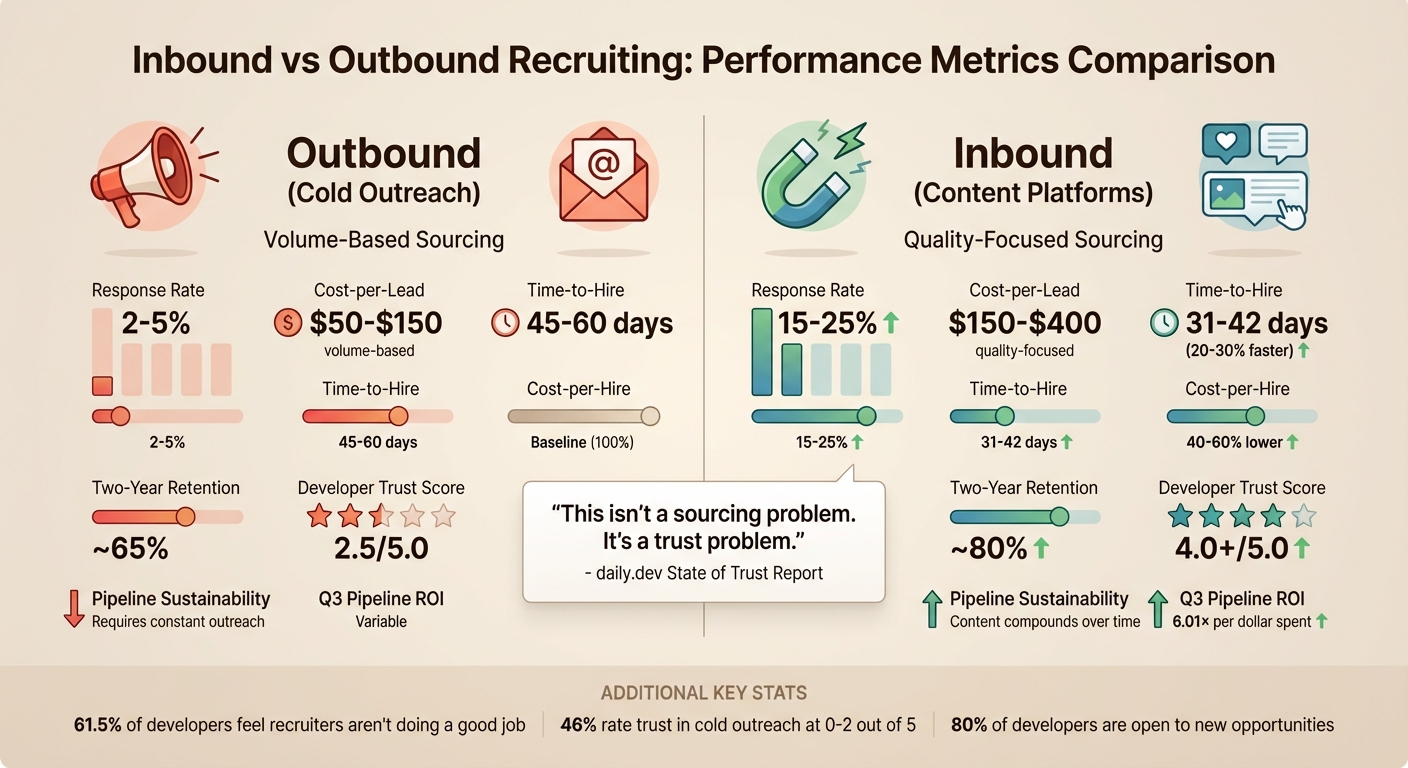 {Inbound vs Outbound Tech Recruiting: ROI and Performance Metrics Comparison 2026}
As recruiting evolves from interruptive tactics to engagement-driven strategies, measuring ROI requires looking beyond immediate results to evaluate long-term candidate quality. While outbound recruiting often emphasizes sheer volume - like the number of messages sent and responses received - inbound recruiting focuses on metrics such as engagement quality, trust-building, and the health of your talent pipeline over time.
Metrics That Matter for Inbound Recruiting
The key to assessing inbound recruiting lies in metrics that capture both short-term performance and long-term value. Research consistently shows that inbound recruiting achieves much higher response rates compared to outbound methods.
For example, campaigns in Q3 demonstrated that a cost-per-lead ranging from $150 to $400 led to a 40–60% reduction in cost-per-hire and delivered up to 6.01× ROI per dollar spent.
Inbound recruiting also accelerates the hiring process, cutting time-to-hire by 20–30%. Candidates who engage with your content are often already familiar with your company’s tools and culture, which can significantly streamline the process. Beyond speed, retention rates highlight the lasting benefits of inbound recruiting: passive candidates sourced through content platforms boast an 80% two-year retention rate, compared to 65% for active job seekers.
It’s also essential to monitor engagement metrics. For instance, platform-specific indicators like click-through rates - where cost-per-click typically ranges from $6.50 to $10 - can help refine your content strategy and targeting efforts.
These metrics provide a foundation for directly comparing inbound and outbound recruiting methods.
ROI Comparison: Outbound vs Inbound
Inbound recruiting offers a clear financial advantage over traditional outbound approaches. While outbound methods require constant spending to maintain candidate pipelines, inbound recruiting builds momentum over time. Quality content continues to attract candidates long after it’s published, creating a compounding effect.
| Metric | Outbound (Cold Outreach) | Inbound (Content Platforms) |
|---|---|---|
| Response Rate | 2–5% | 15–25% |
| Cost-per-Lead | $50–$150 (volume-based) | $150–$400 (quality-focused) |
| Time-to-Hire | 45–60 days | 20–30% faster (31–42 days) |
| Cost-per-Hire | Baseline | 40–60% lower |
| Two-Year Retention | ~65% | ~80% |
| Developer Trust Score | 2.5/5.0 | 4.0+/5.0 |
| Pipeline Sustainability | Requires constant outreach | Content compounds over time |
| Q3 Pipeline ROI | Variable | 6.01× per dollar spent |
The difference in trust is particularly striking. Traditional outbound methods often struggle to establish meaningful connections, especially for specialized roles. According to the daily.dev State of Trust Report, 61.5% of developers feel recruiters aren’t doing a good job, and 46% rate their trust in cold outreach at 0–2 out of 5. Inbound recruiting, by contrast, meets candidates where they are - on platforms they already use to grow their skills and careers.
"This isn't a sourcing problem. It's a trust problem." - daily.dev State of Trust Report
For specialized roles, the ROI gap becomes even more pronounced. A single post on daily.dev can reach over 1 million developers globally - roughly 1 in 50 - thanks to precise behavioral targeting that ensures your content reaches candidates engaged in relevant topics.
To measure your own ROI, track metrics such as cost-per-hire and time-to-hire over a 90-day period. Compare these against the benchmarks above. While inbound recruiting may require a 30–90 day ramp-up period, the long-term benefits - higher candidate quality, improved retention rates, and reduced hiring costs - far outweigh the short-term gains of high-volume outbound strategies.
Case Study: Company Using daily.dev for Employer Branding
Some companies have already embraced daily.dev Recruiter and are seeing results that go well beyond what cold outreach can achieve. This case study highlights how shifting from generic messaging to a more personalized, content-driven recruiting strategy has transformed their hiring process. By leveraging behavioral matching, the platform connects recruiters with developers based on what they’re actively learning, reading, or building - making recruitment feel more relevant and engaging.
Company Results
Companies using daily.dev Recruiter report reply rates three times higher than those achieved through cold emails vs. warm introductions. This success is largely due to the platform's warm introduction model, which boasts a 100% trust score. For comparison, LinkedIn InMail averages just 5%, and cold emails see less than 1% response rates.
daily.dev Recruiter’s automated discovery system takes the guesswork out of finding candidates. It identifies and verifies engineers based on criteria like timezone, location, and seniority. Manual screening becomes unnecessary, as the platform uses a double opt-in system to ensure candidates only receive opportunities that align with their interests. Recruiters who provide clear details upfront - such as salary ranges, remote work policies, and required tech stacks - see the highest levels of engagement. Additionally, native integrations with applicant tracking systems like Greenhouse, Lever, and Ashby make it easy to transfer candidate data, simplifying the hiring process even further.
30-Day Plan to Launch Your Inbound Recruiting Strategy
Getting an inbound recruiting strategy off the ground doesn’t have to be overwhelming. By following a focused, step-by-step approach, you can test what works for developers and refine your tactics based on real engagement data. This 30-day plan breaks the process into weekly goals, helping you build momentum while keeping your team on track.
Week 1: Set Up Your Strategy
Start by defining your hiring goals. Be specific - whether it’s filling three senior backend roles or hiring five React frontend engineers, clarity is key. Next, create detailed developer personas and sourcing strategies to guide your efforts. For example, you might target a "Senior Python developer with 5+ years of experience, interested in AI/ML, who prefers remote work and operates in U.S. time zones."
Once your personas are ready, set up your daily.dev Recruiter account. Use custom screening criteria that align with your personas, including specifics like timezone, location, and seniority. Developers value transparency, so make sure your first message includes details about the tech stack, role scope, salary, and work model (remote, hybrid, or onsite). According to data, 71% of developers expect salary information upfront, and 63% prioritize work model clarity .
Prepare job briefs that are clear and upfront, even if salary ranges are broad. These briefs should seamlessly integrate into your inbound recruiting strategy, ensuring your positions are visible where developers are already active.
With your goals and strategy in place, shift your attention to creating content that speaks directly to your audience.
Week 2: Create and Publish Content
When crafting job briefs, aim for an approachable and conversational tone. Developers can spot generic, templated messages a mile away - 64% say most recruiter messages feel copy-pasted . Be honest and direct about your team’s tech stack, the challenges you’re tackling, and what a typical workweek looks like. As one Senior Backend Engineer shared in the daily.dev State of Trust Report:
"We want to skip the business BS and just have an honest conversation."
Publish your job briefs on daily.dev and consider running targeted ads to increase visibility. With ad costs averaging $6.50–$10 per click and $150–$400 per lead , a budget of $500 to $1,000 is a good starting point for testing engagement. Track which briefs attract the most attention and opt-ins. If one role performs better than others, analyze what made it successful and apply those insights to future postings.
Once your content is live, it’s time to focus on engaging with candidates and measuring your success.
Week 3–4: Engage and Track Results
Pay close attention to your double opt-in rate - this metric indicates how many developers not only viewed your job brief but also expressed active interest. When reaching out, avoid generic follow-ups. Instead, personalize your communication with warm, thoughtful introductions. The platform’s mutual opt-in model ensures trust, so make every interaction count.
Compare your cost per lead with the Q3 pipeline ROI benchmark of 6.01× per dollar spent . If your results aren’t meeting expectations, revisit your job briefs. Are you being transparent about salary? Is your tech stack outlined clearly? Are you highlighting what makes your team stand out? Use tools like the Developer Marketing Budget Calculator on daily.dev to fine-tune your spending based on early performance data.
Conclusion
Cold outreach doesn’t just fall short - it actively harms your chances of hiring top developers. With 61.5% of developers feeling recruiters are missing the mark and trust levels sitting at a low 2.5 out of 5.0 , the days of mass LinkedIn messages and generic emails are fading fast. The future of tech recruiting lies in inbound, intent-focused strategies that build trust. It’s a shift from outdated spam tactics to meaningful, value-based engagement. This shift shows how developer platforms improve hiring by prioritizing these authentic connections.
Take daily.dev Recruiter as an example of this transformation in action. With 500,000+ daily active developers spending an average of 30 minutes per session , and a Q3 return of 6.01× for every dollar invested , the numbers speak for themselves. By connecting with developers in spaces they already frequent, you’re not disrupting their day - you’re becoming part of their professional journey. These results highlight the power of aligning recruitment efforts with developers’ natural behaviors.
Here’s a quick roadmap to get started: define your hiring goals and ideal developer profiles in Week 1, craft clear and honest job descriptions in Week 2, and spend Weeks 3 and 4 focusing on engaging opt-in candidates while tracking recruitment performance metrics. And don’t forget: 80% of developers are open to new opportunities , but only when approached with relevance and respect.
This isn’t about completely ditching outbound strategies - it’s about choosing quality over quantity. Ten well-thought-out, personalized messages will always outperform 200 generic emails . By adopting a data-driven, inbound-first approach, you can reshape your hiring process. In 2026 and beyond, this isn’t just a smarter way forward - it’s the only way to keep up.
FAQs
How do I start inbound recruiting without a big content team?
To kick off inbound recruiting on a tight budget, start by connecting with active developer communities such as daily.dev, which boasts over 500,000 daily active developers. Share content that’s relevant and genuinely useful - something that resonates with the interests and challenges developers face. When reaching out, make it personal: reference their projects, contributions, or the technologies they use. Be upfront about key details like salary ranges and work arrangements. This transparency not only builds trust but also boosts response rates, helping you form authentic and meaningful connections.
What should I track to prove inbound recruiting ROI in 30–90 days?
Tracking developer engagement metrics is crucial. Pay attention to response rates, response quality, and how effective your personalized outreach efforts are. These indicators give you a clear picture of how well you're connecting with potential candidates.
At the same time, monitor essential KPIs like time-to-hire, candidate quality, and offer acceptance rates. These metrics help you gauge the return on investment (ROI) of your inbound recruiting efforts within a 30–90 day window.
By focusing on these measurable outcomes, you can present clear, data-driven evidence of your recruiting success.
How do I share job details without sounding like an ad?
To connect effectively without sounding like an ad, focus on being clear, relevant, and personal. Start by sharing important details upfront - like the salary range, the tech stack involved, and whether the role is remote, hybrid, or in-office. This kind of transparency helps establish trust right away.
Take it a step further by personalizing your message. Reference their past work, specific projects, or interests instead of relying on generic, cookie-cutter templates. This tailored approach not only grabs attention but also demonstrates that you genuinely value their expertise and career aspirations. Authentic, thoughtful outreach leads to better engagement and meaningful conversations.
.png)